Progress often moves achingly slowly in semiconductors, where a new line of business can take a decade to reach the market and a new factory costs $7 billion.
For Intel, despite the best effort of CEO Brian Krzanich, the big strategic shifts needed to match the shifting demands of the market are taking a long time, too.
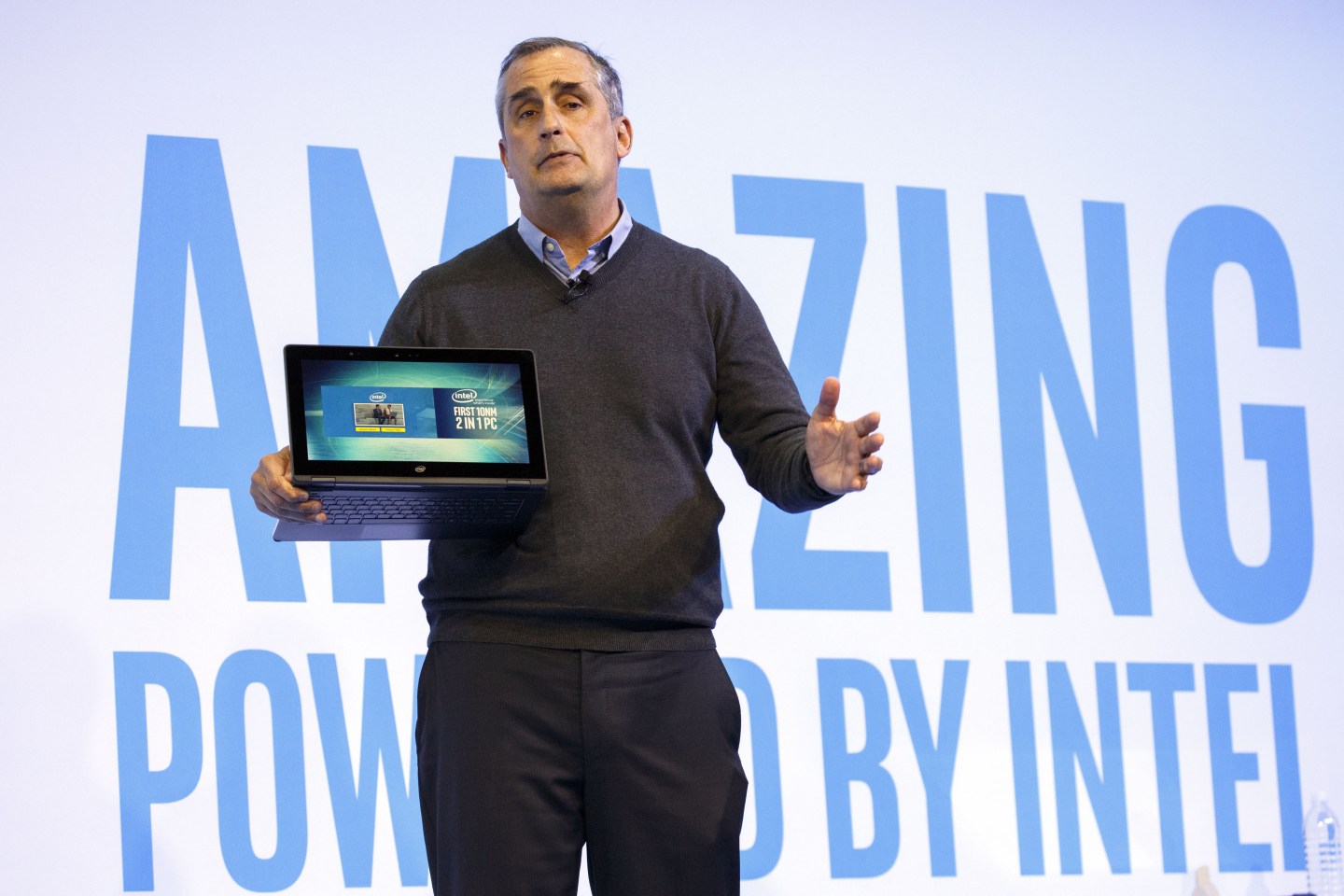
On Thursday, Krzanich and his team let slip a huge shift in strategy, although it was almost completely ignored by the attending audience of Wall Street analysts, who are so focused on their next few quarters of financial projections.
Get Data Sheet, Fortune’s technology newsletter.
Intel, like the entire computing industry, was first about personal computers and later about more capable server computers. And so it has always rolled out new generations of ground-breaking technologies in its PC chips and only years later bringing them to the server side. There may have been a logic to this at one time because consumers used to upgrade their PCs much more quickly than big businesses replaced servers.
But with smartphones crushing the PC replacement cycle, the justification has disappeared. And the massive growth in cloud computing and machine learning tasks has made the server market even more important, trends being targeted by Intel competitors Advanced Micro Devices (AMD) and Nvidia (NVDA).
So going forward, Intel’s head of server chips, Diane Bryant announced on Thursday, the company will use its newest technologies first in server chips and then later in PC chips.
Sounds great, overdue even. The problem is that it takes so long to develop each new generation and build the proper facilities to fabricate the new chips that the impact of the strategic shift won’t be felt for probably three or four years.
Intel (INTC) last made a major improvement, reducing the scale of its chips from 22 nanometers to 14, in 2014 with its Broadwell line. Since then, its been stuck at 14 nm, though 2015’s Skylake and last year’s Kaby Lake offered modest improvements. Finally, 10 nm chips will hit the market towards the end of this year, Intel says, in its Cannonlake line.
But that will be for PC chips. Server versions lag far behind; Intel still sells Broadwell-generation server chips.
So it’s far too late to put server chips first for Cannonlake or even for 2018’s scheduled Ice Lake improvement. Servers should finally get first dibs for the third 10 nm iteration, called Tiger Lake, expected in 2019, according to Bryant. And then the all-new 7 nm chip process, which still has no solid arrival date, will be server-first all the way.
The analysts, meanwhile, were caught up in a short-term consequence of the big strategy shift. With new tech going first to servers, Krzanich decided to allocate more of the company’s total overhead costs to the server unit. Companywide, the move is completely neutral, as the higher overhead in servers will mean lower overhead in the slower growing PC chip unit.
“The cost base that we have is the cost base that we have,” CFO Bob Swan tried to explain during a Q&A session later in the day. “At the Intel level, it is what it is in terms of our overall costs. I wouldn’t be too concerned about how costs get allocated.”
But the analyst and investor community is already concerned about a slowing sales growth forecast from Intel for its server business. On Thursday, Bryant announced Intel was formally abandoning its rarely reached, long-term revenue growth target of 15% for the unit. Instead, growth over the next five years should average in the low double digit percentage points, she said.
That revelation had been hinted at enough that it was largely expected. What was not was Bryant’s further disclosure that the operating margin in the server chip business would slip to 40% to 45% from its current range of about 45% to 50%. Shares of Intel, which had been nearly unchanged for most of the day, slid over 2% after Bryant’s margin comment.
But in the greater scheme of things, the change won’t matter much. If Intel can speed up growth in server chip sales by adding new technology sooner, it could more than offset the slightly lower margins.
By the end of the four hours of presentations, there was a more existential question from one analyst.
Chip competitor Texas Instruments (TXN) has abandon a growth strategy and instead seeks to pay back as much cash to shareholders as possible via dividends and stock buybacks. Last year, TI returned $3.8 billion to shareholders, while spending only $1.4 billion on research and development, on revenue of $13.4 billion. With over four times the revenue, Intel spent only twice as much as TI on buybacks and dividends but nine times more on R&D. And over the past five years, TI’s share price has risen 126% to Intel’s 33% gain.
Couldn’t spending be slowed and “give all the cash back to the investors, does that ever come up,” the analyst asked.
For more on Krzanich’s view of the future, watch:
Krzanich wasn’t biting. “We need to have this growth in order to fuel our factories,” the CEO said. “The minute you stop growing, you’re basically saying over time the likelihood is you’ll run out of the ability to afford those factories.”
Fueling the factories also requires the right strategy to anticipate future market needs. The bigger question for Krzanich–and Intel investors–may be whether he’s anticipated those needs quickly enough.