• Home
  • News
  • Fortune 500
  • Tech
  • Finance
  • Leadership
  • Lifestyle
  • Rankings
  • Multimedia
TechDavos 2017

From Davos, Predictions for the New World Order

By
Adam Lashinsky
Adam Lashinsky
Down Arrow Button Icon
By
Adam Lashinsky
Adam Lashinsky
Down Arrow Button Icon
January 20, 2017, 9:57 AM ET
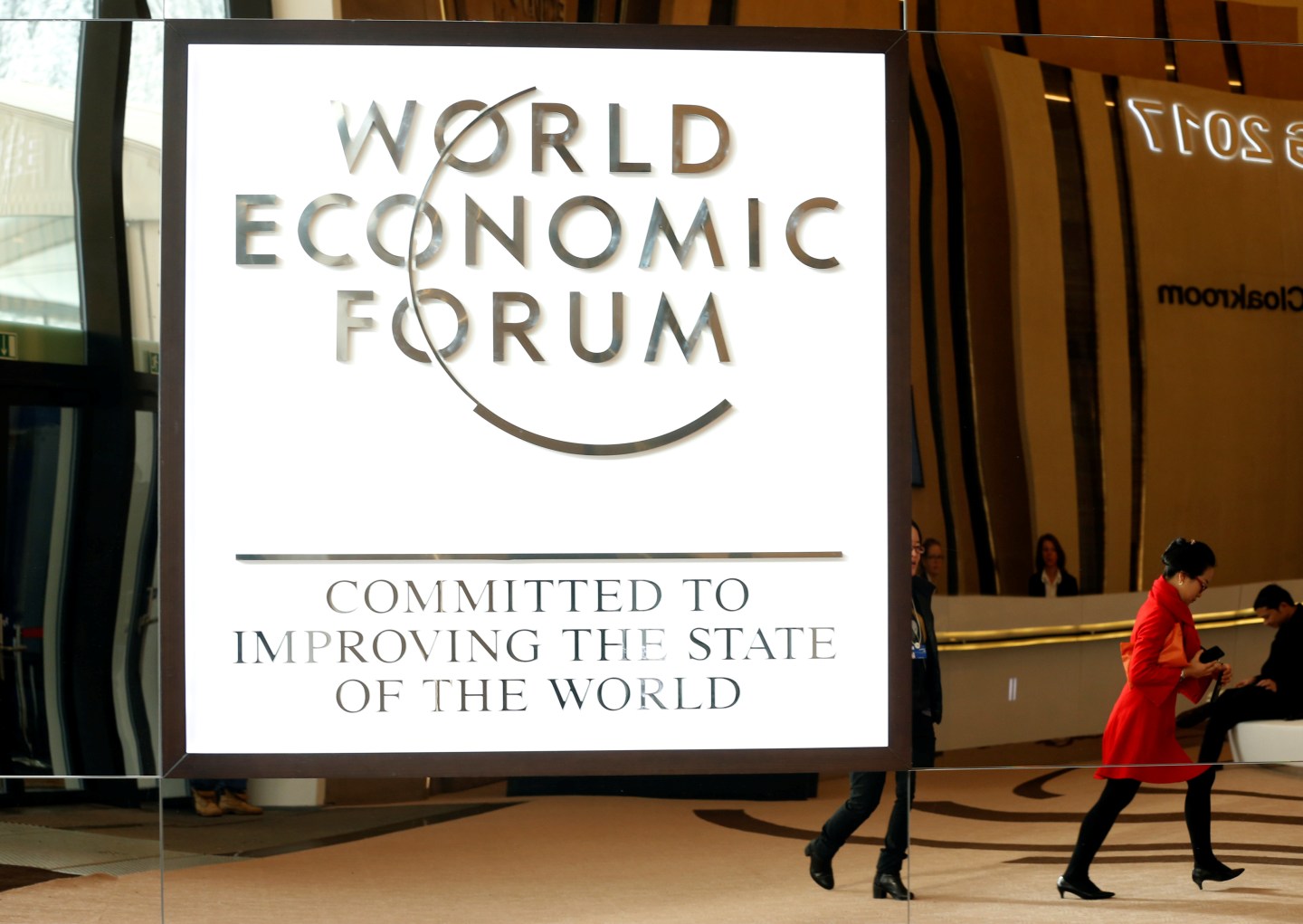
The logo of the World Economic Forum is seen in the congress center of the annual meeting of the World Economic Forum (WEF) in Davos
The logo of the World Economic Forum is seen in the congress center of the annual meeting of the World Economic Forum (WEF) in Davos, Switzerland January 15, 2017. REUTERS/Ruben Sprich - RTSVLHGPhotograph by Ruben Sprich—Reuters

Good morning from Paris, where I am moderating a luncheon program today for the city of Guangzhou, host of the 2017 Fortune Global Forum, which will take place in December in that important southern China business center.

The significance of the events today in Washington, D.C. will be lost on nobody here in the French capital, in China, or in Davos, Switzerland, where the World Economic Forum is wrapping up. The new president of the United States cast a pall over the elites in Davos this week, particularly Europeans put off by his nativist tone and the prospects for protectionism he brings.

This was my first time in Davos since 2012, and the decline in American importance at the meeting was palpable. In the past, the conference arguably was too American, overly focused on the dominant political and commercial voices that fuel and fund its host’s activities.

This time, the conversation often turned to how the world will cope if the U.S. refuses to lead on issues from international trade to human rights to environmental policy. On Thursday, for example, I attended a panel on the future of Asian commerce. Ostensibly about Asia, the conversation quickly focused on the premise that China might take the place of the U.S. as trade-policy leader, a notion that felt equally uncertain and inevitable. “We need to prepare for a new world, where America is an obstacle to international trade,” said Kishore Mahbubani, a professor of public policy at the National University of Singapore.

Get Data Sheet, Fortune’s technology newsletter, where this essay originated.

This shift was in motion well before the election of Donald Trump. “It doesn’t make sense for a player from far away to come to a region and impose a set of rules,” argued Tsinghua University economist Li Daokui, referring to the now extinguished Trans-Pacific Partnership agreement and the prospect of a China-led pact, the Regional Comprehensive Economic Partnership, taking its place. The U.S. remains critical, of course, making the prospect of a trade war with China all the more worrisome. “Protectionism is a direct threat to the Asian economy,” said Nouriel Roubini, the New York University economist. “It’s the market of first and last resort for Asia’s exports.”

Uncertainty over the change in power in Washington was omnipresent in Davos. “I’m quite worried about the Constitution,” Chris Eisgruber, president of Princeton University and a constitutional law scholar, told me. He noted that the Founding Fathers explicitly feared demagoguery. Three facets of today’s U.S. civic discourse would worry the Framers, said Eisgruber: “mistrust of institutions,” which they considered crucial to forming a republic; the “geographic sorting” that finds people of like-minded views grouping together rather than being more evenly distributed throughout the country; and the rise of technologies (read: Facebook) that are keeping people from reading facts and views that give them proper “civic understanding.”

For all this, my time in Davos ended on a high note. Thursday night Fortune and Time hosted a dinner for global CEOs where the discussion turned to how business makes a positive impact on the world. In a continuation of a conversation we began last month at the Vatican, the assembled corporate chieftains shared specific examples of best practices, highlighting the good their companies do as part of their everyday business activities. Their examples were inspiring; expect to see coverage of this important—and hopeful—topic in months to come.

About the Author
By Adam Lashinsky
See full bioRight Arrow Button Icon

Latest in Tech

InnovationBrainstorm Design
Procurement execs often don’t understand the value of good design, experts say
By Angelica AngDecember 8, 2025
1 hour ago
Big TechStreaming
Trump warns Netflix-Warner deal may pose antitrust ‘problem’
By Hadriana Lowenkron, Se Young Lee and BloombergDecember 7, 2025
10 hours ago
Big TechOpenAI
OpenAI goes from stock market savior to burden as AI risks mount
By Ryan Vlastelica and BloombergDecember 7, 2025
10 hours ago
AIData centers
HP’s chief commercial officer predicts the future will include AI-powered PCs that don’t share data in the cloud
By Nicholas GordonDecember 7, 2025
12 hours ago
Future of WorkJamie Dimon
Jamie Dimon says even though AI will eliminate some jobs ‘maybe one day we’ll be working less hard but having wonderful lives’
By Jason MaDecember 7, 2025
16 hours ago
CryptoCryptocurrency
So much of crypto is not even real—but that’s starting to change
By Pete Najarian and Joe BruzzesiDecember 7, 2025
21 hours ago

Most Popular

placeholder alt text
Real Estate
The 'Great Housing Reset' is coming: Income growth will outpace home-price growth in 2026, Redfin forecasts
By Nino PaoliDecember 6, 2025
2 days ago
placeholder alt text
AI
Nvidia CEO says data centers take about 3 years to construct in the U.S., while in China 'they can build a hospital in a weekend'
By Nino PaoliDecember 6, 2025
2 days ago
placeholder alt text
Economy
The most likely solution to the U.S. debt crisis is severe austerity triggered by a fiscal calamity, former White House economic adviser says
By Jason MaDecember 6, 2025
1 day ago
placeholder alt text
Economy
JPMorgan CEO Jamie Dimon says Europe has a 'real problem’
By Katherine Chiglinsky and BloombergDecember 6, 2025
1 day ago
placeholder alt text
Politics
Supreme Court to reconsider a 90-year-old unanimous ruling that limits presidential power on removing heads of independent agencies
By Mark Sherman and The Associated PressDecember 7, 2025
18 hours ago
placeholder alt text
Big Tech
Mark Zuckerberg rebranded Facebook for the metaverse. Four years and $70 billion in losses later, he’s moving on
By Eva RoytburgDecember 5, 2025
3 days ago
Rankings
  • 100 Best Companies
  • Fortune 500
  • Global 500
  • Fortune 500 Europe
  • Most Powerful Women
  • Future 50
  • World’s Most Admired Companies
  • See All Rankings
Sections
  • Finance
  • Leadership
  • Success
  • Tech
  • Asia
  • Europe
  • Environment
  • Fortune Crypto
  • Health
  • Retail
  • Lifestyle
  • Politics
  • Newsletters
  • Magazine
  • Features
  • Commentary
  • Mpw
  • CEO Initiative
  • Conferences
  • Personal Finance
  • Education
Customer Support
  • Frequently Asked Questions
  • Customer Service Portal
  • Privacy Policy
  • Terms Of Use
  • Single Issues For Purchase
  • International Print
Commercial Services
  • Advertising
  • Fortune Brand Studio
  • Fortune Analytics
  • Fortune Conferences
  • Business Development
About Us
  • About Us
  • Editorial Calendar
  • Press Center
  • Work At Fortune
  • Diversity And Inclusion
  • Terms And Conditions
  • Site Map

© 2025 Fortune Media IP Limited. All Rights Reserved. Use of this site constitutes acceptance of our Terms of Use and Privacy Policy | CA Notice at Collection and Privacy Notice | Do Not Sell/Share My Personal Information
FORTUNE is a trademark of Fortune Media IP Limited, registered in the U.S. and other countries. FORTUNE may receive compensation for some links to products and services on this website. Offers may be subject to change without notice.