When action camera maker GoPro unveiled its Karma drone last month, it addressed one of the biggest issues with most high-end drones: Portability. With its foldable legs, the Karma is easier to transport from point A to point B and back again.
Just days later, drone maker DJI responded with the Mavic Pro, its own foldable drone that, when packed, is smaller than a loaf of bread, and, like the Karma, also sized to be stashed away in a backpack.
Despite its compact physique, the Mavic Pro has plenty of high-end features. It can see and avoid obstacles, track a subject as it moves, and automatically fly to a spot selected by the pilot. Thanks to new sensors, the Mavic can pull off a few new tricks, too. A flight mode called Gesture lets flyers snap a photo by waving at the drone, while another called Tripod offers more precise controls for navigating tight spaces.
DJI has been working this year to make its drones easier to fly for beginners, while expanding the features available to power users. When the company launched the Phantom 4 in March, it pitched the drone as intelligent enough for even complete rookies to fly it (be warned: it’s not entirely crash proof). With the Mavic Pro, DJI is aiming to deliver a similar experience in a more convenient form factor.
Here’s a closer look at what it’s like to fly the Mavic Pro, which ships October 15 for $999, or $749 without the controller.
For more, read: This New Drone Is Small Enough to Carry in a Backpack
Even users with little flight experience will have an easy time getting started with the Mavic Pro. With the drone and controller batteries charged and the propellers attached, all you need to do is connect your smartphone to the aircraft via DJI’s app and a cable.
When it comes to flying the Mavic, you have two options. You can either use just your smartphone, or your smartphone in tandem with DJI’s redesigned controller. I prefer the latter. While DJI’s previous controllers have felt clunky and cumbersome, the new model more closely resembles a PlayStation controller. That makes it more familiar, especially for novice flyers. It’s also smaller than DJI’s previous controllers, which helps the whole package stay portable.
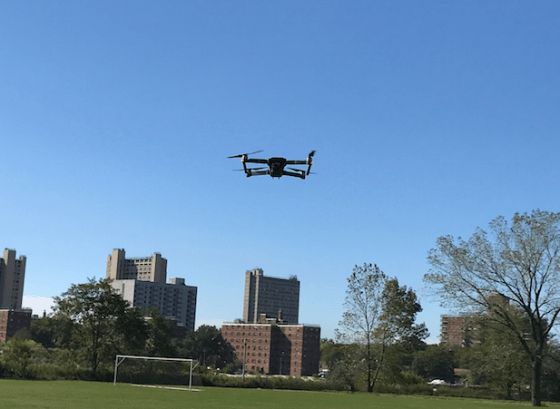
Assuming you’re using the controller and not just the smartphone, you’ll do most of your flying with the control sticks, while you’ll manipulate the drone’s more advanced settings through your phone. The Mavic Pro flies smoothly and is pleasantly easy to maneuver. When you take your fingers off the sticks, it hovers steadily in place (we tested it on a day with almost no wind, it’s unclear how the Mavic might do on a blustery day). That’s especially helpful for lining up precise shots. My colleague and I effortlessly took an aerial selfie (or “dronie”) by steering the aircraft in our direction and changing its altitude using the remote’s joysticks. The Mavic Pro, likely because of its lightweight size, is more difficult to steer in windy conditions, according to our photo editor who also tested the drone. But even in moderate wind, the Mavic Pro was capable of recording stable footage.
Get Data Sheet, Fortune’s technology newsletter
The Mavic has what DJI calls Gesture Mode, which the company says is an easier way to take photographs. In this mode, waving at the drone and then make a frame around your face should prompt the Mavic to count down and snap a photo. But we couldn’t get Gesture Mode to work — maybe the drone was too far or too high. Either way, it doesn’t seem much easier than simply using the control sticks to line up and take a shot.
A feature that worked wonderfully, however, was the Mavic Pro’s tracking mode. It’s meant to keep subjects in frame as they ski down slopes or bike down hills. After activating the feature in DJI’s app, the Mavic locked onto and tracked my colleague while running across a field, steadily keeping him in frame while he changed directions.
The Mavic Pro’s 12-megapixel camera takes sharp colorful photos, although our photo editor said he sometimes had a hard time using DJI’s tap-to-focus feature to get a steady shot. We didn’t experience those issues. Our shots looked crisp and detailed, even when we didn’t take time to pick a particular subject ourselves. Just remember to remove the camera’s protective casing before launching the drone, and you should be all set. (If there are indeed focusing issues with the Mavic, it might be a problem that DJI could address in a software update.)
That said, film and photo enthusiasts may have one reason to consider GoPro’s Karma (GPRO) over the Mavic Pro. Because the Karma works with different kinds of GoPro cameras, it’s a bit more customizable, whereas Mavic buyers are stuck with one configuration. That said, GoPro’s drone doesn’t have the sense-and-avoid smarts included with the Mavic.
For more about GoPro’s Karma drone, watch:
We got about 25 minutes of zipping around and snapping photos out of the Mavic Pro on a single charge. That’s about on par with DJI’s claims. If you’re looking to spend more time with your drone in the air, you’ll want to invest in a few extra batteries. Landing, meanwhile, is as simple as pressing a button on the controller. Like DJI’s previous drones, the Mavic Pro can return to the exact spot from which it took off, thanks to GPS capabilities.
Overall, the Mavic Pro’s compact design, easy operation, and intelligent flying make it a solid choice for “prosumers” looking to buy a high-end but portable drone. However, its high price tag puts it out of the range of many hobbyists, who might be better off considering DJI’s older models, like the Phantom 3. We’ll know more about how the Mavic Pro compares to the GoPro Karma, meanwhile, after we test that model in the near future.
This article originally appeared on Time.com.