Behind the barbed wire, the white minivan’s busted windows and crumpled roof hint at its story. But forklifted to this windblown spot on the John F. Kennedy International Airport tarmac, between a decommissioned 727 and an aircraft hangar, it’s doubtful passing drivers notice it at all.
In the long struggle with the searing memories of 9/11, though, the van’s solitary presence here marks a small but significant transition point.
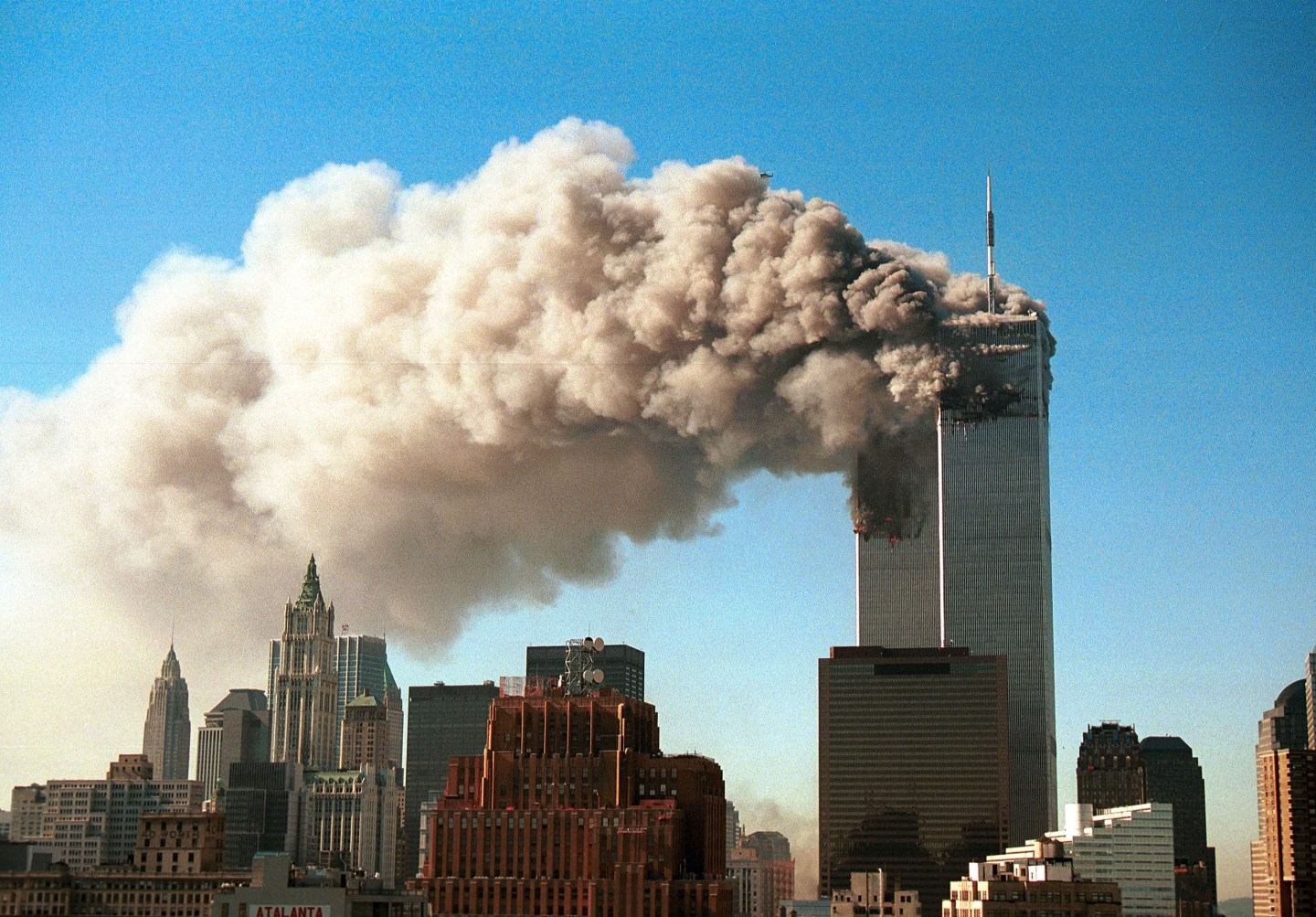
Tons of wreckage — twisted steel beams weighing up to 40,000 pounds, chunks of concrete smelling of smoke, a crushed fire engine, a dust-covered airline slipper — were salvaged from the World Trade Center site for preservation in the weeks after the 2001 terrorist attacks. Now, 15 years later, this van, part of a government agency motor pool likely sheltered from the impact in the parking garage beneath the complex, is the very last artifact without a resting place.
More than 2,600 artifacts have gone to 1,585 fire and police departments, schools and museums, and other nonprofit organizations in every state and at least eight other countries. Each recipient has pledged to use them in memorials or exhibits honoring those killed on 9/11. While some have not followed through, the many that have mean it is now possible to touch a piece of September 11 during a Roman Catholic Mass in Port St. Lucie, Florida, while standing in the shadows of Colorado’s San Juan mountains, or in a park honoring animals in Meaford, Ontario.
“They are the relics of the destruction and they have the same power in the same way as medieval relics that have the power of the saints,” said Harriet Senie, a professor of art history at the City University of New York and author of Memorials to Shattered Myths: Vietnam to 9/11.
“History is a vague concept, but if you have this tangible object that was a part of this historical event, it makes it very difficult to deny and it also makes it possible to experience it in a very visceral way.”
In the days immediately after the attacks, it wasn’t at all clear what would happen to the wreckage of the Trade Center. It’s not as if anyone had confronted questions of that scale before. There was no certainty about exactly which artifacts, if any, should be saved.
The Port Authority of New York & New Jersey, which owned the Trade Center, dispatched an architect to comb through the site and cull pieces that seemed distinctive. Investigators carted away others. Most of the wreckage from the site was scrapped or recycled. But the agency saved about half of 1% of the total.
It all had to go somewhere. That ended up being JFK’s Hangar 17, an 80,000-square-foot cavern of sheet metal left empty when tenant Tower Air went out of business in 2000.
Officials were uncertain what to do with so much material, given the emotions intertwined with it. A judge determined the artifacts were not evidentiary or personal, and approved donations to those who promised to care for them. But where to begin?
“It was piles and piles, probably my height or higher, of steel beams,” says Amy Passiak, the archivist hired to catalog the artifacts and manage their distribution, recalling the first time she walked into the hangar in 2010. Passiak, a high school senior in Michigan at the time of the attacks, had been working as an intern at New York’s 9/11 museum, but says she was still unprepared for the scene.
“I remember going home that day and just being exhausted, just from being there a few hours, just being emotionally exhausted and not being able to comprehend the amount of work that was going to go into the process. It was like, maybe a year, maybe two years. And here I am, six years later.”
Passiak built a database of every item, cataloging its size and approximate weight, with descriptive notes. As word spread that the Port Authority was giving the material away, requests poured in. Through August, the Port Authority had distributed 2,629 artifacts.
Here’s How Much Lower Manhattan Has Changed Since the 9/11 Attacks
Many went to fire departments, local governments and organizations in the New York area with direct ties to the first responders and workers who perished when the towers fell.
“When those buildings came down, everybody and everything in its path was either pulverized or vaporized off the face of the earth,” said John Hodge of the Stephen Siller Tunnels to Towers Foundation, named for his cousin, a New York firefighter killed on 9/11. In late July, the foundation marked the looming closure of Hangar 17 with a ceremony outside before hauling away an elevator motor from the Trade Center, a piece of the parking structure, and a portion of a broadcast antenna that crowned the complex.
“That’s where the DNA is. Neither my cousin or anybody else from Squad 1 was ever found, but it’s in that steel,” Hodge said.
But for many of the people and groups that adopted artifacts from the Trade Center, the loss was more abstract. At least it started off that way.
Heath Satow, a sculptor in southern California hired to design a 9/11 memorial for the plaza fronting Rosemead’s city offices, recalls awkwardly scanning a digital catalog showing beams available from the Trade Center. But hundreds of hours creating the memorial — a 10-foot beam cradled by hands of chrome, the palms and fingers formed from 2,976 interlocking birds representing individual victims — left a deep impression.
“Every individual was attended to,” said Satow, his voice breaking five years later, as he described making the sculpture. “I just was totally unprepared for it. But when you spend all that time seeing it as individuals it will just wreck you.”
[fortune-brightcove videoid=4131516840001]
Satow said he purposely positioned the beam at about eye level, so people could see, touch and feel it. Others who adopted Trade Center artifacts used them to similar effect.
Firefighters in Pagosa Springs, Colorado, created a memorial in front of their station around a small piece of donated I-beam. Many people in the town, surrounded by the San Juan mountains and the Southern Ute Reservation, will never get to New York or Washington D.C., said David Hartman, who worked to obtain the artifact. But September 11 was his generation’s Pearl Harbor, and being able to see and touch the wreckage enables residents to reflect on its lessons, he said.
At Flour Bluff Junior High School in Corpus Christi, Texas, a piece of Trade Center steel — one of three received by the school district — is housed in a case near the entrance to the cafeteria. In September, it is taken out and students from the school’s officer training program stand guard. Bruce Chaney, the naval science instructor who applied for the artifacts, brings another, smaller piece to his classes.
The artifact is “twisted and somewhat burned. It’s not pretty. I’m hoping it will make them think as they’re growing up, that they have to pay attention to their past,” Chaney said.
Most Flour Bluff students hadn’t yet been born in 2001, so the relics are the closest most will ever get to experiencing that day.
But the desire to touch and own history, however distant, has been around since long before this generation, said Erika Doss, a professor of American studies at the University of Notre Dame and author of Memorial Mania: Public Feeling in America.
She notes that after Abraham Lincoln was assassinated, millions of Americans gathered alongside the tracks as a train carrying his body made its way to Illinois. People wore mourning bands on their arms. They hung Lincoln’s portrait in their homes. They flocked to see death masks cast from his face. They wanted to see and touch Lincoln.
Facebook Pulls 9/11 Anniversary Topic after Promoting Conspiracy Article
Artifacts let people grapple with pained memories. But 15 years after September 11, the dispersal of artifacts from the Trade Center has not resolved the public’s conflicted feelings about those events, now set against continued fears of terrorism.
“We just don’t know where the events of 9/11 have led us,” said Rick Sluder, fire chief in Wauseon, Ohio, which obtained a Trade Center beam and, together with neighboring departments built a memorial at the nearby Fulton County Fairgrounds.
“A lot of people are looking at this as, is this the point of downfall or the point at which we rose above the rest, the point of resiliency?” Sluder said. “I don’t think that’s been determined yet.”
There’s little questioning, though, the emotions people invest in the artifacts. During the six years Passiak spent archiving the relics, the people seeking them would often tell her stories of the losses in their own communities — of firefighters, or soldiers or others — that connected them, however tangentially, to 9/11.
In the first years, there were so many artifacts that she could easily match them with requesters. So when a girl at Cracker Trail Elementary School in Sebring, Florida, wrote that she wanted to help her fellow students learn about 9/11, Passiak set aside a children’s alarm clock recovered from a store in the Trade Center’s concourse, a burned notebook, and small piece of steel, 6 inches square.
“I felt like that allowed a full story to be told,” she said.
What the World’s Biggest Leaders Learned on 9/11
As the piles of material winnowed, though, it became more difficult. Most of the groups seeking artifacts wanted pieces they could build a narrative around. The biggest artifacts were unwieldy. By early this year, there was little left except rails from the commuter train line that ran under the complex. Items like police cruisers, whose purpose that day were clear, found takers. But unmarked vehicles, anonymous but for their place in the wreckage, were initially passed over.
When the Port Authority shuttered the artifact program in August and padlocked Hangar 17, officials moved the only remaining artifact — a Dodge Caravan with a ripped out red interior — to the tarmac, uncertain of its fate. It, too, is likely to go soon, to a group officials will not identify until its application has been approved. Hangar 17, itself, may eventually be torn down.
Passiak moved back to Michigan to start a job at an art museum this month. But many of the people whose groups received donations of Trade Center artifacts have stayed in touch with her, extending invitations to visit their memorials, from California to Germany.
Someday, the archivist said, she’d like to take a road trip, stopping in cities and towns along the way to see where the artifacts she once cared for have found homes. She imagines she’ll recognize some of them, and remember their stories. It will not matter that the steel, concrete and other relics are at rest far from lower Manhattan. The memories they hold, she is certain, will not soon fade.