• Home
  • Latest
  • Fortune 500
  • Finance
  • Tech
  • Leadership
  • Lifestyle
  • Rankings
  • Multimedia
CommentaryBank of England

It’s Way Too Early for the Bank of England to Cut Interest Rates

By
Olena Staveley-O'Carroll
and
Bethany Cianciolo
Bethany Cianciolo
Down Arrow Button Icon
By
Olena Staveley-O'Carroll
and
Bethany Cianciolo
Bethany Cianciolo
Down Arrow Button Icon
July 13, 2016, 4:56 PM ET
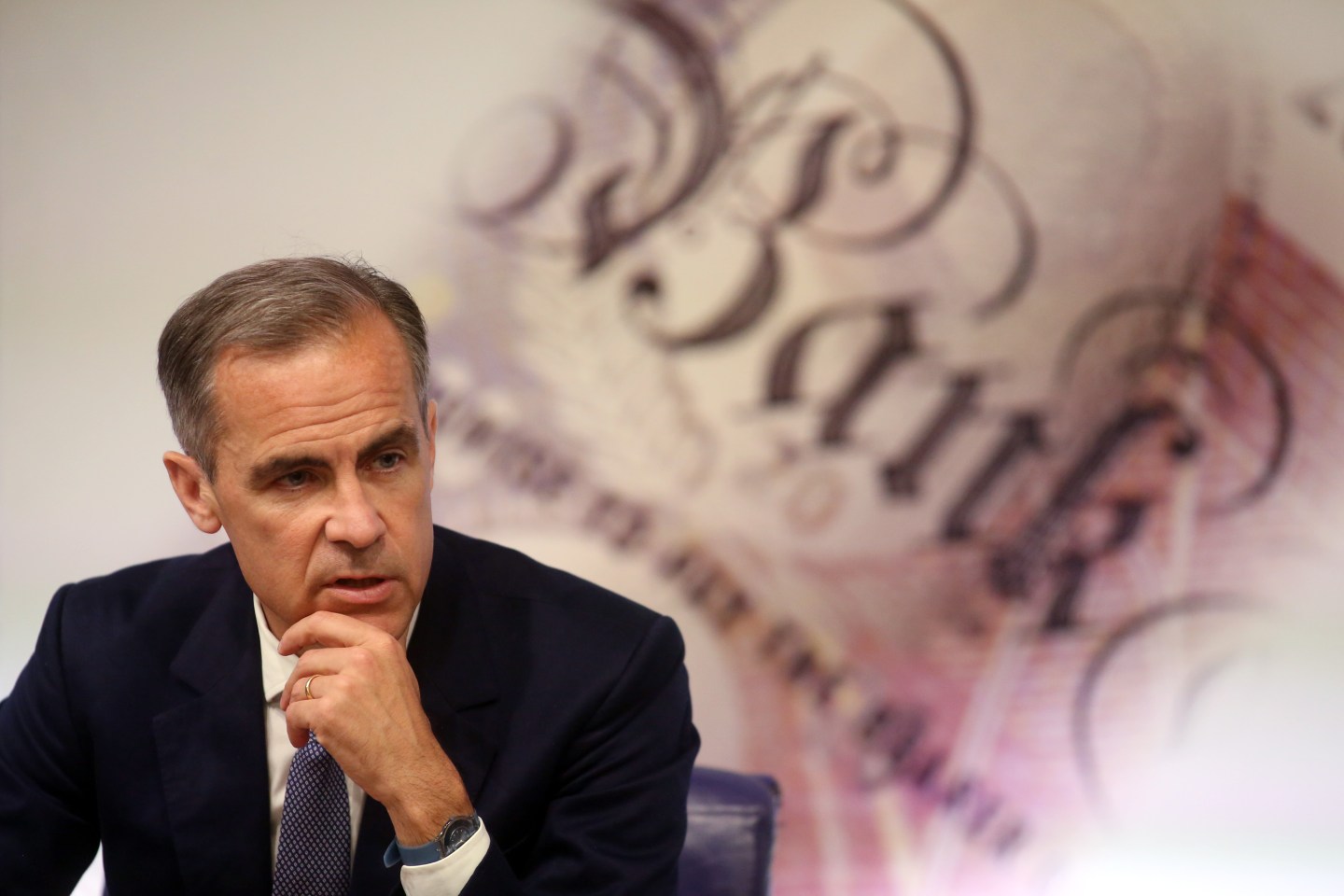
Bank of England Governor Mark Carney Delivers A News Conference On The Bank's Financial Stability Report
Mark Carney, governor of the Bank of England (BOE), speaks during the bank's financial stability report news conference at the Bank of England in the City of London, U.K., on Tuesday, July 5, 2016. The Bank of England cut its capital requirements for U.K. banks and pledged to implement any other measures needed to shore up financial stability after Britain's shock decision to leave the European Union. Photographer: Chris Ratcliffe/Bloomberg via Getty ImagesPhotograph by Chris Ratcliffe — Bloomberg via Getty Images

Olena Staveley-O’Carroll is an assistant professor of economics at the College of the Holy Cross in Worcester, Mass.

On Thursday, the Bank of England is expected to cut the interest rate from 0.5% to as low as zero. Mark Carney, the Bank’s governor, warned about the deteriorating outlook of the British economy after its voters chose to exit the European Union. The resulting political turmoil, including the upcoming replacement of the Prime Minister David Cameron by Theresa May—who had supported Britain staying in the EU prior to the referendum results—has caused a spike in uncertainly about the future economic stability of the economy. Carney hopes that lower interest rates will bolster flagging consumer and business confidence and boost economic output via higher spending and investment, but the impact is likely to be negligible.

In addition to the expected interest rate cut, the Bank of England relaxed its capital requirements on the banking sector earlier this month in an effort to maintain a steady flow of credit to households and firms; the move is expected to release up to $200 billion (at the current rate of $1.32 per pound) in additional loans to the private sector. However, a more prudent course of action—for both interest rates and capital requirements—would be to wait for the outcome of the exit negotiations between the U.K. and the EU. The effect of monetary policy on the economy is likely to be reduced in times of uncertainty, so cutting interest rates this week may not deliver the desired uptick in spending. Worse, the Bank may find itself needing to deliver yet another boost to the economy in the next several months—especially if the EU restricts free access to its markets for goods and services—but without the conventional means to do so if the interest rate already sits at the zero lower bound.

Still, the fears that easing monetary policy may lead to inflation are premature. Positive rates of inflation are difficult to achieve in the environment of heightened uncertainty, when households and businesses tend to postpone major spending decisions and banks are reluctant to issue new loans. Take, for example, the U.S. experience in the wake of the 2008 financial crisis. Even with the federal funds rate hitting zero at the end of 2008—and despite the three subsequent waves of quantitative easing undertaken by the Federal Reserve Bank—the growth rate of consumer prices has remained below 2% for most of the period since the end of the recession in 2009. Most of the liquidity created by the Fed has been hoarded by the banking sector, reluctant to issue new loans in the midst of ongoing talks over new financial regulations.

Nonetheless, the Bank of England will have to keep a close eye on U.K. housing prices, which have grown at a 1.2% quarterly rate between April and June, although more slowly than early in 2016. Near-zero interest rates may cause the financial sector to seek higher returns in other asset markets, potentially inflating a housing bubble.


Even so, the situation in the U.K. is unlikely to evolve along the path that the U.S. housing market found itself on during the early-to-mid 2000s. Two additional factors—capital inflows from abroad and financial deregulation—contributed to the U.S. housing bubble that will not apply to the U.K. in the immediate future. In addition to low interest rates in the aftermath of the 2001 terrorist attacks and the dot-com crash, U.S. housing prices were fueled by capital inflows into the U.S., as central banks of many developing countries looked to shore up their foreign reserves following the Asian financial crisis of 1997-1998, and by proliferation of obscure financial instruments that allowed lending institutions to repackage and sell off risky investments, encouraging the issuance of subprime mortgages.

The next several months are going to define the international environment in which the Bank of England will have to operate to keep the economy on track. EU leaders insist that trade negotiations will not take place until Britain triggers Article 50 of the Treaty of Lisbon to officially indicate its withdrawal from the EU. This is giving pause to the U.K. government, fearful of losing access to its largest trading partner (accounting for 44% and 53% of exports and imports, respectively). Since the Brexit referendum is advisory rather than legally binding, the U.K. government still has the option—however unlikely—to ignore its outcome and instead try to work with the EU to address the issue of migration, apparently central to the British public. Given this very wide range of possible political outcomes, Carney would be best advised to hold the interest rates steady to allow himself room to maneuver a few months down the road.


About the Authors
By Olena Staveley-O'Carroll
See full bioRight Arrow Button Icon
By Bethany Cianciolo
See full bioRight Arrow Button Icon

Latest in Commentary

Finance
Lorem ipsum dolor sit amet, consectetur adipiscing elit, sed do eiusmod tempor incididunt ut labore et dolore magna aliqua. Ut enim ad minim veniam
By Fortune Editors
October 20, 2025
Finance
Lorem ipsum dolor sit amet, consectetur adipiscing elit, sed do eiusmod tempor incididunt ut labore et dolore magna aliqua. Ut enim ad minim veniam
By Fortune Editors
October 20, 2025
Finance
Lorem ipsum dolor sit amet, consectetur adipiscing elit, sed do eiusmod tempor incididunt ut labore et dolore magna aliqua. Ut enim ad minim veniam
By Fortune Editors
October 20, 2025
Finance
Lorem ipsum dolor sit amet, consectetur adipiscing elit, sed do eiusmod tempor incididunt ut labore et dolore magna aliqua. Ut enim ad minim veniam
By Fortune Editors
October 20, 2025
Finance
Lorem ipsum dolor sit amet, consectetur adipiscing elit, sed do eiusmod tempor incididunt ut labore et dolore magna aliqua. Ut enim ad minim veniam
By Fortune Editors
October 20, 2025
Finance
Lorem ipsum dolor sit amet, consectetur adipiscing elit, sed do eiusmod tempor incididunt ut labore et dolore magna aliqua. Ut enim ad minim veniam
By Fortune Editors
October 20, 2025

Most Popular

Finance
Lorem ipsum dolor sit amet, consectetur adipiscing elit, sed do eiusmod tempor incididunt ut labore et dolore magna aliqua. Ut enim ad minim veniam
By Fortune Editors
October 20, 2025
Finance
Lorem ipsum dolor sit amet, consectetur adipiscing elit, sed do eiusmod tempor incididunt ut labore et dolore magna aliqua. Ut enim ad minim veniam
By Fortune Editors
October 20, 2025
Finance
Lorem ipsum dolor sit amet, consectetur adipiscing elit, sed do eiusmod tempor incididunt ut labore et dolore magna aliqua. Ut enim ad minim veniam
By Fortune Editors
October 20, 2025
Finance
Lorem ipsum dolor sit amet, consectetur adipiscing elit, sed do eiusmod tempor incididunt ut labore et dolore magna aliqua. Ut enim ad minim veniam
By Fortune Editors
October 20, 2025
Finance
Lorem ipsum dolor sit amet, consectetur adipiscing elit, sed do eiusmod tempor incididunt ut labore et dolore magna aliqua. Ut enim ad minim veniam
By Fortune Editors
October 20, 2025
Finance
Lorem ipsum dolor sit amet, consectetur adipiscing elit, sed do eiusmod tempor incididunt ut labore et dolore magna aliqua. Ut enim ad minim veniam
By Fortune Editors
October 20, 2025
Rankings
  • 100 Best Companies
  • Fortune 500
  • Global 500
  • Fortune 500 Europe
  • Most Powerful Women
  • Future 50
  • World’s Most Admired Companies
  • See All Rankings
Sections
  • Finance
  • Leadership
  • Success
  • Tech
  • Asia
  • Europe
  • Environment
  • Fortune Crypto
  • Health
  • Retail
  • Lifestyle
  • Politics
  • Newsletters
  • Magazine
  • Features
  • Commentary
  • Mpw
  • CEO Initiative
  • Conferences
  • Personal Finance
  • Education
Customer Support
  • Frequently Asked Questions
  • Customer Service Portal
  • Privacy Policy
  • Terms Of Use
  • Single Issues For Purchase
  • International Print
Commercial Services
  • Advertising
  • Fortune Brand Studio
  • Fortune Analytics
  • Fortune Conferences
  • Business Development
About Us
  • About Us
  • Editorial Calendar
  • Press Center
  • Work At Fortune
  • Diversity And Inclusion
  • Terms And Conditions
  • Site Map

Latest in Commentary

Justin Harlan
Commentaryremote work
I run one of America’s most successful remote work programs and the critics are right. Their solutions are all wrong, though
By Justin HarlanJanuary 11, 2026
15 hours ago
Gene Ludwig
Commentaryaffordability
Millions of Americans are grappling with years of declining economic wellbeing and affordability needs a rethink
By Gene Ludwig and Shannon MeyerJanuary 11, 2026
16 hours ago
doctor
CommentaryMedicaid
Former White House advisor on the real reason your health care costs are going up: Medicare’s doctor pay gap
By Tomas J. PhilipsonJanuary 9, 2026
3 days ago
sudhakar
CommentaryM&A
I’m the SolarWinds CEO. Here’s why a $4.4 billion move to go private was right for us
By Sudhakar RamakrishnaJanuary 8, 2026
3 days ago
Jerome Adams
CommentaryVaccines
Trump’s former surgeon general: One year in, the war on vaccination is undoing the Trump administration’s health agenda
By Jerome AdamsJanuary 8, 2026
3 days ago
kappos
CommentaryEconomics
The Nobel Prize winners have a lesson for us all
By David J. KapposJanuary 8, 2026
3 days ago

Most Popular

placeholder alt text
Economy
Trump may be raising your taxes with his tariffs but he could actually cut inflation with them, too, SF Fed says
By Jake AngeloJanuary 6, 2026
5 days ago
placeholder alt text
Economy
As U.S. debt soars past $38 trillion, the flood of corporate bonds is a growing threat to the Treasury supply
By Jason MaJanuary 10, 2026
1 day ago
placeholder alt text
AI
This CEO laid off nearly 80% of his staff because they refused to adopt AI fast enough. 2 years later, he says he'd do it again
By Nick LichtenbergJanuary 11, 2026
9 hours ago
placeholder alt text
Health
Bill Gates warns the world is going 'backwards' and gives 5-year deadline before we enter a new Dark Age
By Eleanor PringleJanuary 9, 2026
3 days ago
placeholder alt text
Economy
A Supreme Court ruling that strikes down Trump's tariffs would be the fastest way to revive the stalling job market, top economist says
By Jason MaJanuary 11, 2026
7 hours ago
placeholder alt text
Success
Gen Z are arriving to college unable to even read a sentence—professors warn it could lead to a generation of anxious and lonely graduates
By Preston ForeJanuary 9, 2026
2 days ago

© 2025 Fortune Media IP Limited. All Rights Reserved. Use of this site constitutes acceptance of our Terms of Use and Privacy Policy | CA Notice at Collection and Privacy Notice | Do Not Sell/Share My Personal Information
FORTUNE is a trademark of Fortune Media IP Limited, registered in the U.S. and other countries. FORTUNE may receive compensation for some links to products and services on this website. Offers may be subject to change without notice.