According to legend, the last time a woman took Rome, she was in disguise. Pope John VIII is rumored to have actually been a Pope Joan, who never publicly revealed her gender. One can imagine why.
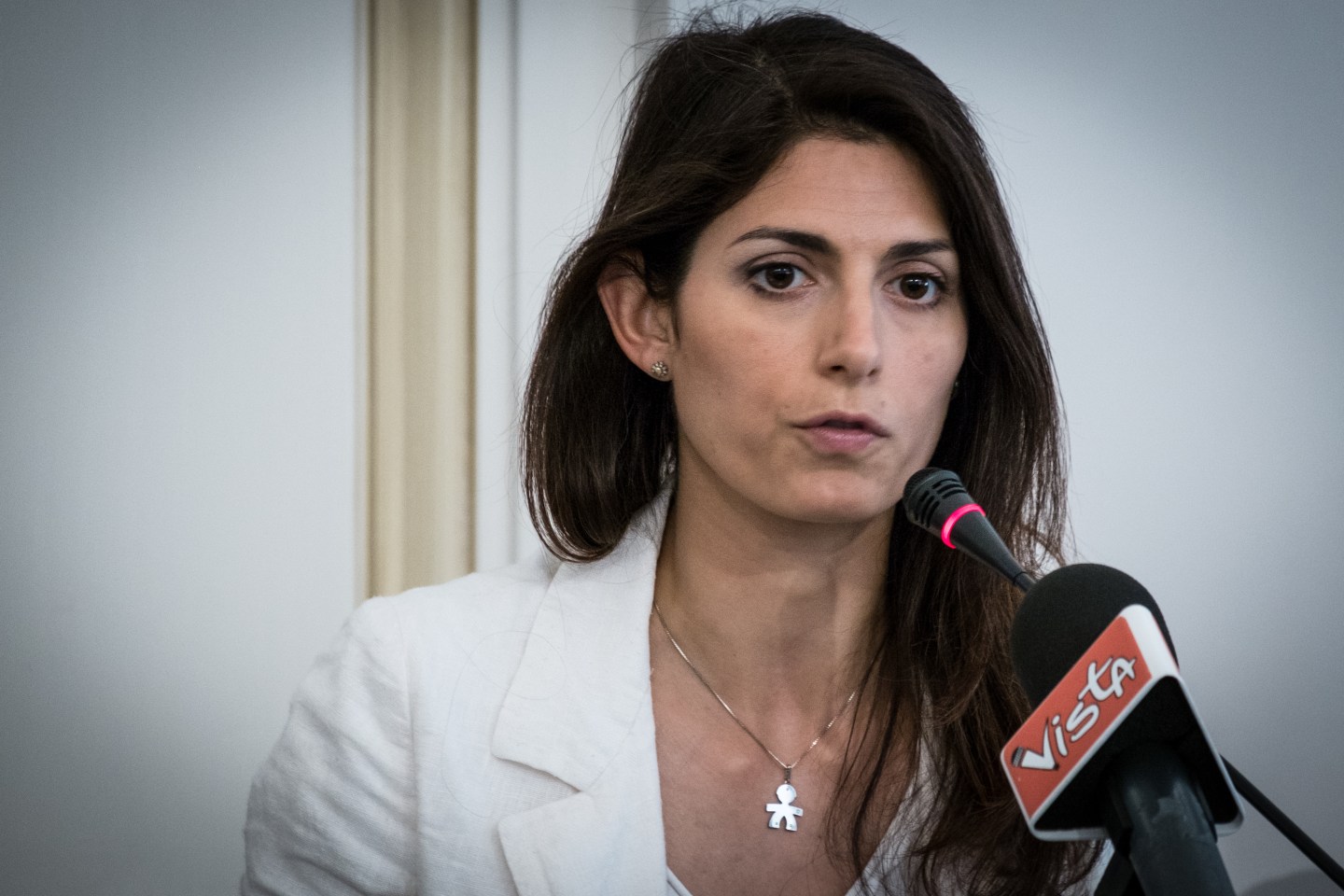
Things in the Italian capital have improved: Rome just elected its first female mayor. On June 19th, lawyer Virginia Raggi won her runoff, beating a candidate backed by the Prime Minister Matteo Renzi in a landslide. At the same time, Turin, Italy’s fourth-largest city, also elected its first female mayor, the manager Chiara Appendino. “This is the beginning of a new era,” said Raggi in her victory speech.
While that may be true, it has yet to manifest itself in the numbers. Women compose 28% of Italy’s Senate and 31% of the House of Representatives, according to the Inter-Parliamentary Union. Those stats put the nation at No. 42 on the IPU’s global list, which ranks countries by percentage of women in the lower house. What’s more, there have been signs that women are actually losing ground in the top level of Italian government; Renzi’s cabinet was fully half female in 2014, but has since slipped to six women out of 16.
So how did Raggi end up as the mayor of the capital?
Most analysts point to the fact that she represents the 5 Stars Movement (as does Appendino). This upstart party runs on an anti-establishment platform, promising to fight corruption and bring about transparency.
The pledge of transparency clearly struck a chord with the Italian populace. Gianni Alemanno, Rome’s mayor until 2013, is on trial for corruption, and the recent Mafia Capitale scandal reveals that a criminal organization has strong influence with Rome’s municipal services. Raggi, it seems, held the right flag at the right time.
Yet I don’t believe it’s a coincidence that Rome elected a woman. Over the past few years, a number of factors have begun to chip away at Italy’s gender bias.
For one, there was the backlash against Silvio Berlusconi, whose four terms as a prime minister brimmed with sex-scandals. Then there was the rise of feminist movement If Not Now, When? (Se Non Ora, Quando?), which denounced the “repeated, indecent, flamboyant representations of women as naked objects of sexual trade, produced by newspapers, television and advertising,” and has grown quickly.
Enrico Letta’s post-Berlusconi government signaled a rise of women in Italian politics, boosting the percentage of female ministers from 20% to 32%. Women of great competence began to appear in powerful and visible positions, such as the Minister of Justice and Internal Affairs.
In 2012, gender quotas were approved at the level of Italian city councils. (They have applied to company boards since 2011.) The subsequent double-preference law required one’s first and second choice in council elections to be of different genders. Women’s presence in city councils thus increased of 39% in 3 years, according to Openpolis. Both Appendino and Raggi served in city councils before becoming mayors.
The 5 Stars Movement (5SM) doesn’t push feminist issues—it’s a populist party focused on disrupting what its members see as the cronyism and corruption of Italy’s political establishment. Yet its emphasis on meritocracy and transparency may be helping female candidates. When decisions are made transparently, women who are competent are more likely to spots they might otherwise be denied. Transparent voting procedures force people to keep an eye on their implicit biases.
Needless to say, women in Italian politics still have many challenges to face. Note that Raggi carefully avoided “playing the woman card” while campaigning. In fact, you might say she did the exact opposite. The Italian feminine term for the word “mayor” (sindaca) is officially part of the Italian language, and advocated by prominent Italian female politicians. Nevertheless, Raggi uses the masculine (sindaco), deeming it safer.
By contrast, the other female candidate in Rome’s mayoral race, Giorgia Meloni, announced her bid while pregnant, noting that the symbol of Rome itself is a she-wolf nursing twins. Several political figures—Berlusconi included—have offered unsolicited advice: Stay home instead of running for mayor. Little wonder that Raggi’s chose her words so carefully.
But after winning Raggi put her gender in the spotlight too, saying, ” I feel like pointing out that, for the first time, the mayor [‘sindaco’, in the masculine] of Rome is a woman. In a time in which gender equality is still a dream, this is a historic moment.”
A telling reaction followed: Journalists described the mayor as “not very sexy,” “a doll,” “a dark lady,” and “Ms. Nobody.” Maybe that’s why Pope John VIII—if he really was a woman in disguise—did not out her gender upon taking Saint Peter’s chair.
Raggi’s road ahead, like Rome’s, is full of potholes. You may have heard of “the glass cliff,” a theory that suggests women are often made CEO of companies in crisis. Rome looks a lot like a company in crisis. While campaigning, Raggi estimated its debt amounts to $13.6 billion. Meanwhile, the city council is in some disarray. “Many colleagues never show up,” an employee tells me.
When a woman ends up at the head of a troubled company, she is often blamed for being an unsuitable leader—as opposed to someone who was saddled with a pre-existing crisis. Raggi faces this risk too. She’ll have to be true to her campaign motto: “coRAGGIo.”
Actually, Raggi is showing some courage already. Since being elected, she has started calling herself “sindaca” (in the feminine) and has announced—in her first international interview as mayor with Euronews—that “it’s time for gender policies to be at the centre of the political scene.”
I feel Pope Joan would agree.
Simona Aimar is an assistant professor in Philosophy at University College London. Previously, she was a visiting assistant professor at Columbia University (Barnard) and a College Lecturer at Oxford University, where she did her doctoral studies.