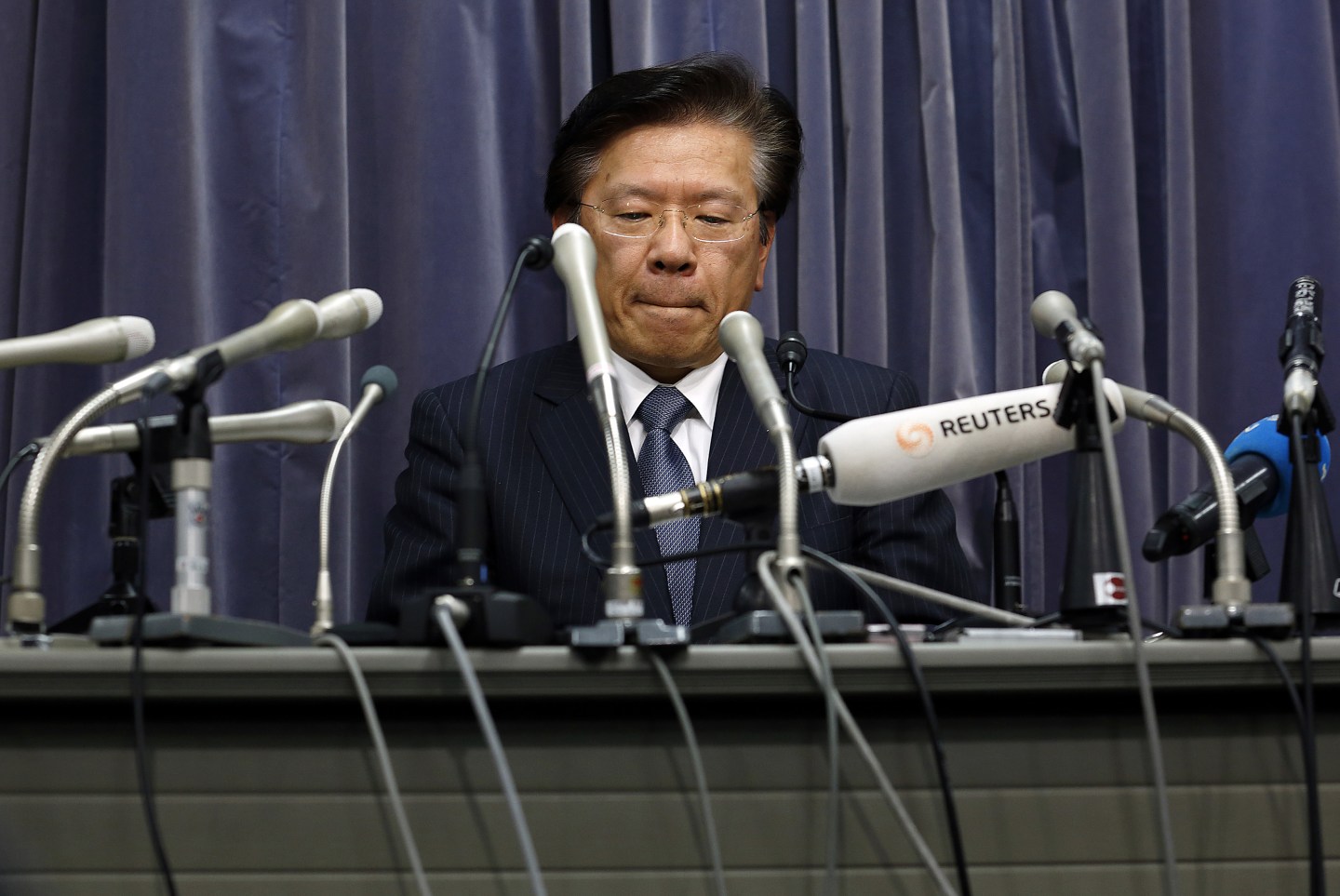
Mitsubishi Motors has had a rocky couple of months. After the company admitted to have falsified fuel-efficiency reports last month, its shares fell by 15%—its largest single-day drop in 12 years—leaving the president no choice but to step down. Mitsubishi’s performance in North America was equally lackluster, having sold just 95,342 vehicles in 2015. But as the scandal quickly spread, so did the rescue.
Last Thursday, CEO Carlos Ghosn announced that his Nissan Motor Company (NSANY) would invest $2.2 billion in Mitsubishi for a 34% stake. Mitsubishi will stay separate, with its own brand and dealership network, much like the current Renault-Nissan Alliance (where Ghosn is chairman of both). The new alliance will achieve a combined production volume of about 9 million vehicles a year, similar to that of top giants General Motors (GM), Toyota (TM), and Volkswagen (VLKAY). With Nissan becoming the largest shareholder of Mitsubishi, an exuberant Ghosn said, “We have the potential to be in [the] top three.” But can getting big turn fortunes around?
It is common knowledge that every automaker worries just about everything—except fighting the top three. They worry about Elon Musk, who popularized electric vehicles and turned what was once a dream into reality. They worry about Uber, which put carpooling and ride-sharing into overdrive. They worry about Google (GOOG), which relegated the role of driving to embedded sensors and machine algorithms. What this means is a complete shift in core competencies with respect to being a carmaker. But this problem isn’t new, unfortunately. There was an identical picture in digital photography two decades ago.
As recent as 1996, Kodak was still ranked one of the most valuable brands, among Disney (DIS), Coca-Cola (KO), and McDonald’s (MCD). Then shortly came digital pixels to replace film, and mobile phones to displace cameras. Kodak’s core capability in filmmaking had been rendered irrelevant in the age of digital photography, and the 131-year-old company filed for bankruptcy in 2012. Still, life is never inevitable. Enter Fujifilm.
Like Kodak, Fujifilm had long understood the threat of digitalization. Unlike Kodak, however, it successfully re-channeled profits from film sales, raced ahead in digital technologies, and diversified into new areas. Fujifilm jumpstarted manufacturing industrial films (used in LCD panels) for computers and other electronics. It leveraged expertise in antioxidants that had been used to preserve colors in printed photographs to formulate new products in skincare and cosmetics. The firm even worked on a new drug delivery system, developing a patch that allows for injection-free medicine absorption.
In the wake of Kodak’s bankruptcy, Fujifilm continued to be a chemical behemoth. A Fortune Global 500 in 2014, only 1% of the company’s annual revenue is from filmmaking. It is the poster child for corporate resilience.
For automakers, an electric vehicle looks déjà vu. The shift from internal combustion engines to electronic and electrical components means that everything under the hood will be radically simplified, dropping the number of components by one third, supplanted much by software design.
Paradoxically, from hardware to software, many of the new car components are made by a host of suppliers outside of the auto industry—companies from the IT world. The historical knowledge and competitive advantage of big carmakers are disappearing fast.
To be sure, nearly all carmakers have some kind of car-sharing initiatives, mimicking Uber and Lyft. The problem is, even if a traditional carmaker becomes a top car-sharing company, the resultant revenue will still be too small to justify its current existence. Toyota made close to $250 billion in 2015. Revenue of Uber? A mere $2 billion. For a long time now, selling cars has simply been too profitable and too easy. Now that car ownership is less appealing, there is less money to be made. Industry consolidation has ensued—which is exactly what happened to Mitsubishi.
Theodore Levitt, the legendary marketing scholar at Harvard Business School, often asked managers, “What business are you in?” The railroads, for example, “let others take customers away from them because they assumed themselves to be in the railroad business rather than in the transportation business,” he wrote. Twenty-first century automakers need to ask an even broader question: Beyond transport, what other businesses can they enter? Not based on what industries they are currently in, but on what existing capabilities can be repurposed, and focus on applying technologies in new areas. Businesses have life-spans, capabilities do not.
Howard Yu is professor of strategic management and innovation at IMD. He specializes in technological innovation, strategic transformation and change management. In 2015 Professor Yu was featured in Poets & Quants as one of the Best 40 Under 40 Professors. He received his doctoral degree at Harvard Business School.