• Home
  • Latest
  • Fortune 500
  • Finance
  • Tech
  • Leadership
  • Lifestyle
  • Rankings
  • Multimedia

Trendingnow

1

Philanthropy leader at Warren Buffett and Bill Gates’ Giving Pledge says children of billionaires are pushing them to give their wealth away faster

2

Meet a 71-year-old who retired as a radiologist and professor, and now runs a banana-skewer business: ‘I never want to retire. Why would you do that?’

3

Hilton received 12,000 Gen Z applications for just 72 internship spots—its CHRO says AI has made the hospitality gigs more competitive

1

Philanthropy leader at Warren Buffett and Bill Gates’ Giving Pledge says children of billionaires are pushing them to give their wealth away faster

2

Meet a 71-year-old who retired as a radiologist and professor, and now runs a banana-skewer business: ‘I never want to retire. Why would you do that?’

3

Hilton received 12,000 Gen Z applications for just 72 internship spots—its CHRO says AI has made the hospitality gigs more competitive
HealthBiotech

This Incredible Technology Let a Paralyzed Man Move His Hand

By
Sy Mukherjee
Sy Mukherjee
Down Arrow Button Icon
By
Sy Mukherjee
Sy Mukherjee
Down Arrow Button Icon
April 14, 2016, 10:10 AM ET
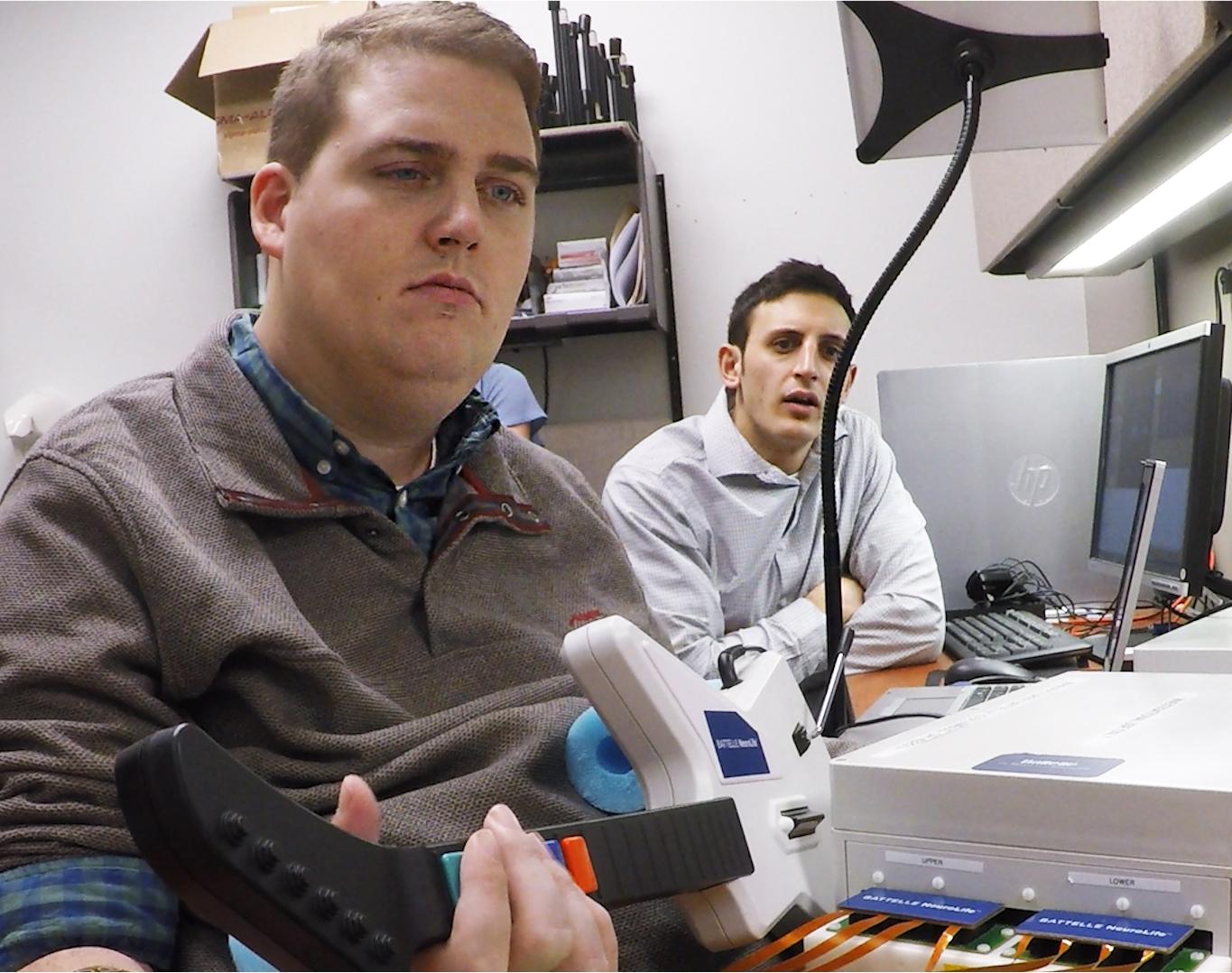
Nick Annetta, right, of Battelle, watches as Ian Burkhart, 24, plays a guitar video game using his paralyzed hand. A computer chip in Burkhart`s brain reads his thoughts, decodes them, then sends signals to a sleeve on his arm, that allows him to move his hand.
Nick Annetta, right, of Battelle, watches as Ian Burkhart, 24, plays a guitar video game using his paralyzed hand. A computer chip in Burkhart`s brain reads his thoughts, decodes them, then sends signals to a sleeve on his arm, that allows him to move his hand.Courtesy of The Ohio State University
Google source logo
Add Fortune on Google for similar content.

A quadriplegic man can now move his right hand thanks to landmark biotechnology which uses a microchip to help relay signals from his brain to his muscles, according to a new study published in the journal Nature.

“This is the first demonstration to our knowledge of successful control of muscle activation using intracortically recorded signals in a paralysed human,” wrote the researchers, who were led by Feinstein Institute for Medical Research’s Chad Bouton.

The man, 24-year-old Ian Burkhart, broke his neck in a swimming accident five years ago and volunteered for the brain experiment three years later. The injury robbed him of nearly all mobility beneath the shoulders, although he can somewhat move his elbow.

Bouton and his team performed a so-called neural bypass surgery after studying the areas of Burkhart’s brain which lit up on an fMRI as he watched videos of hand movements and attempted to ape them. The bypass procedure involved implanting a chip that can detect the electrical activity in those regions as Burkhart thinks about moving his hand and then transmits that information via a wire into a computer.


Next, computer algorithms transform the brain data into electrical data which charges up a special sleeve of bands wrapped around Burkhart’s right forearm (you can check out some pictures and video at Nature.com, including of Burkhart playing a guitar video game), allowing him to perform six different functions such as clenching and twisting with his right hand and wrist while connected to the machinery.

While similar brain-machine interface technology has been used to manipulate robotic prosthetics, this is the first such procedure to directly work with a real limb, according to the researchers.
The technology holds special promise for spinal cord injury patients since its success implies that the reshuffling of neural pathways following such trauma can be at least somewhat fixed. But although it’s a clear milestone, there’s still a way to go. Bouton admits that the process is far too cumbersome, requiring daily recalibration, and the system doesn’t give Burkhart back his sense of touch.
About the Author
By Sy Mukherjee
See full bioRight Arrow Button Icon

Latest in Health


Most Popular

Fortune Secondary Logo
Rankings
  • 100 Best Companies
  • Fortune 500
  • Global 500
  • Fortune 500 Europe
  • Most Powerful Women
  • World's Most Admired Companies
  • See All Rankings
  • Lists Calendar
Sections
  • Finance
  • Fortune Crypto
  • Features
  • Leadership
  • Health
  • Commentary
  • Success
  • Retail
  • Mpw
  • Tech
  • Lifestyle
  • CEO Initiative
  • Asia
  • Politics
  • Conferences
  • Europe
  • Newsletters
  • Personal Finance
  • Environment
  • Magazine
  • Education
Customer Support
  • Frequently Asked Questions
  • Customer Service Portal
  • Privacy Policy
  • Terms Of Use
  • Single Issues For Purchase
  • International Print
Commercial Services
  • Advertising
  • Fortune Brand Studio
  • Fortune Analytics
  • Fortune Conferences
  • Business Development
  • Group Subscriptions
About Us
  • About Us
  • Press Center
  • Work At Fortune
  • Terms And Conditions
  • Site Map
  • About Us
  • Press Center
  • Work At Fortune
  • Terms And Conditions
  • Site Map
  • Facebook icon
  • Twitter icon
  • LinkedIn icon
  • Instagram icon
  • TikTok icon
  • YouTube icon

    Latest in Health


    Most Popular

    © 2026 Fortune Media IP Limited. All Rights Reserved. Use of this site constitutes acceptance of our Terms of Use and Privacy Policy | CA Notice at Collection and Privacy Notice | Do Not Sell/Share My Personal Information
    FORTUNE is a trademark of Fortune Media IP Limited, registered in the U.S. and other countries. FORTUNE may receive compensation for some links to products and services on this website. Offers may be subject to change without notice.