• Home
  • Latest
  • Fortune 500
  • Finance
  • Tech
  • Leadership
  • Lifestyle
  • Rankings
  • Multimedia

How March Madness Athletes Help Fund ‘Country Club’ Sports

By
Lauren Silva Laughlin
Down Arrow Button Icon
By
Lauren Silva Laughlin
Down Arrow Button Icon
April 2, 2016, 12:00 PM ET
Texas Tech at Kansas
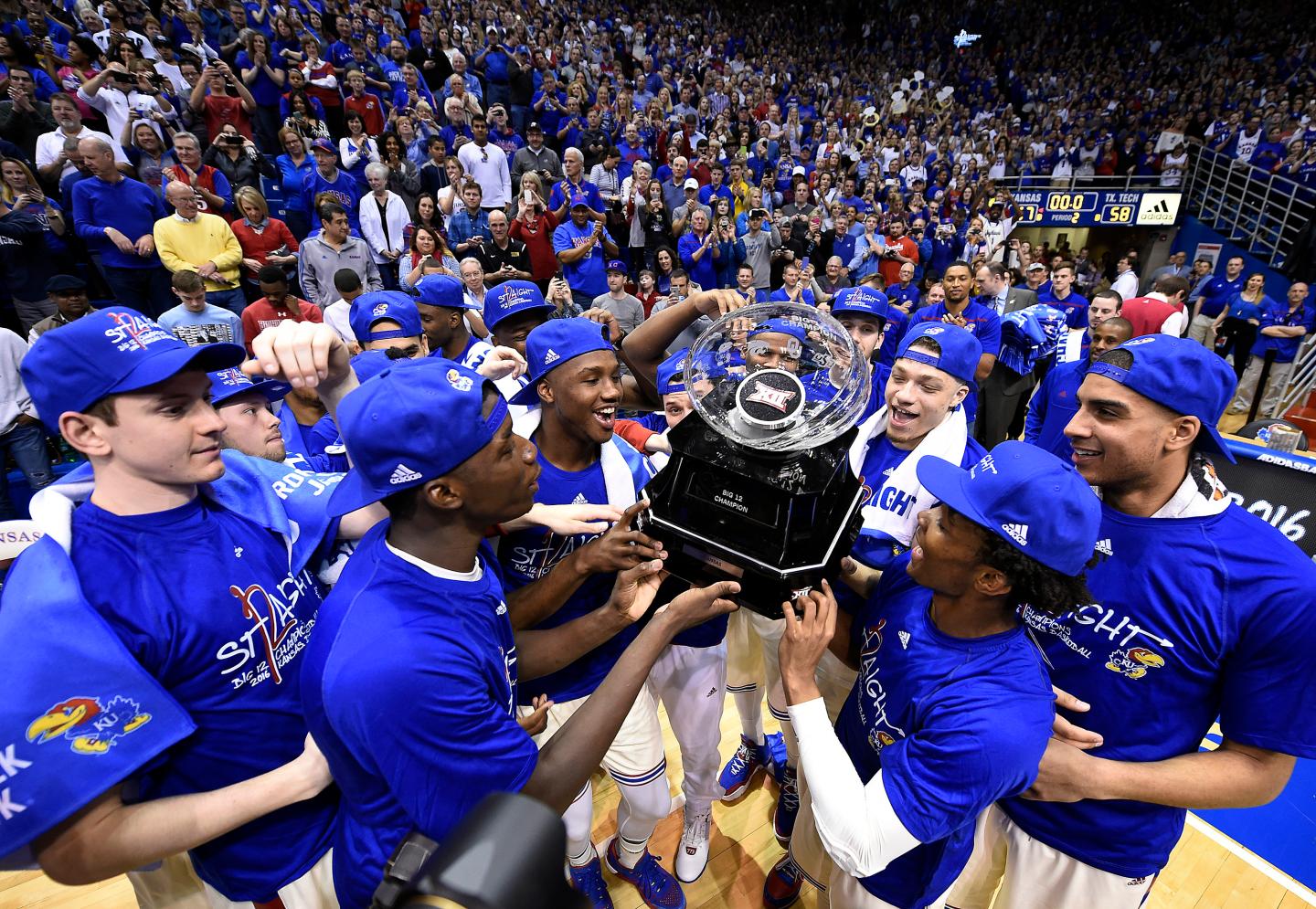
The Kansas Jayhawks celebrate a 12th consecutive Big 12 Conference title with a 67-58 win against Texas Tech on Saturday, Feb. 27, 2016, at Allen Fieldhouse in Lawrence, Kan. (Rich Sugg/Kansas City Star/TNS via Getty Images)Photograph by Rich Sugg —Kansas City Star TNS via Getty Images

The financial contributions of star NCAA basketball players to universities are well-documented. According to a recent report from the National College Players Association, the fair market value of a Louisville basketball player in the 2011-2012 season was more than $1.6 million. Syracuse, Duke, and UNC players were all worth nearly $1 million each.

But these lucrative players contribute much more than just to the bottom line. It’s common belief in many athletic circles that, if it weren’t for revenue-generating sports like basketball, others like swimming, lacrosse, and tennis, wouldn’t be funded. Colleges dole out scholarship money fairly between sports to give these “amateur” athletes–the ones who major in something other than their sport, as the NCAA commercial proudly states–an education.

But if this is true, it brings up another inequity. Students from lower socioeconomic standing often fill out rosters on basketball teams. In practice, less-privileged athletes are supporting the scholarships of students who play “country club” sports that favor athletes who come from affluent families. In the debate about fairness in sport, it gives athletes of Olympic sports very little ground to stand on.

Because of legal restrictions, researchers have a hard time pinning down the socioeconomic breakdown of individuals in NCAA athletics. The Family Educational Rights and Privacy Act (FERPA) restricts people from obtaining certain personal financial information at universities. “It makes it difficult to find out and indentify which athletes that may come from privilege and which come from low socioeconomic backgrounds,” says Richard Southall, Director at the College Sport Research Institute at the University of South Carolina.

Nevertheless, there are ways to piece together the socioeconomic disparity between various sports. For example, the NCAA publishes an annual report card that breaks down race in every sport. Though race doesn’t absolutely speak to socioeconomic standing, it can say something about it if you assume the NCAA’s population reflects society over all.

In the 2014-2015 school year, for example, 2.2% of the male athletes who swim at Division 1 schools are black, while more than 80% were white. In lacrosse, 85% of players on the teams, on average, are white. In golf, 71% were white while only 3% were black. Meanwhile, in basketball, only a quarter of the male players are white.

Now consider the average median income per race in the US. African American households, according to the most recent US census data, make around $35,000 a year, about 35% less than the average white household.

When looking at research that shows the socioeconomic breakdown in youth sports, this disparity becomes more drastic. For example, 56% of athletes that play lacrosse come from families that make more than $100,000 a year, according to the Aspen Institute. Only about 4% of the athletes in the sport come from families below the poverty line.

The most affluent category accounts for 43% of the athletes in swimming. About 8% of the athletes who swim are from families that live below the poverty line. In basketball, however, 16% of the athletes who play the sport come from families below the poverty line. Only about a quarter of the young athletes who play the game are from families who make more than $100,000 a year.

Now let’s go back to the example of the Louisville players, for illustrative purposes. If one player is worth $1.6 million to the university, and the cost of tuition at the school is roughly $31,000, a single star basketball player could fund the scholarships of nearly the entire lacrosse team at the average NCAA Division 1 school. Meanwhile only 6% of those lacrosse athletes should be receiving need-based grants, according to financial aid statistics released by the National Center for Education Statistics, if the Aspen Institute household incomes data hold steady through college.

If fairness were a concern, scholarships of sports like swimming and lacrosse should disappear. The trouble with fixing this disparity is two-fold, says Southall. First, disproportionately across athletes, their grant is greater than their market value. So if an athlete plays tennis, for example, “you are going to be quiet because it is a good deal.”

Parents don’t help. “Parents love to talk about their child who is a division 1 scholarship as opposed to be a ‘walk-on,’” he says.

Second, players of the revenue generating sports have a hard time speaking out against their program. “They say to themselves I better stay quiet and the program will take care of me,” Southall says.

But there is another misnomer, according to Ramogi Huma, president of the National College Players Association. “Does it take football and basketball to sustain sports? If so, how does Division 2 and 3 exist? It’s a myth that you need football and basketball to sustain other sports,” he says. Universities like to use this as an excuse to pit athletes against each other. But at universities that have less athletic prominence, “they give hired coaches a full schedule and travel.” In other words, people would probably swim anyway.

Lauren Silva Laughlin is a freelancer for Fortune. She was awarded a full scholarship to the University of North Carolina at Chapel Hill for swimming.

About the Author
By Lauren Silva Laughlin
See full bioRight Arrow Button Icon

Latest in

Finance
Lorem ipsum dolor sit amet, consectetur adipiscing elit, sed do eiusmod tempor incididunt ut labore et dolore magna aliqua. Ut enim ad minim veniam
By Fortune Editors
October 20, 2025
Finance
Lorem ipsum dolor sit amet, consectetur adipiscing elit, sed do eiusmod tempor incididunt ut labore et dolore magna aliqua. Ut enim ad minim veniam
By Fortune Editors
October 20, 2025
Finance
Lorem ipsum dolor sit amet, consectetur adipiscing elit, sed do eiusmod tempor incididunt ut labore et dolore magna aliqua. Ut enim ad minim veniam
By Fortune Editors
October 20, 2025
Finance
Lorem ipsum dolor sit amet, consectetur adipiscing elit, sed do eiusmod tempor incididunt ut labore et dolore magna aliqua. Ut enim ad minim veniam
By Fortune Editors
October 20, 2025
Finance
Lorem ipsum dolor sit amet, consectetur adipiscing elit, sed do eiusmod tempor incididunt ut labore et dolore magna aliqua. Ut enim ad minim veniam
By Fortune Editors
October 20, 2025
Finance
Lorem ipsum dolor sit amet, consectetur adipiscing elit, sed do eiusmod tempor incididunt ut labore et dolore magna aliqua. Ut enim ad minim veniam
By Fortune Editors
October 20, 2025

Most Popular

Finance
Lorem ipsum dolor sit amet, consectetur adipiscing elit, sed do eiusmod tempor incididunt ut labore et dolore magna aliqua. Ut enim ad minim veniam
By Fortune Editors
October 20, 2025
Finance
Lorem ipsum dolor sit amet, consectetur adipiscing elit, sed do eiusmod tempor incididunt ut labore et dolore magna aliqua. Ut enim ad minim veniam
By Fortune Editors
October 20, 2025
Finance
Lorem ipsum dolor sit amet, consectetur adipiscing elit, sed do eiusmod tempor incididunt ut labore et dolore magna aliqua. Ut enim ad minim veniam
By Fortune Editors
October 20, 2025
Finance
Lorem ipsum dolor sit amet, consectetur adipiscing elit, sed do eiusmod tempor incididunt ut labore et dolore magna aliqua. Ut enim ad minim veniam
By Fortune Editors
October 20, 2025
Finance
Lorem ipsum dolor sit amet, consectetur adipiscing elit, sed do eiusmod tempor incididunt ut labore et dolore magna aliqua. Ut enim ad minim veniam
By Fortune Editors
October 20, 2025
Finance
Lorem ipsum dolor sit amet, consectetur adipiscing elit, sed do eiusmod tempor incididunt ut labore et dolore magna aliqua. Ut enim ad minim veniam
By Fortune Editors
October 20, 2025
Fortune Secondary Logo
Rankings
  • 100 Best Companies
  • Fortune 500
  • Global 500
  • Fortune 500 Europe
  • Most Powerful Women
  • World's Most Admired Companies
  • See All Rankings
  • Lists Calendar
Sections
  • Finance
  • Fortune Crypto
  • Features
  • Leadership
  • Health
  • Commentary
  • Success
  • Retail
  • Mpw
  • Tech
  • Lifestyle
  • CEO Initiative
  • Asia
  • Politics
  • Conferences
  • Europe
  • Newsletters
  • Personal Finance
  • Environment
  • Magazine
  • Education
Customer Support
  • Frequently Asked Questions
  • Customer Service Portal
  • Privacy Policy
  • Terms Of Use
  • Single Issues For Purchase
  • International Print
Commercial Services
  • Advertising
  • Fortune Brand Studio
  • Fortune Analytics
  • Fortune Conferences
  • Business Development
  • Group Subscriptions
About Us
  • About Us
  • Press Center
  • Work At Fortune
  • Terms And Conditions
  • Site Map
  • About Us
  • Press Center
  • Work At Fortune
  • Terms And Conditions
  • Site Map
  • Facebook icon
  • Twitter icon
  • LinkedIn icon
  • Instagram icon
  • Pinterest icon

Latest in

ExxonMobil CEO Darren Woods, far right, listens as U.S. President Donald Trump,left, speaks during a meeting with oil company executives in the East Room of the White House on Jan. 9. President Trump is aiming to convince oil executives to support his plans in Venezuela, a country whose energy resources he says he expects to control for years to come. US forces seized Venezuelan president Nicolas Maduro in a sweeping military operation on January 3, with Trump making no secret that control of Venezuela's oil was at the heart of his actions.
EnergyIran
Exxon Mobil CEO sees ‘more to come’ on price spikes from Iran war as Exxon, Chevron beat on earnings despite plunging profits
By Jordan BlumMay 1, 2026
38 minutes ago
trump
PoliticsIran
Trump on Iran: ‘They want to make a deal, I’m not satisfied with it, so we’ll see what happens’
By Toqa Ezzidin, Munir Ahmed, Collin Binkley and The Associated PressMay 1, 2026
2 hours ago
infantino
North AmericaWorld Cup
Fifa’s Infantino predicted sellouts and ‘1,000 years of World Cups at once,’ but fans aren’t biting
By James Robson and The Associated PressMay 1, 2026
3 hours ago
bernie
PoliticsElections
Bernie Sanders is destroying Chuck Schumer in the Democratic Party’s Civil War ahead of the midterms
By Steve Peoples and The Associated PressMay 1, 2026
3 hours ago
cox
C-SuiteWealth
Billionaires have a problem money can’t solve: They don’t know how to talk to their kids
By Nick LichtenbergMay 1, 2026
3 hours ago
charles
PoliticsRoyals
King Charles’ stiff upper lip on Epstein: ‘support victims of some of the ills that, so tragically, exist in both our societies’
By Jill Lawless and The Associated PressMay 1, 2026
3 hours ago

Most Popular

China dominates the world's lithium supply. The U.S. just found 328 years' worth in its own backyard
North America
China dominates the world's lithium supply. The U.S. just found 328 years' worth in its own backyard
By Jake AngeloApril 30, 2026
1 day ago
Scott Bessent on financial literacy: 'it drives me crazy' to see young men in blue-collar construction jobs playing the lottery
Personal Finance
Scott Bessent on financial literacy: 'it drives me crazy' to see young men in blue-collar construction jobs playing the lottery
By Fatima Hussein and The Associated PressMay 1, 2026
8 hours ago
The U.S. economy is booming — just not where 50 million Americans live
Commentary
The U.S. economy is booming — just not where 50 million Americans live
By Derek KilmerMay 1, 2026
13 hours ago
Accenture's Julie Sweet blew up 50 years of company history. She says the hardest part is still ahead
Conferences
Accenture's Julie Sweet blew up 50 years of company history. She says the hardest part is still ahead
By Nick LichtenbergApril 29, 2026
2 days ago
Apple cofounder Ronald Wayne—whose stake would be worth up to $400 billion had he not sold it in 1976—says that at 91, he has no regrets
Success
Apple cofounder Ronald Wayne—whose stake would be worth up to $400 billion had he not sold it in 1976—says that at 91, he has no regrets
By Preston ForeApril 27, 2026
4 days ago
Exclusive: America's largest Black-owned bank launches podcast with mission to unlock hidden shame holding back generational wealth
Banking
Exclusive: America's largest Black-owned bank launches podcast with mission to unlock hidden shame holding back generational wealth
By Nick LichtenbergApril 29, 2026
2 days ago

© 2026 Fortune Media IP Limited. All Rights Reserved. Use of this site constitutes acceptance of our Terms of Use and Privacy Policy | CA Notice at Collection and Privacy Notice | Do Not Sell/Share My Personal Information
FORTUNE is a trademark of Fortune Media IP Limited, registered in the U.S. and other countries. FORTUNE may receive compensation for some links to products and services on this website. Offers may be subject to change without notice.