• Home
  • Latest
  • Fortune 500
  • Finance
  • Tech
  • Leadership
  • Lifestyle
  • Rankings
  • Multimedia
CommentaryAlphaGo

What AlphaGo’s Win Means for Your Job

By
Howard Yu
Howard Yu
and
Bethany Cianciolo
Bethany Cianciolo
Down Arrow Button Icon
By
Howard Yu
Howard Yu
and
Bethany Cianciolo
Bethany Cianciolo
Down Arrow Button Icon
March 21, 2016, 3:11 PM ET
Professional 'Go' Player Lee Se-dol Set To Play Google's AlphaGo
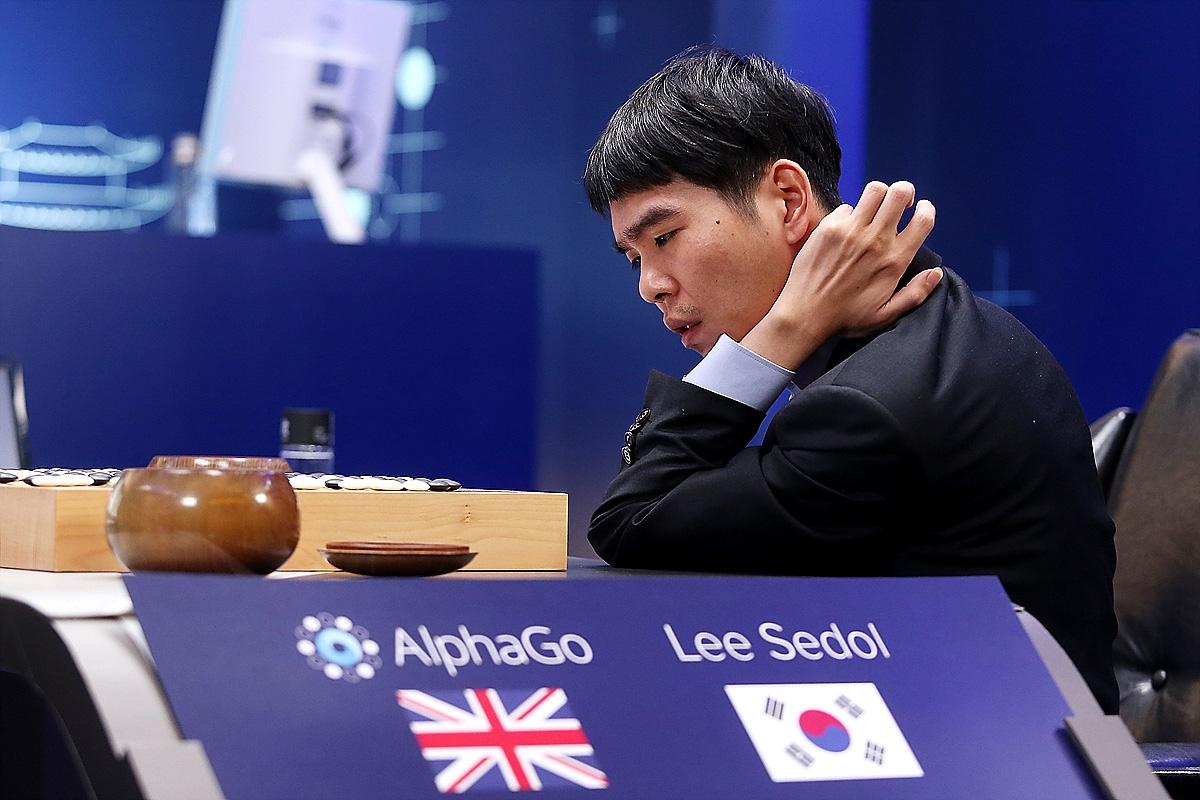
SEOUL, SOUTH KOREA - MARCH 13: In this handout image provided by Google, South Korean professional Go player Lee Se-Dol reviews the match after the fourth match against Google's artificial intelligence program, AlphaGo, during the Google DeepMind Challenge Match on March 13, 2016 in Seoul, South Korea. Lee Se-dol played a five-game match against a computer program developed by a Google, AlphaGo. (Photo by Google via Getty Images)Photograph by Google via Getty Images

Just last week, machines crossed a momentous milestone. Google’s AlphaGo, a computer algorithm, beat Go world champion Lee Sedol 4 to 1 in the ancient Chinese board game.

Unlike Western chess, which consists of about 40 turns in a game, Go entails up to 200. Back in 1997, IBM (IBM)‘s Deep Blue trumped chess Grandmaster Garry Kasparov by deploying a brute force approach—calculating all of the possible end games and then making an optimal choice for the next move. You can’t do this with Go. The permutation of outcomes on a 19-by-19 grid quickly compounds to a bewildering range—10761 to be exact—more than the total number of atoms of the entire observable universe. To compete, a machine needs to think more intuitively, more human-like. AlphaGo did just that.

Before AlphaGo played Go, Google (GOOG) researchers had been developing it to play other video games—Space Invaders, Breakout, Pong, and others. Without the need for any specific programming, the algorithm was able to master each game by trial and error—pressing different buttons randomly at first, then adjusting to maximize rewards. Game after game, the software proved to be cunningly versatile in figuring out an appropriate strategy, and then applying it without making any mistakes.

Among computer scientists, such is a general-purpose algorithm, capable of self-learning and tackling different problem domains. This is made possible by building a network of hardware and software that mimics the web of neurons in the human brain. In this sense, computers can be programmed to seek positive rewards that come in the form of scores.

AlphaGo continually reinforces and improves its performance by playing millions of games against tweaked versions of itself. Displaying wisdom of its inner-workings, during the 37th move in the match’s second game, AlphaGo made a surprise move that flummoxed Lee Sedol.

But such breakneck advances naturally prompt existential questioning. Elon Musk said artificial intelligence could be “potentially more dangerous than nukes,” and likened it to “summoning the demon.” Apple cofounder Steve Wozniak went further still: “…The future is scary and very bad for people,” he argued. “Will we be the gods? Will we be the family pets? Or will we be ants that get stepped on?”


Such questions, as odd as they sound, are all relevant, with the business impacts of artificial intelligence already evident. IBM Watson, hailed to be the first computer capable of understanding natural human language, showed how machine learning can go beyond just games and trivia. By digesting millions of pages of medical journals and patient data, Watson provides recommendations—from blood tests to clinical trials—to physicians. A cancer doctor only needs to describe a patient’s symptoms to Watson in plain, spoken English over an iPad application.

Both Watson and AlphaGo are showing that the ability for human experts who masterfully recognize patterns will soon turn cheap. Analytical decisions—like when an art expert is able to “sense” that he’s looking at a forgery, or when a medical specialist develops a “clinical glance” that allows her to make diagnosis almost as soon as a patient walks in—are exactly the sorts of human advantages that will disappear first. Similarly, analyses currently done on any excel spreadsheet, like supply-chain coordination, marketing-dollar spread, or tactical resource allocation, will soon be easily mastered by machines. Ken Jennings, the former champion who lost to IBM Watson in the game show Jeopardy! in February 2011, said, “Just as factory jobs were eliminated in the 20th century by new assembly-line robots, [we] were the first knowledge-industry workers put out of work by the new generation of ‘thinking’ machines.”

So there is a threat to many jobs, but the good news is that there will always be plenty of new jobs that reemerge. When textile machines decimated the entire industry of weaving and spinning, 20th-century workers went on to build more complex goods: automotive, aircraft, and consumer electronics. Now that the routine white-collar work is being automated, occupations that demand higher forms of human empathy and long-range planning will be the new frontier. Already, we have seen the evangelization of design thinking for almost a decade, where business managers are encouraged to embrace a human-centric perspective when conceptualizing new product offerings—from liquid detergent to MRI scanners and insulin syringes. The acceleration of evermore user-friendly products can only be achieved when a substantial part of the office work is automated, thereby releasing the human brain for higher purposes.

In this changing flux, IT experts will have to ask themselves if they are cutting-edge enough to help companies automate human intuition faster than competitors.

And those in non-IT roles will need to question whether their current job is specialized enough to not become vulnerable in the age of machines.

In the direction the world is headed, everyone will need to rethink their professional existence to ensure they have a broad prospective of where they could integrate different domain knowledge in their career track in a creative way.

As Mary Kay Ash said, “There are three types of people in this world: those who make things happen, those who watch things happen and those who wonder what happened.” Let us not become the last.

Howard Yu is a professor of strategic management and innovation at IMD, a business school based in Lausanne, Switzerland. Yu does not have investments in any of the above companies mentioned.

About the Authors
By Howard Yu
See full bioRight Arrow Button Icon
By Bethany Cianciolo
See full bioRight Arrow Button Icon

Latest in Commentary

Finance
Lorem ipsum dolor sit amet, consectetur adipiscing elit, sed do eiusmod tempor incididunt ut labore et dolore magna aliqua. Ut enim ad minim veniam
By Fortune Editors
October 20, 2025
Finance
Lorem ipsum dolor sit amet, consectetur adipiscing elit, sed do eiusmod tempor incididunt ut labore et dolore magna aliqua. Ut enim ad minim veniam
By Fortune Editors
October 20, 2025
Finance
Lorem ipsum dolor sit amet, consectetur adipiscing elit, sed do eiusmod tempor incididunt ut labore et dolore magna aliqua. Ut enim ad minim veniam
By Fortune Editors
October 20, 2025
Finance
Lorem ipsum dolor sit amet, consectetur adipiscing elit, sed do eiusmod tempor incididunt ut labore et dolore magna aliqua. Ut enim ad minim veniam
By Fortune Editors
October 20, 2025
Finance
Lorem ipsum dolor sit amet, consectetur adipiscing elit, sed do eiusmod tempor incididunt ut labore et dolore magna aliqua. Ut enim ad minim veniam
By Fortune Editors
October 20, 2025
Finance
Lorem ipsum dolor sit amet, consectetur adipiscing elit, sed do eiusmod tempor incididunt ut labore et dolore magna aliqua. Ut enim ad minim veniam
By Fortune Editors
October 20, 2025

Most Popular

Finance
Lorem ipsum dolor sit amet, consectetur adipiscing elit, sed do eiusmod tempor incididunt ut labore et dolore magna aliqua. Ut enim ad minim veniam
By Fortune Editors
October 20, 2025
Finance
Lorem ipsum dolor sit amet, consectetur adipiscing elit, sed do eiusmod tempor incididunt ut labore et dolore magna aliqua. Ut enim ad minim veniam
By Fortune Editors
October 20, 2025
Finance
Lorem ipsum dolor sit amet, consectetur adipiscing elit, sed do eiusmod tempor incididunt ut labore et dolore magna aliqua. Ut enim ad minim veniam
By Fortune Editors
October 20, 2025
Finance
Lorem ipsum dolor sit amet, consectetur adipiscing elit, sed do eiusmod tempor incididunt ut labore et dolore magna aliqua. Ut enim ad minim veniam
By Fortune Editors
October 20, 2025
Finance
Lorem ipsum dolor sit amet, consectetur adipiscing elit, sed do eiusmod tempor incididunt ut labore et dolore magna aliqua. Ut enim ad minim veniam
By Fortune Editors
October 20, 2025
Finance
Lorem ipsum dolor sit amet, consectetur adipiscing elit, sed do eiusmod tempor incididunt ut labore et dolore magna aliqua. Ut enim ad minim veniam
By Fortune Editors
October 20, 2025
Fortune Secondary Logo
Rankings
  • 100 Best Companies
  • Fortune 500
  • Global 500
  • Fortune 500 Europe
  • Most Powerful Women
  • World's Most Admired Companies
  • See All Rankings
  • Lists Calendar
Sections
  • Finance
  • Fortune Crypto
  • Features
  • Leadership
  • Health
  • Commentary
  • Success
  • Retail
  • Mpw
  • Tech
  • Lifestyle
  • CEO Initiative
  • Asia
  • Politics
  • Conferences
  • Europe
  • Newsletters
  • Personal Finance
  • Environment
  • Magazine
  • Education
Customer Support
  • Frequently Asked Questions
  • Customer Service Portal
  • Privacy Policy
  • Terms Of Use
  • Single Issues For Purchase
  • International Print
Commercial Services
  • Advertising
  • Fortune Brand Studio
  • Fortune Analytics
  • Fortune Conferences
  • Business Development
  • Group Subscriptions
About Us
  • About Us
  • Press Center
  • Work At Fortune
  • Terms And Conditions
  • Site Map
  • About Us
  • Press Center
  • Work At Fortune
  • Terms And Conditions
  • Site Map
  • Facebook icon
  • Twitter icon
  • LinkedIn icon
  • Instagram icon
  • Pinterest icon

Latest in Commentary

hollywood
CommentaryMarketing
I spent 20 years learning to navigate an industry. Then I built a campaign for the man who’s dismantling it
By Matti YahavApril 29, 2026
18 hours ago
aging
HealthLongevity
We’re the CEOs of Peloton and the Hospital for Special Surgery. Living longer isn’t enough, we need to live better, too
By Bryan T. Kelly and Peter SternApril 29, 2026
19 hours ago
gen z
Commentarydisruption
AI won’t kill your job — it will kill the path to your first one
By Jeffrey Sonnenfeld, Stephen Henriques, Johan Griesel, Andrew Alam-Nist and Peter YuApril 29, 2026
20 hours ago
greer
CommentaryTariffs
No, tariffs are not strengthening the economy
By Alex DuranteApril 29, 2026
21 hours ago
AI is changing who gets to be an expert. Are your colleagues ready to become ‘directors of intelligence’?
AIProductivity
AI is changing who gets to be an expert. Are your colleagues ready to become ‘directors of intelligence’?
By Bruce BroussardApril 29, 2026
22 hours ago
gen z
CommentaryEducation
Gen Z has the wrong idea about college. Your career doesn’t start after you graduate 
By Ashley BigdaApril 29, 2026
23 hours ago

Most Popular

Apple cofounder Ronald Wayne—whose stake would be worth up to $400 billion had he not sold it in 1976—says that at 91, he has no regrets
Success
Apple cofounder Ronald Wayne—whose stake would be worth up to $400 billion had he not sold it in 1976—says that at 91, he has no regrets
By Preston ForeApril 27, 2026
3 days ago
‘Take the money and run’: Johns Hopkins economist Steve Hanke on why the UAE quit OPEC
Energy
‘Take the money and run’: Johns Hopkins economist Steve Hanke on why the UAE quit OPEC
By Shawn TullyApril 29, 2026
1 day ago
‘The cost of compute is far beyond the costs of the employees’: Nvidia executive says right now AI is more expensive than paying human workers
AI
‘The cost of compute is far beyond the costs of the employees’: Nvidia executive says right now AI is more expensive than paying human workers
By Sasha RogelbergApril 28, 2026
2 days ago
Jamie Dimon gets candid about national debt: ‘There will be a bond crisis, and then we’ll have to deal with it’
Economy
Jamie Dimon gets candid about national debt: ‘There will be a bond crisis, and then we’ll have to deal with it’
By Eleanor PringleApril 29, 2026
21 hours ago
‘They left me no choice’: Powell isn’t going anywhere—blocking Trump from another Fed appointee
Banking
‘They left me no choice’: Powell isn’t going anywhere—blocking Trump from another Fed appointee
By Eva RoytburgApril 29, 2026
13 hours ago
More than two-thirds of U.S. schools say they’re unable to afford the cost of student free lunch—and MAHA’s dietary guidelines may make it worse
Economy
More than two-thirds of U.S. schools say they’re unable to afford the cost of student free lunch—and MAHA’s dietary guidelines may make it worse
By Sasha RogelbergApril 29, 2026
23 hours ago

© 2026 Fortune Media IP Limited. All Rights Reserved. Use of this site constitutes acceptance of our Terms of Use and Privacy Policy | CA Notice at Collection and Privacy Notice | Do Not Sell/Share My Personal Information
FORTUNE is a trademark of Fortune Media IP Limited, registered in the U.S. and other countries. FORTUNE may receive compensation for some links to products and services on this website. Offers may be subject to change without notice.