• Home
  • Latest
  • Fortune 500
  • Finance
  • Tech
  • Leadership
  • Lifestyle
  • Rankings
  • Multimedia
Leadership

Why Trump Thinks He Can Save a ‘Fortune’ With Lowest Bidder Contracts

By
Liz Olson
Liz Olson
Down Arrow Button Icon
By
Liz Olson
Liz Olson
Down Arrow Button Icon
March 15, 2016, 11:30 AM ET
USA-ELECTION/TRUMP
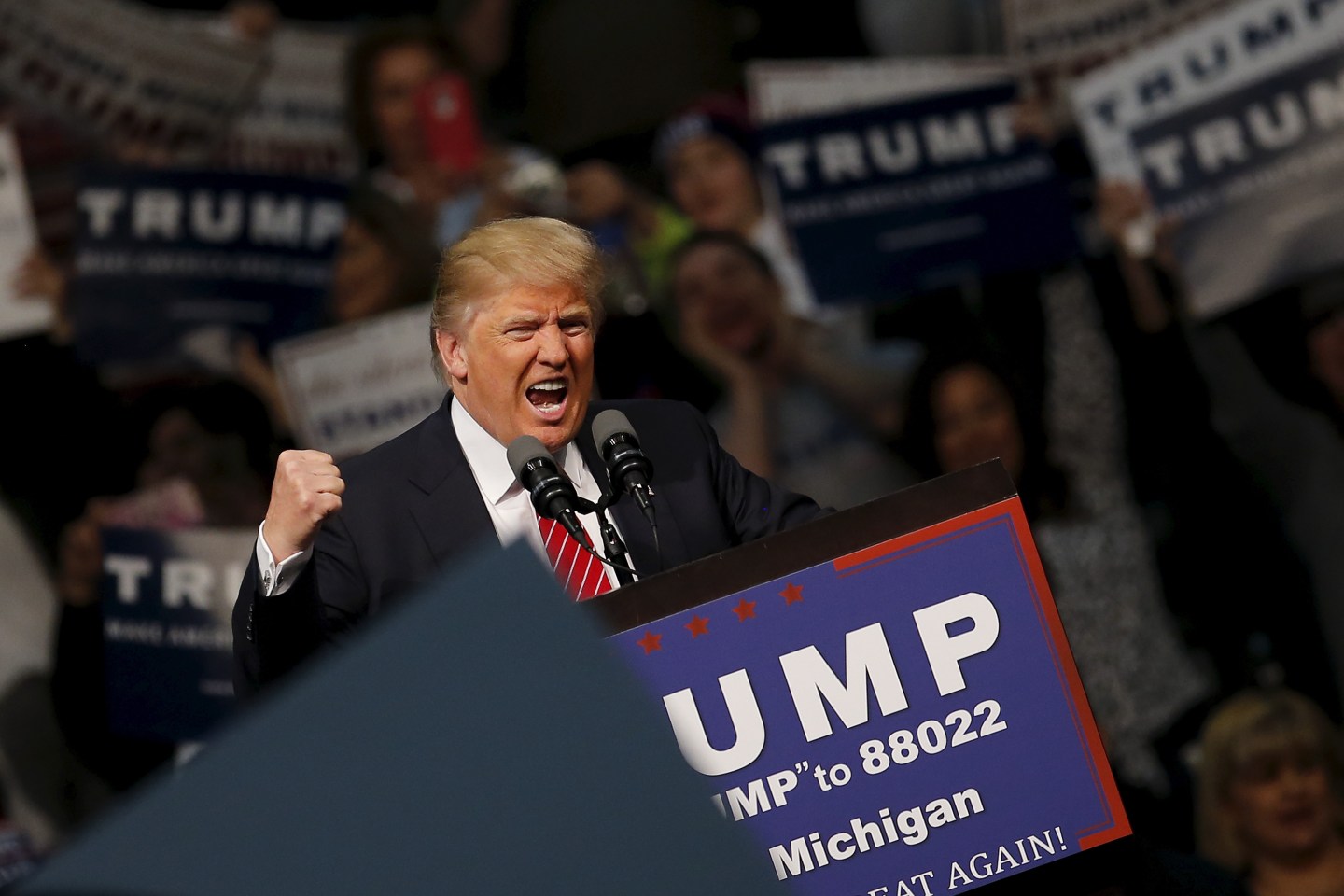
Republican U.S. presidential candidate Donald Trump speaks to supporters during a campaign rally in Warren, Michigan, March 4, 2016. REUTERS/Carlos Barria - RTS9BR8Photograph by Carlos Barria — Reuters

If there is one thing that’s good news to people all across the political spectrum, it’s the promise that there is a goldmine of money to be found if only fraud and waste can be slashed from government contracts. Millions of dollars—or, more often, billions—could be saved simply by awarding contracts to the lowest bidders.

Or so the promise goes.

Almost every candidate heaps praise on this idea. Just last week, Donald Trump pledged at a presidential nominee debate at the University of Miami, “We’re going out to bid in virtually every facet of our government. We are going to save a fortune.”

Trump, who touts his billionaire status as proof he could bring the federal government in line, singled out prescription medication prices, a closely watched topic in a state with a high number of retirees. He said that the government pays “almost as if you walk into a drugstore. That’s what they are paying.”

Trump attributed high drug prices to the pharmaceutical industry’s “fantastic” lobby. “They take care of all the senators, the congressmen,” he said. “They have great power and they don’t bid out.” And he’s repeatedly made the much-disputed claim that under his plan—which would let Medicare directly negotiate lower prices with drug companies—the U.S. could save $300 billion a year.

While the Republican presidential contender may have hit on some hard truths (and dubious math), particularly at a time when public attention is focused on the rising and sometimes inexplicably high cost of medications, his own track record with governmental agencies—as well as efforts by previous administrations—underscore how tangled and difficult the issue of contracting is.

Barack Obama made contracting a centerpiece early in his administration, promising that by “eliminating what doesn’t work, improving oversight and cracking down on waste,” his administration would cut fraud and abuse and save significant taxpayer money.

But in the wake of the passage of the national health care overhaul, when the Obama Administration tried to corral costs for medical equipment such as power wheelchairs and mail-order diabetes test strips, it ran straight into congressional forces that can derail such changes.

In spring 2012, the White House announced that a one-year pilot had saved $202 million in Medicare outlays by allowing bidding on such equipment, which had previously been supplied on a fee-for-services model where patients were allowed to choose their own supplier of goods or services.

Medicare officials said the goal was to use the pilot to pave the way for competitive bidding on medical equipment to spread nationally by 2016. They projected that in a decade it could save over $42 billion, more than half of which would go to the Medicare program and the rest to patients, who typically must pay about 20% of what Medicare approves as the official payment for medical supplies.

But the effort ran into major problems when Medicare patients complained about incorrect equipment or delays in receiving supplies or equipment, and companies said that the government had accepted low bids from providers with little experience, which hurt businesses with proven track records.

Lawmakers jumped in to help constituent companies that lost business under the new program. And, thus far, the predicted savings have not been realized.

The same dynamic governs the defense industry, even as the Obama Administration has tried to enforce more competitive contracting. In 2009, the White House said competitive bidding could save billions of dollars each year, and warned that relying on sole source contract bidding “creates a risk that taxpayer funds will be spent on contracts that are wasteful, inefficient, [and] subject to misuse.”

And yet, past working relationships, rush jobs, and personal contacts can play a large part in such contract awards, and armies of lobbyists armed with expense accounts and deep pockets for political donations have inordinate sway. Highly paid military procurement officials are also skilled at intricacies of making new awards appear as if they are extensions of existing awards.

Today, powerful industry giants—including Lockheed Martin, Boeing, and Raytheon—continue to be major recipients of single-source contracts. Despite the White House determination to cut back such contracts, President Obama’s first term in office saw a 9% increase in the amount spent on no-bid contracts.

In the current campaign, Trump’s ire is not directed at the dealmakers and contractors, however, but at the government employees who fail, in his view, to make better deals. That makes sense, considering his experience as a developer: While he criticizes and threatens to eliminate federal agencies such as the Environmental Protection Agency and the Department of Education, he is not a stranger to the world of government largesse.

One of the most famous examples is a 40-year property tax abatement he received in the late 70’s for rebuilding the deteriorated Hotel Commodore at New York’s Grand Central Station. Price tags on that deal vary but the first decade alone may have cost taxpayers $60 million.

More recently, in 2013 he signed a deal with the General Services Administration to renovate the Old Post Office Building, just blocks from the White House, and turn it into a luxury hotel.


Trump makes no bones about how he has used strategic political donations to curry favor with elected officials; his father Fred was an old political ally of Abraham Beame, who was mayor of New York when he got the Hotel Commodore tax abatement. And Trump doesn’t hide how he’s worked government rules to make a profit for his companies.

But for Trump—and his ardent supporters—the fact that he’s a fox is another reason to hire him to guard the henhouse. Back in 2011, he made just that point in an interview with the Los Angeles Times:

“When I work for myself, I try to make the maximum profit,” he said at the time. “If I run [for president] and if I win, I will no longer care about myself. I’ll be doing the same kind of things for this country.”

In other words, since he knows all the tricks of the contracting trade, he will be able to stave off other manipulators and save taxpayers—you got it—“a fortune.”
About the Author
By Liz Olson
See full bioRight Arrow Button Icon

Latest in Leadership

Finance
Lorem ipsum dolor sit amet, consectetur adipiscing elit, sed do eiusmod tempor incididunt ut labore et dolore magna aliqua. Ut enim ad minim veniam
By Fortune Editors
October 20, 2025
Finance
Lorem ipsum dolor sit amet, consectetur adipiscing elit, sed do eiusmod tempor incididunt ut labore et dolore magna aliqua. Ut enim ad minim veniam
By Fortune Editors
October 20, 2025
Finance
Lorem ipsum dolor sit amet, consectetur adipiscing elit, sed do eiusmod tempor incididunt ut labore et dolore magna aliqua. Ut enim ad minim veniam
By Fortune Editors
October 20, 2025
Finance
Lorem ipsum dolor sit amet, consectetur adipiscing elit, sed do eiusmod tempor incididunt ut labore et dolore magna aliqua. Ut enim ad minim veniam
By Fortune Editors
October 20, 2025
Finance
Lorem ipsum dolor sit amet, consectetur adipiscing elit, sed do eiusmod tempor incididunt ut labore et dolore magna aliqua. Ut enim ad minim veniam
By Fortune Editors
October 20, 2025
Finance
Lorem ipsum dolor sit amet, consectetur adipiscing elit, sed do eiusmod tempor incididunt ut labore et dolore magna aliqua. Ut enim ad minim veniam
By Fortune Editors
October 20, 2025

Most Popular

Finance
Lorem ipsum dolor sit amet, consectetur adipiscing elit, sed do eiusmod tempor incididunt ut labore et dolore magna aliqua. Ut enim ad minim veniam
By Fortune Editors
October 20, 2025
Finance
Lorem ipsum dolor sit amet, consectetur adipiscing elit, sed do eiusmod tempor incididunt ut labore et dolore magna aliqua. Ut enim ad minim veniam
By Fortune Editors
October 20, 2025
Finance
Lorem ipsum dolor sit amet, consectetur adipiscing elit, sed do eiusmod tempor incididunt ut labore et dolore magna aliqua. Ut enim ad minim veniam
By Fortune Editors
October 20, 2025
Finance
Lorem ipsum dolor sit amet, consectetur adipiscing elit, sed do eiusmod tempor incididunt ut labore et dolore magna aliqua. Ut enim ad minim veniam
By Fortune Editors
October 20, 2025
Finance
Lorem ipsum dolor sit amet, consectetur adipiscing elit, sed do eiusmod tempor incididunt ut labore et dolore magna aliqua. Ut enim ad minim veniam
By Fortune Editors
October 20, 2025
Finance
Lorem ipsum dolor sit amet, consectetur adipiscing elit, sed do eiusmod tempor incididunt ut labore et dolore magna aliqua. Ut enim ad minim veniam
By Fortune Editors
October 20, 2025
Rankings
  • 100 Best Companies
  • Fortune 500
  • Global 500
  • Fortune 500 Europe
  • Most Powerful Women
  • Future 50
  • World’s Most Admired Companies
  • See All Rankings
Sections
  • Finance
  • Leadership
  • Success
  • Tech
  • Asia
  • Europe
  • Environment
  • Fortune Crypto
  • Health
  • Retail
  • Lifestyle
  • Politics
  • Newsletters
  • Magazine
  • Features
  • Commentary
  • Mpw
  • CEO Initiative
  • Conferences
  • Personal Finance
  • Education
Customer Support
  • Frequently Asked Questions
  • Customer Service Portal
  • Privacy Policy
  • Terms Of Use
  • Single Issues For Purchase
  • International Print
Commercial Services
  • Advertising
  • Fortune Brand Studio
  • Fortune Analytics
  • Fortune Conferences
  • Business Development
About Us
  • About Us
  • Editorial Calendar
  • Press Center
  • Work At Fortune
  • Diversity And Inclusion
  • Terms And Conditions
  • Site Map
  • Facebook icon
  • Twitter icon
  • LinkedIn icon
  • Instagram icon
  • Pinterest icon

© 2026 Fortune Media IP Limited. All Rights Reserved. Use of this site constitutes acceptance of our Terms of Use and Privacy Policy | CA Notice at Collection and Privacy Notice | Do Not Sell/Share My Personal Information
FORTUNE is a trademark of Fortune Media IP Limited, registered in the U.S. and other countries. FORTUNE may receive compensation for some links to products and services on this website. Offers may be subject to change without notice.


Most Popular

placeholder alt text
Economy
'I just don't have a good feeling about this': Top economist Claudia Sahm says the economy quietly shifted and everyone's now looking at the wrong alarm
By Eleanor PringleJanuary 31, 2026
1 day ago
placeholder alt text
Success
Ryan Serhant starts work at 4:30 a.m.—he says most people don’t achieve their dreams because ‘what they really want is just to be lazy’
By Preston ForeJanuary 31, 2026
22 hours ago
placeholder alt text
Future of Work
Ford CEO has 5,000 open mechanic jobs with up to 6-figure salaries from the shortage of manually skilled workers: 'We are in trouble in our country'
By Marco Quiroz-GutierrezJanuary 31, 2026
19 hours ago
placeholder alt text
Success
Alexis Ohanian walked out of the LSAT 20 minutes in, went to a Waffle House, and decided he was 'gonna invent a career.' He founded Reddit
By Preston ForeJanuary 31, 2026
19 hours ago
placeholder alt text
Economy
Right before Trump named Warsh to lead the Fed, Powell seemed to respond to some of his biggest complaints about the central bank
By Jason MaJanuary 30, 2026
2 days ago
placeholder alt text
AI
Top engineers at Anthropic, OpenAI say AI now writes 100% of their code—with big implications for the future of software development jobs
By Beatrice NolanJanuary 29, 2026
3 days ago

Latest in Leadership

The founder and CEO of $1.25 billion AI identity verification platform Incode, Ricardo Amper
SuccessGen Z
CEO of $1.25 billion AI company says he hires Gen Z because they’re ‘less biased’ than older generations—too much knowledge is actually bad, he warns
By Emma BurleighFebruary 1, 2026
50 minutes ago
Elon Musk sits with his hands on his knees in front of a blue "World Economic Forum" background.
Economythe future of work
Musk’s fantasy for a future where work is optional just got more real: UK minister calls for universal basic income to cushion AI-related job losses
By Sasha RogelbergFebruary 1, 2026
2 hours ago
Startups & VentureVenture Capital
Silicon Valley legend Kleiner Perkins was written off. Then an unlikely VC showed up
By Allie GarfinkleJanuary 31, 2026
15 hours ago
AIData Security
Moltbook, a social network where AI agents hang together, may be ‘the most interesting place on the internet right now’
By Jason MaJanuary 31, 2026
17 hours ago
texas A&M
PoliticsColleges and Universities
Conservative cancel culture clashes with college and social media at Texas A&M to bring curtain down on women’s and gender studies
By Juan A. Lozano and The Associated PressJanuary 31, 2026
19 hours ago
Future of WorkAutos
Ford CEO has 5,000 open mechanic jobs with up to 6-figure salaries from the shortage of manually skilled workers: ‘We are in trouble in our country’
By Marco Quiroz-GutierrezJanuary 31, 2026
19 hours ago