• Home
  • Latest
  • Fortune 500
  • Finance
  • Tech
  • Leadership
  • Lifestyle
  • Rankings
  • Multimedia
Leadership

Donald Trump Might Do What Teddy Roosevelt Couldn’t

By
Roger Lowenstein
Roger Lowenstein
Down Arrow Button Icon
By
Roger Lowenstein
Roger Lowenstein
Down Arrow Button Icon
March 9, 2016, 11:01 AM ET
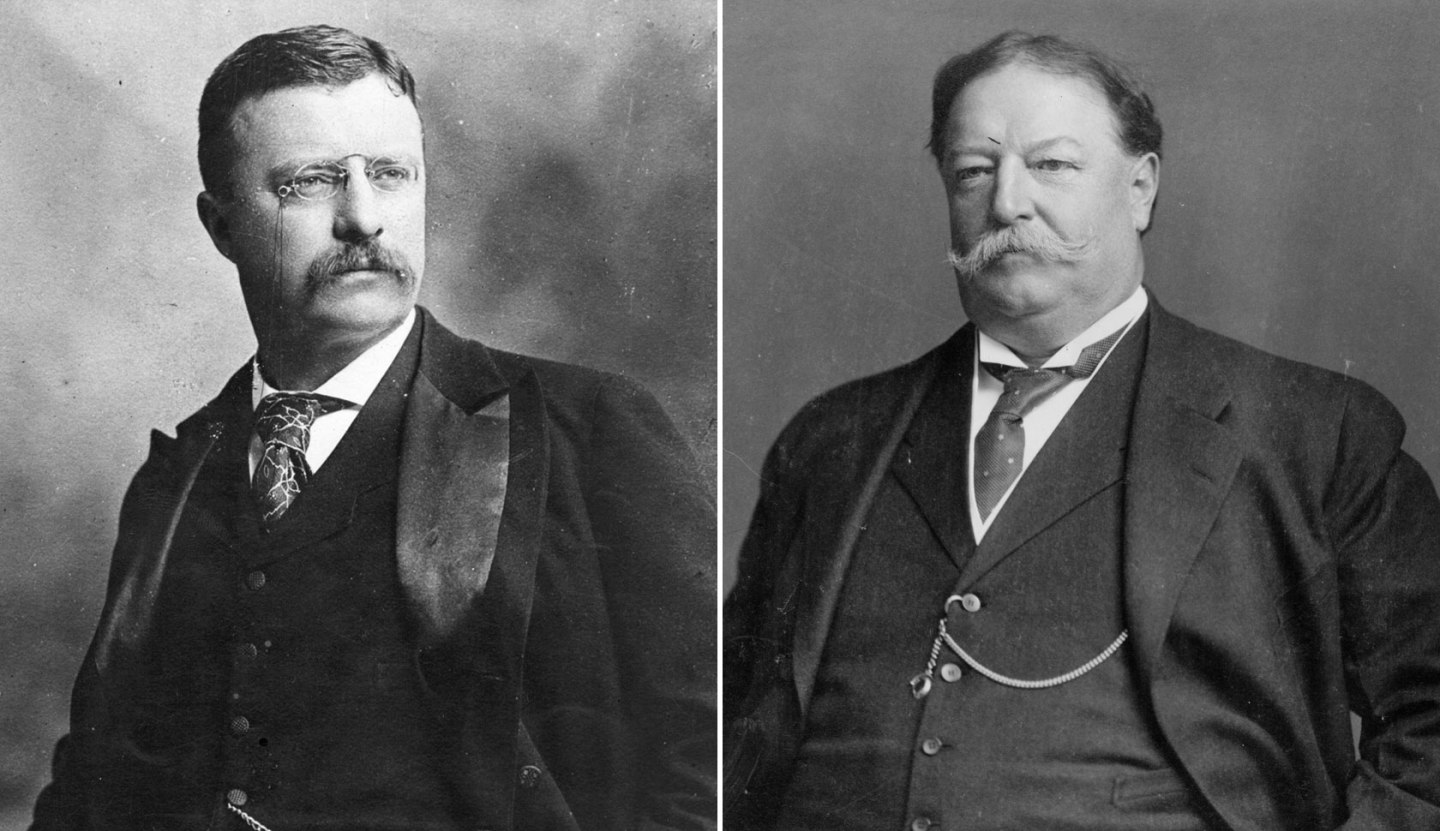
Theodore Roosevelt William Howard Taft Split
Photographs by Getty Images

Will Donald Trump destroy the Republican Party? Political parties have splintered before. Two examples from history—each of them involving the Grand Old Party—offer unlike prospects for the GOP of today. For the 19th century Whigs, the damage was permanent; for the Republicans of the William Howard Taft era, it wasn’t. What do these episodes tell us about the Republicans circa 2016?

In the 1850s, the Whig Party faced intense pressure over the issue of slavery. Unhappily for would-be unifiers like Mitt Romney, the Whigs had much in common with the present-day GOP. They represented a patchwork of interests; they were bitterly divided geographically, and they were right of the political center.

Beginning in the late 1840s, the Whigs suffered defections to splinter parties such as the Free Soil Party. When a viable new alternative, the Republicans, were organized in 1854, the Whigs completely dissolved.

Fearing a similar dissolution, Peggy Noonan, the columnist (and former Ronald Reagan speechwriter), wrote last week in the Wall Street Journal that “Something important is ending.” She confessed to anger and conveyed great sadness. And this, of course, was before this week’s “Super Tuesday 2,” when Trump’s victories in Michigan, Mississippi and Hawaii solidified his lead in the race for the GOP nomination.

The Republican fiasco of 1912 might cheer her. Yes, the party cracked that year, but the egg was put back together. And for sheer drama, the campaign of 104 years ago matched that of today.

The 1912 election was one of the last to feature a truly “brokered” convention–and that occurred among the Democrats, where Woodrow Wilson, the governor of New Jersey, eventually beat Champ Clark, speaker of the House, on the 46th ballot.

But the real circus was among the Republicans. Theodore Roosevelt, a former president, rebelled against the incumbent, the modest former jurist William Howard Taft. Not only was Taft a fellow Republican, he was Roosevelt’s political protégé and handpicked successor.

As today, the electorate was aroused by economic issues and angered by unequal distribution of income, exemplified back then by the spread of “trusts” (that is, monopolies). Roosevelt, who believed Taft was too soft on corporate interests, appealed to the progressive vote, campaigning on Taft’s left. He waged a fierce campaign against his friend in states with primaries, generally winning them.

But somehow, Roosevelt’s challenge was as much about his charismatic personality as it was about issues. Though not as outrageous as Trump, T.R. was an outsized egotist who shot from the hip and on occasion stooped to demagoguery. When party bosses handed the nomination to Taft, Roosevelt proclaimed he had been cheated—didn’t Trump say something similar after Iowa?—and formed his own party.

The parallels to Trump stop there. Roosevelt was a consistent progressive over his career, also a prolific writer and naturalist, hardly calling to mind the casino mogul. And Roosevelt, a war hero, was genuinely courageous. While on the stump in 1912, T.R. was shot; he refused to cancel a speech, even with his chest oozing blood, telling his stunned audience, “It takes more than that to kill a bull moose!”

However dramatic, Roosevelt’s third-party bid handed the election to the Democrats and Wilson. And there, the Republican fissure ended. Roosevelt was grumpily reconciled with the party. Wilson served two terms, after which the Republicans reassumed what had been their dominant political status, winning three consecutive elections.

Both the Whigs and the Wilson-era Republicans faced political convulsions. Why did only the Whigs perish? The party of Henry Clay was reasonably coherent. Its main planks—a protectionist tariff, a central bank, and government support for railroads and canals—all fit under the mantle of economic nationalism. True, the Whigs also attracted social reformers, temperance types and anti-Catholic nativists—but these it could survive. At the center of the party was an agreement not to engage the slumbering issue of whether to permit the extension of slavery. With the Compromise of 1850, the subject could not be avoided. The party’s southern and northern wings hopelessly split.

The GOP of 1912 did not so much survive as assume new colors. Prior to World War I, Republicans were the internationalist party; Democrats were isolationist. World War I changed all that. By the 1920s, although a core of influential internationalists, especially on Wall Street, remained in the GOP, the party came to espouse the narrow isolationism, often tinged with bigotry, that would resist rearmament in the 1930s. Similarly, prior to 1912 the Republicans were generally the more “progressive” party—more liberal and more open to an expanding federal role in the economy. In the ‘20s, the GOP retreated to laissez faire.

The Democrats, responding to the progressive movement, made a converse flip. They embraced government regulation of corporations and social reform, and thus slipstreamed the Republicans to the left. The point is that, to endure, political parties now and then have to adapt. Coalitions aren’t forever.

The Taft Republicans were well-positioned to endure; they had won nine of eleven elections since the Civil War. (The Whigs, overmatched by Andrew Jackson’s Democrats, had no majority to fall back on.)

Today’s Republicans might take comfort. They won seven of ten presidential races prior to 2008, and even during the Obama years they’ve steadily advanced in both houses of Congress and also gained 900 state legislative seats and 11 governorships.

But what exactly do they stand for? They are surely less coherent than Henry Clay’s Whigs. No logic explains why social conservatives, small-government purists, free traders, immigration refuseniks, foreign policy hawks and (with Trump) economic populists should all belong to the same party.

Admittedly there is no issue convulsing the GOP as slavery did in the 1850s, though discontent with the economy may come close. Trump has found a convenient scapegoat—immigrants—for slow growth, but not a cause. But this discontent is fueling a populist rebellion, on the left and on the right, not wholly dissimilar from the progressive upheaval of 1912. Moreover, in the full-primary era, parties can change whether or not their leaders want them to.

The lesson of history is that parties must adapt. The question for the Republicans is whether there is any shape that can fit a suitable number of them.

About the Author
By Roger Lowenstein
See full bioRight Arrow Button Icon

Latest in Leadership

Finance
Lorem ipsum dolor sit amet, consectetur adipiscing elit, sed do eiusmod tempor incididunt ut labore et dolore magna aliqua. Ut enim ad minim veniam
By Fortune Editors
October 20, 2025
Finance
Lorem ipsum dolor sit amet, consectetur adipiscing elit, sed do eiusmod tempor incididunt ut labore et dolore magna aliqua. Ut enim ad minim veniam
By Fortune Editors
October 20, 2025
Finance
Lorem ipsum dolor sit amet, consectetur adipiscing elit, sed do eiusmod tempor incididunt ut labore et dolore magna aliqua. Ut enim ad minim veniam
By Fortune Editors
October 20, 2025
Finance
Lorem ipsum dolor sit amet, consectetur adipiscing elit, sed do eiusmod tempor incididunt ut labore et dolore magna aliqua. Ut enim ad minim veniam
By Fortune Editors
October 20, 2025
Finance
Lorem ipsum dolor sit amet, consectetur adipiscing elit, sed do eiusmod tempor incididunt ut labore et dolore magna aliqua. Ut enim ad minim veniam
By Fortune Editors
October 20, 2025
Finance
Lorem ipsum dolor sit amet, consectetur adipiscing elit, sed do eiusmod tempor incididunt ut labore et dolore magna aliqua. Ut enim ad minim veniam
By Fortune Editors
October 20, 2025

Most Popular

Finance
Lorem ipsum dolor sit amet, consectetur adipiscing elit, sed do eiusmod tempor incididunt ut labore et dolore magna aliqua. Ut enim ad minim veniam
By Fortune Editors
October 20, 2025
Finance
Lorem ipsum dolor sit amet, consectetur adipiscing elit, sed do eiusmod tempor incididunt ut labore et dolore magna aliqua. Ut enim ad minim veniam
By Fortune Editors
October 20, 2025
Finance
Lorem ipsum dolor sit amet, consectetur adipiscing elit, sed do eiusmod tempor incididunt ut labore et dolore magna aliqua. Ut enim ad minim veniam
By Fortune Editors
October 20, 2025
Finance
Lorem ipsum dolor sit amet, consectetur adipiscing elit, sed do eiusmod tempor incididunt ut labore et dolore magna aliqua. Ut enim ad minim veniam
By Fortune Editors
October 20, 2025
Finance
Lorem ipsum dolor sit amet, consectetur adipiscing elit, sed do eiusmod tempor incididunt ut labore et dolore magna aliqua. Ut enim ad minim veniam
By Fortune Editors
October 20, 2025
Finance
Lorem ipsum dolor sit amet, consectetur adipiscing elit, sed do eiusmod tempor incididunt ut labore et dolore magna aliqua. Ut enim ad minim veniam
By Fortune Editors
October 20, 2025
Fortune Secondary Logo
Rankings
  • 100 Best Companies
  • Fortune 500
  • Global 500
  • Fortune 500 Europe
  • Most Powerful Women
  • World's Most Admired Companies
  • See All Rankings
  • Lists Calendar
Sections
  • Finance
  • Fortune Crypto
  • Features
  • Leadership
  • Health
  • Commentary
  • Success
  • Retail
  • Mpw
  • Tech
  • Lifestyle
  • CEO Initiative
  • Asia
  • Politics
  • Conferences
  • Europe
  • Newsletters
  • Personal Finance
  • Environment
  • Magazine
  • Education
Customer Support
  • Frequently Asked Questions
  • Customer Service Portal
  • Privacy Policy
  • Terms Of Use
  • Single Issues For Purchase
  • International Print
Commercial Services
  • Advertising
  • Fortune Brand Studio
  • Fortune Analytics
  • Fortune Conferences
  • Business Development
  • Group Subscriptions
About Us
  • About Us
  • Press Center
  • Work At Fortune
  • Terms And Conditions
  • Site Map
  • About Us
  • Press Center
  • Work At Fortune
  • Terms And Conditions
  • Site Map
  • Facebook icon
  • Twitter icon
  • LinkedIn icon
  • Instagram icon
  • Pinterest icon

Latest in Leadership

pete hegseth
PoliticsIran
‘A strategic blunder’: Democrats confront Hegseth as the Iran war’s price tag hits $25 billion
By The Associated Press, Ben Finley, Stephen Groves, David Klepper and Konstantin ToropinApril 29, 2026
18 minutes ago
Jamie Dimon says bureaucracy sinks companies and the solution may be getting rid of the ‘jerks’ who don’t want to solve it
C-SuiteJamie Dimon
Jamie Dimon says bureaucracy sinks companies and the solution may be getting rid of the ‘jerks’ who don’t want to solve it
By Marco Quiroz-GutierrezApril 29, 2026
1 hour ago
Hilton CEO Christopher Nassetta
EconomyHospitality
Hilton’s CEO says the economy is actually C-shaped to the benefit of the middle class. Most of his competitors disagree
By Tristan BoveApril 29, 2026
1 hour ago
How JPMorgan’s CIO is reshaping work at the bank with a $19.8 billion annual tech and AI budget
NewslettersCIO Intelligence
How JPMorgan’s CIO is reshaping work at the bank with a $19.8 billion annual tech and AI budget
By John KellApril 29, 2026
4 hours ago
Starbucks is winning customers back after investing $500 million in workers and stores
Workplace CultureFortune 500
Starbucks is winning customers back after investing $500 million in workers and stores
By Phil WahbaApril 29, 2026
4 hours ago
Robinhood CEO says a ‘tokenization supercycle’ is underway
CryptoRobinhood
Robinhood CEO says a ‘tokenization supercycle’ is underway
By Jeff John RobertsApril 29, 2026
5 hours ago

Most Popular

Apple cofounder Ronald Wayne—whose stake would be worth up to $400 billion had he not sold it in 1976—says that at 91, he has no regrets
Success
Apple cofounder Ronald Wayne—whose stake would be worth up to $400 billion had he not sold it in 1976—says that at 91, he has no regrets
By Preston ForeApril 27, 2026
2 days ago
‘The cost of compute is far beyond the costs of the employees’: Nvidia executive says right now AI is more expensive than paying human workers
AI
‘The cost of compute is far beyond the costs of the employees’: Nvidia executive says right now AI is more expensive than paying human workers
By Sasha RogelbergApril 28, 2026
2 days ago
‘Take the money and run’: Johns Hopkins economist Steve Hanke on why the UAE quit OPEC
Energy
‘Take the money and run’: Johns Hopkins economist Steve Hanke on why the UAE quit OPEC
By Shawn TullyApril 29, 2026
14 hours ago
Current price of gold as of April 28, 2026
Personal Finance
Current price of gold as of April 28, 2026
By Danny BakstApril 28, 2026
1 day ago
The U.S. military may have already used up half of its most expensive missiles, and it could take up to 4 years to rebuild its stockpiles
Politics
The U.S. military may have already used up half of its most expensive missiles, and it could take up to 4 years to rebuild its stockpiles
By Sasha RogelbergApril 24, 2026
5 days ago
More than two-thirds of U.S. schools say they’re unable to afford the cost of student free lunch—and MAHA’s dietary guidelines may make it worse
Economy
More than two-thirds of U.S. schools say they’re unable to afford the cost of student free lunch—and MAHA’s dietary guidelines may make it worse
By Sasha RogelbergApril 29, 2026
12 hours ago

© 2026 Fortune Media IP Limited. All Rights Reserved. Use of this site constitutes acceptance of our Terms of Use and Privacy Policy | CA Notice at Collection and Privacy Notice | Do Not Sell/Share My Personal Information
FORTUNE is a trademark of Fortune Media IP Limited, registered in the U.S. and other countries. FORTUNE may receive compensation for some links to products and services on this website. Offers may be subject to change without notice.