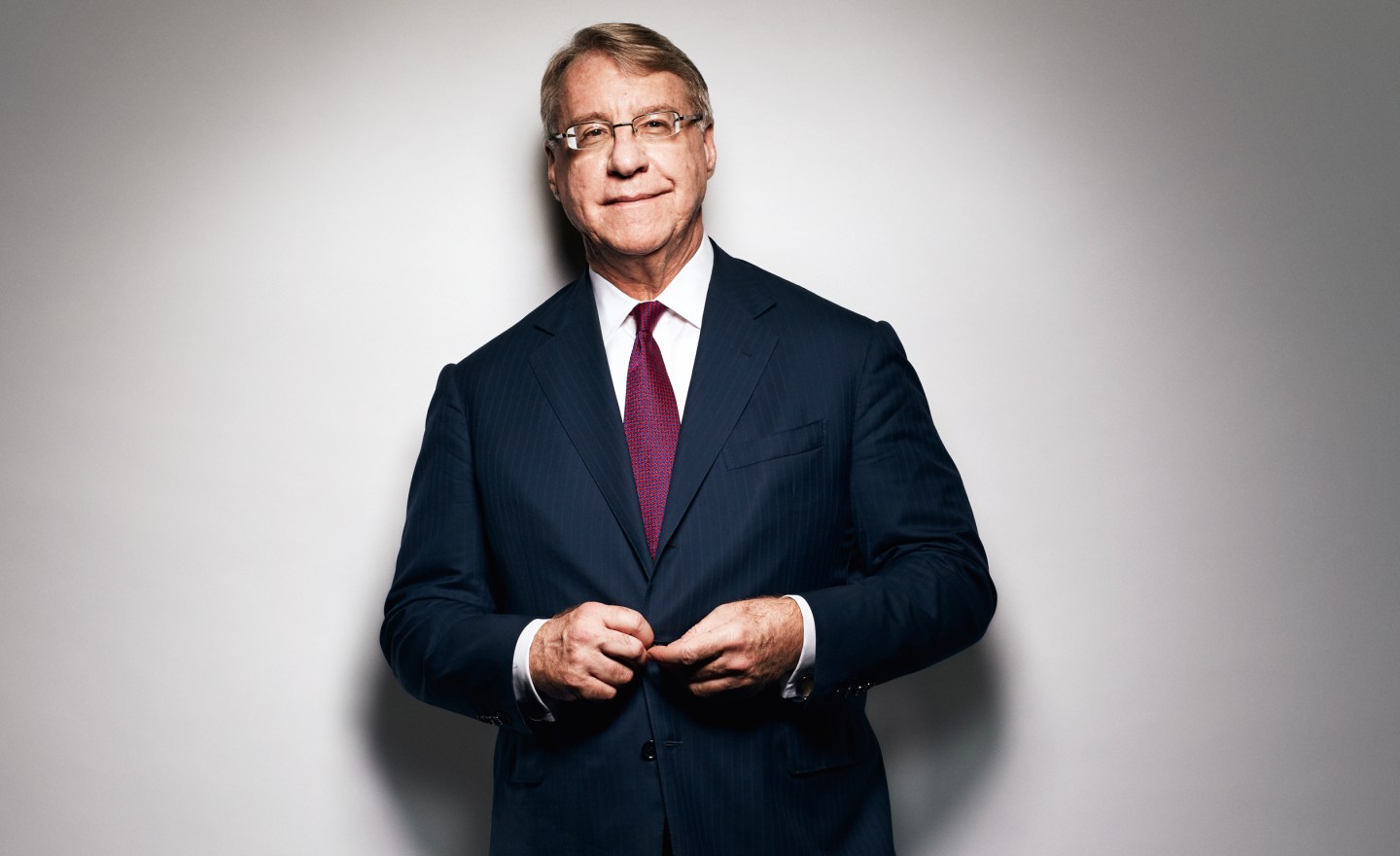
At Michael’s, a cheery, art-filled eatery in Midtown Manhattan where media, finance, and entertainment celebrities go to be seen, James Chanos somehow achieves invisibility. Chanos, whose $3 billion Kynikos Associates hedge fund firm is headquartered next door, has a regular table for lunch in the far corner of the glass-walled back room—Siberia to most patrons—where he downs his Cobb salad and Diet Coke away from the crowd.
Keeping a low profile may benefit the 58-year-old contrarian right now. Chanos is best known for shorting stocks—making investments that pay off when share prices decline. In 2015, Chanos’s short-only fund, called Ursus (Latin for “bear”), was up 10%, trouncing the S&P 500. This year has also started with a bang. And with so many of his peers losing money, it’s probably best to avoid chances to say “I told you so.”
You can blame China for Chanos’s success. China’s economic weakness pummeled global stock markets and pushed commodities prices to new lows this year. And with 40% of his short portfolio betting against Chinese stocks—from homebuilders to banks to Alibaba—Chanos is betting that the slide is far from done. He has been warning of a Chinese real estate bubble since 2009 and is now homing in on China’s indebtedness; he regularly tells investors that China is on a “treadmill to hell.”
Hell for most investors can be heaven for short-sellers. Well-known “shorts” like Chanos are reporting big gains from their bearish calls. Investors spooked by the recent stock correction are flocking to their funds again, while the Oscar darling The Big Short, about the guys who successfully bet against the housing bubble, is reminding the public just how prescient they can be.

But the recent wins also underscore how hard life has been for short investors in recent years. The epic stretch of uninterrupted gains from 2009 to mid-2015 saddled them with big losses, chasing many pros out of the business; the frauds, fads and plain old business failures shorts are trying to expose went unchecked when stocks were on a tear. Last year, only 15 short-biased hedge funds reported results to Hedge Fund Research, down from 54 in 2008. Those that remain managed just $4.7 billion, a tiny portion of the $3 trillion hedge fund universe.
“A very long-term bull market has ground people up,” says David Rocker, who retired from his namesake short-oriented hedge fund a decade ago. Rocker, who will talk your ear off about what a lousy business shorting is, says that last year he went looking for dedicated short sellers to invest with. But the naysayers he talked to were so diminished in size that he decided against it. “The darkest hour is just before it turns black,” he quips.
To profit from a falling stock, short investors borrow shares and sell them, assuming those shares will be cheaper to buy back and return to lenders in the future. When a short call is wrong and the stock rises, the downside is unlimited. Timing is also an issue. Losses for short sellers–who say they must do extensive and costly research, while company managements often spend millions of dollars battling them –can quickly add up if a short seller doesn’t have the capital to wait it out.
Recent results at Ursus show how treacherous the strategy can be: A dollar invested in Ursus at the beginning of 2007 would have been worth about 68¢ at the end of 2015, according to estimates by its investors. If you didn’t get in until 2009—when the last bull market started—your $1 would have dwindled to about 38¢.
Chanos is hardly alone on this front. One of the best-regarded short-only firms, Kingsford Capital Management, last year was down to about $250 million in assets, from $1.8 billion in 2008, investors say. Not all of that is due to investing losses: Judging (correctly) that it would be hard to find shorts after 2008’s bear market, Kingsford founder Mike Wilkins gave about $800 million back to investors at the end of that year. Kingsford is known for hosting what it calls an annual “short seller’s Woodstock” at the Giants baseball stadium in San Francisco each July, where 100 people bat around short ideas as well as baseballs. The firm finally broke its losing streak last year, registering a 5% gain.

Full-time short-sellers have always been a rare breed. For most money managers, shorting is just one arrow in the investing quiver, a hedge against losses elsewhere in their portfolios. Daniel Loeb’s $16.3 billion Third Point firm, for example, has $4.5 billion in equity shorts, he recently told investors. Even Chanos currently holds the majority of his firm’s assets in funds that are either long on stocks or market-neutral. And overall within the shorting world, there’s been a shift in recent years. While broad-based short-biased hedge funds have been in decline, there has been an uptick in managers making very public short bets.
Aside from Chanos, few of the best-known “activist shorts” are primarily short-sellers. Only about 10% of Bill Ackman’s $12.3 billion in assets at Pershing Square Capital Management is devoted to his famous, nearly four-year-old short on Herbalife. Shares of the multilevel marketing company are down 11% since last August, when the rest of Ackman’s portfolio began going south. The trade is still in the red overall. Small wonder that at his recent annual investor dinner at the New York City Public Library, Ackman joked that his capacity for pain was “infinite.” But despite Herbalife, Ackman has one of the best short-selling records among active managers: he comes in sixth out of the 43 short sellers tracked by Activist Shorts Research, with an average “campaign loss” (a decline in company shares, and thus a gain for Ackman) of 45% on his short bets.
One well-known hedge fund manager who has stumbled badly is David Einhorn. Though renowned for a timely short of Lehman Brothers in 2008, he has made a number of unsuccessful short bets since then—including against Green Mountain Coffee Roasters and Chipotle. Those misses help put him 39th out of of 43 short sellers, according to the Activist Shorts ranking; his average campaign actually ended with the short-target shares going up 22%. But the CEO of $8.6 billion Greenlight Capital hasn’t given up. He recently announced shorts of Netflix and Amazon, which are down this year more 11% and 15% respectively. And his short calls are now helping Greenlight, which was up 3.3% through February.
Adam Kommel of Activist Shorts says there were 175 such short calls in 2015, compared with 119 in 2013. On average, companies targeted by activist shorts saw their stocks fall 35% in 2015. As with Ursus, China’s woes are pumping up the performance. Two research outfits that earned Street cred exposing Chinese stock frauds, Muddy Waters and GeoInvesting, are launching hedge funds that channel their analysis into short bets. Carson Block has raised $100 million for Muddy Waters Capital. The 20 stocks Block has shorted have an average loss of 25% since he bet against them, according to Activist Shorts, ranking him 23rd. “Investors are now seeing short managers as insurance against a correction,” Block says.
GeoInvesting, ranked 17th, started shorting small Chinese companies it suspected were fraudulent in 2011. It has made 46 short calls since then, and the company says that a portfolio based on its picks would have had annualized returns of 56%. Geo’s latest China short is a New York Stock Exchange–traded real estate company, SouFun, which Geo alleges has made “fake contracts.” SouFun has dismissed some employees for unspecified wrong-doing and has said it has “zero tolerance” for improprieties; still, the stock is down 14% since Geo targeted it in October. Co-founder Dan David launched a short-biased hedge fund on March 1 and says he hopes to keep it small, with no more than $50 million in assets. As funds get bigger, he says, it becomes hard to borrow enough shares to make a big profit from a short position.
That said, greater scale can enable short specialists to attract institutional investors looking for a hedge—one reason Chanos has been able to stay in the game since the early 1980s. Chanos diversifies with about 50 short positions at any given time. Since 2007, he has gone public with 33 short calls on specific stocks—more than all but four of the 46 investors tracked by Activist Shorts, which ranks him 28th. Twenty four of those stocks now trade lower than when Chanos began shorting them. While China and a sizeable energy short book (with names like Cheniere and Consol Energy) may have more room to run, his newest shorts are in the frothy technology space. Alibaba shares are down 15% since Chanos targeted it last November, while Tesla has fallen 14% since his October mention.
In one sense, today’s short-selling successes may have been inevitable. Even bullish investors have recently fretted that stocks worldwide were overpriced and due for a correction; early this year, the shares of good companies and shaky ones alike got clobbered. The next time the broader market is on an upswing, the gap between the shorts’ pessimism and conventional wisdom will widen once more—and their emotional mettle will be tested. “It’s a business where you bang your head against the wall every single day,” says Dan David. “You age.”
A version of this article appears in the March 15, 2016 issue of Fortune with the headline “The Return of the Big Shorts.”