• Home
  • Latest
  • Fortune 500
  • Finance
  • Tech
  • Leadership
  • Lifestyle
  • Rankings
  • Multimedia

Trendingnow

1

Social Security's 2032 deadline puts a 22% cut on the table — but Washington has way less room to negotiate than 1983

2

CEO of $20 billion AI firm Perplexity says the secret to success is ‘sleeping with that fear’ that your competitor will steal your idea

3

Boomers actually do hold most of the wealth and power. So why do they call it 'whiny' to point that out?

1

Social Security's 2032 deadline puts a 22% cut on the table — but Washington has way less room to negotiate than 1983

2

CEO of $20 billion AI firm Perplexity says the secret to success is ‘sleeping with that fear’ that your competitor will steal your idea

3

Boomers actually do hold most of the wealth and power. So why do they call it 'whiny' to point that out?
Leadership

The Completely Absurd (and Infuriating) Reason CEOs Get Paid So Much

By
Ian Salisbury
Ian Salisbury
and
Money
Money
Down Arrow Button Icon
By
Ian Salisbury
Ian Salisbury
and
Money
Money
Down Arrow Button Icon
February 22, 2016, 3:36 PM ET
cash
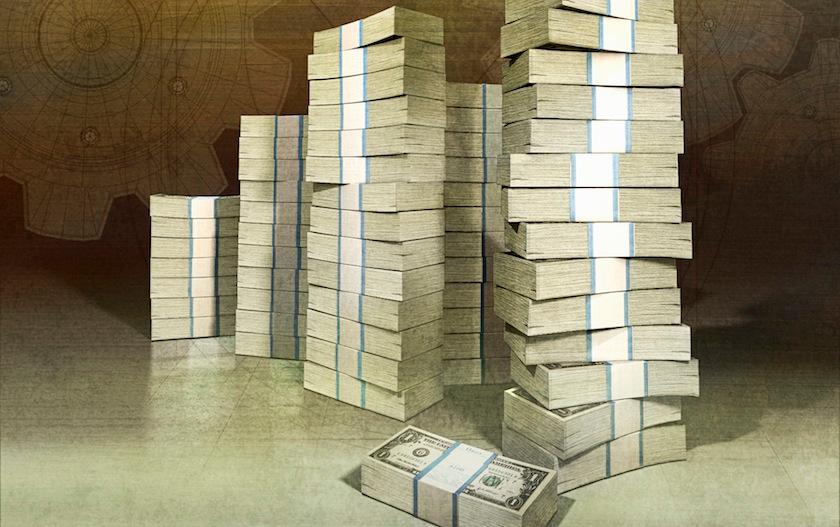
cashIllustration by Ryan Etter—Getty Images/Ikon Images

For years economists—not to mention everyday Americans hanging out on bar stools or on Twitter—have argued about why even mediocre CEOs get paid such ridiculous sums of money.

Of course, corporate bigwigs have always been handsomely rewarded. But in the past generation, average pay for CEOs at American’s largest companies has leaped nearly sixfold, from $2.8 million a year in 1989 to $16.3 million today, according the Economic Policy Institute. Exactly why this has happened is a matter of some debate, even among experts. Arguments range from corporate self-dealing to the just rewards for talent in a free-market system.

Now researchers from Dartmouth and the University of Chicago have examined years of pay data to offer up a new explanation: Boards have been handing CEOs bigger and bigger slugs of company stock because they don’t understand how stock options—a key component of CEO pay—work.

Options, which allow corporate executives to buy shares of their employers’ stock at preferential prices, were originally designed to constrain top executives’ pay, or at least make sure that pay is tied closely to company performance. It has long been understood that if a company’s stock rockets ahead, a rich grant of options can lead to big payday. Fair or not, that’s the way the system was engineered.

The new research shows that something different has been happening: Boards have been allowing CEO pay to climb ever higher by offering executives the same number of options year in and year out, regardless of company stock prices. The practice means that each new year’s grants tend to end up being potentially more valuable than the previous year’s, just because stock prices tend to drift higher over time.

Here is how it works: Corporate stock options (which are different from those that trade on exchanges) are typically issued “at the money.” That means they give executives the right to buy a number of the company’s shares at today’s prices, even if they appreciate in value in the near future.

The idea is that if the stock is flat or down, the CEO will make nothing. But if the value rises, he or she will be able to buy shares at what has become a discounted price. Once the options are exercised and the shares are purchased, the CEO can turn around and sell, pocketing the difference, essentially sharing in the wealth he or she created for shareholders.

The problem, according to the paper, is that boards don’t have a very strong grasp on options’ potential value, something that it typically takes a sophisticated computer algorithm (known as the Black-Scholes formula) to analyze.

Because option values can be difficult to understand, boards have tended to issue a certain number of options from year to year, regardless of the grant’s dollar value, rather than calculate a desired dollar value and vary the number of options. But since stock prices tend to drift upward over time, this can lead to what looks in retrospect like a boneheaded move. Option grants end up being worth more and more every year—simply because an option on a share with a high nominal value is more potentially lucrative than an option on a share with a low nominal value.

Author Kelly Shue, of the University of Chicago, says boards’ apparent mistake is a common one, highlighted by years of research in the field of behavioral economics, and much like the way workers get confused about the effect of inflation on the real value of their paychecks. “It’s called ‘the money illusion,’” she says. “People tend to think about nominal units, not real dollars.”

To understand, consider a simple example: In the first year, a board issues a CEO options to buy 10 shares at a price of $10. The stock climbs 10%, to $11. The CEO cashes in, paying $100 for shares worth $110, and making a $10 profit.

Now imagine it is 10 years later. The market is up generally, or the company has reduced the number of shares and increased their nominal value through a reverse stock split, so that each share now trades at $20. The board, however, is still in the habit of issuing options to buy 10 shares at the market price, in this case $20. Again the stock price climbs 10%, this time to $22. Now, however, the options give the CEO the chance to buy $220 worth of stock for $200. In other words the CEO’s reward for the same 10% stock bump has doubled.

Could boards really be this knuckle-headed? The researchers collected a lot of evidence suggesting that they might. Looking at the number of options awarded by S&P 500 companies for the roughly two decades between 1992 and 2010, they found about 20% of the time boards simply kept the number of options they granted to their top executive the same from one year to the next. That might not sound like all that much. But it was by far the most common move boards made, occurring roughly four times more frequently than any other grant.

The researchers also found that when boards did vary the number of options granted to CEOs, they often picked round numbers, such as increasing the number of options by 10% or doubling it. Such behavior, the researchers argue, suggests that boards indeed tend to think about grants in terms of the number of options, not their dollar value.

There is some good news. In the past several years, it has gotten a lot harder for boards to give away the store. Starting in 2006 large companies have been required to figure out the dollar value of options—and disclose them to investors. The researchers concluded that since that time, boards appear to have become much more thoughtful about how they make grants to CEOs, and the growth rate of CEO pay has also tapered off.

But that doesn’t exactly mean boards have turned back the clock. According to the Economic Policy Institute, the typical CEO made about 58 times the average worker in 1989. By 2014 it had climbed to more than 300 times.

This article was originally published on Money.com.

About the Authors
By Ian Salisbury
See full bioRight Arrow Button Icon
By Money
See full bioRight Arrow Button Icon

Latest in Leadership

Finance
Lorem ipsum dolor sit amet, consectetur adipiscing elit, sed do eiusmod tempor incididunt ut labore et dolore magna aliqua. Ut enim ad minim veniam
By Fortune Editors
October 20, 2025
Finance
Lorem ipsum dolor sit amet, consectetur adipiscing elit, sed do eiusmod tempor incididunt ut labore et dolore magna aliqua. Ut enim ad minim veniam
By Fortune Editors
October 20, 2025
Finance
Lorem ipsum dolor sit amet, consectetur adipiscing elit, sed do eiusmod tempor incididunt ut labore et dolore magna aliqua. Ut enim ad minim veniam
By Fortune Editors
October 20, 2025
Finance
Lorem ipsum dolor sit amet, consectetur adipiscing elit, sed do eiusmod tempor incididunt ut labore et dolore magna aliqua. Ut enim ad minim veniam
By Fortune Editors
October 20, 2025
Finance
Lorem ipsum dolor sit amet, consectetur adipiscing elit, sed do eiusmod tempor incididunt ut labore et dolore magna aliqua. Ut enim ad minim veniam
By Fortune Editors
October 20, 2025
Finance
Lorem ipsum dolor sit amet, consectetur adipiscing elit, sed do eiusmod tempor incididunt ut labore et dolore magna aliqua. Ut enim ad minim veniam
By Fortune Editors
October 20, 2025

Most Popular

Finance
Lorem ipsum dolor sit amet, consectetur adipiscing elit, sed do eiusmod tempor incididunt ut labore et dolore magna aliqua. Ut enim ad minim veniam
By Fortune Editors
October 20, 2025
Finance
Lorem ipsum dolor sit amet, consectetur adipiscing elit, sed do eiusmod tempor incididunt ut labore et dolore magna aliqua. Ut enim ad minim veniam
By Fortune Editors
October 20, 2025
Finance
Lorem ipsum dolor sit amet, consectetur adipiscing elit, sed do eiusmod tempor incididunt ut labore et dolore magna aliqua. Ut enim ad minim veniam
By Fortune Editors
October 20, 2025
Finance
Lorem ipsum dolor sit amet, consectetur adipiscing elit, sed do eiusmod tempor incididunt ut labore et dolore magna aliqua. Ut enim ad minim veniam
By Fortune Editors
October 20, 2025
Finance
Lorem ipsum dolor sit amet, consectetur adipiscing elit, sed do eiusmod tempor incididunt ut labore et dolore magna aliqua. Ut enim ad minim veniam
By Fortune Editors
October 20, 2025
Finance
Lorem ipsum dolor sit amet, consectetur adipiscing elit, sed do eiusmod tempor incididunt ut labore et dolore magna aliqua. Ut enim ad minim veniam
By Fortune Editors
October 20, 2025
Fortune Secondary Logo
Rankings
  • 100 Best Companies
  • Fortune 500
  • Global 500
  • Fortune 500 Europe
  • Most Powerful Women
  • World's Most Admired Companies
  • See All Rankings
  • Lists Calendar
Sections
  • Finance
  • Fortune Crypto
  • Features
  • Leadership
  • Health
  • Commentary
  • Success
  • Retail
  • Mpw
  • Tech
  • Lifestyle
  • CEO Initiative
  • Asia
  • Politics
  • Conferences
  • Europe
  • Newsletters
  • Personal Finance
  • Environment
  • Magazine
  • Education
Customer Support
  • Frequently Asked Questions
  • Customer Service Portal
  • Privacy Policy
  • Terms Of Use
  • Single Issues For Purchase
  • International Print
Commercial Services
  • Advertising
  • Fortune Brand Studio
  • Fortune Analytics
  • Fortune Conferences
  • Business Development
  • Group Subscriptions
About Us
  • About Us
  • Press Center
  • Work At Fortune
  • Terms And Conditions
  • Site Map
  • About Us
  • Press Center
  • Work At Fortune
  • Terms And Conditions
  • Site Map
  • Facebook icon
  • Twitter icon
  • LinkedIn icon
  • Instagram icon
  • Pinterest icon

Latest in Leadership

Gwynne Shotwell, President & COO, SpaceX
Startups & VentureSpaceX
Meet Gwynne Shotwell, the engineer-turned-COO who runs SpaceX in platform heels and is now worth over $2 billion
By Eva RoytburgJune 15, 2026
3 hours ago
Wall Street is gaining access to new catastrophe models to help predict wars
BankingWar
Wall Street is gaining access to new catastrophe models to help predict wars
By Gautam Naik and BloombergJune 14, 2026
17 hours ago
People wait outside a building
AIJobs
AI job disruption is here. The problem may be compounded because nearly 75% of people don’t apply for unemployment benefits
By Jacqueline MunisJune 14, 2026
18 hours ago
Photo of Kevin O'Leary
SuccessSteve Jobs
Kevin O’Leary says being liked has nothing to do with success—Steve Jobs taught him: ‘You can’t worry about whose feelings you bruise’
By Emma BurleighJune 14, 2026
18 hours ago
Photo of young woman with a photo of a pizza
SuccessThe Interview Playbook
Gen Z grad landed an internship by wearing her university baseball cap to her pizza joint job. Now she works at Cisco
By Orianna Rosa RoyleJune 14, 2026
18 hours ago
SpaceX went from three consecutive rocket explosions and near-bankruptcy in 2008 to the biggest IPO in history
Startups & VentureSpaceX
SpaceX went from three consecutive rocket explosions and near-bankruptcy in 2008 to the biggest IPO in history
By Marco Quiroz-GutierrezJune 14, 2026
21 hours ago

Most Popular

Social Security's 2032 deadline puts a 22% cut on the table — but Washington has way less room to negotiate than 1983
Personal Finance
Social Security's 2032 deadline puts a 22% cut on the table — but Washington has way less room to negotiate than 1983
By John W. Diamond and The ConversationJune 12, 2026
3 days ago
CEO of $20 billion AI firm Perplexity says the secret to success is ‘sleeping with that fear’ that your competitor will steal your idea
Success
CEO of $20 billion AI firm Perplexity says the secret to success is ‘sleeping with that fear’ that your competitor will steal your idea
By Preston ForeJune 13, 2026
2 days ago
Boomers actually do hold most of the wealth and power. So why do they call it 'whiny' to point that out?
Economy
Boomers actually do hold most of the wealth and power. So why do they call it 'whiny' to point that out?
By Nick LichtenbergJune 14, 2026
22 hours ago
Iran proved it can close the Strait of Hormuz, but the U.S. is advertising very loudly that the world's top superpower can at least punch open a hole
Energy
Iran proved it can close the Strait of Hormuz, but the U.S. is advertising very loudly that the world's top superpower can at least punch open a hole
By Jason MaJune 14, 2026
14 hours ago
The Gen Z cofounder of $1.6 billion Whop says his platform has minted over 650 millionaires—he wants to make work fun and money worries obsolete
Success
The Gen Z cofounder of $1.6 billion Whop says his platform has minted over 650 millionaires—he wants to make work fun and money worries obsolete
By Emma BurleighJune 14, 2026
23 hours ago
SpaceX surge further boosts Saudi billionaire prince’s fortune
Investing
SpaceX surge further boosts Saudi billionaire prince’s fortune
By Adveith Nair and BloombergJune 14, 2026
17 hours ago

© 2026 Fortune Media IP Limited. All Rights Reserved. Use of this site constitutes acceptance of our Terms of Use and Privacy Policy | CA Notice at Collection and Privacy Notice | Do Not Sell/Share My Personal Information
FORTUNE is a trademark of Fortune Media IP Limited, registered in the U.S. and other countries. FORTUNE may receive compensation for some links to products and services on this website. Offers may be subject to change without notice.