• Home
  • Latest
  • Fortune 500
  • Finance
  • Tech
  • Leadership
  • Lifestyle
  • Rankings
  • Multimedia
Leadership

The $6.8 Trillion Question in Marco Rubio’s Tax Plan

By
Haley Sweetland Edwards
and
TIME
TIME
Down Arrow Button Icon
By
Haley Sweetland Edwards
and
TIME
TIME
Down Arrow Button Icon
February 11, 2016, 9:30 PM ET
Marco Rubio
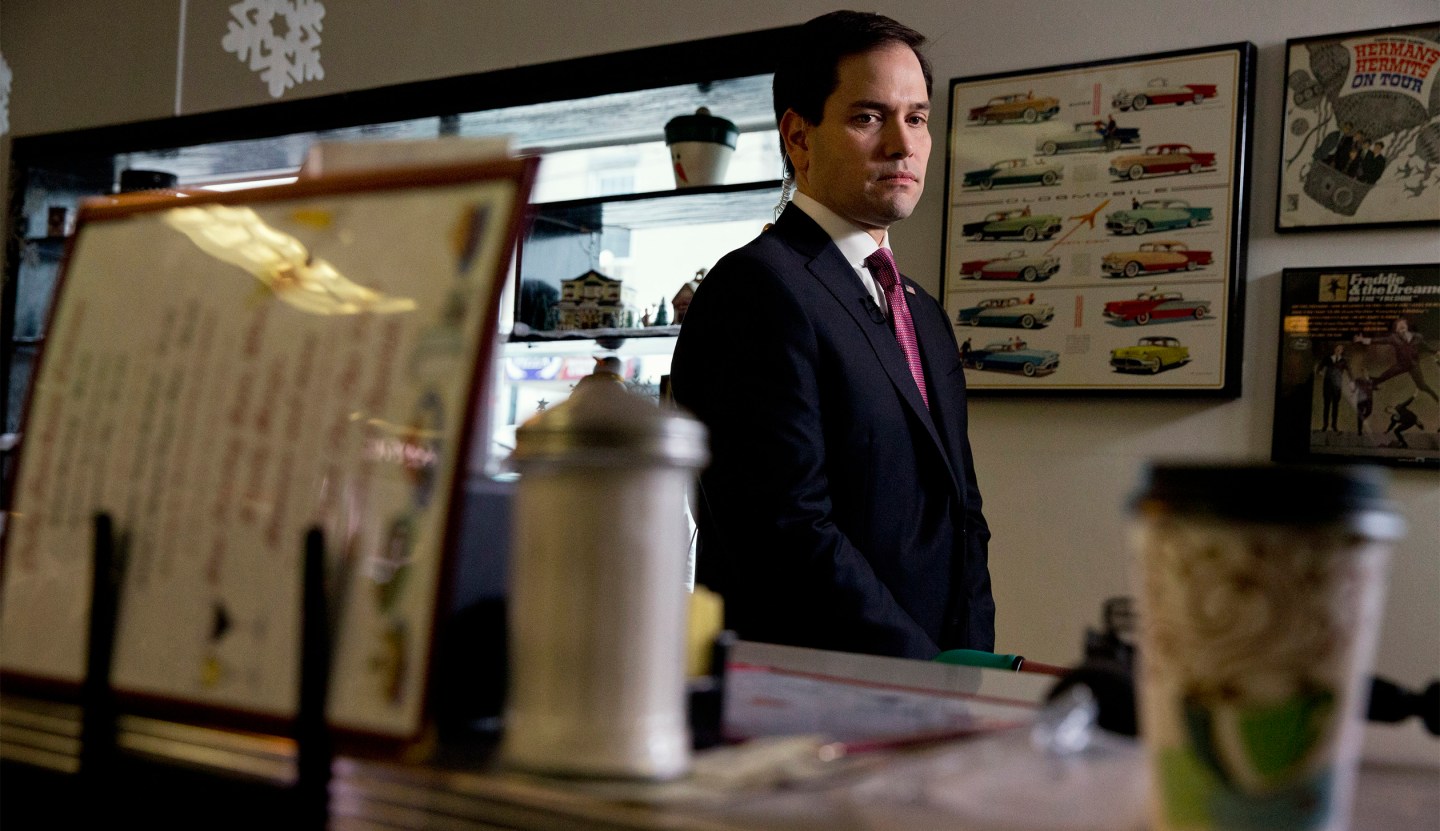
Republican presidential candidate, Sen. Marco Rubio, R-Fla. waits for an interview with CBS to begin during a campaign stop at Norton's Classic Cafe in Nashua, N.H., Monday Feb. 8, 2016. (AP Photo/Jacquelyn Martin)Photograph by Jacquelyn Martin — AP

If Sen. Marco Rubio becomes president, he’ll face a $6.8 trillion question: What should he cut?

That’s the amount of spending cuts over 10 years that the Florida Republican’s tax plan would require Congress to find in order to balance the budget, unless a booming economy made up the difference, according to a new report by the Tax Foundation.

To put that in context, it would mean axing all discretionary defense spending for a decade. Or closing the Department of Education. Or simply shutting down every federal program, including the military, for nearly two years.

To be fair, presidential candidates’ tax plans are not intended to be realistic, exactly. They’re more like the political equivalent of a vision board: they’re what candidates wish for. It’s what they would do if they had a magic wand. Or absolute power.

In that context, Rubio’s plan is a love letter to the purest version of trickle-down economics: the long-held conservative idea that if you cut taxes, the free market will make up the difference. People will use the savings to grow their businesses, invest more and hire more people, thereby ginning up the economy and leading to more tax revenue on smaller tax rates. Voila!

According to the Tax Foundation, Rubio’s plan gets us halfway there. It would deliver a huge 48.9% growth in capital investment, second only to retired neurosurgeon Ben Carson’s plan, which would precipitate a 46.6% growth in capital investment. If that holds true, then Rubio’s budget hole would shrink to $2.4 trillion—still a sizable amount. And neither he nor Carson provide much detail on what they’d do to make up the difference.

That’s one thing for Carson to say. But it’s another for Rubio, who remains the top pick of the Establishment wing of the Republican Party, a group that prizes its reputation for fiscal responsibility.

As of now, Rubio’s plan for how he would actually balance the budget is notably devoid of details. It includes a list of 10 bullet points featuring such vague gems as “Prevent massive, irresponsible spending bills” and “force Washington to live within its means without raising taxes.”

Rubio’s hardly alone. Every other Republican candidate remaining this cycle has produced a tax plan that would lead to at least some substantial deficit spending, even factoring in the Tax Foundation’s model for how tax breaks would gin-up capital investment.

Under the more generous assumptions of that model, Texas Sen. Ted Cruz would leave us $768 billion dollars in the red, former Florida Gov. Jeb Bush would leave us $1.6 trillion dollars in the hole, compared to Rubio’s $2.4 trillion. And real estate mogul Donald Trump, who continues to lead the Republican field, would strike a staggering $10 trillion blow to the budget.

The Democratic candidates, meanwhile, operate under different political pressures. Unlike Republicans, the Democratic Party struggles with a reputation for being fiscally irresponsible, leaving candidates in a general election open to withering attacks that they are fiscally reckless, while their party’s grassroots voters are less bothered by raising taxes on the rich.

As a result, both former Secretary of State Hillary Clinton’s and Vermont Sen. Bernie Sanders’ tax plans raise taxes, mostly the wealthiest Americans, and produce budget surpluses after 10 years: $191 billion in Clinton’s case, and nearly $10 trillion in Bernie’s, which also includes one of his major vision board items: passing, and funding, universal health care.

But according to the Tax Foundation, both Clinton and Sanders would hurt capital investment growth: Clinton by nearly 3% and Sanders by nearly 20%.

That’s a tradeoff they’re not likely to mention, just as Rubio hasn’t answered his $6.8 trillion question. But then, one of the rules of making a vision board is to avoid including anything you’d rather not have in your life.

This article was originally published on Time.com.

About the Authors
By Haley Sweetland Edwards
See full bioRight Arrow Button Icon
By TIME
See full bioRight Arrow Button Icon

Latest in Leadership

Nicholas Thompson
C-SuiteBook Excerpt
I took over one of the most prestigious media firms while training for an ultramarathon. Here’s what I learned becoming CEO of The Atlantic
By Nicholas ThompsonDecember 13, 2025
13 hours ago
Lauren Antonoff
SuccessCareers
Once a college dropout, this CEO went back to school at 52—but she still says the Gen Zers who will succeed are those who ‘forge their own path’
By Preston ForeDecember 13, 2025
14 hours ago
Asiathe future of work
The CEO of one of Asia’s largest co-working space providers says his business has more in common with hotels
By Angelica AngDecember 12, 2025
22 hours ago
Donald Trump
HealthHealth Insurance
‘Tragedy in the making’: Top healthcare exec on why insurance will spike to subsidize a tax cut to millionaires and billionaires
By Nick LichtenbergDecember 12, 2025
1 day ago
three men in suits, one gesturing
AIBrainstorm AI
The fastest athletes in the world can botch a baton pass if trust isn’t there—and the same is true of AI, Blackbaud exec says
By Amanda GerutDecember 12, 2025
1 day ago
Brainstorm AI panel
AIBrainstorm AI
Creative workers won’t be replaced by AI—but their roles will change to become ‘directors’ managing AI agents, executives say
By Beatrice NolanDecember 12, 2025
1 day ago

Most Popular

placeholder alt text
Economy
Tariffs are taxes and they were used to finance the federal government until the 1913 income tax. A top economist breaks it down
By Kent JonesDecember 12, 2025
2 days ago
placeholder alt text
Success
Apple cofounder Ronald Wayne sold his 10% stake for $800 in 1976—today it’d be worth up to $400 billion
By Preston ForeDecember 12, 2025
1 day ago
placeholder alt text
Success
40% of Stanford undergrads receive disability accommodations—but it’s become a college-wide phenomenon as Gen Z try to succeed in the current climate
By Preston ForeDecember 12, 2025
1 day ago
placeholder alt text
Economy
The Fed just ‘Trump-proofed’ itself with a unanimous move to preempt a potential leadership shake-up
By Jason MaDecember 12, 2025
1 day ago
placeholder alt text
Economy
For the first time since Trump’s tariff rollout, import tax revenue has fallen, threatening his lofty plans to slash the $38 trillion national debt
By Sasha RogelbergDecember 12, 2025
1 day ago
placeholder alt text
Success
Apple CEO Tim Cook out-earns the average American’s salary in just 7 hours—to put that into context, he could buy a new $439,000 home in just 2 days
By Emma BurleighDecember 12, 2025
1 day ago
Rankings
  • 100 Best Companies
  • Fortune 500
  • Global 500
  • Fortune 500 Europe
  • Most Powerful Women
  • Future 50
  • World’s Most Admired Companies
  • See All Rankings
Sections
  • Finance
  • Leadership
  • Success
  • Tech
  • Asia
  • Europe
  • Environment
  • Fortune Crypto
  • Health
  • Retail
  • Lifestyle
  • Politics
  • Newsletters
  • Magazine
  • Features
  • Commentary
  • Mpw
  • CEO Initiative
  • Conferences
  • Personal Finance
  • Education
Customer Support
  • Frequently Asked Questions
  • Customer Service Portal
  • Privacy Policy
  • Terms Of Use
  • Single Issues For Purchase
  • International Print
Commercial Services
  • Advertising
  • Fortune Brand Studio
  • Fortune Analytics
  • Fortune Conferences
  • Business Development
About Us
  • About Us
  • Editorial Calendar
  • Press Center
  • Work At Fortune
  • Diversity And Inclusion
  • Terms And Conditions
  • Site Map

© 2025 Fortune Media IP Limited. All Rights Reserved. Use of this site constitutes acceptance of our Terms of Use and Privacy Policy | CA Notice at Collection and Privacy Notice | Do Not Sell/Share My Personal Information
FORTUNE is a trademark of Fortune Media IP Limited, registered in the U.S. and other countries. FORTUNE may receive compensation for some links to products and services on this website. Offers may be subject to change without notice.