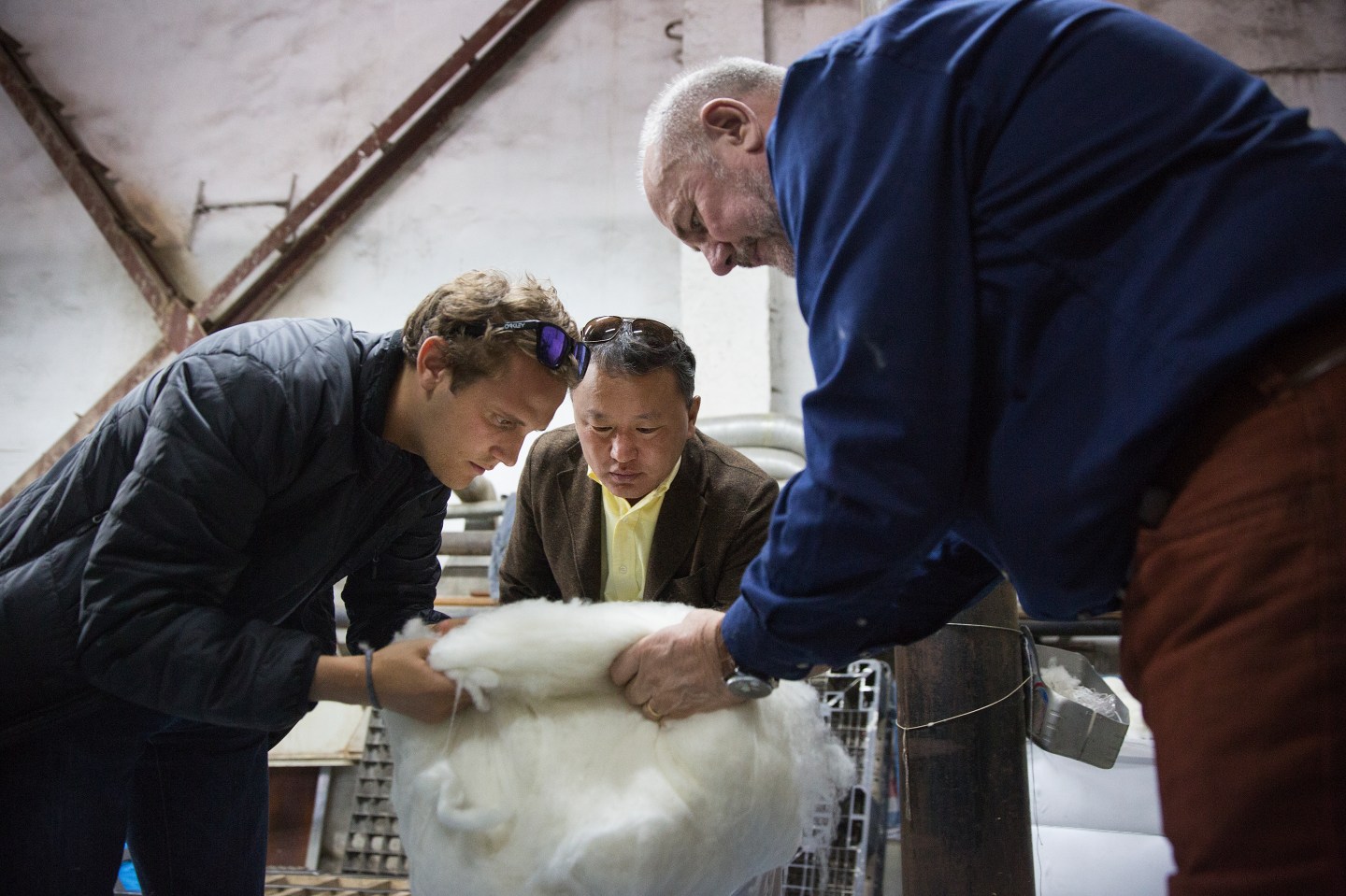
It’s not easy fostering relationships with groups of nomadic herders in the middle of the Gobi Desert, but my experience is not entirely unique. My company’s bottom line is not solely made up of annual margin growth or net profit increases (although these things are obviously very important). Naadam Cashmere, a socially-conscious brand that sources cashmere from local herders in Mongolia, doesn’t just do business – we build relationships. Our experience doing business abroad boils down to three key things: a common belief system, compounded trust, and collaboration.
We look very closely at the micro-economic impact we have on the lives of the people we work with. During my first trip to Mongolia, my business partner Diederik and I went on a 20-hour car ride, off-roading into the middle of nowhere. We were not entirely sure where we were actually headed and no idea how we were getting back (we still can’t really point it out on a map). This is a rather humbling experience, yet what came out of this was something very genuine. Our objective was ultimately business-related, but our approach was never about what we could get – it was about what we could give. We don’t speak Mongolian, and the people we were in contact with did not speak English. Our initial conversations were via a translator, wide smiles, and an attempt to observe customs and cultural norms. We lived on the herders’ local cuisine, milked goats and learned to ride motorcycles.
But trust is not easily earned. What we learned is that trust compounds. If you earn the trust of someone who is widely respected in the community, then by extension, you are considered trustworthy. Investors often ask me what is proprietary about my business. In fact, there is absolutely nothing proprietary about it, and we like it that way. This is why it works. We are using tools and processes that are available to anyone. We approached something in a way that had never been done before, or at least not in a very long time. Traditionally, the approach has been very different. Traders come from outside regions with little interest the community or the people, and force prices down because that’s what is easiest and they act as the middleman. The offer was simple and needed very little translation – we help you, and in return, you help us. The process then moves back around cyclically. It is the most natural business relationship, a symbiotic one. For whatever reason, this type of business relationship has mostly disappeared in my industry. The focus is often about marginalization and profit increase, when in fact profit increase can be a derivative of inclusion and collaboration.
The industry focuses on the wrong things: ignoring people and communities, using misinformation and a lack of consistent communication, and forcing the bottom of the supply chain down to widen the margin. We do the opposite: we use communication and collaboration to enable conversation with people and communities to lift the bottom of the supply chain up. In return we are rewarded with the cream of the crop. The lesson is a simple one: when you are nice to people, when you are thoughtful about their needs, they reciprocate in kind. It’s refreshing for a lot of people, both customers and herders alike. We find ourselves disrupting a thousand-year-old industry using nothing but good intentions and smart business.
From a macro-perspective, this all makes sense. The difficulties arise when we begin to look at the details. We found that when we were on the ground in Mongolia, everything seemed to go smoothly and according to plan. When we left, however, we found that important follow-through conversations had been miscommunicated and deadlines were missed. We were 5,000 miles away, and we couldn’t seem to explain simple, small details that could potentially save thousands of dollars (i.e. customs codes, dates, and processing yields). With a 13-hour time difference and a consumer-facing business to run, things slipped through the cracks and we made mistakes. We often found ourselves “chalking it up to the learning curve,” but in fact, this was International Business 101. The solution was to look where we started: collaboration.
We were lucky: we work with people who relate to the core of our business. We all agree on the “why” behind the “how” or “what.” We are collaborating on something that requires no translation; it is a belief system. This belief system then has ripple effects from our operation to our customer and becomes the common thread behind everything we do. Trust becomes a given, and the relationship is a bond.
When I show up in the Gobi Desert this June, I will be greeted like a returning family member. With wide smiles and a better understanding of the customs, we continue to do business.
Matt Scanlan is the CEO and co-founder of Naadam Cashmere, a socially-conscious brand that sources cashmere from local herders in Mongolia.