• Home
  • News
  • Fortune 500
  • Tech
  • Finance
  • Leadership
  • Lifestyle
  • Rankings
  • Multimedia
LeadershipBernie Sanders

Here’s the Case Against Bernie Sanders Getting the Nomination

By
Jay Newton-Small
Jay Newton-Small
and
TIME
TIME
Down Arrow Button Icon
By
Jay Newton-Small
Jay Newton-Small
and
TIME
TIME
Down Arrow Button Icon
January 20, 2016, 12:46 PM ET
Democratic Presidential Candidates Attend Black & Brown Forum In Iowa
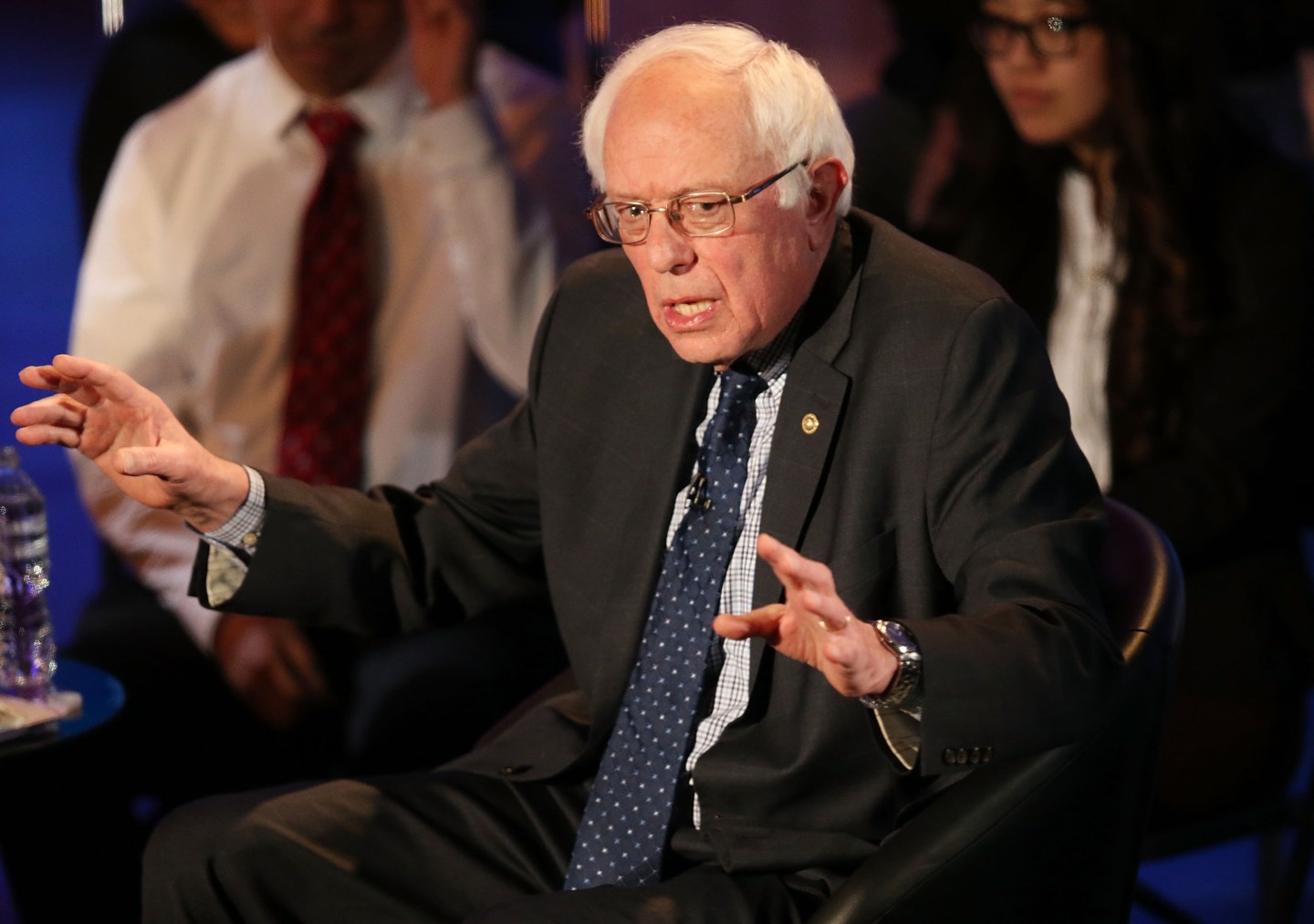
DES MOINES, IA - JANUARY 11: Democratic presidential candidate U.S. Sen. Bernie Sanders (I-VT) speaks during the the Iowa Brown and Black Forum sponsored by FUSION and broadcasted from Drake University on January 11, 2016 in Des Moines, Iowa. The Democratic presidential candidates spoke at the forum in which all candidates have the opportunity to answer concerns of African-Americans and Latinos. (Photo by Joe Raedle/Getty Images)Photograph by Joe Raedle — Getty Images

On paper, it’s Bernie Sanders’ moment. He has the edge in polls in Iowa and New Hampshire, an enormous war chest of small-dollar donations, huge energetic crowds and all the momentum heading into the beginning of the Democratic primary.

But beneath the surface, getting to the nomination remains an uphill climb for the Vermont Senator.

A self-described democratic socialist who has been on a 40-year mission against Wall Street greed, Sanders is the darling of white progressives and millenials. This helps a lot in states like Iowa (94 percent white) and New Hampshire (92 percent white). If those two states were representative of the country as a whole, Sanders would be on track to become president. The problem for Sanders is there are another 54 states and territories that also vote and—with the exception of Wyoming, Montana, the Dakotas and his home state of Vermont—they are a lot more diverse.

In the 2008 general election, Barack Obama assembled a coalition: progressive whites, millenials, blue collar union voters, African Americans, Latinos and women. He barely eked out a primary win—and indeed, lost the popular vote—to Hillary Clinton who pulled blue-collar union voters, Latinos and some women from him.

This time around, Clinton has more of the Obama coalition: most women, African Americans, well as some progressive whites and millenials. After Iowa and New Hampshire, the Democratic electorate is more than 40 percent minorities and Clinton is beating Sanders amongst non-whites 69 percent to 23 percent. “We’re fighting over whether Bernie will get 52% in Iowa,” says Joe Trippi, who managed Howard Dean’s 2004 presidential bid. “What does that tell you? It tells you that once you make the turn and only 54% of the party is similar to Iowa and New Hampshire, they’ll split that vote even. And then she’s beating him with the other 46 percent of the vote.”

Sanders was asked about this exact problem at the debate Sunday night in Charleston. His answer:

“When the African American community becomes familiar with my Congressional record and with our agenda, and with our views on the economy, and criminal justice — just as the general population has become more supportive, so will the African American community, so will the Latino community. We have the momentum, we’re on a path to a victory.”

Leaving aside the troubling idea that African Americans and Latinos aren’t part of the “general population,” Sanders missed a giant opportunity in flubbing this question. He is a man who marched with Martin Luther King Jr., and supported civil rights when it was incredibly unpopular amongst white Democrats to do so. “Bernie on civil rights, there’s no question he has a great record,” says Donna Brazile, who managed Al Gore’s 2000 campaign and is currently the vice chair of the Democratic Party.“But you have to go out and tell people: I stood with you and I fought for you and he’s just beginning to do that.”

Sanders also has an image problem to address post-Iowa and New Hampshire: does he have the gravitas to actually be president—or at least have enough that people can imagine him as commander-in-chief? To that end, Sanders has in recent weeks finally been putting forth details on his plans on healthcare, education and other policy points aside from his favorite shtick, campaign finance reform—though the multi-trillion dollar proposals have been much mocked in the media as unrealistic given the likely continued Republican control of the House.

“The challenge for Bernie is that he set out to highlight an issue—the marginalization of working Americans by the wealthy and powerful—which is an essential challenge. He has moved the debate. But to take the next step, he would need a second act,” says David Axelrod, Obama’s former top political adviser. “The mantra of banks and billionaires is a clarion call, but to be more than a messenger, he needs a wider lens. Obama’s appeal began with his opposition to the war in Iraq but was much broader in scope.”

What African American voters did take away from that debate is that Clinton hearts Barack Obama—and she would represent a third Obama term. Clinton’s strong embrace of a somewhat unpopular president nationally helps her with one key demographic: African Americans. In the history of insurgent versus establishment Democratic presidential candidates—Jerry Brown vs. Bill Clinton, Dean vs. John Kerry, Bill Bradley vs. Al Gore—only one insurgent has won: Obama. That was almost entirely thanks to the African American vote. Which is why Clinton reminded debate viewers that Sanders actively sought progressives to challenge Obama to a primary battle in his 2012 reelect.

Of course, before he won Iowa, Obama was also losing the non-white vote—a point the Sanders camp often makes. They assert that Sanders’ movement will be unstoppable if he wins Iowa and New Hampshire. “Back in ‘08 if Barack Obama could prove he could win Iowa, he proved his electability,” Brazile says. Once non-white voters saw he was electable, could actually win, they flocked to him.

But Sanders is no Obama. “Obama did what he did because he was going to be first black president in history. I don’t know how Bernie does that,” Trippi says. “I see no signs yet that he’ll split open the non-white vote.”

This article was originally published on Time.com.

About the Authors
By Jay Newton-Small
See full bioRight Arrow Button Icon
By TIME
See full bioRight Arrow Button Icon

Latest in Leadership

CryptoBinance
Binance has been proudly nomadic for years. A new announcement suggests it’s finally chosen a headquarters
By Ben WeissDecember 7, 2025
4 hours ago
Future of WorkJamie Dimon
Jamie Dimon says even though AI will eliminate some jobs ‘maybe one day we’ll be working less hard but having wonderful lives’
By Jason MaDecember 7, 2025
14 hours ago
business
C-Suitechief executive officer (CEO)
Inside the Fortune 500 CEO pressure cooker: surviving is harder than ever and requires an ‘odd combination’ of traits
By Nick LichtenbergDecember 7, 2025
18 hours ago
Alex Amouyel is the President and CEO of Newman’s Own Foundation
Commentaryphilanthropy
Following in Paul Newman and Yvon Chouinard’s footsteps: There are more ways for leaders to give it away in ‘the Great Boomer Fire Sale’ than ever
By Alex AmouyelDecember 7, 2025
19 hours ago
Hank Green sipping tea
SuccessPersonal Finance
Millionaire YouTuber Hank Green tells Gen Z to rethink their Tesla bets—and shares the portfolio changes he’s making to avoid AI-bubble fallout
By Preston ForeDecember 7, 2025
20 hours ago
MagazineWarren Buffett
Warren Buffett: Business titan and cover star
By Indrani SenDecember 7, 2025
21 hours ago

Most Popular

placeholder alt text
Real Estate
The 'Great Housing Reset' is coming: Income growth will outpace home-price growth in 2026, Redfin forecasts
By Nino PaoliDecember 6, 2025
2 days ago
placeholder alt text
AI
Nvidia CEO says data centers take about 3 years to construct in the U.S., while in China 'they can build a hospital in a weekend'
By Nino PaoliDecember 6, 2025
2 days ago
placeholder alt text
Economy
The most likely solution to the U.S. debt crisis is severe austerity triggered by a fiscal calamity, former White House economic adviser says
By Jason MaDecember 6, 2025
1 day ago
placeholder alt text
Economy
JPMorgan CEO Jamie Dimon says Europe has a 'real problem’
By Katherine Chiglinsky and BloombergDecember 6, 2025
1 day ago
placeholder alt text
Big Tech
Mark Zuckerberg rebranded Facebook for the metaverse. Four years and $70 billion in losses later, he’s moving on
By Eva RoytburgDecember 5, 2025
3 days ago
placeholder alt text
Politics
Supreme Court to reconsider a 90-year-old unanimous ruling that limits presidential power on removing heads of independent agencies
By Mark Sherman and The Associated PressDecember 7, 2025
16 hours ago
Rankings
  • 100 Best Companies
  • Fortune 500
  • Global 500
  • Fortune 500 Europe
  • Most Powerful Women
  • Future 50
  • World’s Most Admired Companies
  • See All Rankings
Sections
  • Finance
  • Leadership
  • Success
  • Tech
  • Asia
  • Europe
  • Environment
  • Fortune Crypto
  • Health
  • Retail
  • Lifestyle
  • Politics
  • Newsletters
  • Magazine
  • Features
  • Commentary
  • Mpw
  • CEO Initiative
  • Conferences
  • Personal Finance
  • Education
Customer Support
  • Frequently Asked Questions
  • Customer Service Portal
  • Privacy Policy
  • Terms Of Use
  • Single Issues For Purchase
  • International Print
Commercial Services
  • Advertising
  • Fortune Brand Studio
  • Fortune Analytics
  • Fortune Conferences
  • Business Development
About Us
  • About Us
  • Editorial Calendar
  • Press Center
  • Work At Fortune
  • Diversity And Inclusion
  • Terms And Conditions
  • Site Map

© 2025 Fortune Media IP Limited. All Rights Reserved. Use of this site constitutes acceptance of our Terms of Use and Privacy Policy | CA Notice at Collection and Privacy Notice | Do Not Sell/Share My Personal Information
FORTUNE is a trademark of Fortune Media IP Limited, registered in the U.S. and other countries. FORTUNE may receive compensation for some links to products and services on this website. Offers may be subject to change without notice.