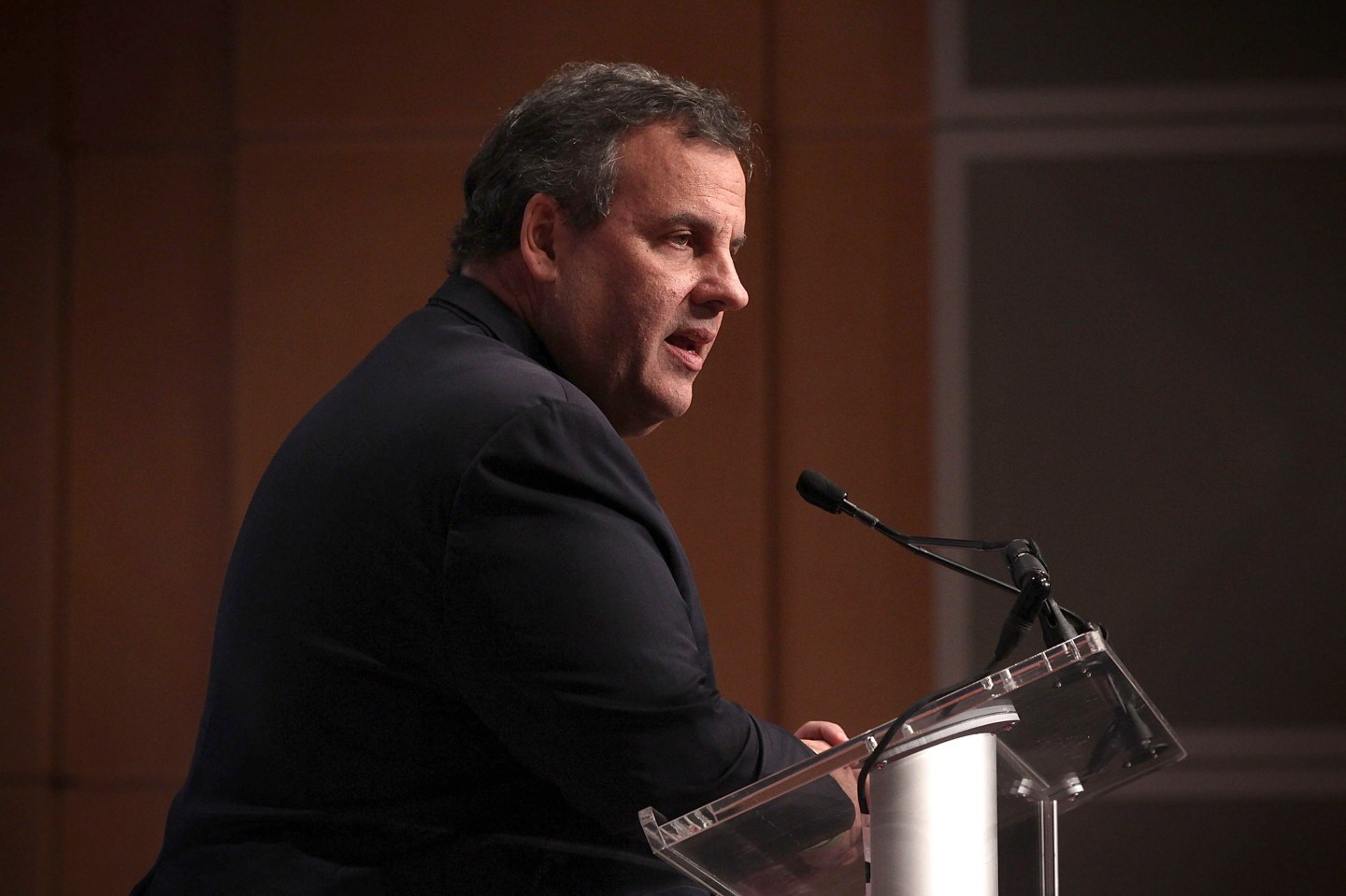
Donald Trump will once again be the central figure during Tuesday’s Republican debate, this time for his recent comments regarding Muslims and terrorism. The press will say he has done severe damage to the Republican Party, and the other GOP candidates are sure to gang up on him. But as his ratings continue to rise, both seem to be overlooking the candidate who is rejoining the main debate stage and most likely, in my opinion, to win the presidency: Chris Christie.
Christie aside, this is clearly a Republican year. The United States changes the parties of its president every eight years with extraordinary regularity. Since 1945, the only exception was the 1981-1985 period when the former New Dealer Ronald Reagan stole the second Democratic term from the conservative Jimmy Carter. And given the country’s historic pattern of changing parties and Hillary Clinton’s weakness as a candidate, the Democrats are unlikely to win, unless the Republican primary voters make an unbelievable mistake. On the surface, though, the voters are doing precisely that. There still are 14 candidates, and the campaign, as covered by the media, does seem a clown show.
The media take the polls seriously and proclaim that totally implausible candidates are the leaders. Three such early candidates—Jeb Bush, Ben Carson, and Carla Fiorina—have already faded into obscurity. Now, attention is focused on Donald Trump, Ted Cruz, and Marco Rubio as the only three favored candidates.
What nonsense. Each of the three have always had zero chance of being elected and, therefore, the same chance of being nominated. Trump’s language and nativist positions are hopelessly extreme, and Cruz is so reactionary and confrontational that even his conservative Senate colleagues don’t like him. He is totally unacceptable, except in the now meaningless Republican Iowa caucus, which selected Mike Huckabee and Rick Santorum in the last two elections.
Marco Rubio seems more plausible, but he, too, has far right-wing views. More damaging, he reminds Republican primary voters far too much of Obama with his youth and inexperience (worse than Obama in 2008), and his appearance to many of being another affirmative action candidate. The voters believe he still holds his former pro-immigration views. He might get the vice presidential nomination, but he too has zero chance as the presidential nominee.
There are, however, two candidates who are experienced, relatively moderate, and certain to defeat Clinton. The purpose of the Iowa Caucus and the New Hampshire primary is to give such candidates exposure and name recognition, and the Republican Party leaders have deliberately prolonged the real primary season to ensure the candidates get it. One will be nominated, and the New Hampshire polls indicate it could be Christie.
Since the media have ignored Chris Christie and John Kasich, they have no name recognition. This could change after the New Hampshire primary, and their comparative performances against Clinton in the polls will be decisive. They are likely to do much better than those like Donald Trump, Ted Cruz, and Marco Rubio, and voters will notice.
The key primary decisions will be made from March 1 until June 7, and the schedule has been arranged to give an advantage to the moderates. All of the conservative Southern and Prairie states—except for Florida—will vote between March 1 and 14. Their delegates are elected proportionately, unless a candidate receives 50% of the vote. The division between Trump and Cruz means neither will get 50%. Hence, the most conservative states will have their votes divided. New England also votes in that period and could give Christie substantial victories in blue states. The press will notice.
The elections after March 14 are predominantly blue states, and the plurality winner gets all of the delegates in each. Christie or Kasich should win the overwhelming majority of them, and the New Hampshire polls indicate Christie has already defeated Kasich. Christie would be wise to get Kasich to drop out in exchange for the vice presidency.
Trump ensures that Christie will not be able to repeat Mitt Romney’s mistake of moving right on economic questions. He will have to say that the voters are not nativists, and he has no choice but to say they are angry because of their wages and Obama’s bailout of Citigroup (C). He must say he will change both.
Christie has also been helped by Trump’s extremism in language. This year, an angry public has always wanted someone who would drop a bridge on Congressional and foreign leaders, but Christie has been too sharp. Now Trump has made him a moderate in comparison.
As a result, moderates will accept Christie not only because he can beat Clinton, but because his style can control the angry voters who might otherwise flow in a more dangerous direction in the next five years.
In short, take the media commentary on the debate with a huge grain of salt. The nomination of a reasonable Republican candidate and the usual change of party in the White House every eight years are both extremely likely.
Jerry F. Hough is a research professor at Duke University. Professor Hough teaches the courses on the U.S. presidency at Duke.