• Home
  • Latest
  • Fortune 500
  • Finance
  • Tech
  • Leadership
  • Lifestyle
  • Rankings
  • Multimedia
CommentaryChina

China’s Growing Footprint in Africa is Potentially Damaging

By
Mark Esposito
Mark Esposito
,
Terence Tse
Terence Tse
, and
Bethany Cianciolo
Bethany Cianciolo
Down Arrow Button Icon
By
Mark Esposito
Mark Esposito
,
Terence Tse
Terence Tse
, and
Bethany Cianciolo
Bethany Cianciolo
Down Arrow Button Icon
November 20, 2015, 10:53 AM ET
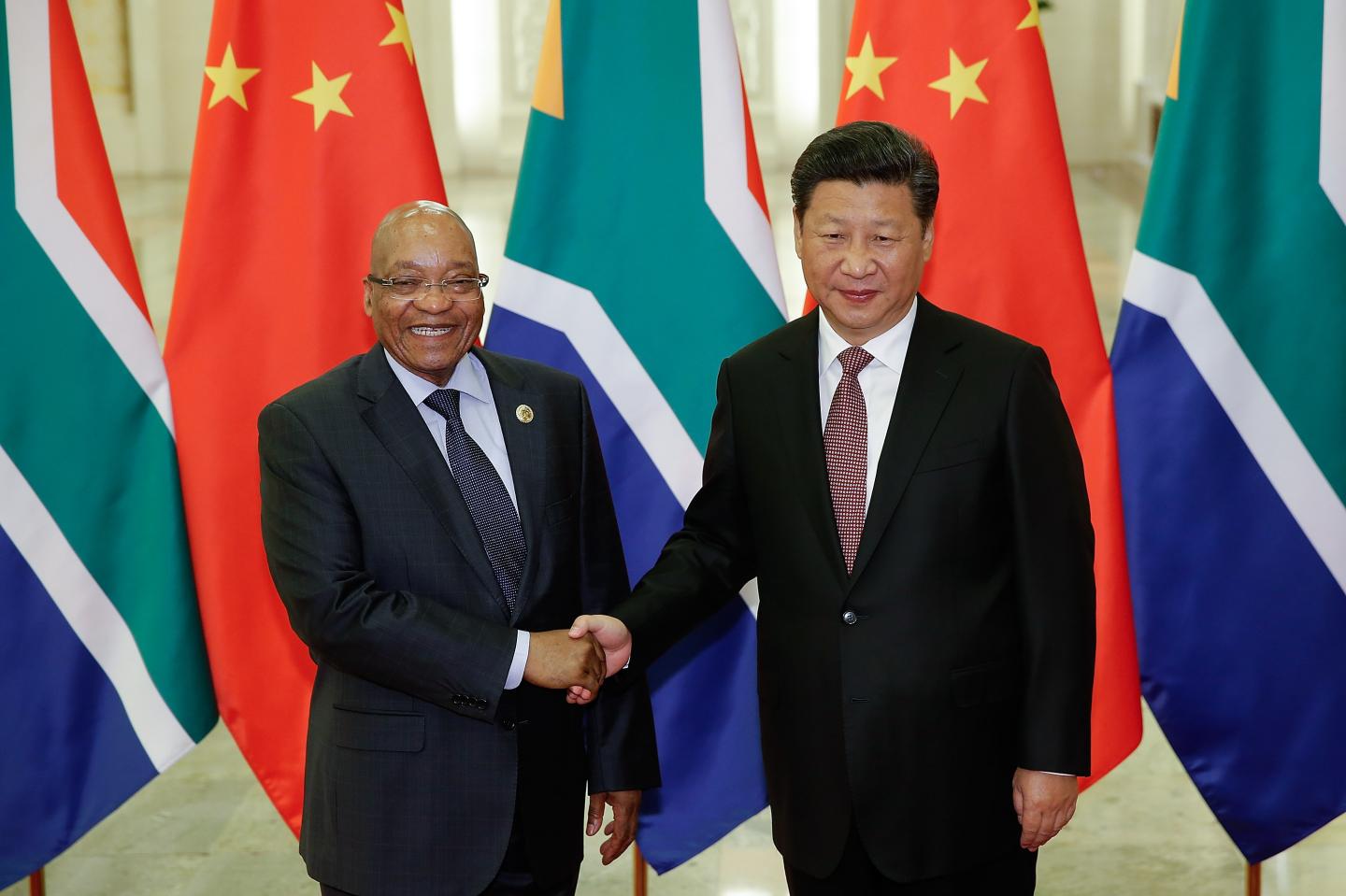
South African President Jacob Zuma Visits China
BEIJING, CHINA - SEPTEMBER 04: Chinese President Xi Jinping (R) shakes hands with South African President Jacob Zuma (L) at The Great Hall Of The People on September 4, 2015 in Beijing, China. Jacob Zuma has arrived in China to participate in the commemorative activities of the 70th anniversary of the victory of the Chinese Peoples's War of Resisitance against Japanese aggression and World War II. (Photo by Lintao Zhang/Getty Images)Photograph by Lintao Zhang — Getty Images

China’s ties to Africa are likely to get stronger this year as the world’s biggest economy appears poised to once again double its investments across the fast-growing continent.

The run-up to the sixth Forum on China-Africa Cooperation (FOCAC) to be held early next month in South Africa is under way. The forum—in its 15th year and the first held under President Xi Jinping’s administration—has been the main venue for setting the investment, trade, and integration agenda between China and countries in Africa.

But has this relationship been as good for Africa as it has been for China? And what can other countries beginning to receive more of its largesse learn from it?

Spreading wealth

As the poster child for economic growth in recent decades, China has been increasingly keen to spread its wealth and influence around.

Even though the country is suffering from a slowdown and expected to achieve “only” single-digit growth rate in the coming years, it remains one of the fastest-growing economies in the world. Its success has been, in part, the result of it being the recipient of huge amounts of foreign direct investment itself.

As China gradually embraces the roles and responsibilities of the world’s biggest economy as well, it is increasingly reversing that flow of cash and is expected to soon surpass the U.S. as the largest investor in other countries.

The inauguration of the China-led Asian Infrastructure Investment Bank, a rival to the World Bank and International Monetary Fund, is a sign of that, with its $100 billion in financial firepower, as is the new China-Pakistan Economic Corridor (CPEC), which will run from Gwadar in Pakistan to China’s western Xinjiang region, supported by a historical agreement of over $46 billion.

Indeed, the amount of investments made by China abroad is estimated to be $531 billion in outward foreign direct investment, with 4% of it—$22 billion—going to investments in natural resource extraction, finance, infrastructure, power generation, textiles, and home appliances in Africa.

That’s a small sum at first glance, but its economic impact to the region is both huge and far-reaching, especially in Sub-Saharan Africa, with the biggest investments made in Nigeria, Sudan, South Africa, and Angola.

In addition to investment projects, China has quickly become the continent’s biggest trading partner, with trade volume of $166 billion in 2014. This is likely to continue to increase and reach an estimated $1.7 trillion by 2030.

Losing hearts, minds, and jobs?

But despite the substantial investments, most of the them have been routinely cast as detrimental to Africa’s overall competitiveness.

The projects are dependent on deals made at the highest political levels. They lack competitive and transparent bidding processes, and most of the work force employed at these ventures has been Chinese. Promises of job creation have not been fulfilled. Further, when Africans are hired, local rules and regulations are often flouted, leading at times to poor safety.

For instance, at Chinese-run mines in Zambia’s copper belt, employees must work for two years before they get safety helmets. Ventilation below ground is poor, and deadly accidents occur almost on a daily basis.

More frequently, jobs are lost to Chinese employees, who are ferried in project by project. For example, the growing Chinese presence in South Africa may have cost the country 75,000 jobs from 2000 to 2011. In Nigeria, the influx of low-priced Chinese textile goods has caused 80% of Nigerian companies in this industry to close.

Africans’ impression of Chinese firms could also be shaped by illegal practices carried out by them.

For example, by law, mining on small plots of 25 acres or less is restricted to Ghanaian nationals. However, many Chinese continue to explore for gold in conjunction with local landowners, even though regulations have made it clear that such practice is illegal. The result: Many Africans see themselves to be exploited by the newcomers.

One-sided trade?

Perhaps making matter worse, the kinds of goods that the two partners trade with each other have done little to change such perception.

Whereas China buys from Africa mainly natural resources—minerals and metals—African countries import primarily the finished results, ranging from machinery and electrical goods to plastics and rubber.

Such an arrangement could benefit both parties, but it’s more often seen as China exploiting Africa’s natural resources to feed its need for industrial output.

At the same time, by exporting cheap—and often shoddy—manufactured goods to African countries, local companies not only become less competitive but they also grow increasingly dependent on China.

Recent research has also suggested that the Chinese presence has failed to bring significant skill developments, adequate technological transfer or any measurable upgrade to the productivity levels to this part of the world.

Jobs and infrastructure, not just oil and mines

Recently, China has become more tactful in its approach to Africa, trying to preempt the perception that its presence in Africa may be one-sided only.

In this year’s China-Africa forum, for example, the Middle Kingdom is believed to be making efforts to mitigate the broad criticisms of its “mercantilist” approach toward Africa by, among other things, offering more access to capital for local companies. The fact is that China’s Export-Import Bank extended $62.7 billion in loans to African countries from 2001 to 2010, some $12.5 billion more than the World Bank.

And contrary to what many may believe, China’s investment is not concentrated in countries with inadequate rule of law. The biggest recipient is in fact South Africa—though the Chinese presence is often more visible in other countries from which Western governments have shied away.

Indeed, as researchers have pointed out, Chinese investments are not concentrated in natural resources: Services are the most common sector, with significant investments in manufacturing as well. This suggests that China is now doing more to help African countries to build up their competitiveness.

Lately, the Middle Kingdom has tended to reduce to publicize major oil and mining contracts and instead has focused more on areas where it’s creating jobs, investing in infrastructure, and transferring technology. And the latest Forum on China-Africa Cooperation is meant to showcase that.

But will loans to support new railroads and other infrastructure projects be enough to make up for concerns that African resources are being exploited?

The challenge for Xi, and China, is to further develop the relationship and at the same time alter sometimes negative perceptions. That’s the opportunity presented by the forum, which could be a game changer for China, its external policy model and its growing footprint beyond its borders.

Key to that is ensuring Chinese companies operating in Africa comply with local rules and regulations. They also have to change their views of the locals, so that the latter are seen as equal business partners.

Only by making such fundamental shifts can China capture people’s hearts and minds and not just their mines.


Mark Esposito is a professor of business & economics at Harvard University. Terence Tse is an associate professor of finance and head of competitiveness studies at i7 Institute for Innovation and Competitiveness at ESCP Europe. This piece was originally published on The Conversation.
The Conversation

About the Authors
By Mark Esposito
See full bioRight Arrow Button Icon
By Terence Tse
See full bioRight Arrow Button Icon
By Bethany Cianciolo
See full bioRight Arrow Button Icon

Latest in Commentary

Finance
Lorem ipsum dolor sit amet, consectetur adipiscing elit, sed do eiusmod tempor incididunt ut labore et dolore magna aliqua. Ut enim ad minim veniam
By Fortune Editors
October 20, 2025
Finance
Lorem ipsum dolor sit amet, consectetur adipiscing elit, sed do eiusmod tempor incididunt ut labore et dolore magna aliqua. Ut enim ad minim veniam
By Fortune Editors
October 20, 2025
Finance
Lorem ipsum dolor sit amet, consectetur adipiscing elit, sed do eiusmod tempor incididunt ut labore et dolore magna aliqua. Ut enim ad minim veniam
By Fortune Editors
October 20, 2025
Finance
Lorem ipsum dolor sit amet, consectetur adipiscing elit, sed do eiusmod tempor incididunt ut labore et dolore magna aliqua. Ut enim ad minim veniam
By Fortune Editors
October 20, 2025
Finance
Lorem ipsum dolor sit amet, consectetur adipiscing elit, sed do eiusmod tempor incididunt ut labore et dolore magna aliqua. Ut enim ad minim veniam
By Fortune Editors
October 20, 2025
Finance
Lorem ipsum dolor sit amet, consectetur adipiscing elit, sed do eiusmod tempor incididunt ut labore et dolore magna aliqua. Ut enim ad minim veniam
By Fortune Editors
October 20, 2025

Most Popular

Finance
Lorem ipsum dolor sit amet, consectetur adipiscing elit, sed do eiusmod tempor incididunt ut labore et dolore magna aliqua. Ut enim ad minim veniam
By Fortune Editors
October 20, 2025
Finance
Lorem ipsum dolor sit amet, consectetur adipiscing elit, sed do eiusmod tempor incididunt ut labore et dolore magna aliqua. Ut enim ad minim veniam
By Fortune Editors
October 20, 2025
Finance
Lorem ipsum dolor sit amet, consectetur adipiscing elit, sed do eiusmod tempor incididunt ut labore et dolore magna aliqua. Ut enim ad minim veniam
By Fortune Editors
October 20, 2025
Finance
Lorem ipsum dolor sit amet, consectetur adipiscing elit, sed do eiusmod tempor incididunt ut labore et dolore magna aliqua. Ut enim ad minim veniam
By Fortune Editors
October 20, 2025
Finance
Lorem ipsum dolor sit amet, consectetur adipiscing elit, sed do eiusmod tempor incididunt ut labore et dolore magna aliqua. Ut enim ad minim veniam
By Fortune Editors
October 20, 2025
Finance
Lorem ipsum dolor sit amet, consectetur adipiscing elit, sed do eiusmod tempor incididunt ut labore et dolore magna aliqua. Ut enim ad minim veniam
By Fortune Editors
October 20, 2025
Fortune Secondary Logo
Rankings
  • 100 Best Companies
  • Fortune 500
  • Global 500
  • Fortune 500 Europe
  • Most Powerful Women
  • World's Most Admired Companies
  • See All Rankings
  • Lists Calendar
Sections
  • Finance
  • Fortune Crypto
  • Features
  • Leadership
  • Health
  • Commentary
  • Success
  • Retail
  • Mpw
  • Tech
  • Lifestyle
  • CEO Initiative
  • Asia
  • Politics
  • Conferences
  • Europe
  • Newsletters
  • Personal Finance
  • Environment
  • Magazine
  • Education
Customer Support
  • Frequently Asked Questions
  • Customer Service Portal
  • Privacy Policy
  • Terms Of Use
  • Single Issues For Purchase
  • International Print
Commercial Services
  • Advertising
  • Fortune Brand Studio
  • Fortune Analytics
  • Fortune Conferences
  • Business Development
  • Group Subscriptions
About Us
  • About Us
  • Press Center
  • Work At Fortune
  • Terms And Conditions
  • Site Map
  • About Us
  • Press Center
  • Work At Fortune
  • Terms And Conditions
  • Site Map
  • Facebook icon
  • Twitter icon
  • LinkedIn icon
  • Instagram icon
  • Pinterest icon

Latest in Commentary

francis
CommentaryFlorida
Former Miami Mayor Francis Suarez: Why I’m joining Stephen Ross and Ken Griffin in betting big on ambitious business leaders
By Francis SuarezMay 1, 2026
2 hours ago
valerie
CommentaryLayoffs
Tesla’s former HR chief: the AI layoff panic Is built on a false premise—here’s what most workers need to know
By Valerie Capers WorkmanMay 1, 2026
3 hours ago
tamas
CommentaryPolymarket
SEON CEO: Prediction markets can forecast the future. Can they survive their own manipulation problem?
By Tamas KadarMay 1, 2026
6 hours ago
sundar
Commentary250 Years of Innovation
America at 250: immigration and the making of an innovative nation
By Nasser KazeminyMay 1, 2026
8 hours ago
Derek Kilmer
CommentaryEconomics
The U.S. economy is booming — just not where 50 million Americans live
By Derek KilmerMay 1, 2026
8 hours ago
hegseth
CommentaryMilitary
America shot its arsenal empty in 2 wars. Now it needs Beijing’s permission to reload
By Steve H. Hanke and Jeffrey WengApril 30, 2026
23 hours ago

Most Popular

China dominates the world's lithium supply. The U.S. just found 328 years' worth in its own backyard
North America
China dominates the world's lithium supply. The U.S. just found 328 years' worth in its own backyard
By Jake AngeloApril 30, 2026
23 hours ago
Accenture's Julie Sweet blew up 50 years of company history. She says the hardest part is still ahead
Conferences
Accenture's Julie Sweet blew up 50 years of company history. She says the hardest part is still ahead
By Nick LichtenbergApril 29, 2026
2 days ago
Apple cofounder Ronald Wayne—whose stake would be worth up to $400 billion had he not sold it in 1976—says that at 91, he has no regrets
Success
Apple cofounder Ronald Wayne—whose stake would be worth up to $400 billion had he not sold it in 1976—says that at 91, he has no regrets
By Preston ForeApril 27, 2026
4 days ago
The U.S. economy is booming — just not where 50 million Americans live
Commentary
The U.S. economy is booming — just not where 50 million Americans live
By Derek KilmerMay 1, 2026
8 hours ago
America shot its arsenal empty in 2 wars. Now it needs Beijing's permission to reload
Commentary
America shot its arsenal empty in 2 wars. Now it needs Beijing's permission to reload
By Steve H. Hanke and Jeffrey WengApril 30, 2026
23 hours ago
Exclusive: America's largest Black-owned bank launches podcast with mission to unlock hidden shame holding back generational wealth
Banking
Exclusive: America's largest Black-owned bank launches podcast with mission to unlock hidden shame holding back generational wealth
By Nick LichtenbergApril 29, 2026
2 days ago

© 2026 Fortune Media IP Limited. All Rights Reserved. Use of this site constitutes acceptance of our Terms of Use and Privacy Policy | CA Notice at Collection and Privacy Notice | Do Not Sell/Share My Personal Information
FORTUNE is a trademark of Fortune Media IP Limited, registered in the U.S. and other countries. FORTUNE may receive compensation for some links to products and services on this website. Offers may be subject to change without notice.