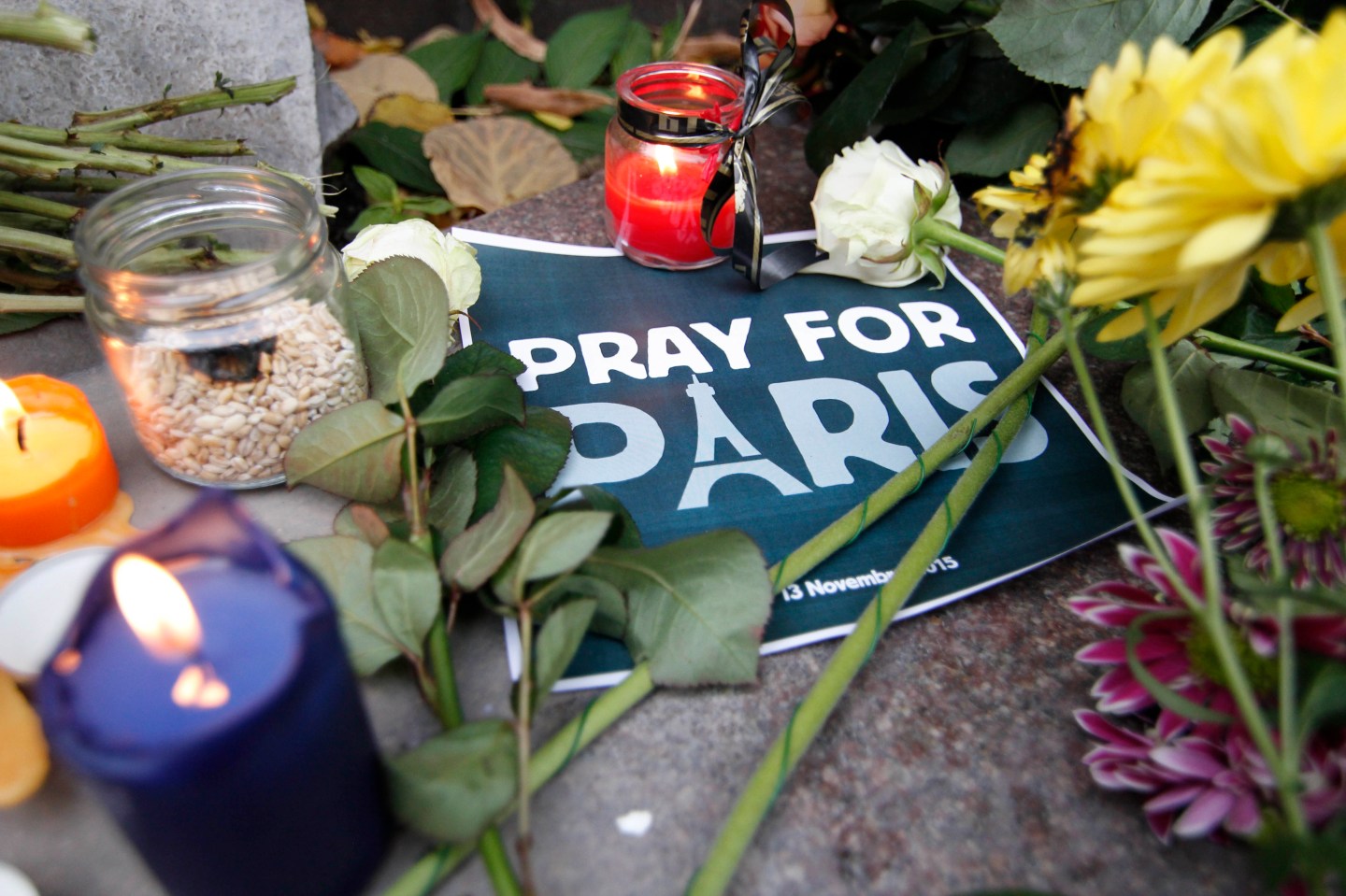
Why Paris? I am struggling for answers after cold-blooded mass killers struck the French capital for the second time in a year. For a few months I lived next door to the Le Carillon bar in the Rue Bichat. I wandered home along the canal, enjoying the lively chatter at the tables and the spicy fragrances of the Little Cambodia restaurant opposite. The Rue Bichat is now a place of silence, blood and shattered glass. Piles of flowers mark the world’s grief. Why Paris? The answer is complex.
Paris makes the front page
One answer is simply opportunism. Although the attackers’ identities are not yet clear, we know that a shadowy network of skilled persuaders has been at work, priming young men to become human killing machines. The answer, then, is that it could easily have been New York, Sydney, Munich, Stockholm. But it was none of these cities. It was Paris, and Paris makes the front page. This is another part of the answer.
We know that vicious attacks also took place in Beirut and Baghdad and were barely mentioned anywhere, while Paris dominated the news channels and the banner headlines. That is certainly one reason why recruiters went to so much trouble planning these coordinated attacks. But there is more.
Those of us who study France know how uncomfortable French society is with its own diversity. At least five million French citizens have another language, culture or nationality. Yet terms equivalent to “Arab American” are unknown – in France you are either French or Arab. Affirmative action and quotas are fiercely rejected. In consequence, as one writer has put it, “the social elevator has broken down. The French are not just ill-at-ease but ill-informed about their own diversity.
No-one knows exactly how many Muslims live in France, because it is illegal to count them. The prohibition on collecting such data is, apparently, intended to protect minorities from attack, but it relegates them to the shadows. Estimates range wildly from 5 to 8 million: perhaps seven to ten per cent of the population. This is more than any other European nation.
France’s colonial legacy
For 130 years, France carved out an empire in the Muslim world. France’s India, Canada, Australia were Morocco, Syria, Lebanon. Yet Islam was never recognized as a French religion in the way that Catholicism, Protestantism and Judaism were. In 1830, France brutally invaded Algeria and incorporated its territory – but not its people – into mainland France. To become citizens, Muslims had to renounce their “Muslim status”: only a handful would ever agree. After 1881, a new code excluded Muslims entirely from the protections of French law.
France today prides itself on its “laicité” (secularism) which some seek to add to its national values of liberty, equality and fraternity. Church and state were separated in France by the law of 1905. But many French people think this means all signs of religion must be removed from the public space. Students in public schools, or government employees can be excluded for wearing “ostentatious” signs of their religion such as an Islamic headscarf, a Sikh turban, or a Jewish kippah. Women wearing an Islamic face covering on the street can be arrested. This is fuel to the fire of radicalization.
Religious struggles have riven French history, from the wars between Protestant and Catholic in the 16th century to the schisms of the French Revolution. The legacy was so bitter that some Republicans began to hate priests with an almost superstitious passion. Voltaire is still a hero to many for his crushing attacks on religion: the magazine Charlie Hebdo was a great heir of this tradition. This antipathy is deeply etched into French Republicanism, and it can translate into a knee-jerk hatred of all religion. Republicans would not support votes for women until 1944, in case it allowed priests more influence. This helps to explain the French hysteria around the hijab, the Islamic headscarf. Recently, I was told by a French acquaintance that Muslims in France are not a problem because most of them are not Muslim anyway. It is not surprising, then, that many French Muslims do not feel French.
Islam kept at bay
When religion was driven out of metropolitan France, it found its niche in the colonies. Millions of Africans and Indochinese converted to Catholicism, and churches flourished – sometimes in confiscated mosques. But Islam was also encouraged in the colonies as a way of controlling the population. When Muslims began to move to the mainland to work – around 10,000 Algerians migrated before 1914, rising to 800,000 in the mid 1980s – religion was a useful way to control them and preserve the barrier that kept them from becoming full citizens. French Muslim men could not vote until 1944, and Muslim women until 1958.
After the bitter eight-year Algerian war came to an end in 1962 with Algeria’s independence, many North African Muslims stayed in France. Special agreements between governments allowed migration to continue, and even to accelerate as the French economy boomed, and Algeria’s stagnated. With the loss of most of its empire by the end of the 1960s, France appeared to be decolonized. But the same colonial relationships continued and continue today.
In Paris, above all, the bulk of the second and third generations of Muslims remain in a kind of colonial shanty-town on the outskirts of the wealthy, vibrant city where I was lucky enough to rent an apartment. This is the Arab Paris of today, a Paris that most tourists never see. It is a place of vibrant markets, hardworking families and close-knit neighbourhoods. It is also a place that breeds unemployment, crime, despair and radicalization. These suburbs burst into three weeks of riotous protest in 2005 after the death of two young Muslims in a police chase. What was striking then was that religion was not involved. But the government has failed to learn the lessons of anger, inequality and exclusion.
It would be foolish to suggest that such considerations are the reasons Daesh (a loose acronym for ISIS in Arabic that also has negative connotations because of its similarity to “dahes” or “one who sows discord”) trumpets its bloody threats against Paris. It is precisely because the so-called Islamic State is not a state that it must attempt to show its power through attacks of this nature. The choice of Paris is as much about a perverted kind of cultural resentment as it is about history. But history does help to explain the disturbing number – an estimated 1,200 – of eager recruits in France.
The dark areas of France’s past have bred an army in the shadows. To “declare war”, as the French President has insisted he will do, is only to give this alienation a new impetus, and to lend a lunatic fringe-group the aura of statehood it so desperately seeks. The only answer is to meet shadow with light, and evil with good. There is no quick fix for this violence. Instead, the patient work of fighting racism, exclusion and intolerance must continue. France must keep struggling to be the France we believe in, the France we love: the France of human rights, justice and respect, and not the shrunken parody of nationalism pedalled by its extreme right.
In this respect, Je suis and always will be Paris.
Ian Coller is an associate professor of history at the University of California, Irvine. This article originally appeared on The Conversation. 











