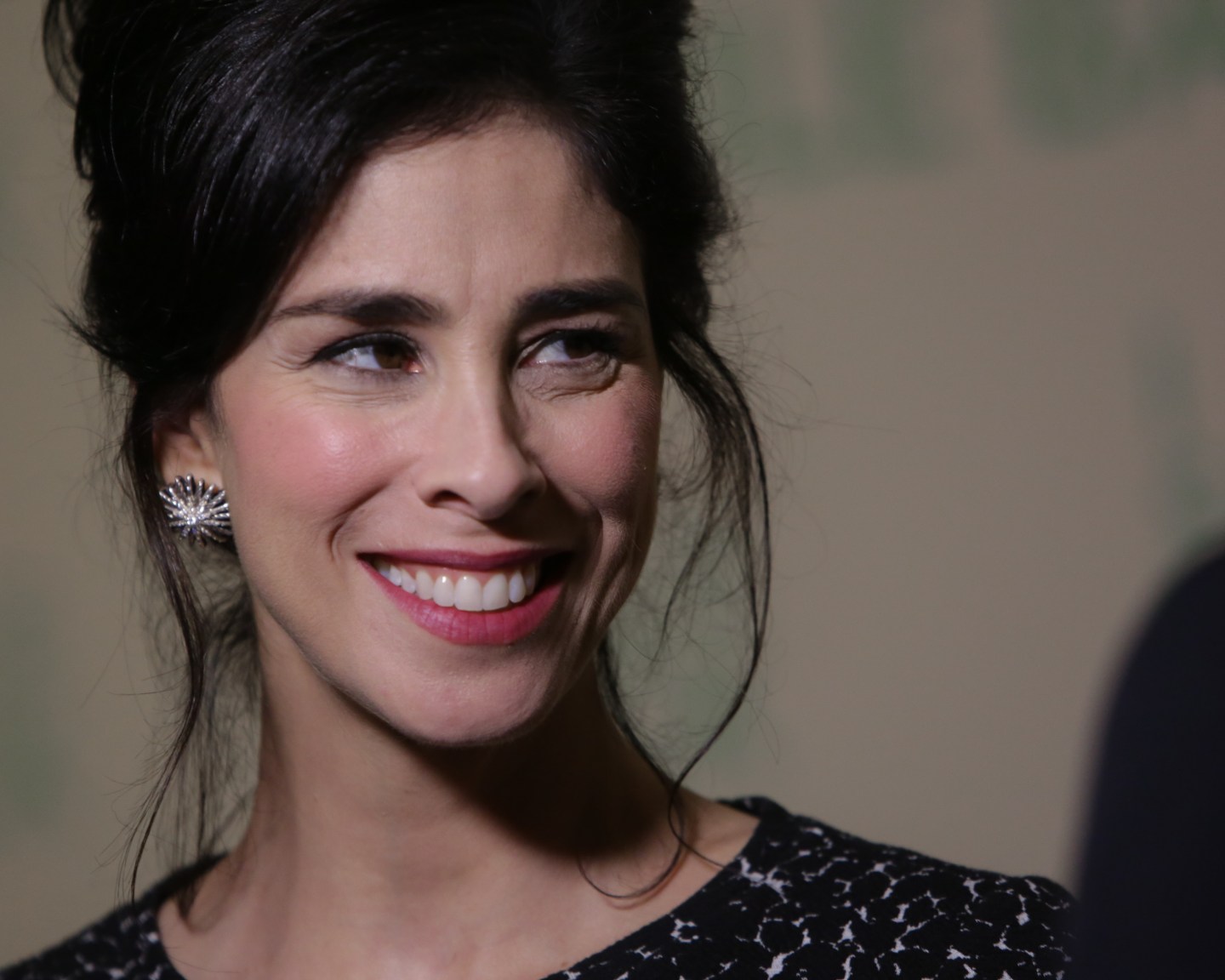
People know actress, comedian and author Sarah Silverman for her outrageous and sometimes shocking humor, but she has a serious side–one that has helped guide her over the last 20 years.
Audiences will get a full dose of Silverman’s sober side in her new dramatic film, I Smile Back, in which she plays a troubled housewife seeking redemption.
I spoke with Silverman about why her dad offered to pay her rent if she dropped out of college, who inspires her comedy, and what it was like to be one of the few female writers on Saturday Night Live. The following interview has been edited and condensed for clarity.
Fortune: I heard that the woman who wrote the book I Smile Back, Amy Koppelman, hand-picked you for this role. How did that come about?
Sarah Silverman: She heard me on Howard Stern’s radio show talking about my book The Bedwetter, which is a bunch of personal essays turned into a memoir. I was talking about my experience with depression, and she just connected and felt like I was right for this, and decided to write a screenplay version.
Was there something that you related to in this character? How did you deal with her dark side?
I think most comedians wrestle with a darker side, and it wasn’t totally unfamiliar to me. There are elements of it that I could draw from my own life, and others that I had come to understand through working in therapy and being interested in human nature. Addiction isn’t something I have experienced—unless Law and Order counts.
As a comedian, I’m surrounded by addiction, sometimes in my peers and certainly the audience. It’s a bar kind of world. I had a lot of things I could draw on and resources—good resources.
You do a full-frontal nude scene in this movie. I was talking about this with somebody, and he said, “Well, was it really her?”
Yeah, like this $400,000 budget allowed for a lot of CGI.
So it was you. What was that like?
I’d never been naked in anything until I turned 40, and then I was naked in a few things and that worked out well for me because I’ve grown emotionally. I’m not perfect, and I nitpick things about myself, but I mostly know that this is my human shell and it’s just fine. It’s good to show your body; there’s nothing wrong with it. I felt like the moment was really real and something that is totally relatable. I have stood in front of the mirror and lifted my boobs and been like, “They used to be there, and now they’re here.”
It’s scary. If you don’t at least journey to reconcile with the process of aging and mortality, then life, especially for a woman, is like a very, very slow-moving horror film.
Before this film came along, had you ever considered doing anything other than comedy?
Yeah. There are lots of sides of me, like all of us. I’ve always mined not just taboo subjects, but also darker topics for my material. I think comedians share a darker side, and I think that’s why many of us do dramas, and do them well.
I never have a game plan for my career or anything. I wasn’t looking for this; it came to me, and I knew I was lucky to have a new experience. I feel I’ve had in me the ability to have the dramatic experience, to pretend this reality like it was real for me. That’s what I did.
You got your start at Saturday Night Live, writing.
I’d been doing stand-up since I was 17. I finished high school, moved to New York and passed out flyers for a comedy club for two years, and they let me have stage time. By the time I was 19, I was doing stand-up professionally, meaning I got $10 at each spot.
I was at NYU, and after a year, my dad made a deal: If I dropped out of college, he would pay my rent for the next three years, and I would continue doing stand-up. It was a good deal. I did take classes. I stole classes from NYU after that because we both realized what I wanted to do didn’t take a degree. They don’t know if you’re in their class because they’re big, giant lecture classes. I took a whole philosophy course—I just didn’t pass in papers. I enjoyed it, and I got a lot out of it. By the time I would’ve graduated, I was hired as a writer on Saturday Night Live.
Your dad made this deal with you, not the other way around?
It was his idea.
What prompted that conversation?
Well, college is really, really expensive and I knew I wanted to be a comedian and an actor. I was a drama major at NYU, which is an amazing program, and wonderful if you’re very rich or have a full scholarship. It’s a lot of money for something that you don’t need a degree to get hired for. I think that’s a big reality right now in America. For all sorts of vocations, unless you need a diploma for something, college, sadly, isn’t worth it.
What was your experience at Saturday Night Live? Were you one of a few women in that writer’s room?
There was one other woman, a woman named Marilyn Suzanne Miller, who had been there since the beginning. And there had been women there before me who had gone off to create shows and stuff, but it was mostly men. It was a long time ago. There were computers, but there were not computers there. We wrote on legal pads and gave them to a room of typists.
I was hired at the same time as three boys from Harvard. Lorne [Michaels] put us together and said, “You guys can hang out together.” I spent the whole day with them, and we had lunch and then they said, “So are you a typist, or an assistant?” I go, “No, I’m a writer like you, ass****.” But I guess it was an innocent mistake, because they were living in the world we were living in at that time.
What have you seen change since 1993 relative to women in comedy?
Everything. When I started, the comics we looked up to would say, “If you’re a really good comic, then you write material that a woman or a man could do.” That was the thing, and I bought into that, because look at Paula Poundstone. She’s so brilliant, and her material could work for either sex. It was considered hacky or not cool, or you were not a real comic if you talked about the female experience. I think that that is the opposite of how it is now.
Tina Fey becoming head writer at Saturday Night Live was a really big thing. She and Amy Poehler and Chelsea Handler and other really powerful women are unafraid to be powerful, and also unafraid to be vulnerable. I think that’s what important: to realize that I can talk about a female experience, and maybe you’re just not my audience. To me, the best comedy isn’t second-guessing your audience.
What do you want to be known for in your career?
I don’t know, I don’t know. I’m trying in therapy to live a life undaunted by the thoughts of legacy or mortality or immortality or how I’m perceived, or having how I feel about myself be dependent on how people may perceive me. That’s a prison, I think. It’s a practice to try not to do that. I’m not perfect at it, obviously, but that’s what I’m aiming for.
What’s the best advice about acting you’ve ever received?
Oh my gosh. I’ve gotten a lot of great advice. Garry Shandling gave me a lot of great advice about the moments between the lines—not being afraid of the quiet moments. When I was a kid, I took an acting class, and the teacher said, “Acting is reacting.” Up until about a year ago, I was like, what is that, reacting? Acting again? Then I was driving, less than year ago, and I went, “Oh! Reacting! Yes, I agree.”
Lauren Schiller is the host of Inflection Point, where she interviews women changing the status quo. Inflection Point is broadcast on public radio stations, podcast on iTunes, and online at inflectionpointradio.org. The above article is an edited and condensed version of the broadcast interview. Click here to listen to the full audio version and find episodes of the show on iTunes.