• Home
  • Latest
  • Fortune 500
  • Finance
  • Tech
  • Leadership
  • Lifestyle
  • Rankings
  • Multimedia
Commentary

Proof the Presidential Debates Are Ruining Democracy

By
Matthew Jordan
Matthew Jordan
,
The Conversation
The Conversation
, and
Bethany Cianciolo
Bethany Cianciolo
Down Arrow Button Icon
By
Matthew Jordan
Matthew Jordan
,
The Conversation
The Conversation
, and
Bethany Cianciolo
Bethany Cianciolo
Down Arrow Button Icon
November 10, 2015, 9:28 AM ET
Photograph by Frederic J. Brown—AFP via Getty Images

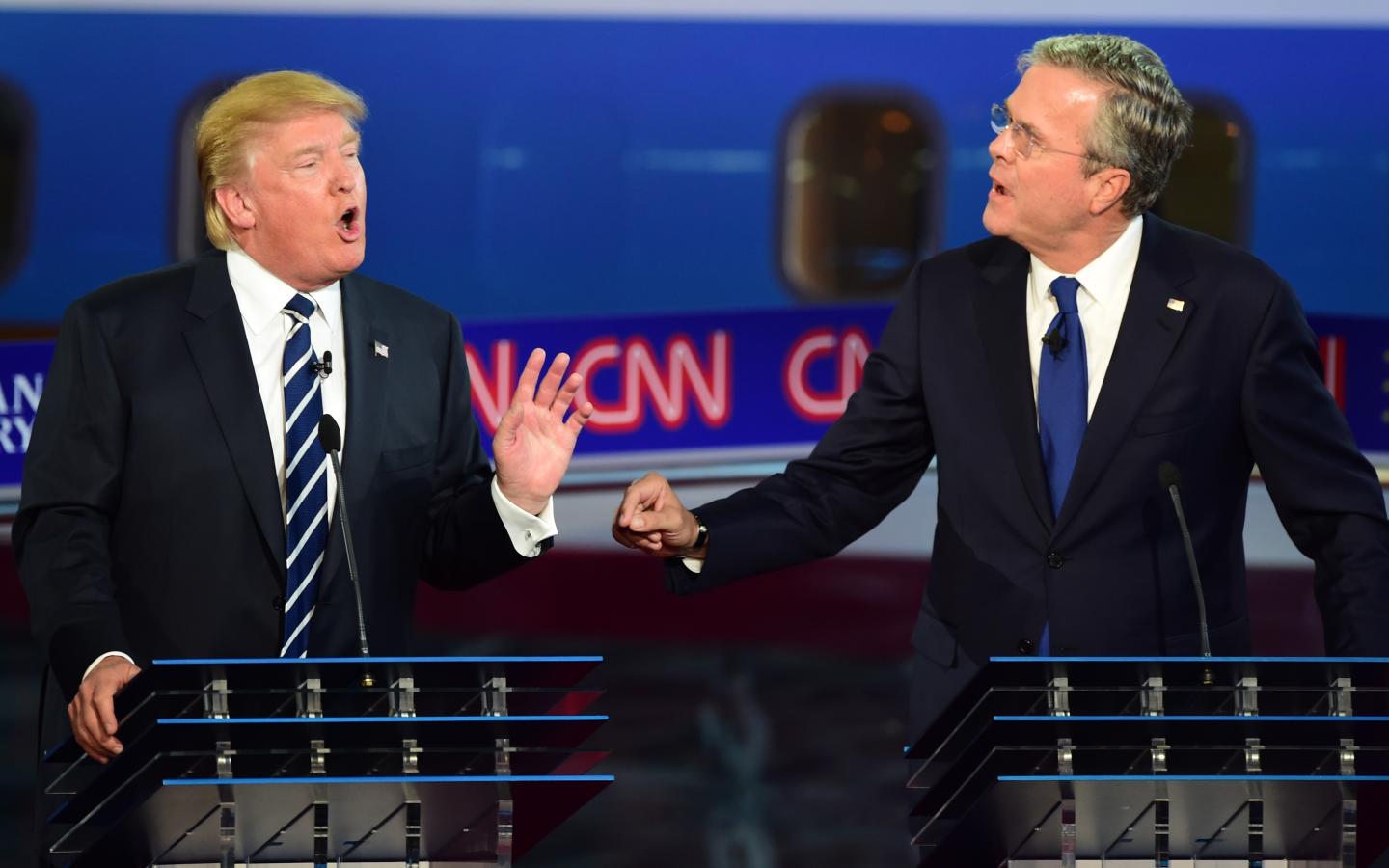
Anyone curious about the state of American democracy should simply tune into the GOP debate series, whose next episode airs Tuesday night on Fox Business Network.

If the first two debates are any indication, advertisers will be clamoring to buy up commercial spots, especially after the “buzz” generated last week: special conditions demanded by the candidates, Trump’s controversial—though dull—SNL appearance and the Ben Carson “bombshell” that he never applied to West Point (as he’d previously claimed). Yes, the debate has the makings of another ratings bonanza.

Televised presidential debates originated in the 1960s, during TV’s golden era. But back then, networks ran news divisions at a loss in exchange for being granted a licensed monopoly over public airways by the FCC. Candidates, in exchange for the publicity, answered hard questions posed by moderators.

Today, the rules of the debate game have shifted to reflect a new media reality, one in which broadcasters have a powerful financial interest in promoting debates centered on entertainment, rather than substantive discussions of policy issues.

In fact, today’s debates can be likened to World Wrestling Entertainment: There are heroes and villains, winners and losers, entrance themes and announcers, drama, and intrigue (will Biden show?)—even an “undercard.”

Like it or not, the democratic process has been usurped by an endless, ratings-driven spectacle. And for networks—with the debates’ stripped-down production costs and high ratings—it’s like hitting the mother lode.

Record audiences yield record profits

Back in August, 24 million viewers watched the first GOP debate on Fox News. A month later, CNN drafted off this success, drawing 23.1 million viewers and selling commercials at $200,000 apiece, roughly 40 times what they normally charge. And even though CNBC only drew 14 million viewers in the latest debate, it was the network’s most-watched show. Accordingly, they charged $250,000 per spot, a surge pricing rate that yielded record profits.

Tuesday night, 21st Century Fox and News Corp will list two of its properties—Fox Business Network (FBN) and the Wall Street Journal—as cohosts. It will be a big moment for the nascent network: their biggest show ever.

Even the undercard debate, which captured 1.6 million viewers for CNBC, will yield unprecedented audiences and profits for FBN, whose most-watched show drew a mere 152,000 viewers. No matter which network airs which show, the audiences this year dwarf anything seen in the 2012 GOP debates, which had a peak viewership of 7.6 million.

If, as Marshall McLuhan once speculated, the medium is the message, political rhetoric and modes of campaigning—at least for candidates whom TV talking heads call “electable”—have become indistinguishable from strategies used by TV networks to boost ratings.

In an age of slickly produced identity politics, the presidential debate series—part reality show, part melodrama—is a hit that bounces from network to network and features different personality types that appeal to different viewer demographics. Audiences get to “know” the contestants, and throwing their weight behind those they like and raging against those they hate, they’re deeply invested in their success or failure.

Though pundits and pollsters determine who wins or loses each debate, the media corporations who put on the shows—and who use the ongoing drama to pump up ratings for other shows—are the real winners.

Leveraging a hot commodity

And the candidates have noticed. Last week, while discussing the backlash CNBC received for asking hard questions, Rand Paul plainly expressed the new order:

We have a product that 20 million people want to watch. And so we should negotiate. People should bid for this. In fact, I think the networks ought to pay the Republican Party to air it.

Live debates, once commercial-free and sober, are now seen by politicians and networks as profitable entertainment products, viewed by audiences who have been conditioned to evaluate them as such. No matter how hard the media tries to comb over this bald reality beneath the ratings-driven political process, democracy in America has been hijacked by the entertainment industry.

Viewed through this lens, the orchestrated pushback against CNBC after the last debate by candidates and pundits (who largely parroted 50-year-old complaints about “trust” and “liberal bias”) is nakedly cynical.

With Fox leading the charge, it’s clearly a strategy to drive up ratings for Tuesday’s show—and for Fox Business Network to grab some of CNBC’s market share.

Meanwhile, the GOP candidate demands last week for friendlier treatment from networks speak to a shift in power brought about by the profitability of the series, which the performers are now using as leverage.

In media we trust

As Donald Trump learned for 14 years on The Apprentice and The Celebrity Apprentice, big ratings demand sensationalism, polarizing personalities, catchphrases, and conflict.

Yet this creates risk for the presidential candidates. Even though running for president gives you free access to media and fundraising machines, candidates spend enormous sums on ads across multiple media platforms to build their brands, and they need to protect them.

Moreover, the candidates’ commercials build awareness of the debate series, which then helps the networks sell more ads and drive ratings for all the shows the candidates appear on. With the success of the two players—candidate and media conglomerate—so tightly intertwined, it’s no surprise the GOP performers want more favorable conditions in return for the added value they bring to networks.

Ultimately, if there’s “trust” at work in the age of ratings-driven democracy, it isn’t between the media and citizens they purport to serve.

Rather, the producers and the performers—in this case, the presidential candidates—trust that everyone will follow the rules, generating entertainment for audiences and ratings for advertisers, while protecting the brands of the celebrities who are auditioning for a recurring role in the ongoing spectacle.

And that you can bank on.


Matthew Jordan is an associate professor of media studies at Pennsylvania State University. This piece was originally published on The Conversation.
The Conversation

About the Authors
By Matthew Jordan
See full bioRight Arrow Button Icon
By The Conversation
See full bioRight Arrow Button Icon
By Bethany Cianciolo
See full bioRight Arrow Button Icon

Latest in Commentary

Finance
Lorem ipsum dolor sit amet, consectetur adipiscing elit, sed do eiusmod tempor incididunt ut labore et dolore magna aliqua. Ut enim ad minim veniam
By Fortune Editors
October 20, 2025
Finance
Lorem ipsum dolor sit amet, consectetur adipiscing elit, sed do eiusmod tempor incididunt ut labore et dolore magna aliqua. Ut enim ad minim veniam
By Fortune Editors
October 20, 2025
Finance
Lorem ipsum dolor sit amet, consectetur adipiscing elit, sed do eiusmod tempor incididunt ut labore et dolore magna aliqua. Ut enim ad minim veniam
By Fortune Editors
October 20, 2025
Finance
Lorem ipsum dolor sit amet, consectetur adipiscing elit, sed do eiusmod tempor incididunt ut labore et dolore magna aliqua. Ut enim ad minim veniam
By Fortune Editors
October 20, 2025
Finance
Lorem ipsum dolor sit amet, consectetur adipiscing elit, sed do eiusmod tempor incididunt ut labore et dolore magna aliqua. Ut enim ad minim veniam
By Fortune Editors
October 20, 2025
Finance
Lorem ipsum dolor sit amet, consectetur adipiscing elit, sed do eiusmod tempor incididunt ut labore et dolore magna aliqua. Ut enim ad minim veniam
By Fortune Editors
October 20, 2025

Most Popular

Finance
Lorem ipsum dolor sit amet, consectetur adipiscing elit, sed do eiusmod tempor incididunt ut labore et dolore magna aliqua. Ut enim ad minim veniam
By Fortune Editors
October 20, 2025
Finance
Lorem ipsum dolor sit amet, consectetur adipiscing elit, sed do eiusmod tempor incididunt ut labore et dolore magna aliqua. Ut enim ad minim veniam
By Fortune Editors
October 20, 2025
Finance
Lorem ipsum dolor sit amet, consectetur adipiscing elit, sed do eiusmod tempor incididunt ut labore et dolore magna aliqua. Ut enim ad minim veniam
By Fortune Editors
October 20, 2025
Finance
Lorem ipsum dolor sit amet, consectetur adipiscing elit, sed do eiusmod tempor incididunt ut labore et dolore magna aliqua. Ut enim ad minim veniam
By Fortune Editors
October 20, 2025
Finance
Lorem ipsum dolor sit amet, consectetur adipiscing elit, sed do eiusmod tempor incididunt ut labore et dolore magna aliqua. Ut enim ad minim veniam
By Fortune Editors
October 20, 2025
Finance
Lorem ipsum dolor sit amet, consectetur adipiscing elit, sed do eiusmod tempor incididunt ut labore et dolore magna aliqua. Ut enim ad minim veniam
By Fortune Editors
October 20, 2025
Fortune Secondary Logo
Rankings
  • 100 Best Companies
  • Fortune 500
  • Global 500
  • Fortune 500 Europe
  • Most Powerful Women
  • World's Most Admired Companies
  • See All Rankings
  • Lists Calendar
Sections
  • Finance
  • Fortune Crypto
  • Features
  • Leadership
  • Health
  • Commentary
  • Success
  • Retail
  • Mpw
  • Tech
  • Lifestyle
  • CEO Initiative
  • Asia
  • Politics
  • Conferences
  • Europe
  • Newsletters
  • Personal Finance
  • Environment
  • Magazine
  • Education
Customer Support
  • Frequently Asked Questions
  • Customer Service Portal
  • Privacy Policy
  • Terms Of Use
  • Single Issues For Purchase
  • International Print
Commercial Services
  • Advertising
  • Fortune Brand Studio
  • Fortune Analytics
  • Fortune Conferences
  • Business Development
  • Group Subscriptions
About Us
  • About Us
  • Press Center
  • Work At Fortune
  • Terms And Conditions
  • Site Map
  • About Us
  • Press Center
  • Work At Fortune
  • Terms And Conditions
  • Site Map
  • Facebook icon
  • Twitter icon
  • LinkedIn icon
  • Instagram icon
  • Pinterest icon

Latest in Commentary

Hong Kong is the hub for China’s AI IPOs. It can be so much more than that
CommentaryHong Kong
Hong Kong is the hub for China’s AI IPOs. It can be so much more than that
By Brian Wong and Tony ChanMay 3, 2026
6 hours ago
jason corso
Commentarydisruption
AI models are choking on junk data
By Jason CorsoMay 3, 2026
14 hours ago
blake
CommentaryHousing
I spent a decade selling homes to the ultra-wealthy. What I saw explains the housing market’s nepo problem
By Blake O'ShaughnessyMay 3, 2026
16 hours ago
Can the ‘blue economy’ deliver on its promise? Investors are starting see the ocean as an asset worth protecting
CommentaryConservation
Can the ‘blue economy’ deliver on its promise? Investors are starting see the ocean as an asset worth protecting
By Natalie Sum Yue ChungMay 2, 2026
1 day ago
old
Commentaryaffordability
The American household just took an 81% margin cut. Wall Street hasn’t priced it in
By Katica RoyMay 2, 2026
2 days ago
dario
CommentaryAnthropic
Anthropic’s most powerful AI model just exposed a crisis in corporate governance. Here’s the framework every CEO needs.
By Jeffrey Sonnenfeld, Stephen Henriques, Dan Kent and Holden LeeMay 2, 2026
2 days ago

Most Popular

Scott Bessent on financial literacy: 'it drives me crazy' to see young men in blue-collar construction jobs playing the lottery
Personal Finance
Scott Bessent on financial literacy: 'it drives me crazy' to see young men in blue-collar construction jobs playing the lottery
By Fatima Hussein and The Associated PressMay 1, 2026
3 days ago
America got rich and got sad. A top economist says 2020 broke something that hasn't healed
Economy
America got rich and got sad. A top economist says 2020 broke something that hasn't healed
By Nick LichtenbergMay 3, 2026
16 hours ago
Gen Z is rebelling against the economy with ‘disillusionomics,’ tackling near 6-figure debt by turning life into a giant list of income streams
Economy
Gen Z is rebelling against the economy with ‘disillusionomics,’ tackling near 6-figure debt by turning life into a giant list of income streams
By Jacqueline MunisMay 2, 2026
2 days ago
China dominates the world's lithium supply. The U.S. just found 328 years' worth in its own backyard
North America
China dominates the world's lithium supply. The U.S. just found 328 years' worth in its own backyard
By Jake AngeloApril 30, 2026
3 days ago
I spent a decade selling homes to the ultra-wealthy. What I saw explains the housing market's nepo problem
Commentary
I spent a decade selling homes to the ultra-wealthy. What I saw explains the housing market's nepo problem
By Blake O'ShaughnessyMay 3, 2026
16 hours ago
Sam Altman says the quiet part out loud, confirming some companies are ‘AI washing’ by blaming unrelated layoffs on the technology
AI
Sam Altman says the quiet part out loud, confirming some companies are ‘AI washing’ by blaming unrelated layoffs on the technology
By Sasha RogelbergMay 3, 2026
15 hours ago

© 2026 Fortune Media IP Limited. All Rights Reserved. Use of this site constitutes acceptance of our Terms of Use and Privacy Policy | CA Notice at Collection and Privacy Notice | Do Not Sell/Share My Personal Information
FORTUNE is a trademark of Fortune Media IP Limited, registered in the U.S. and other countries. FORTUNE may receive compensation for some links to products and services on this website. Offers may be subject to change without notice.