• Home
  • News
  • Fortune 500
  • Tech
  • Finance
  • Leadership
  • Lifestyle
  • Rankings
  • Multimedia
Commentary

Why the Democratic presidential debate is just like the GOP’s

By
Dean Baker
Dean Baker
Down Arrow Button Icon
By
Dean Baker
Dean Baker
Down Arrow Button Icon
October 14, 2015, 12:37 PM ET
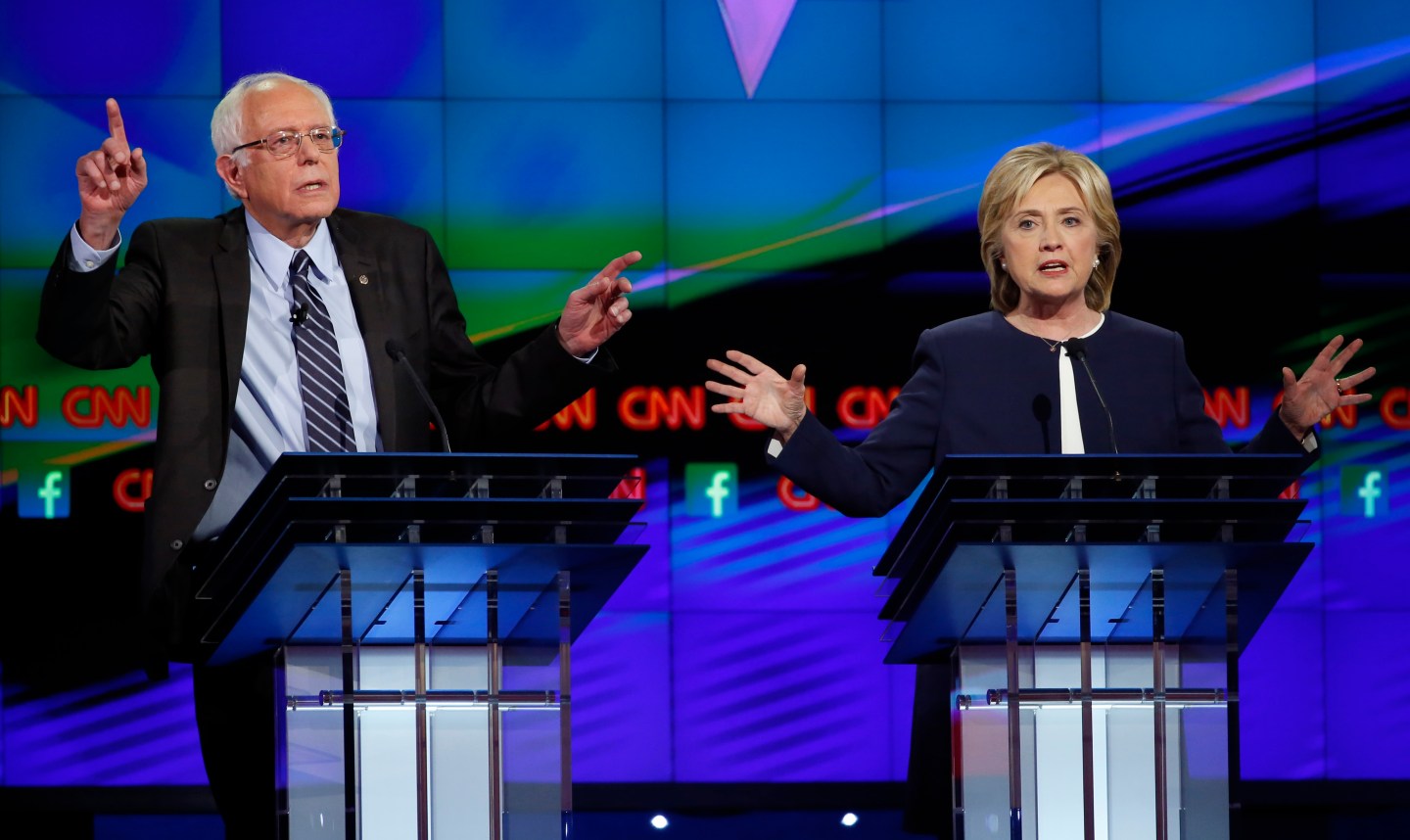
Democratic presidential candidates U.S. Senator Bernie Sanders and former Secretary of State Hillary Clinton debate during the first official Democratic candidates debate of the 2016 presidential campaign in Las Vegas
Democratic presidential candidates U.S. Senator Bernie Sanders (L) and former Secretary of State Hillary Clinton debate duringthe first official Democratic candidates debate of the 2016 presidential campaign in Las Vegas, Nevada October 13, 2015. REUTERS/Lucy Nicholson (TPX IMAGES OF THE DAY) - RTS4CPXPhotograph by Lucy Nicholson — Reuters

In Tuesday night’s first Democratic presidential debate, contenders gave their views on how the government can ensure that the benefits from economic growth are broadly shared, so that ordinary workers see rising living standards. In the debate and prior campaign comments, both of the two leading contenders, former Secretary of State Hillary Clinton and Vermont Sen. Bernie Sanders put forward proposals that would have the government reduce the cost to families of health care and college education. They also promised measures to give workers more control over their time in the form of paid family leave and paid vacation in the case of Sanders.

In these areas, the Democratic contenders are following in a long tradition of the party’s leaders. In the case of health care, it was of course Lyndon Johnson who pushed the Medicare legislation that provided insurance for the country’s seniors, along with Medicaid that provided health care to the poor. This safety net was expanded with the State Children’s Health Insurance Program under President Clinton and the Affordable Care Act (ACA) under President Obama. Now Clinton is proposing to fill some of the gaps in coverage left by the ACA, while Sanders wants to expand Medicare to cover the whole population.

Read more: Who won the Democratic debate?

The commitment to making college affordable to children from poor and moderate income families historically had bipartisan support, with the National Direct (originally “Defense”) Student Loan program initiated in the Eisenhower administration. The Johnson administration supplemented these subsidized loans with the Pell Grant program. More recently, the Obama administration has expanded the loan program, reducing costs by providing loans directly rather than through private lenders. It also has allowed income-based repayments to protect graduates who have difficulty finding jobs or earn low pay. Clinton promises to make all loan repayments income based, while Sanders proposes to have free tuition at public universities.

Both Clinton and Sanders want to mandate paid family leave to ensure that workers can take time off to care for a newborn baby or sick family member. Sanders also wants to ensure that all workers have at least two weeks a year of paid vacation. The effort to ensure workers enjoy some amount of leisure dates back to the Fair Labor Standards Act (FLSA) passed in the Roosevelt administration. The FLSA institutionalized the 40-hour workweek, requiring employers to pay an overtime premium if their workers put in more than forty hours a week.

The FLSA also put in place the first nation-wide minimum wage. Both Clinton and Sanders propose raising the minimum wage. Sanders has chosen a target of $15 an hour by 2020. Clinton has not yet indicated what her target would be for the minimum wage.

Read more: Democratic debate: Hillary Clinton has an open field to run in

Both candidates also promised a tighter rein on Wall Street. Both urge stronger regulation of banks, with Sanders proposing a financial transactions tax that will provide a harsh penalty for excessive trading. This again follows in the tradition of the New Deal regulation of the financial sector. Bill Clinton’s administration provided a major break from this tradition, as it joined a push toward deregulation of the sector.

If the Democratic candidates are sticking to party traditions, the same is true of the Republican candidates as well. Most of the leading candidates have put forward proposals for major tax cuts, as had President George W. Bush and President Reagan. Their tax cuts would give the largest breaks to high- income taxpayers. This is justified by the fact that they pay the most in taxes so that an across the board tax cut will give them the most money.

Like their predecessors, the Republican candidates seem little concerned about the budgetary impact of these tax cuts. They claim, like prior Republican presidents, that the faster economic growth induced by their tax cuts will largely make up for lost revenue. This has not proved be the case in the past. As far as paying for the Democratic initiatives, Sanders has been clear about his desire to raise taxes on the wealthy, although it will be necessary to see both the programs and tax proposals spelled out in more detail to determine if and how they balance out.

While the party nominations are still far from settled, it seems clear that there will be some real differences on economic issues in the election next fall. The differences are likely to have noticeable consequences for most of the public.

Dean Baker is a macroeconomist and co-director of the Center for Economic and Policy Research in Washington, DC. He previously worked as a senior economist at the Economic Policy Institute and an assistant professor at Bucknell University.


About the Author
By Dean Baker
See full bioRight Arrow Button Icon

Latest in Commentary

Alex Amouyel is the President and CEO of Newman’s Own Foundation
Commentaryphilanthropy
Following in Paul Newman and Yvon Chouinard’s footsteps: There are more ways for leaders to give it away in ‘the Great Boomer Fire Sale’ than ever
By Alex AmouyelDecember 7, 2025
19 hours ago
Amit Walia
CommentaryM&A
Why the timing was right for Salesforce’s $8 billion acquisition of Informatica — and for the opportunities ahead
By Amit WaliaDecember 6, 2025
2 days ago
Steve Milton is the CEO of Chain, a culinary-led pop-culture experience company founded by B.J. Novak and backed by Studio Ramsay Global.
CommentaryFood and drink
Affordability isn’t enough. Fast-casual restaurants need a fandom-first approach
By Steve MiltonDecember 5, 2025
3 days ago
Paul Atkins
CommentaryCorporate Governance
Turning public companies into private companies: the SEC’s retreat from transparency and accountability
By Andrew BeharDecember 5, 2025
3 days ago
Matt Rogers
CommentaryInfrastructure
I built the first iPhone with Steve Jobs. The AI industry is at risk of repeating an early smartphone mistake
By Matt RogersDecember 4, 2025
4 days ago
Jerome Powell
CommentaryFederal Reserve
Fed officials like the mystique of being seen as financial technocrats, but it’s time to demystify the central bank
By Alexander William SalterDecember 4, 2025
4 days ago

Most Popular

placeholder alt text
Real Estate
The 'Great Housing Reset' is coming: Income growth will outpace home-price growth in 2026, Redfin forecasts
By Nino PaoliDecember 6, 2025
2 days ago
placeholder alt text
AI
Nvidia CEO says data centers take about 3 years to construct in the U.S., while in China 'they can build a hospital in a weekend'
By Nino PaoliDecember 6, 2025
2 days ago
placeholder alt text
Economy
The most likely solution to the U.S. debt crisis is severe austerity triggered by a fiscal calamity, former White House economic adviser says
By Jason MaDecember 6, 2025
1 day ago
placeholder alt text
Economy
JPMorgan CEO Jamie Dimon says Europe has a 'real problem’
By Katherine Chiglinsky and BloombergDecember 6, 2025
1 day ago
placeholder alt text
Big Tech
Mark Zuckerberg rebranded Facebook for the metaverse. Four years and $70 billion in losses later, he’s moving on
By Eva RoytburgDecember 5, 2025
3 days ago
placeholder alt text
Politics
Supreme Court to reconsider a 90-year-old unanimous ruling that limits presidential power on removing heads of independent agencies
By Mark Sherman and The Associated PressDecember 7, 2025
17 hours ago
Rankings
  • 100 Best Companies
  • Fortune 500
  • Global 500
  • Fortune 500 Europe
  • Most Powerful Women
  • Future 50
  • World’s Most Admired Companies
  • See All Rankings
Sections
  • Finance
  • Leadership
  • Success
  • Tech
  • Asia
  • Europe
  • Environment
  • Fortune Crypto
  • Health
  • Retail
  • Lifestyle
  • Politics
  • Newsletters
  • Magazine
  • Features
  • Commentary
  • Mpw
  • CEO Initiative
  • Conferences
  • Personal Finance
  • Education
Customer Support
  • Frequently Asked Questions
  • Customer Service Portal
  • Privacy Policy
  • Terms Of Use
  • Single Issues For Purchase
  • International Print
Commercial Services
  • Advertising
  • Fortune Brand Studio
  • Fortune Analytics
  • Fortune Conferences
  • Business Development
About Us
  • About Us
  • Editorial Calendar
  • Press Center
  • Work At Fortune
  • Diversity And Inclusion
  • Terms And Conditions
  • Site Map

© 2025 Fortune Media IP Limited. All Rights Reserved. Use of this site constitutes acceptance of our Terms of Use and Privacy Policy | CA Notice at Collection and Privacy Notice | Do Not Sell/Share My Personal Information
FORTUNE is a trademark of Fortune Media IP Limited, registered in the U.S. and other countries. FORTUNE may receive compensation for some links to products and services on this website. Offers may be subject to change without notice.