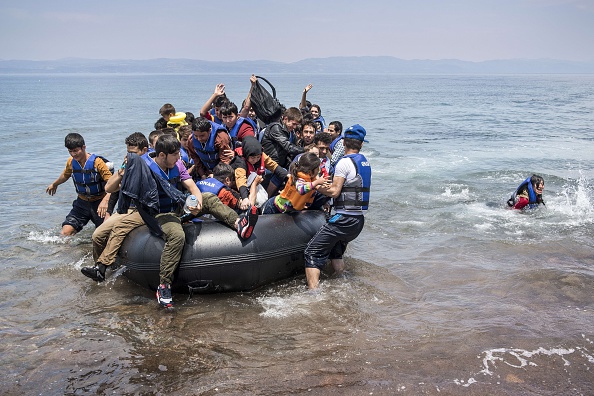
The European union is suffering from yet another crisis: the tens of thousands of migrants arriving at its shores each month, a large portion of whom are fleeing the civil war in Syria.
According to Eurostat, the number of asylum seekers in the European Union’s 28 member states reached a record 626,000 in 2014, with no sign that the flow will abate any time soon. These numbers have been quickly rising since 2012, when conflicts in the Middle East and North Africa came to a boil and displaced hundreds of thousands of refugees.
With newspapers and television dominated by pictures and reports of hundreds of migrants who have either died or been turned away by the richest continent in the world, the situation has reached a breaking point for Europe’s leaders. In a piece in Wednesday’s New York Times, Steven Erlanger argued that the migrant crisis bares resemblance to the debt crisis that continues to plague that EU:
That tension has, in some sense, made both the Greek and migrant crises two sides of the same problem. The Greeks lived large borrowing in euros, which Germany backed with its sterling credit, and then challenged Germany’s demands for harsh austerity when it ran into financial problems.
Similarly, people in the eastern reaches of Europe have enjoyed unfettered access to the big German market. But they have balked at Germany’s evolving demands for how to grapple with non-European migrants crisscrossing their lands on their way to seek asylum or work in Europe’s wealthier core.
This analysis gets both the economics of the European debt crisis wrong and places too much faith in Europe’s ability to solve a crisis that is the result of wars outside its borders. First, the European debt crisis is a bit more complicated than Greeks going on a borrowing binge backed by German credit. The German economy has benefited for years from its use of a currency that is undervalued because its alliance with less productive economies. Germany has benefitted immensely from its ability to export its products cheaply to the rest of the EU.
Meanwhile, as Hein de Haas, co-director of the International Migration Institute and professor at the University of Oxford, has pointed out that the level of immigration to a given country is directly related to the economic health of the destination and the conditions within the point of departure. That’s why the previous migrant “crisis” in the EU happened in 1992, at the height of the Balkan Wars. As long as the destination country offers far better conditions than what’s available in migrants’ home countries, any efforts to stem the flow will only speed up migration and endanger those who are fleeing. de Haas writes, “while immigration restrictions often reduce immigration, these effects tend to be rather small. In addition, restrictions often have four potential side-effects (‘substitution effects’) which further undermine their effectiveness or can even make them counter-productive.”
Those four side-effects are:
- Migrants find other illegal channels through which to migrate. “For instance, when European countries tried to curb immigration from Moroccan and Turkish workers from the 1970s, people continued to migrate as family and irregular migrants.”
- “Now or never migration,” where migrants rush to avoid new restrictions
- Migrants simply use another geographic route. “For instance, if one European country toughens its asylum policies, this may divert asylum seekers to neighbouring countries. We also see this with migration controls in the Mediterranean Sea, which do not stop migration but rather compel migrants and smugglers to use other geographical routes.”
- “The fourth and probably strongest side effect of immigration restrictions is that they not only reduce immigration but that they also reduce return migration. In other words: they reduce circulation and push migrants into permanent settlement. Ironically, this is exactly the opposite of what the policies aim to achieve.”
So while it’s laudable that Germans have spent extensive resources on refugee resettlement, and that German chancellor Angela Merkel is spending political capital on the effort to get EU countries to devote more resources to help these refugees, it’s actually the German economy most of all which is attracting them. And it’s German resistance to fixing Europe’s broken currency union that is hampering the abilities of countries like Italy and Greece to recover from the economic depression they are suffering from.