• Home
  • News
  • Fortune 500
  • Tech
  • Finance
  • Leadership
  • Lifestyle
  • Rankings
  • Multimedia
TechMusic

Pandora continues to grow, but giants loom on the horizon

By
Mathew Ingram
Mathew Ingram
Down Arrow Button Icon
By
Mathew Ingram
Mathew Ingram
Down Arrow Button Icon
July 23, 2015, 6:28 PM ET
Pandora To Raise $231 Million With Sale Of 10 Million Shares
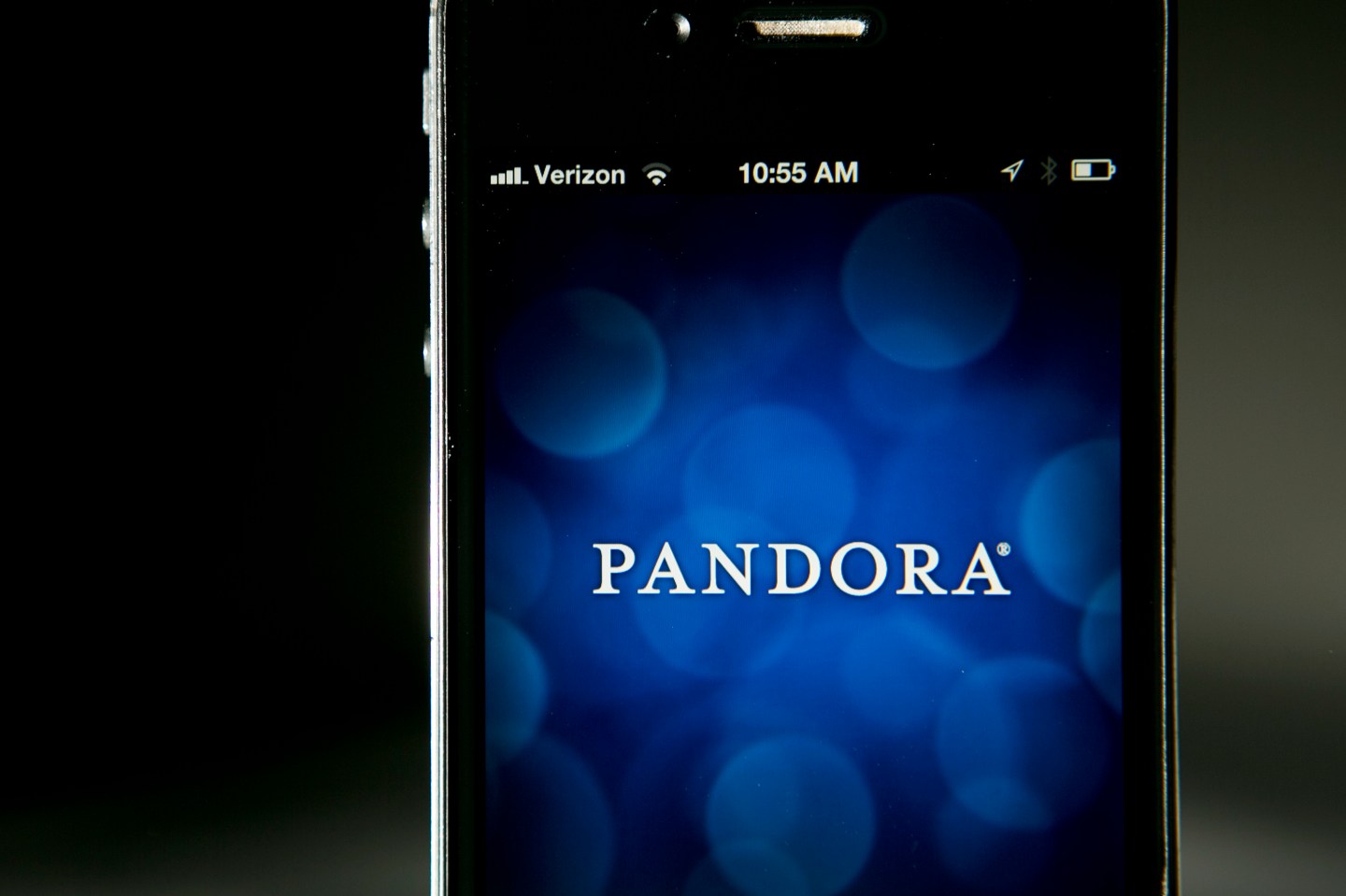
The Pandora Media Inc. logo is seen on an Apple Inc. iPhone displayed for a photograph in Washington, D.C., U.S., on Tuesday, Sept. 17, 2013. Pandora Media Inc., owner of the biggest Web radio service, filed to raise about $231 million by issuing new shares after its stock more than doubled this year. Photographer: Andrew Harrer/Bloomberg via Getty ImagesPhotograph by Andrew Harrer — Bloomberg via Getty Images

The streaming-music business has been heating up of late, with the much-hyped entrance of Apple Music, the launch of a new streaming service from Google and continued moves by Spotify, but Pandora remains the grandaddy of the industry—at least for now. Despite all the competition, the company has managed to grow both its subscriber base and the money it makes from advertising, but its losses also continue to grow, and that is likely to keep the company’s share price under pressure.

The problem for Pandora (P) is similar to that facing other streaming music services, especially those that are using a large free tier to appeal to casual users and convince them to sign up for a paid account. In order to get as broad a reach as possible in such a hyper-competitive market, Pandora has to keep spending more and more to get the artists and music that listeners want, and in order to get Google and other platforms to promote its service.

All of that costs money, substantially more than Pandora is making either from subscriptions or from music-related advertising—and in fact, that gap is increasing. In its most recent quarter, for example, the company had revenues of $285 million, up 30% over the same quarter a year earlier, but the company’s net loss for the quarter was almost 40% higher than that year-earlier period, at $16 million. The culprit, as in the previous quarter, was higher sales and marketing expenses.

Investors seemed enthusiastic about Pandora’s revenue growth when it announced its results on Thursday, and the fact that adjusted earnings (excluding stock-based compensation and other expenses) hit $0.05 per share, sharply higher than the consensus estimate of $0.02 per share. The stock was up by as much as 11% in after-hours trading following the earnings report.

That after-hours jump was a change from the general trend when it comes to Pandora’s share price, however. The stock has fallen by more than 50% in the past year, as investors have grown increasingly skeptical about the company’s ability to control its costs and remain competitive, especially with giants such as Apple (AAPL) and Google (GOOG) entering the market. Neither had much effect on Pandora’s results in the most recent quarter because they are still being rolled out.

Despite having the largest streaming music user base, with more than 80 million listeners (about 4 million of whom pay for the service monthly), Pandora isn’t the most valuable music service. That honor goes to Spotify, which has an estimated market value of about $8 billion, compared with Pandora’s market cap of just $3 billion. Why? Because while Spotify has fewer users overall, with about 75 million, it has a larger number of paying customers, at about 20 million.

On the company’s earnings conference call, CEO Brian McAndrews hinted at the hyper-competitive nature of the music market. “Monetizing free audio is a fantastically difficult problem to solve, and we are the only ones who have done it,” he said. “We intend to move aggressively to build on that over the coming year.”

Pandora wants to build on its market lead in part by becoming more than just a streaming-music service, McAndrews said. The company also wants to become a platform that connects artists and record labels not just to users but to information about those users and what they like—which is why the company acquired a music-analytics startup called Next Big Sound earlier this year.

McAndrews said his long-term goal is to have Pandora become “an indispensable partner for the music industry.” The only problem, of course, is that there are at least five other significant players who would like to do the exact same thing, and many of them have far deeper pockets than Pandora does.


About the Author
By Mathew Ingram
See full bioRight Arrow Button Icon

Latest in Tech

Big TechStreaming
Trump warns Netflix-Warner deal may pose antitrust ‘problem’
By Hadriana Lowenkron, Se Young Lee and BloombergDecember 7, 2025
5 hours ago
Big TechOpenAI
OpenAI goes from stock market savior to burden as AI risks mount
By Ryan Vlastelica and BloombergDecember 7, 2025
5 hours ago
AIData centers
HP’s chief commercial officer predicts the future will include AI-powered PCs that don’t share data in the cloud
By Nicholas GordonDecember 7, 2025
7 hours ago
Future of WorkJamie Dimon
Jamie Dimon says even though AI will eliminate some jobs ‘maybe one day we’ll be working less hard but having wonderful lives’
By Jason MaDecember 7, 2025
11 hours ago
CryptoCryptocurrency
So much of crypto is not even real—but that’s starting to change
By Pete Najarian and Joe BruzzesiDecember 7, 2025
16 hours ago
Elon Musk
Big TechSpaceX
SpaceX to offer insider shares at record-setting $800 billion valuation
By Edward Ludlow, Loren Grush, Lizette Chapman, Eric Johnson and BloombergDecember 6, 2025
1 day ago

Most Popular

placeholder alt text
Real Estate
The 'Great Housing Reset' is coming: Income growth will outpace home-price growth in 2026, Redfin forecasts
By Nino PaoliDecember 6, 2025
2 days ago
placeholder alt text
AI
Nvidia CEO says data centers take about 3 years to construct in the U.S., while in China 'they can build a hospital in a weekend'
By Nino PaoliDecember 6, 2025
1 day ago
placeholder alt text
Economy
The most likely solution to the U.S. debt crisis is severe austerity triggered by a fiscal calamity, former White House economic adviser says
By Jason MaDecember 6, 2025
1 day ago
placeholder alt text
Big Tech
Mark Zuckerberg rebranded Facebook for the metaverse. Four years and $70 billion in losses later, he’s moving on
By Eva RoytburgDecember 5, 2025
2 days ago
placeholder alt text
Economy
JPMorgan CEO Jamie Dimon says Europe has a 'real problem’
By Katherine Chiglinsky and BloombergDecember 6, 2025
1 day ago
placeholder alt text
Uncategorized
Transforming customer support through intelligent AI operations
By Lauren ChomiukNovember 26, 2025
11 days ago
Rankings
  • 100 Best Companies
  • Fortune 500
  • Global 500
  • Fortune 500 Europe
  • Most Powerful Women
  • Future 50
  • World’s Most Admired Companies
  • See All Rankings
Sections
  • Finance
  • Leadership
  • Success
  • Tech
  • Asia
  • Europe
  • Environment
  • Fortune Crypto
  • Health
  • Retail
  • Lifestyle
  • Politics
  • Newsletters
  • Magazine
  • Features
  • Commentary
  • Mpw
  • CEO Initiative
  • Conferences
  • Personal Finance
  • Education
Customer Support
  • Frequently Asked Questions
  • Customer Service Portal
  • Privacy Policy
  • Terms Of Use
  • Single Issues For Purchase
  • International Print
Commercial Services
  • Advertising
  • Fortune Brand Studio
  • Fortune Analytics
  • Fortune Conferences
  • Business Development
About Us
  • About Us
  • Editorial Calendar
  • Press Center
  • Work At Fortune
  • Diversity And Inclusion
  • Terms And Conditions
  • Site Map

© 2025 Fortune Media IP Limited. All Rights Reserved. Use of this site constitutes acceptance of our Terms of Use and Privacy Policy | CA Notice at Collection and Privacy Notice | Do Not Sell/Share My Personal Information
FORTUNE is a trademark of Fortune Media IP Limited, registered in the U.S. and other countries. FORTUNE may receive compensation for some links to products and services on this website. Offers may be subject to change without notice.