
• Home
  • Latest
  • Fortune 500
  • Finance
  • Tech
  • Leadership
  • Lifestyle
  • Rankings
  • Multimedia
TechFuture of Work

Why robots are taking over China

Robert Hackett
By
Robert Hackett
Robert Hackett
Down Arrow Button Icon
Robert Hackett
By
Robert Hackett
Robert Hackett
Down Arrow Button Icon
July 6, 2015, 12:03 PM ET
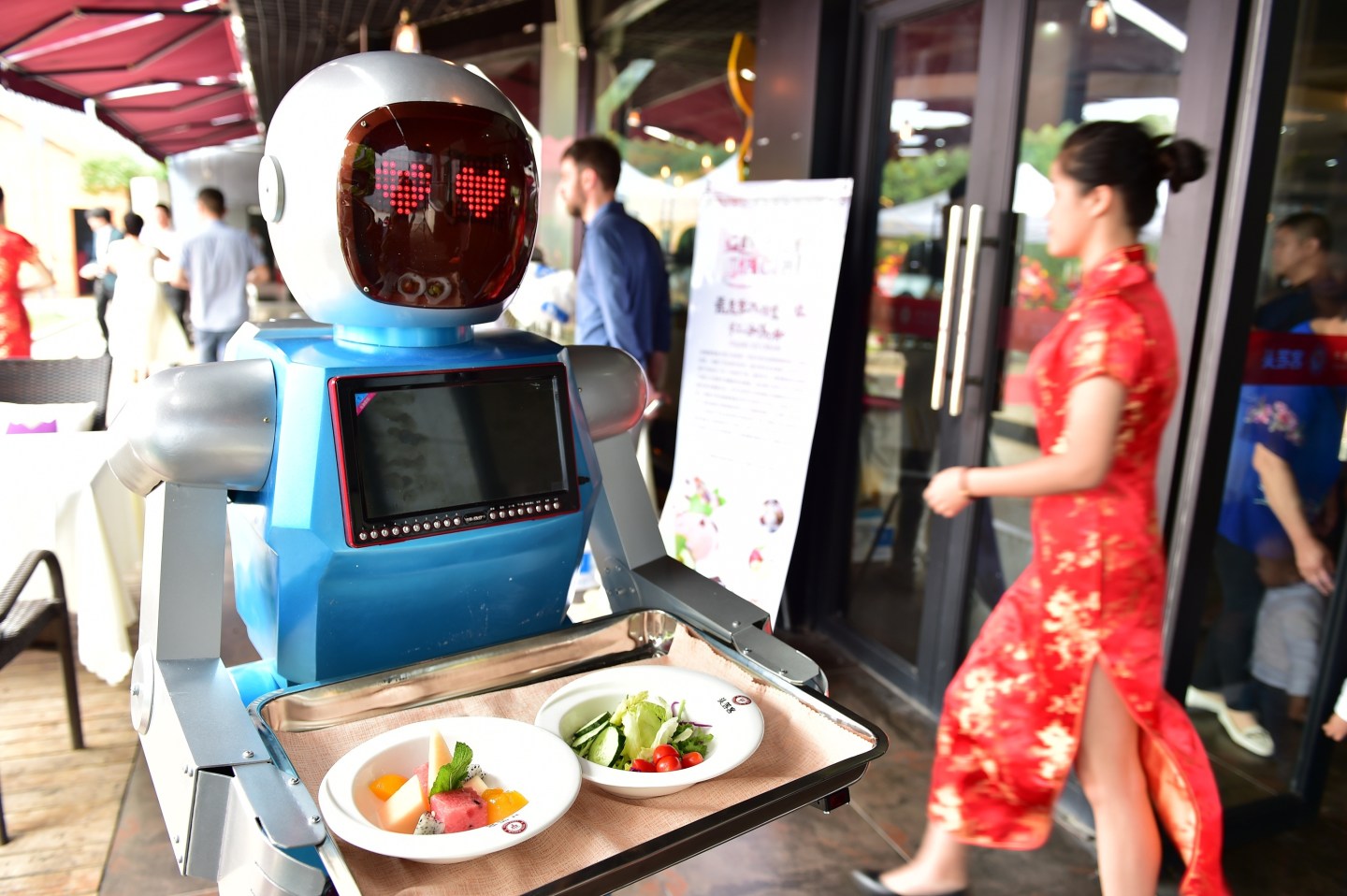
Couple Of Robot Waiters Show In Yiwu's Restaurant
YIWU, CHINA - MAY 18: (CHINA OUT) A "male" robot waiter delivers meals for customers at robot-themed restaurant on May 18, 2015 in Yiwu, Zhejiang province of China. Sophomore Xu Jinjin in 22 years old from Hospitality Management of Yiwu Industrial and Commercial College managed a restaurant where a pair of robot acted as waiters. The "male" one was named "Little Blue" (for in blue color) and the "female" one was "Little Peach" (for in pink) and they could help order meals and then delivered them to customers along the magnetic track and said: "Here're your meals, please enjoy". According to Xu Jinjin, They had contacted with the designer to present more robot waiters to make the restaurant a real one that depends completely on robots. (Photo by ChinaFotoPress/ChinaFotoPress via Getty Images)Photograph by ChinaFotoPress via Getty Images

Automation is taking China by storm. First, the country hoovered up many of the world’s manufacturing jobs, and now it is, in turn, outsourcing that work to robots.

Since 2013, China has topped the list as the world’s biggest market for robotic machinery. That appetite is not subsiding. The country’s sales for the machines surged 54% last year compared to the year prior, according to the Wall Street Journal, which cites statistics from the International Federation of Robotics. Next year, China is poised to have installed more robotic machines than any other country, the paper reports.

What’s driving the transition? Even though the cost of labor in Asia remains relatively low, it has been on the rise recently. Economists anticipate average wages to grow 10% this year, according to the Journal of Commerce. In order to keep costs own, employers are trading humans for cheaper robots.

By 2017, the IFR expects the number of robots in operation to double to 400,000 from today’s 200,000. North America, on the other hand, will grow to have about 300,000.

The automotive and electronics industries are leading the charge in workforce automation. The Taiwanese manufacturing giant Foxconn, which supplies iPhones for Apple (AAPL), for instance, predicts that 70% of its assembly line work will be taken over by robots three years from now. As an IFR document summarizes about the explosive demand for robots worldwide:

Impetus will mainly come from Asia, particularly from China, and from North America. The automotive industry will continue to be the innovator for new technology. The growing global demand for electronic products, new products, and new production technologies are boosting investments in retooling of existing production processes and expanding production capacities of the electrical/electronics industry particularly in Asia.

At the moment, China has 30 industrial robots for every 10,000 manufacturing workers—about double what it had in 2013.

Experts refer to this figure “robot density.” In comparison, South Korea has the world’s highest robot density at 437 robots per 10,000 manufacturing workers, which is about 15 times greater than China’s. Japan’s is about 11 times greater than China’s; Germany’s is 10 times higher; and the United States’ is about three times higher.

“The automation of China’s production plants has just started”, ABB Robotics managing director Per Vegard Nerseth told IFR in January. “As the first foreign robot manufacturer to arrive here, we have observed the market and developments for years now. We have witnessed swift, almost explosive growth over the last two or three years, surpassing even our expectations.”

Industry watchers are expecting major growth to continue in Asian markets such as China, Korea, and other Southeast Asian countries. As the IFR forecasts, “The potential for robot installations in this market is still tremendous.”


About the Author
Robert Hackett
By Robert Hackett
Instagram iconLinkedIn iconTwitter icon
See full bioRight Arrow Button Icon

Latest in Tech

Gary Locke is the former U.S. ambassador to China, U.S. secretary of commerce, and governor of Washington.
CommentaryChina
China is winning the biotech race. Patent reform is how we catch up
By Gary LockeDecember 12, 2025
30 minutes ago
skills
C-Suiteskills
The AI skills gap is really a ‘critical thinking’ gap: The Fortune 500 fears it can’t find talent with enough sharp thinking
By Nick LichtenbergDecember 12, 2025
40 minutes ago
Carl Rinsch
Big TechCrime
Netflix’s $11 million funding for a director’s sports cars and luxury mattresses—not a show—leads to fraud conviction
By The Associated PressDecember 12, 2025
1 hour ago
Sarandos
CommentaryAntitrust
Netflix, Warner, Paramount and antitrust: Entertainment megadeal’s outcome must follow the evidence, not politics or fear of integration
By Satya MararDecember 12, 2025
2 hours ago
Elon Musk, wearing a black DOGE hat, looks forward. He is standing in the Oval Office.
PoliticsDOGE
DOGE isn’t dead—it’s been absorbed into the bloodstream of the government, federal employees say
By Sasha RogelbergDecember 12, 2025
2 hours ago
InvestingMarkets
Retail investors drive stocks to a pre-Christmas all-time high—and Wall Street sees a moment to sell
By Jim EdwardsDecember 12, 2025
2 hours ago

Most Popular

placeholder alt text
Success
At 18, doctors gave him three hours to live. He played video games from his hospital bed—and now, he’s built a $10 million-a-year video game studio
By Preston ForeDecember 10, 2025
2 days ago
placeholder alt text
Success
Palantir cofounder calls elite college undergrads a ‘loser generation’ as data reveals rise in students seeking support for disabilities, like ADHD
By Preston ForeDecember 11, 2025
23 hours ago
placeholder alt text
Investing
Baby boomers have now 'gobbled up' nearly one-third of America's wealth share, and they're leaving Gen Z and millennials behind
By Sasha RogelbergDecember 8, 2025
4 days ago
placeholder alt text
Economy
‘We have not seen this rosy picture’: ADP’s chief economist warns the real economy is pretty different from Wall Street’s bullish outlook
By Eleanor PringleDecember 11, 2025
1 day ago
placeholder alt text
Uncategorized
Transforming customer support through intelligent AI operations
By Lauren ChomiukNovember 26, 2025
16 days ago
placeholder alt text
Success
What it takes to be wealthy in America: $2.3 million, Charles Schwab says
By Sydney LakeDecember 11, 2025
1 day ago
Rankings
  • 100 Best Companies
  • Fortune 500
  • Global 500
  • Fortune 500 Europe
  • Most Powerful Women
  • Future 50
  • World’s Most Admired Companies
  • See All Rankings
Sections
  • Finance
  • Leadership
  • Success
  • Tech
  • Asia
  • Europe
  • Environment
  • Fortune Crypto
  • Health
  • Retail
  • Lifestyle
  • Politics
  • Newsletters
  • Magazine
  • Features
  • Commentary
  • Mpw
  • CEO Initiative
  • Conferences
  • Personal Finance
  • Education
Customer Support
  • Frequently Asked Questions
  • Customer Service Portal
  • Privacy Policy
  • Terms Of Use
  • Single Issues For Purchase
  • International Print
Commercial Services
  • Advertising
  • Fortune Brand Studio
  • Fortune Analytics
  • Fortune Conferences
  • Business Development
About Us
  • About Us
  • Editorial Calendar
  • Press Center
  • Work At Fortune
  • Diversity And Inclusion
  • Terms And Conditions
  • Site Map

© 2025 Fortune Media IP Limited. All Rights Reserved. Use of this site constitutes acceptance of our Terms of Use and Privacy Policy | CA Notice at Collection and Privacy Notice | Do Not Sell/Share My Personal Information
FORTUNE is a trademark of Fortune Media IP Limited, registered in the U.S. and other countries. FORTUNE may receive compensation for some links to products and services on this website. Offers may be subject to change without notice.