• Home
  • News
  • Fortune 500
  • Tech
  • Finance
  • Leadership
  • Lifestyle
  • Rankings
  • Multimedia
Tech

Shipping crude oil by rail: Are the gains worth the risks?

By
David Z. Morris
David Z. Morris
Down Arrow Button Icon
By
David Z. Morris
David Z. Morris
Down Arrow Button Icon
July 2, 2015, 10:00 AM ET
Oil Collapse-Railroads
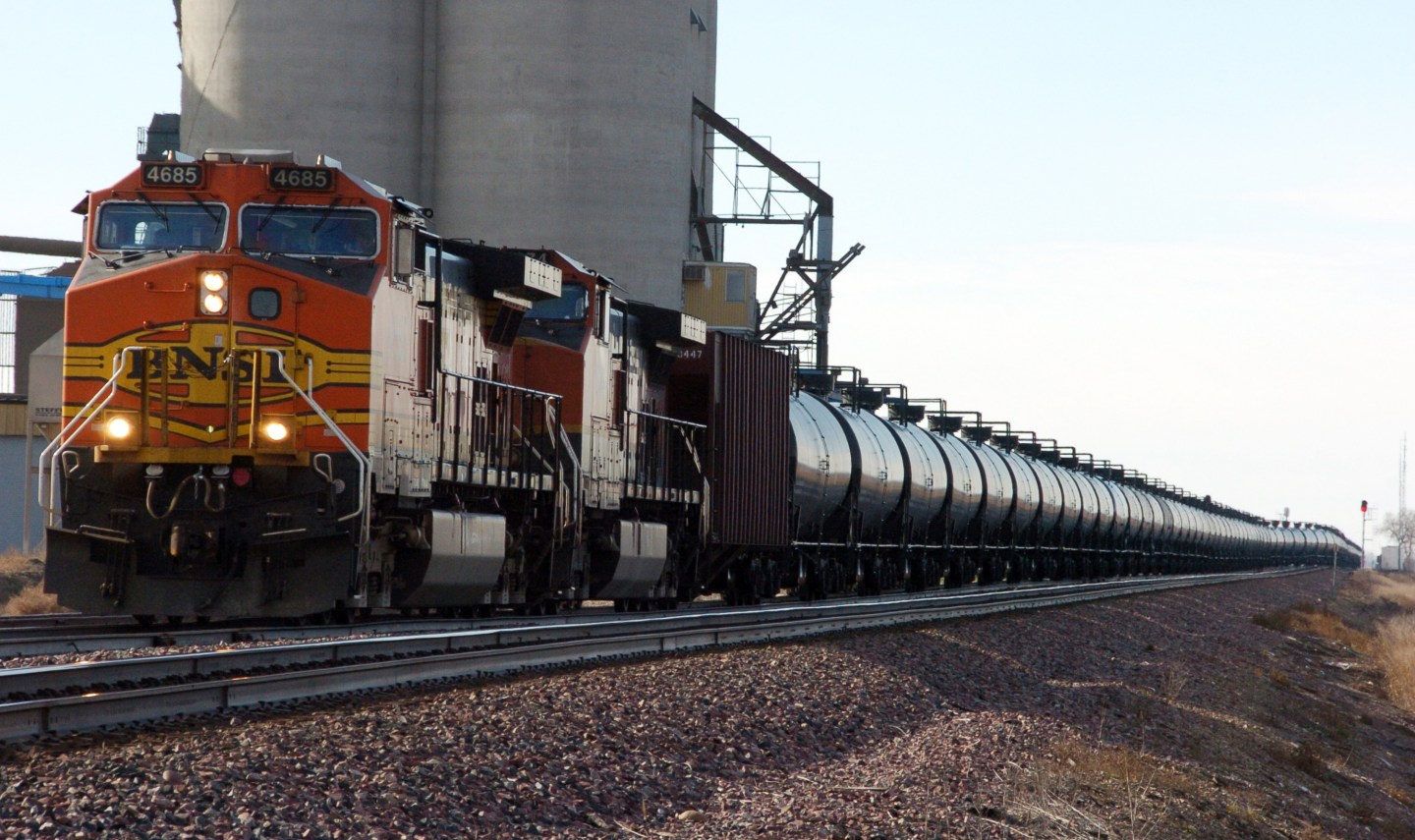
FILE - In this Nov. 6, 2013, file photo, a BNSF Railway train hauls crude oil near Wolf Point, Mont. A collapse in oil prices won't derail the railroads’ profit engine even if it does slow the tremendous growth in crude oil shipments seen in recent years. Railroads went from hauling 9,500 carloads of crude oil in 2008 to 435,560 last year, as production boomed and oil routinely sold for $90 a barrel or more. But even with the surge, crude oil shipments remain less than 2 percent of all the carloads major U.S. railroads deliver. (AP Photo/Matthew Brown, File)Photograph by Matthew Brown — AP

The past five years have seen a dramatic rise in the shipping of crude oil by rail, triggered by rapidly expanding production in both the Bakken Shale region of North Dakota and the Tar Sands of Alberta.

The U.S. Energy Information Administration reports that crude-by-rail expanded by more than eighteenfold between 2010 and 2014, as production has exceeded existing pipeline capacity and trains have taken up the slack.

But one side effect has been a string of derailments, explosions, and leaks involving crude oil trains. On June 22, 2015, the Canadian government filed new charges in connection with the 2013 explosion of a train carrying crude oil through Lac-Megantic, Quebec. The now-defunct Montreal Maine & Atlantic Railway and its affiliates are charged with safety violations including insufficient testing of hand brakes. The explosion killed 47, making it the deadliest train disaster in North America in two decades.

And according to the International Energy Agency, 4.35 million liters of crude oil were spilled in 2013 by U.S. railroads—more than the total for every previous year in which records were kept. Those who support more pipeline construction have also pointed out that moving oil by rail creates more greenhouse gas emissions. And studies have shown that both shale and sand-extracted crude is much more volatile than conventional oils.

The big railroads have made safety improvements—for example, upgrading dated tanker cars. But despite safety and environmental concerns, rail’s flexibility may be its trump card over pipelines in the new North American oil landscape.

Shipping of crude by rail had been a negligible in North America since competitors of Standard Oil rolled out pipelines in the 1870s. Even with John D. Rockefeller’s sweetheart rail deals, the pipelines were a cheaper way to move oil—and still are, by as much as half, according to the Congressional Research Service.

But pipelines require serious capital investment, long-term commitments, and even political will, while railroads are more able to accommodate short-term needs. Progress in building more pipeline capacity has been spotty: Koch Pipeline Co. in early 2014 suspended plans to construct a pipeline from North Dakota to Illinois, and the Keystone XL pipeline originating in Alberta remains in legislative limbo.

The advantages of rail’s flexibility have continued to be highlighted over the past year, as crude prices have collapsed, then rebounded slightly. Because shale and sand oil production is more expensive than conventional drilling, falling prices disproportionately depress production and exploration. That has led to what some have called a “shale bust” in North Dakota, and stalled growth in crude freighting. Pipelines, and oil producers locked into long-term contracts with them, could have become something of an albatross in the world of $60-a-barrel crude oil.

While crude prices are likely to rebound sooner rather than later, cold, hard geology also suggests pipelines could be a bad bet, at least in North Dakota. Speaking with Bloomberg, geologists have argued that unlike conventional wells, shale formations lose between 60 and 70% of their productivity after their first year. The USEIA has projected that shale oil production nationwide will peak as early as 2020, which would leave any pipeline projects underutilized within a matter of a few years.


About the Author
By David Z. Morris
See full bioRight Arrow Button Icon

Latest in Tech

Rakesh Kumar
CommentarySemiconductors
China does not need Nvidia chips in the AI war — export controls only pushed it to build its own AI machine
By Ramesh KumarDecember 3, 2025
33 minutes ago
Rochelle Witharana is Chief Financial and Investment Officer for The California Wellness Foundation
Commentarydiversity and inclusion
Fund managers from diverse backgrounds are delivering standout returns and the smart money is slowly starting to pay attention
By Rochelle WitharanaDecember 3, 2025
33 minutes ago
CryptoCryptocurrency
Exclusive: Harvard grads raise $20 million for Ostium, a platform focused on a derivative popular with crypto traders
By Ben WeissDecember 3, 2025
1 hour ago
MagazineMedia
CoComelon started as a YouTube show for toddlers. It’s now a $3 billion empire that even Disney can’t ignore
By Natalie JarveyDecember 3, 2025
2 hours ago
SAN FRANCISCO, CALIFORNIA - SEPTEMBER 04: Anthropic Co-founder and CEO Dario Amodei speaks at the "How AI Will Transform Business in the Next 18 Months" panel during INBOUND 2025 Powered by HubSpot at Moscone Center on September 04, 2025 in San Francisco, California. (Photo by Chance Yeh/Getty Images for HubSpot)
InvestingAnthropic
Anthropic considers IPO despite warnings that excess liquidity is blowing a bubble in the markets
By Jim EdwardsDecember 3, 2025
2 hours ago
NewslettersTerm Sheet
Exclusive: Angle Health raises $134 million Series B to grow its AI-driven healthcare benefits offerings
By Allie GarfinkleDecember 3, 2025
2 hours ago

Most Popular

placeholder alt text
Economy
Ford workers told their CEO 'none of the young people want to work here.' So Jim Farley took a page out of the founder's playbook
By Sasha RogelbergNovember 28, 2025
5 days ago
placeholder alt text
Success
Warren Buffett used to give his family $10,000 each at Christmas—but when he saw how fast they were spending it, he started buying them shares instead
By Eleanor PringleDecember 2, 2025
1 day ago
placeholder alt text
North America
Jeff Bezos and Lauren Sánchez Bezos commit $102.5 million to organizations combating homelessness across the U.S.: ‘This is just the beginning’
By Sydney LakeDecember 2, 2025
23 hours ago
placeholder alt text
Economy
Elon Musk says he warned Trump against tariffs, which U.S. manufacturers blame for a turn to more offshoring and diminishing American factory jobs
By Sasha RogelbergDecember 2, 2025
21 hours ago
placeholder alt text
C-Suite
MacKenzie Scott's $19 billion donations have turned philanthropy on its head—why her style of giving actually works
By Sydney LakeDecember 2, 2025
1 day ago
placeholder alt text
North America
Anonymous $50 million donation helps cover the next 50 years of tuition for medical lab science students at University of Washington
By The Associated PressDecember 2, 2025
1 day ago
Rankings
  • 100 Best Companies
  • Fortune 500
  • Global 500
  • Fortune 500 Europe
  • Most Powerful Women
  • Future 50
  • World’s Most Admired Companies
  • See All Rankings
Sections
  • Finance
  • Leadership
  • Success
  • Tech
  • Asia
  • Europe
  • Environment
  • Fortune Crypto
  • Health
  • Retail
  • Lifestyle
  • Politics
  • Newsletters
  • Magazine
  • Features
  • Commentary
  • Mpw
  • CEO Initiative
  • Conferences
  • Personal Finance
  • Education
Customer Support
  • Frequently Asked Questions
  • Customer Service Portal
  • Privacy Policy
  • Terms Of Use
  • Single Issues For Purchase
  • International Print
Commercial Services
  • Advertising
  • Fortune Brand Studio
  • Fortune Analytics
  • Fortune Conferences
  • Business Development
About Us
  • About Us
  • Editorial Calendar
  • Press Center
  • Work At Fortune
  • Diversity And Inclusion
  • Terms And Conditions
  • Site Map

© 2025 Fortune Media IP Limited. All Rights Reserved. Use of this site constitutes acceptance of our Terms of Use and Privacy Policy | CA Notice at Collection and Privacy Notice | Do Not Sell/Share My Personal Information
FORTUNE is a trademark of Fortune Media IP Limited, registered in the U.S. and other countries. FORTUNE may receive compensation for some links to products and services on this website. Offers may be subject to change without notice.