• Home
  • News
  • Fortune 500
  • Tech
  • Finance
  • Leadership
  • Lifestyle
  • Rankings
  • Multimedia
Finance

GE the latest to fall victim to the government’s renewed antitrust vigor

By
Stephen Gandel
Stephen Gandel
Down Arrow Button Icon
By
Stephen Gandel
Stephen Gandel
Down Arrow Button Icon
July 1, 2015, 5:32 PM ET
GE Appliances Sold To Electrolux Of Sweden For 3.3 Billion
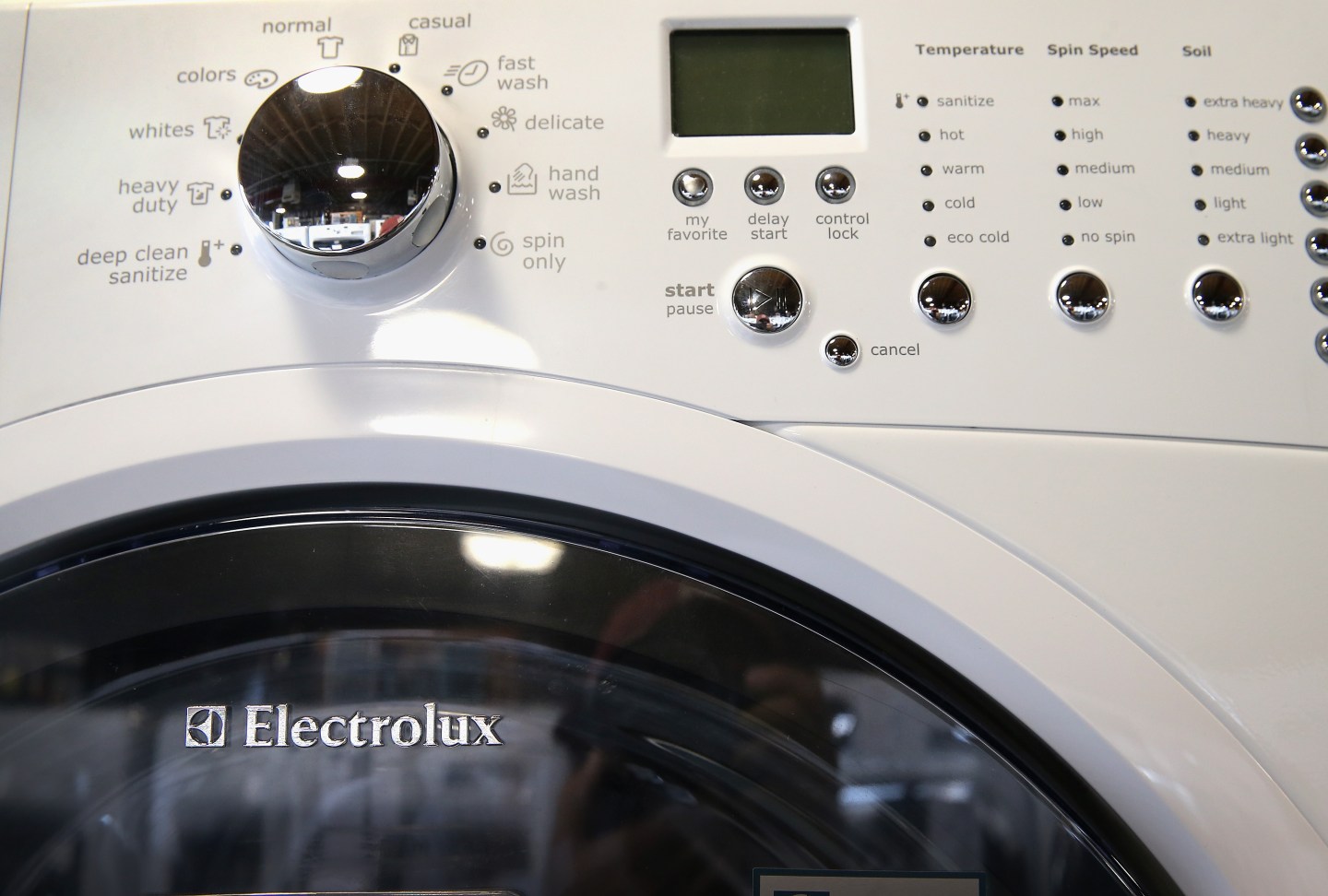
CHICAGO, IL - SEPTEMBER 08: An Electrolux washing machine is offered for sale at an appliance store on September 8, 2014 in Chicago, Illinois. Sweden's Electrolux AB, makers of Electrolux and Frigidaire appliances, announced today that it has agreed to purchase General Electric Co's (GE) appliances business for $3.3 billion in cash. (Photo by Scott Olson/Getty Images)Photograph by Scott Olson — Getty Images

When Whirlpool bought Maytag a decade ago to create by far the largest appliance maker in the world, antitrust regulators let the deal sail by. Things have certainly changed since then.

On Wednesday, the U.S. government sued Electrolux to halt its purchase of General Electric’s appliance division. The U.S. government says the merger would create a company that would dominate the sale of appliances to home builders and property managers. It would also be a major competitor in the consumer market, as well, though not as big as Whirlpool (WHR).

It’s hard to know if we have hit peak antitrust, but it feels like it. In the past two months, the government put up a road block for a number of large deals, including Comcast’s proposed merger with Time Warner Cable and U.S. Foods’ purchase of rival Sysco. And if at least one of the many proposed healthcare deals get done, the government has said that it will take a hard look at that. The Staples deal to buy Office Depot could be the next one to hit the chopping block, but given that neither of those companies have done particularly well lately, it’s likely that that may be the mega-merger to slip through.

The government’s antitrust vigor goes in waves, political ones. And it’s hard to know whether the recent rise in antitrust fights is a result of a renewed interest in regulation, or simply an indication that American industry has reached its consolidation tipping point, and that any new merger, particularly a mega one, would put us over the edge. For instance, if Electrolux were allowed to buy the appliance division of GE (GE), the combined company, along with Whirlpool, would control roughly 70% of the appliance market. Although one could argue that giving Whirlpool, which has 40% of the market alone, a stronger rival could actually increase competition.

The American economy does seem more consolidated than it used to be. But at the same time, new startups like Uber and AirBnb are turning over industries long dominated by incumbents. Even the big banks, a poster child for industry consolidation that’s gone too far, seem concerned about losing ground to startups.

Early on, the Obama Administration seemed friendlier to mergers than expected. That led executives like Brian Roberts at Comcast to think that big mergers, even in an industry like cable, would be fine. In retrospect, that was clearly a miscalculation.

But Roberts is not alone. The government’s increased focus on antitrust has done nothing to slow mergers. M&A activity is on fire this year, and it’s on track to handily surpass last year’s torrid pace. And the deals are getting larger. What’s more, the fact that a merger could get blocked is clearly not making a dent on what acquirers are willing to pay. So far this year, U.S. companies are paying a 27% premium to their target’s trading price one week before a deal is announced, according to Dealogic. That’s slightly less than the 20-year average of 30%, but it’s up from 20% two years ago.

It might be time for deal makers to recalibrate.
About the Author
By Stephen Gandel
See full bioRight Arrow Button Icon

Latest in Finance

Greg Abbott and Sundar Pichai sit next to each other at a red table.
AITech Bubble
Bank of America predicts an ‘air pocket,’ not an AI bubble, fueled by mountains of debt piling up from the data center rush
By Sasha RogelbergDecember 3, 2025
5 minutes ago
Dell
Personal FinanceWhite House
Why the government is really going to give your baby $1,000, collecting interest until they turn 18
By Moriah Balingit and The Associated PressDecember 3, 2025
1 hour ago
Bessent
BankingFederal Reserve
‘We’re going to veto them’: Bessent backs new rules to give White House more power over Federal Reserve
By Christopher Rugaber and The Associated PressDecember 3, 2025
2 hours ago
Bessent
Economyphilanthropy
Scott Bessent calls the Giving Pledge well-intentioned but ‘very amorphous,’ growing from ‘a panic among the billionaire class’
By Nick LichtenbergDecember 3, 2025
2 hours ago
William Stone
SuccessBillionaires
While Billie Eilish slams non-philanthropic billionaires, this CEO says telling people what to do with their cash is ‘invasive’ and to ‘butt out’
By Jessica CoacciDecember 3, 2025
2 hours ago
Scott Bessent
EconomyTariffs and trade
Scott Bessent is defiant on whether tariffs are a tax, demands Democrats work to cut actual taxes instead
By Nick LichtenbergDecember 3, 2025
2 hours ago

Most Popular

placeholder alt text
North America
Jeff Bezos and Lauren Sánchez Bezos commit $102.5 million to organizations combating homelessness across the U.S.: ‘This is just the beginning’
By Sydney LakeDecember 2, 2025
1 day ago
placeholder alt text
Economy
Ford workers told their CEO 'none of the young people want to work here.' So Jim Farley took a page out of the founder's playbook
By Sasha RogelbergNovember 28, 2025
5 days ago
placeholder alt text
North America
Anonymous $50 million donation helps cover the next 50 years of tuition for medical lab science students at University of Washington
By The Associated PressDecember 2, 2025
1 day ago
placeholder alt text
Economy
Elon Musk says he warned Trump against tariffs, which U.S. manufacturers blame for a turn to more offshoring and diminishing American factory jobs
By Sasha RogelbergDecember 2, 2025
1 day ago
placeholder alt text
Success
Warren Buffett used to give his family $10,000 each at Christmas—but when he saw how fast they were spending it, he started buying them shares instead
By Eleanor PringleDecember 2, 2025
1 day ago
placeholder alt text
C-Suite
MacKenzie Scott's $19 billion donations have turned philanthropy on its head—why her style of giving actually works
By Sydney LakeDecember 2, 2025
1 day ago
Rankings
  • 100 Best Companies
  • Fortune 500
  • Global 500
  • Fortune 500 Europe
  • Most Powerful Women
  • Future 50
  • World’s Most Admired Companies
  • See All Rankings
Sections
  • Finance
  • Leadership
  • Success
  • Tech
  • Asia
  • Europe
  • Environment
  • Fortune Crypto
  • Health
  • Retail
  • Lifestyle
  • Politics
  • Newsletters
  • Magazine
  • Features
  • Commentary
  • Mpw
  • CEO Initiative
  • Conferences
  • Personal Finance
  • Education
Customer Support
  • Frequently Asked Questions
  • Customer Service Portal
  • Privacy Policy
  • Terms Of Use
  • Single Issues For Purchase
  • International Print
Commercial Services
  • Advertising
  • Fortune Brand Studio
  • Fortune Analytics
  • Fortune Conferences
  • Business Development
About Us
  • About Us
  • Editorial Calendar
  • Press Center
  • Work At Fortune
  • Diversity And Inclusion
  • Terms And Conditions
  • Site Map

© 2025 Fortune Media IP Limited. All Rights Reserved. Use of this site constitutes acceptance of our Terms of Use and Privacy Policy | CA Notice at Collection and Privacy Notice | Do Not Sell/Share My Personal Information
FORTUNE is a trademark of Fortune Media IP Limited, registered in the U.S. and other countries. FORTUNE may receive compensation for some links to products and services on this website. Offers may be subject to change without notice.