• Home
  • Latest
  • Fortune 500
  • Finance
  • Tech
  • Leadership
  • Lifestyle
  • Rankings
  • Multimedia
CommentaryG7 Summit

Why the economy will be every country’s weapon of choice

By
Jennifer M. Harris
Jennifer M. Harris
Down Arrow Button Icon
By
Jennifer M. Harris
Jennifer M. Harris
Down Arrow Button Icon
June 12, 2015, 3:50 PM ET
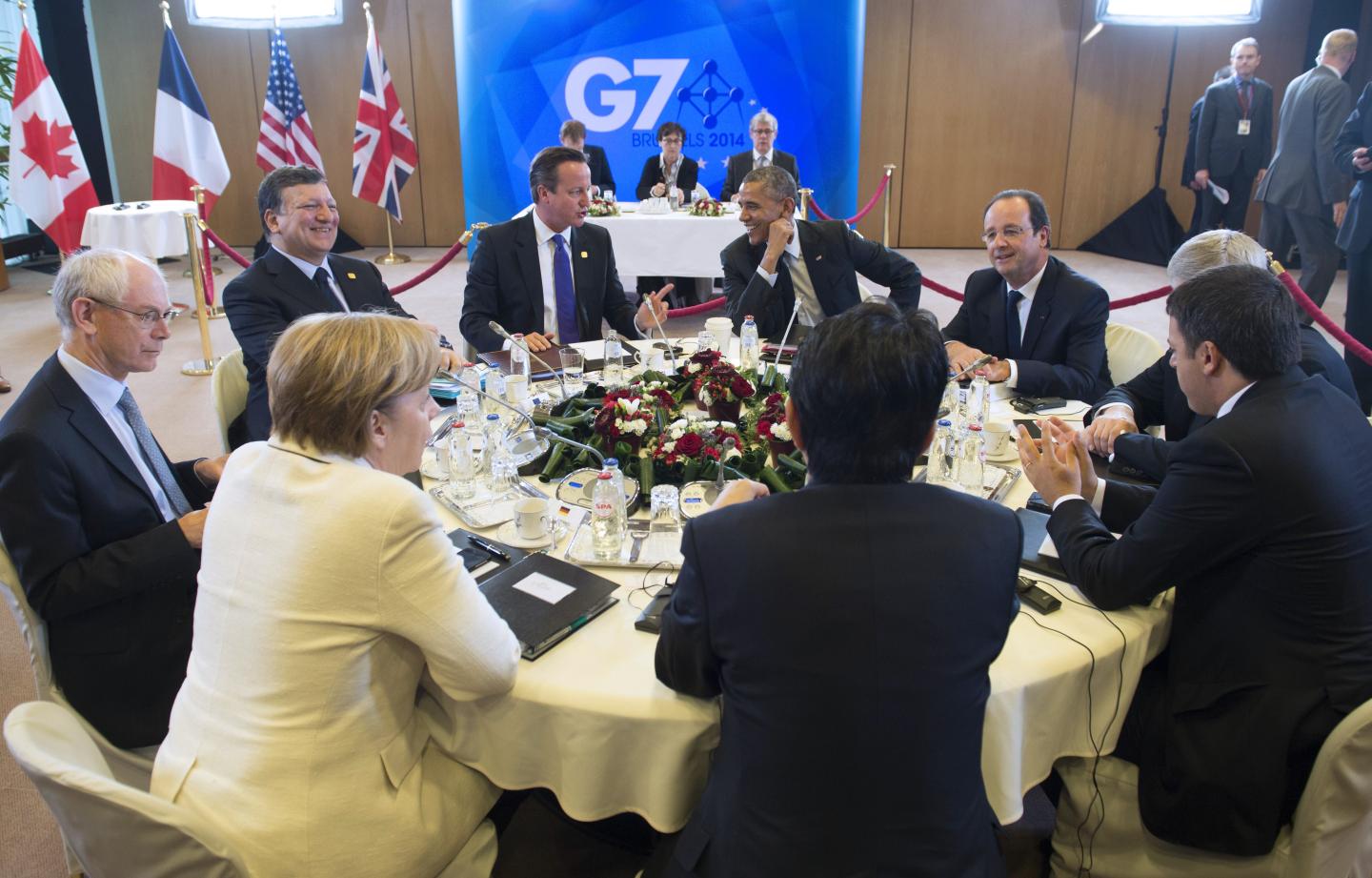
(clockwise) US President Barack Obama, French President Francois Hollande, Canadian Prime Minister Stephen Harper, Italian President Matteo Renzi, Japanese Prime Minister Shinzo Abe, German Chancellor Angela Merkel, President of the European Council Herman Van Rompuy, President of the European Commission Jose Manuel Barroso and British Prime Minister David Cameron participate in a session on the global economy during the G7 Summit at the European Council in Brussels, on June 5, 2014. AFP PHOTO / Saul LOEB        (Photo credit should read SAUL LOEB/AFP/Getty Images)
(clockwise) US President Barack Obama, French President Francois Hollande, Canadian Prime Minister Stephen Harper, Italian President Matteo Renzi, Japanese Prime Minister Shinzo Abe, German Chancellor Angela Merkel, President of the European Council Herman Van Rompuy, President of the European Commission Jose Manuel Barroso and British Prime Minister David Cameron participate in a session on the global economy during the G7 Summit at the European Council in Brussels, on June 5, 2014. AFP PHOTO / Saul LOEB (Photo credit should read SAUL LOEB/AFP/Getty Images)SAUL LOEB/AFP/Getty Images

President Barack Obama was in the Bavarian Alps this week for the annual Group of Seven Leaders’ Summit, complete with the time-honored awkward Group photo, a rite that even the leaders of the free world seem powerless to end (2013’s entry remains the one to beat). Yet for all of its timeworn familiarity, this year’s photo offered hints of something new.

It captured the Group’s first real gathering as a body of seven again, down from eight — or, at least the first that all sides had the benefit of a year to plan (while the Group did meet as seven last year, that meeting came just weeks after the Group’s decision to uninvite Russia for conduct unbecoming of a G8 member, upending the planned agenda and forcing a last-minute change of venue from Sochi to the Hague). As such, this week’s Summit suggested the return of a more familiar form of “global governance” – Trans-atlanticism plus Japan. It was the most concrete admission yet that global governance in the post-Cold War era had bitten off more than it could manage, and was in need of downscaling.

Back among true friends, then, how did the G7 do?

First the good news.

Leaders seized the occasion to keep their gaze on Russia, as the United States and the United Kingdom sought to stiffen the resolve of EU countries waning in their enthusiasm for the current U.S. – EU sanctions on Russia. The spectacle underscored just how novel the current U.S.- EU coordination on sanctions is; never before has Washington exercised this much restraint in refusing to get out ahead of a European Union foreign policy apparatus that can be maddeningly slow and unwieldy.

Such difficulties maintaining a unified line on sanctions drew especially sharp contrast with the routine and sophisticated coordination—the basic habits of cooperation and shared understandings—that the U.S. and Europe enjoy on the military and security side. No doubt NATO has its flaws, but nor are Washington and Brussels inventing military redlines from scratch. Whether or not the specific decisions coming out of NATO over the past 12 months have been the right ones, NATO’s leaders have in relatively short-order managed to settle on, communicate, and execute a concrete set of responses to Russian provocations. The U.S. and Europe have no such economic counterpart similar to what NATO represents on the security side, no such framework or foundation for jointly exercising economic muscle. So long as that is the case, U.S and EU leaders will continue to struggle with many of the most important ingredients to resolving this conflict —from coordinated sanctions capable of pushing back on Russian aggression, to a joint blueprint for stabilizing Ukraine from economic freefall, to adequate defenses against the pipeline politics and other forms of economic coercion so favored by Moscow.

It is no accident that these economic dimensions are proving central to this crisis and its eventual outcomes. This contrast—the most sophisticated alliance system to answer military threats in the modern world on one hand, and no meaningful counterpart when it comes to advancing the economic aspects of our common foreign policy objectives—is precisely why President Putin has taken to economic tatics as a first resort (of course military tactics are in full evidence, too, but in dialing up or down aggression at will, President Putin’s military strategy seems calculated to fatigue Ukraine economically and exhaust Europe’s pain tolerance for maintaining sanctions). And it is why China, too, has opted for economic means of working its will in the world. Welcome to the era of geoeconomic statecraft, where more and more, geopolitics and state power struggles will be waged through economic means.

This week’s Summit was a heartening sign that the leaders assembled at the leaner, more nimble G7 table are at least beginning to wake up to this new era of geoeconomic statecraft, and the new habits of cooperation it will require. That is the opportunity of the newly returned G7: to offer a foundation for the kind of geoeconomic cooperation the West will need if it is to meet the challenges of a rising China, a belligerent Russia, and a sophisticated financing outfit like the Islamic State.

But to evolve in this direction, the G7 will need to make some conscious decisions. It will need new norms that give all sides better baseline presumptions. Take sanctions, for instance, and the structural design flaws inherent to the current EU sanctions approach. Why, when wrangling 27 member nations is certain to prove challenging, are the EU’s sanctions designed so as to automatically expire? Why place the default burden on EU member countries to renew these sanctions, rather than on Moscow to earn their removal through delivering on stated commitments? The G7 would be a useful venue for member countries to agree to a basic architecture for how their respective sanctions regimes should work jointly—a place where leaders could smooth the many design and enforcement wrinkles plaguing important sanctions regimes against both Russia and Iran.

Finally, a return to the G7 should also allow for more ambition and meaningful linkages across issues of genuine, unanimous concern in the United States, Europe and Japan—in short, more “two-fers” and “three-fers.” In addition to the Russia – Ukraine crisis, another of the Group’s major agenda items this week was climate. Here, the Group could have targeted fuel subsidies. Recent work I have done with colleagues at the Council on Foreign Relations and experts in the field makes clear how centrally fuel subsidies figure into Ukraine’s economic viability (fuel subsidies have cost Ukraine roughly $10 billion per year in recent years—an amazing sum, especially considering that the country’s current IMF bailout totals $17.5 billion over four years); how they reward Russia along with other major oil and gas producers, and how, if dismantled, oil consumption could fall by 3 to 4 million barrels of oil per day. Instead, G7 leaders contented themselves with a pledge to ween themselves from carbon by the end of this century—when neither they will be around to answer for failure, nor we to point it out. At least now back among friends, can’t we agree to do better?

Jennifer M. Harris is a senior fellow at the Council on Foreign Relations (CFR). Prior to joining CFR, Jennifer was a member of the policy planning staff at the U.S. Department of State responsible for global markets, geo-economic issues, and energy security. Jennifer is currently writing a book on the modern use of economic and financial instruments as tools of statecraft.

About the Author
By Jennifer M. Harris
See full bioRight Arrow Button Icon

Latest in Commentary

Finance
Lorem ipsum dolor sit amet, consectetur adipiscing elit, sed do eiusmod tempor incididunt ut labore et dolore magna aliqua. Ut enim ad minim veniam
By Fortune Editors
October 20, 2025
Finance
Lorem ipsum dolor sit amet, consectetur adipiscing elit, sed do eiusmod tempor incididunt ut labore et dolore magna aliqua. Ut enim ad minim veniam
By Fortune Editors
October 20, 2025
Finance
Lorem ipsum dolor sit amet, consectetur adipiscing elit, sed do eiusmod tempor incididunt ut labore et dolore magna aliqua. Ut enim ad minim veniam
By Fortune Editors
October 20, 2025
Finance
Lorem ipsum dolor sit amet, consectetur adipiscing elit, sed do eiusmod tempor incididunt ut labore et dolore magna aliqua. Ut enim ad minim veniam
By Fortune Editors
October 20, 2025
Finance
Lorem ipsum dolor sit amet, consectetur adipiscing elit, sed do eiusmod tempor incididunt ut labore et dolore magna aliqua. Ut enim ad minim veniam
By Fortune Editors
October 20, 2025
Finance
Lorem ipsum dolor sit amet, consectetur adipiscing elit, sed do eiusmod tempor incididunt ut labore et dolore magna aliqua. Ut enim ad minim veniam
By Fortune Editors
October 20, 2025

Most Popular

Finance
Lorem ipsum dolor sit amet, consectetur adipiscing elit, sed do eiusmod tempor incididunt ut labore et dolore magna aliqua. Ut enim ad minim veniam
By Fortune Editors
October 20, 2025
Finance
Lorem ipsum dolor sit amet, consectetur adipiscing elit, sed do eiusmod tempor incididunt ut labore et dolore magna aliqua. Ut enim ad minim veniam
By Fortune Editors
October 20, 2025
Finance
Lorem ipsum dolor sit amet, consectetur adipiscing elit, sed do eiusmod tempor incididunt ut labore et dolore magna aliqua. Ut enim ad minim veniam
By Fortune Editors
October 20, 2025
Finance
Lorem ipsum dolor sit amet, consectetur adipiscing elit, sed do eiusmod tempor incididunt ut labore et dolore magna aliqua. Ut enim ad minim veniam
By Fortune Editors
October 20, 2025
Finance
Lorem ipsum dolor sit amet, consectetur adipiscing elit, sed do eiusmod tempor incididunt ut labore et dolore magna aliqua. Ut enim ad minim veniam
By Fortune Editors
October 20, 2025
Finance
Lorem ipsum dolor sit amet, consectetur adipiscing elit, sed do eiusmod tempor incididunt ut labore et dolore magna aliqua. Ut enim ad minim veniam
By Fortune Editors
October 20, 2025
Fortune Secondary Logo
Rankings
  • 100 Best Companies
  • Fortune 500
  • Global 500
  • Fortune 500 Europe
  • Most Powerful Women
  • World's Most Admired Companies
  • See All Rankings
  • Lists Calendar
Sections
  • Finance
  • Fortune Crypto
  • Features
  • Leadership
  • Health
  • Commentary
  • Success
  • Retail
  • Mpw
  • Tech
  • Lifestyle
  • CEO Initiative
  • Asia
  • Politics
  • Conferences
  • Europe
  • Newsletters
  • Personal Finance
  • Environment
  • Magazine
  • Education
Customer Support
  • Frequently Asked Questions
  • Customer Service Portal
  • Privacy Policy
  • Terms Of Use
  • Single Issues For Purchase
  • International Print
Commercial Services
  • Advertising
  • Fortune Brand Studio
  • Fortune Analytics
  • Fortune Conferences
  • Business Development
  • Group Subscriptions
About Us
  • About Us
  • Lists Calendar
  • Press Center
  • Work At Fortune
  • Terms And Conditions
  • Site Map
  • About Us
  • Lists Calendar
  • Press Center
  • Work At Fortune
  • Terms And Conditions
  • Site Map
  • Facebook icon
  • Twitter icon
  • LinkedIn icon
  • Instagram icon
  • Pinterest icon

Latest in Commentary

ken
Commentary250 Years of Innovation
The longevity revolution is here. Our systems still think we die at 65
By Ken DychtwaldApril 23, 2026
15 hours ago
tenzin
Commentaryclean energy
The Iran War just made the clean energy transition non-negotiable
By Tenzin SeldonApril 23, 2026
23 hours ago
Software developers discussing programming code and planning how to create innovative software at co-working office. Two software developers checking programming code on computer screen. working through a coding problem together.
Commentaryregulation
Inflated AI claims are under fire—and the regulatory reckoning is coming
By Perrie M. WeinerApril 23, 2026
24 hours ago
Kemba Walden served as Acting National Cyber Director of the United States and is President of the Paladin Global Institute.
CommentaryHacking
Former national cyber director: Anthropic’s ‘Mythos’ AI can hack nearly anything and we aren’t ready
By Kemba WaldenApril 23, 2026
1 day ago
frank
CommentaryVisa
Visa CMO: AI agents are your new customers — here’s how to sell to them
By Frank Cooper IIIApril 22, 2026
2 days ago
shlomit
Commentarycyber
The Mythos meeting focused on the wrong AI risk to banks. Here’s the one nobody is talking about
By Shlomit WagmanApril 22, 2026
2 days ago

Most Popular

When interest on national debt overtook military spending, it triggered a limit where the U.S. may ‘cease to be a great power,’ warns Hoover historian
Economy
When interest on national debt overtook military spending, it triggered a limit where the U.S. may ‘cease to be a great power,’ warns Hoover historian
By Eleanor PringleApril 23, 2026
1 day ago
Despite nearing their 60s, nearly four in 10 Americans heading towards the end of their careers don’t even have a retirement account
Success
Despite nearing their 60s, nearly four in 10 Americans heading towards the end of their careers don’t even have a retirement account
By Emma BurleighApril 23, 2026
20 hours ago
Officials will flush 50,000 toilets to flood a Utah lake in order to generate electricity
Environment
Officials will flush 50,000 toilets to flood a Utah lake in order to generate electricity
By Mead Gruver, Dorany Pineda and The Associated PressApril 22, 2026
2 days ago
Cursor’s 25-year-old CEO is a former Google intern who just inked a $60 billion deal with SpaceX
AI
Cursor’s 25-year-old CEO is a former Google intern who just inked a $60 billion deal with SpaceX
By Marco Quiroz-GutierrezApril 22, 2026
2 days ago
The Iran war is pushing Southeast Asia to debate the once unthinkable: Whether ships will need to pay to transit the Strait of Malacca
Economy
The Iran war is pushing Southeast Asia to debate the once unthinkable: Whether ships will need to pay to transit the Strait of Malacca
By Angelica AngApril 23, 2026
24 hours ago
The Gen Z Pout and the Gen Z Stare are both a warning to Fortune 500 CEOs
Future of Work
The Gen Z Pout and the Gen Z Stare are both a warning to Fortune 500 CEOs
By Nick LichtenbergApril 23, 2026
1 day ago

© 2026 Fortune Media IP Limited. All Rights Reserved. Use of this site constitutes acceptance of our Terms of Use and Privacy Policy | CA Notice at Collection and Privacy Notice | Do Not Sell/Share My Personal Information
FORTUNE is a trademark of Fortune Media IP Limited, registered in the U.S. and other countries. FORTUNE may receive compensation for some links to products and services on this website. Offers may be subject to change without notice.