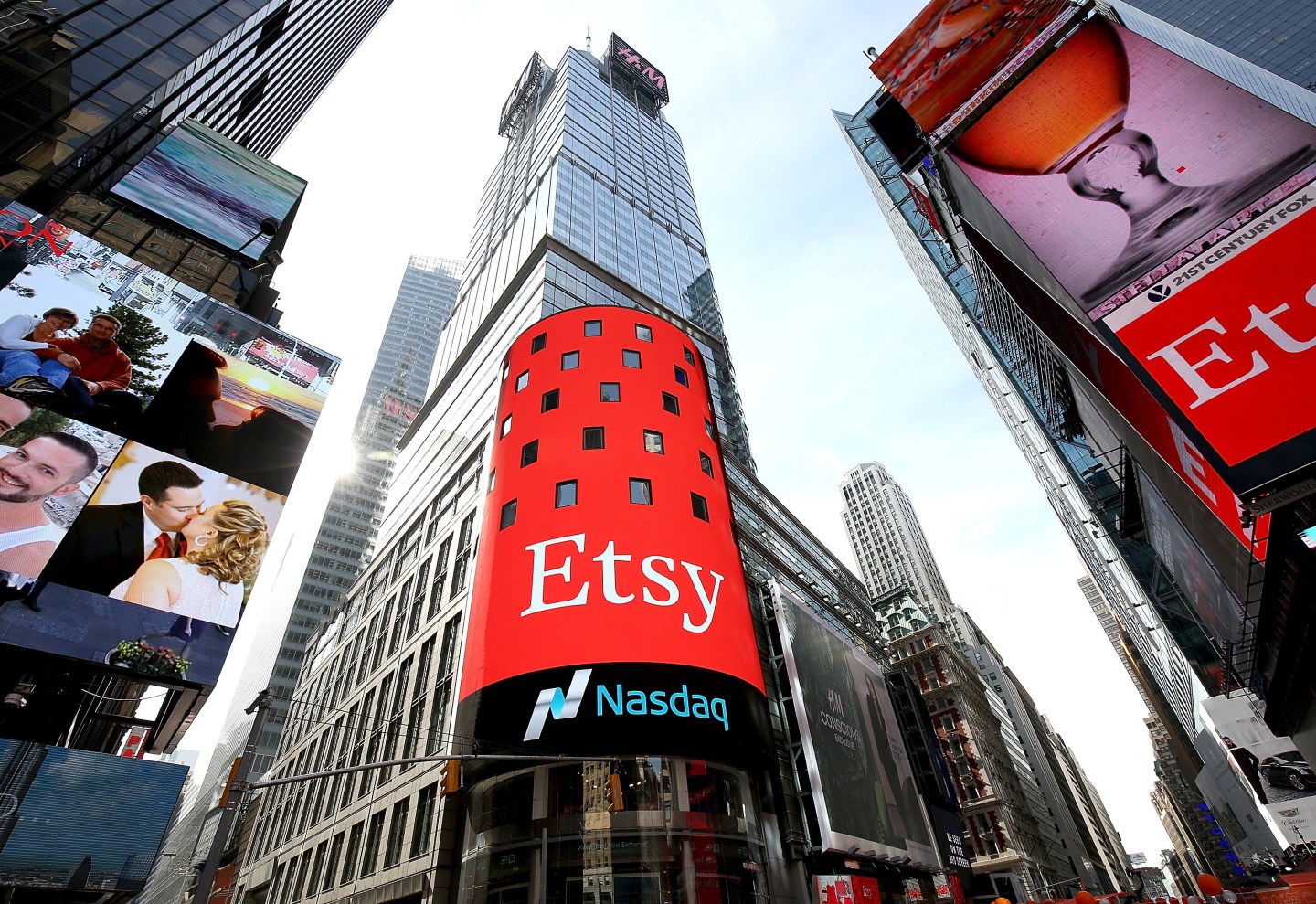
When Etsy went public earlier this year, the Securities and Exchange Commission questioned the way the company would record revenue from certain fees. The regulator was also concerned that a graphic at the beginning of Etsy’s IPO prospectus was misleading. The graphic, which was labeled “our innovative platform,” showed sales growing from $280 billion in 2008 to $695 billion in 2013. In fact, Etsy’s revenue in 2013 was only $125 million (yes, million).
The company eventually revised the graphic, making it clear that it was talking about industry-wide sales and not revenues specifically at Etsy. Shares of Etsy (ETSY), which is an online marketplace for vintage and craft goods, have fallen nearly 50% from where they closed on their first day of trading after its IPO.
Etsy is far from the only tech startup to go back and forth with the SEC over its unconventional financial reporting practices. As tech startups stay private for longer periods of time, more and more are being questioned about the way they book sales and report those sales to their potential investors.
Twitter (TWTR) also had words with the SEC over its revenue recognition policies when it went public in late 2013. Following questions from the regulator, the social media company changed and expanded the description of how it tallies sales from some of its advertising deals in its IPO filings.
Initially, Twitter planned to tell investors that it hadn’t yet developed a policy for how it would book sales from some of its long-term advertising deals, ones where the expected revenue to the company wasn’t immediately clear. The company said it would use its “best estimate of sales price” when tallying up figures from these deals to compute its quarterly statements. It also said that the way it calculates those estimates could change over time.
But by the time the social media company went public, Twitter had changed most of the language in that part of its offering documents. Instead, the company gave a detailed description of the types of deals where estimates would be needed and why and said that its policies for making those estimates would be consistent. The final draft of its offering statement said the company was confident in its estimation abilities for these deals.
Earlier this year, law firm Proskauer Rose published a report that found that the SEC had questioned 88% of the technology, media, and telecommunications companies that went public last year about the way they record and report their sales. That was up from 79% the year before. Non-technology companies received far fewer inquires from the SEC. Overall, the SEC asked 46% of companies going public to clarify their revenue recognition policies.
The report also found that 30% of the companies going public last year acknowledged they were at serious risk of incorrectly reporting their financial information. That was up from 17% the year before. Etsy was among the companies that reported that, during their IPO process, they had a weakness in their accounting procedures. Also in that group were camera company GoPro and food delivery service GrubHub.
On Wednesday, The Wall Street Journal reported that a number of private technology companies seemed to be very loose about how they reported revenue or potential revenue to investors. In one instance, tech company Hortonworks implied that it would have annual sales of $100 million by the end of 2014. After it went public, the company reported that its actual 2014 sales were less than half of what it told private investors.
Some worry that the weak reporting standards for private companies could be inflating a bubble in technology companies that have yet to go public. A growing number of private companies are being valued at $1 billion or more. The New York Times recently reported that many of these private companies may not be worth as much as their latest round of financing implies. A number of the companies have had to lower their valuations and hand out additional shares to earlier investors when they go public.
For Etsy and Twitter, the revenue accounting policies examined by the SEC appear to have to do with a very small portion of the companies’ revenues. In one instance, the SEC asked Etsy how it recorded wholesaler enrollment fees that it charges certain sellers on its website. The company said it recorded the fees as revenue not at the time it was charged but spread those amounts over the time the seller remains in the wholesaler program. Since the program was new, the SEC asked Etsy how it would know how long sellers would remain as wholesalers. Etsy said the program had generated less than $15,000 in revenue. The SEC appears to have dropped its concerns about the program, and Etsy didn’t have to change the wording in its filings. The SEC also questioned how Etsy recorded the fees it charges sellers for processing transactions. That issue was also resolved without Etsy having to restate anything in its filings.
Like other tech startups, Etsy used to regularly report its sales in blog posts on its website. It stopped doing that as it neared its IPO. Those sales, though, appear to be in line with what the company eventually reported in its IPO filings.
But Etsy was forced to make some changes in its IPO filings related to accounting issues. The company’s final pre-IPO prospectus said that it had discovered two material weaknesses in its accounting practices. The company said those weaknesses led to some miscalculations in its expenses. Etsy was also forced to restate its earnings in prior years. For instance, it said it made $518,000 from its operations in 2013. Instead, its restated numbers showed a profit of just $58,000 for that year. Etsy’s original IPO filing made no mention of accounting issues.