• Home
  • Latest
  • Fortune 500
  • Finance
  • Tech
  • Leadership
  • Lifestyle
  • Rankings
  • Multimedia
FeaturesBullet Trains

Why America is betting big on bullet trains

By
Brian Dumaine
Brian Dumaine
Down Arrow Button Icon
By
Brian Dumaine
Brian Dumaine
Down Arrow Button Icon
June 4, 2015, 8:23 AM ET
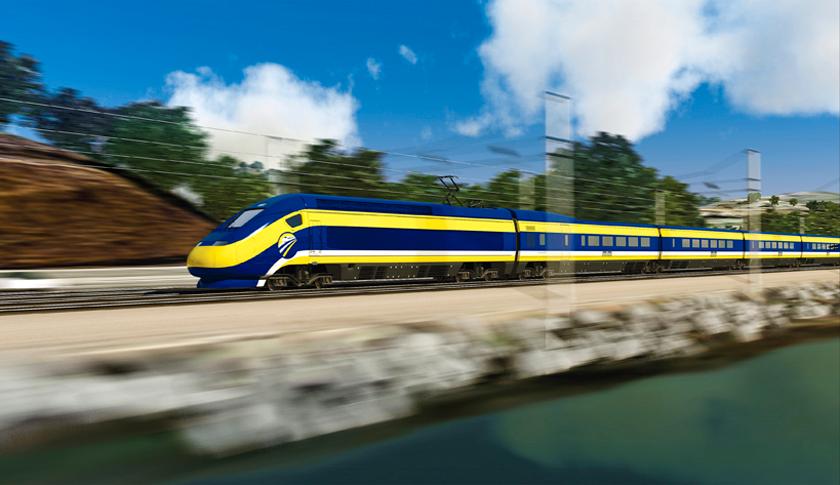
A rendering of California's high-speed-rail system, currently under construction, will link Los Angeles with San Francisco and make the 410-mile trek in under three hours with top speeds of more than 200 mph. The state eventually plans to extend the system to Sacramento and San Diego, totaling 800 miles with up to 24 stations.
A rendering of California's high-speed-rail system, currently under construction, will link Los Angeles with San Francisco and make the 410-mile trek in under three hours with top speeds of more than 200 mph. The state eventually plans to extend the system to Sacramento and San Diego, totaling 800 miles with up to 24 stations.Courtesy of California High-Speed Rail Authority

Americans love cars, which goes a long way to explain why we’ve failed to build a serious high-speed-rail network. Yes, we have Amtrak’s Acela Express, which runs from Boston to Washington, D.C., but that passenger train only occasionally hits 150 miles per hour—its average speed is a paltry 68 mph. (Too much speed contributed to the fatal Amtrak regional train crash in May.) By comparison Shanghai’s maglev train hits a high of 268 mph and averages 143 mph. That might be about to change, as crowded highways, growing populations, and a generation of millennials lukewarm on car ownership have encouraged entrepreneurs and state officials in California, Texas, and Florida to start building the next generation of bullet trains.

Existing miles of high-speed rail
ChinaEuropeJapanU.S.
6,917 miles4,699 miles1,655 miles456 miles

Where bullet trains make the most sense in a big country

Amtrak, with 21,300 miles of rail, covers most of the nation. High-speed trains, however, just wouldn’t be able to compete with planes for long-distance travel. Expect instead to see them on heavily traveled urban corridors.

The challenge with high-speed rail is that America is a vast nation. Amtrak covers most of the country, last year moving 31 million passengers to more than 500 destinations in 46 states. Its long routes, however, such as from New York City to the West Coast can’t compete with airlines either in terms of time or cost and are money losers. In fiscal 2014, the government-owned company suffered an operating loss of $227 million on $3.2 billion in revenues. By contrast, its busy Northeast corridor, where 11.4 million passengers traveled along the 456-mile route in 2014, posted an operating profit. The private companies moving into markets such as Florida and Texas see the sweet spot for high-speed rail to be trips of around 400 miles or less.

Ridership for Amtrak Selected Stations, 2014
Map by Nicolas Rapp

Amtrak’s Acela wants to boost its speed

Amtrak’s Acela Express is America’s fastest train, yet its average speed is only 68 mph on the trip between Boston and Washington, D.C.  The train does hit 150 mph along a few stretches of straight track, but that hardly warrants the tag bullet train. One possibility for boosting speed would be to upgrade its lines and build a new track through central Connecticut to avoid the current curves along the coastline. Amtrak says three-hour service between Boston and D.C. could be possible. It would need to secure tricky rights of way for new tracks and billions in new federal funding —no easy task.

Amtrak's Acela wants to boost its speed

The sunshine state embraces Amtrak high-speed rail

A Coral Gables, Fla., real estate and transportation company, FECI (FIG), has broken ground on All Aboard Florida, a $3 billion express passenger train that will run on the popular corridor between Miami and Orlando. Scheduled to roll in 2017, the train will travel the 235-mile route at an average speed of 81 mph. Its maximum speed: 125 mph.

The sunshine state embraces high-speed rail

Japan’s bullet trains are headed for the lone star state

A private company named Texas Central Partners plans to build a $10 billion, for-profit high-speed-train system that will travel the 240-mile route between Dallas and Houston in under 90 minutes. The company says that will make rail travel much faster than autos and competitive with air. The system, slated to open in 2021, will employ a fleet of Japan’s N700 bullet trains. Top speed? A sleek 205 mph.

Japan's bullet trains are headed for the Lone Star State

California’s bold bid for high-speed rail

California’s high-speed-rail system, currently under construction, will link Los Angeles with San Francisco and make the 410-mile trek in under three hours with top speeds of more than 200 mph. (An artist’s version of one is below.) The state eventually plans to extend the system to Sacramento and San Diego, totaling 800 miles with up to 24 stations.

California's bold bid for high-speed rail


How to pay for high-speed rail

Some ­private investors in Texas and Florida think they can make bullet trains profitable.

If america is going to bite the bullet on bullet trains, it can’t depend on the federal government for much help. Since Amtrak was founded in 1970, the railroad and Congress have had a contentious relationship, with charges flying that the highly subsidized company is nothing but a money-losing boondoggle. With this kind of antipathy toward the program, funding for Amtrak has been flat at best (see chart below), which leaves few if any new funds available to build high-speed systems.

California plans to construct a high-speed system from Los Angeles to San Fran­cisco, using private and state funds (including a proposal to use some of the state’s carbon cap-and-trade revenue), plus some leftover federal stimulus dollars. Elsewhere, the private sector is stepping in. A proposed Dallas-to-Houston line promises 205 mph service in 2021 without a single dollar from taxpayers. Private money also backs a Miami-to-Orlando line, with service to begin in 2017. Do such projects make economic sense? Robert ­Puentes, a policy analyst at the Brookings Institution, says, “It’s not clear. In California there’s an expectation the train will be profitable because there’s a big market for travel on that corridor. To make high-speed pay, private companies building such railroads will likely have to develop land around their train stations to make it work financially.” That’s a model that has worked well in Asia, so why not here?

Yearly Amtrak ridership / Federal Amtrak subsidies

Train safety gets worse as Congress squabbles

The Philadelphia Amtrak crash in May that killed eight and injured many more suggests that the nation is skimping on infrastructure spending, and train safety is one victim. Congressional Democrats charge that recent budget cuts have hurt safety. Republicans say that’s absurd.

Train safety gets worse as Congress squabbles


Green Transport

How do trains stack up environmentally to other modes of travel? Better than you might think.

You can talk all you want about Teslas, but when it comes to overall energy efficiency, Amtrak beats other modes of transport hands down. According to the U.S. Department of Transportation, trains are dramatically more efficient per passenger mile than autos and air travel. And as a general rule, trains are also considerably more energy-efficient than buses, while emitting less damaging compounds into the air. Amtrak’s electrified trains in the Northeast corridor are better fuel misers than its diesels and can feed energy captured from regenerative braking back to the electrical grid.

Traveling by train, however, is on the pricey side, costing on average 31¢ per passenger mile, compared with 13¢ for flying. But going by rail is a steal compared with driving the family sedan, which costs a whopping 61¢ a mile.

Energy intensity of transportation modes


Super-Fast Trains on a Roll Globally

From China to Japan to Europe, nations are investing billions in high-speed, high-tech trains.

Over the past decade or so, China has built the world’s biggest high-speed-train network, with some 6,900 miles of track. Since the service was first launched in 2007, the number of passengers riding each day has risen from 237,000 to 2.5 million last year, making it the heaviest trafficked in the world. To give you an idea of the scale, China is investing more than $128 billion in domestic railway construction in 2015, compared with about $100 billion in 2014. China plans to add another 4,700 miles of passenger track this year alone. By comparison, the U.S. government invests $1.4 billion annually in Amtrak.

Maglev Test Track
In April the Central Japan Railway’s maglev train set a speed record when it hit 366 mph on a test track near Mount FujiKiyoshi Ota —Getty Images
Kiyoshi Ota —Getty Images

China is not alone in its high-speed push. Despite complaints from some lawmakers that Europe’s high-speed train system is too expensive and too subsidized, the continent is moving forward with a flourish. Poland introduced its first high-speed service between Warsaw and Kraków; Serbia plans a fast line from Belgrade to Budapest.

Proposed just this month: a new high-speed rail linking Asia to Europe.

Miles of high-speed lines in the world

A version of this article appears in the June 15, 2015 issue of Fortune magazine with the headline ‘America Bets Big on Bullet Trains.’

About the Author
By Brian Dumaine
See full bioRight Arrow Button Icon

Latest in Features

Finance
Lorem ipsum dolor sit amet, consectetur adipiscing elit, sed do eiusmod tempor incididunt ut labore et dolore magna aliqua. Ut enim ad minim veniam
By Fortune Editors
October 20, 2025
Finance
Lorem ipsum dolor sit amet, consectetur adipiscing elit, sed do eiusmod tempor incididunt ut labore et dolore magna aliqua. Ut enim ad minim veniam
By Fortune Editors
October 20, 2025
Finance
Lorem ipsum dolor sit amet, consectetur adipiscing elit, sed do eiusmod tempor incididunt ut labore et dolore magna aliqua. Ut enim ad minim veniam
By Fortune Editors
October 20, 2025
Finance
Lorem ipsum dolor sit amet, consectetur adipiscing elit, sed do eiusmod tempor incididunt ut labore et dolore magna aliqua. Ut enim ad minim veniam
By Fortune Editors
October 20, 2025
Finance
Lorem ipsum dolor sit amet, consectetur adipiscing elit, sed do eiusmod tempor incididunt ut labore et dolore magna aliqua. Ut enim ad minim veniam
By Fortune Editors
October 20, 2025
Finance
Lorem ipsum dolor sit amet, consectetur adipiscing elit, sed do eiusmod tempor incididunt ut labore et dolore magna aliqua. Ut enim ad minim veniam
By Fortune Editors
October 20, 2025

Most Popular

Finance
Lorem ipsum dolor sit amet, consectetur adipiscing elit, sed do eiusmod tempor incididunt ut labore et dolore magna aliqua. Ut enim ad minim veniam
By Fortune Editors
October 20, 2025
Finance
Lorem ipsum dolor sit amet, consectetur adipiscing elit, sed do eiusmod tempor incididunt ut labore et dolore magna aliqua. Ut enim ad minim veniam
By Fortune Editors
October 20, 2025
Finance
Lorem ipsum dolor sit amet, consectetur adipiscing elit, sed do eiusmod tempor incididunt ut labore et dolore magna aliqua. Ut enim ad minim veniam
By Fortune Editors
October 20, 2025
Finance
Lorem ipsum dolor sit amet, consectetur adipiscing elit, sed do eiusmod tempor incididunt ut labore et dolore magna aliqua. Ut enim ad minim veniam
By Fortune Editors
October 20, 2025
Finance
Lorem ipsum dolor sit amet, consectetur adipiscing elit, sed do eiusmod tempor incididunt ut labore et dolore magna aliqua. Ut enim ad minim veniam
By Fortune Editors
October 20, 2025
Finance
Lorem ipsum dolor sit amet, consectetur adipiscing elit, sed do eiusmod tempor incididunt ut labore et dolore magna aliqua. Ut enim ad minim veniam
By Fortune Editors
October 20, 2025
Fortune Secondary Logo
Rankings
  • 100 Best Companies
  • Fortune 500
  • Global 500
  • Fortune 500 Europe
  • Most Powerful Women
  • World's Most Admired Companies
  • See All Rankings
  • Lists Calendar
Sections
  • Finance
  • Fortune Crypto
  • Features
  • Leadership
  • Health
  • Commentary
  • Success
  • Retail
  • Mpw
  • Tech
  • Lifestyle
  • CEO Initiative
  • Asia
  • Politics
  • Conferences
  • Europe
  • Newsletters
  • Personal Finance
  • Environment
  • Magazine
  • Education
Customer Support
  • Frequently Asked Questions
  • Customer Service Portal
  • Privacy Policy
  • Terms Of Use
  • Single Issues For Purchase
  • International Print
Commercial Services
  • Advertising
  • Fortune Brand Studio
  • Fortune Analytics
  • Fortune Conferences
  • Business Development
  • Group Subscriptions
About Us
  • About Us
  • Press Center
  • Work At Fortune
  • Terms And Conditions
  • Site Map
  • About Us
  • Press Center
  • Work At Fortune
  • Terms And Conditions
  • Site Map
  • Facebook icon
  • Twitter icon
  • LinkedIn icon
  • Instagram icon
  • Pinterest icon

Latest in Features

Anduril CEO Brian Schimpf
MagazineDefense
Inside Anduril: Meet the quiet engineer-CEO building America’s $31 billion weapons startup
By Allie GarfinkleMay 6, 2026
6 days ago
A Michigan farm town voted down plans for a giant OpenAI-Oracle data center. Weeks later, construction began
MagazineData centers
A Michigan farm town voted down plans for a giant OpenAI-Oracle data center. Weeks later, construction began
By Sharon GoldmanMay 6, 2026
6 days ago
The American Express CEO defied haters who said he’d never have the top job—winning with millennials and Gen Z and trouncing the competition
MagazineAmerican Express
The American Express CEO defied haters who said he’d never have the top job—winning with millennials and Gen Z and trouncing the competition
By Shawn TullyMay 6, 2026
6 days ago
Photo of Marc Benioff
Magazinecommunication
Salesforce CEO Marc Benioff turned his earnings call into a vodcast. Why other Fortune 500 CEOs might follow
By Rachel VentrescaMay 6, 2026
6 days ago
Intel Chief Exec, Lip-Bu Tan, on stage
EuropeIntel
Intel’s share price just blew the doors off. One man thinks he knows the reason why
By Kamal AhmedApril 27, 2026
15 days ago
Who owns ideas in the AI age?
MagazinePublishing
Who owns ideas in the AI age?
By Francesca CassidyApril 8, 2026
1 month ago

Most Popular

Forget U.S. debt, China's total borrowing is in 'a league of its own'—much worse and deteriorating faster, analyst says
Economy
Forget U.S. debt, China's total borrowing is in 'a league of its own'—much worse and deteriorating faster, analyst says
By Jason MaMay 11, 2026
23 hours ago
Microsoft’s CFO admits she joined the tech giant without even knowing her salary—and then missed her first day of work
Success
Microsoft’s CFO admits she joined the tech giant without even knowing her salary—and then missed her first day of work
By Preston ForeMay 11, 2026
1 day ago
OpenAI CEO Sam Altman says Gen Z and millennials are using ChatGPT like a 'life advisor'—but college students might be one step ahead
Tech
OpenAI CEO Sam Altman says Gen Z and millennials are using ChatGPT like a 'life advisor'—but college students might be one step ahead
By Sydney LakeMay 10, 2026
2 days ago
Trump Mobile quietly rewrote its fine print to say the gold Trump phone may never be made, a year after taking $100 deposits
North America
Trump Mobile quietly rewrote its fine print to say the gold Trump phone may never be made, a year after taking $100 deposits
By Marco Quiroz-GutierrezMay 11, 2026
17 hours ago
Current price of oil as of May 11, 2026
Personal Finance
Current price of oil as of May 11, 2026
By Joseph HostetlerMay 11, 2026
1 day ago
‘This is the way’: Elon Musk endorses Warren Buffett’s famed 5-minute plan to fix the national debt
Economy
‘This is the way’: Elon Musk endorses Warren Buffett’s famed 5-minute plan to fix the national debt
By Jacqueline MunisMay 10, 2026
2 days ago

© 2026 Fortune Media IP Limited. All Rights Reserved. Use of this site constitutes acceptance of our Terms of Use and Privacy Policy | CA Notice at Collection and Privacy Notice | Do Not Sell/Share My Personal Information
FORTUNE is a trademark of Fortune Media IP Limited, registered in the U.S. and other countries. FORTUNE may receive compensation for some links to products and services on this website. Offers may be subject to change without notice.