• Home
  • Latest
  • Fortune 500
  • Finance
  • Tech
  • Leadership
  • Lifestyle
  • Rankings
  • Multimedia
Financemonetary policy

GMO’s James Montier: Bernanke and Yellen don’t understand how the economy works

By
Chris Matthews
Chris Matthews
Down Arrow Button Icon
By
Chris Matthews
Chris Matthews
Down Arrow Button Icon
May 22, 2015, 7:46 AM ET
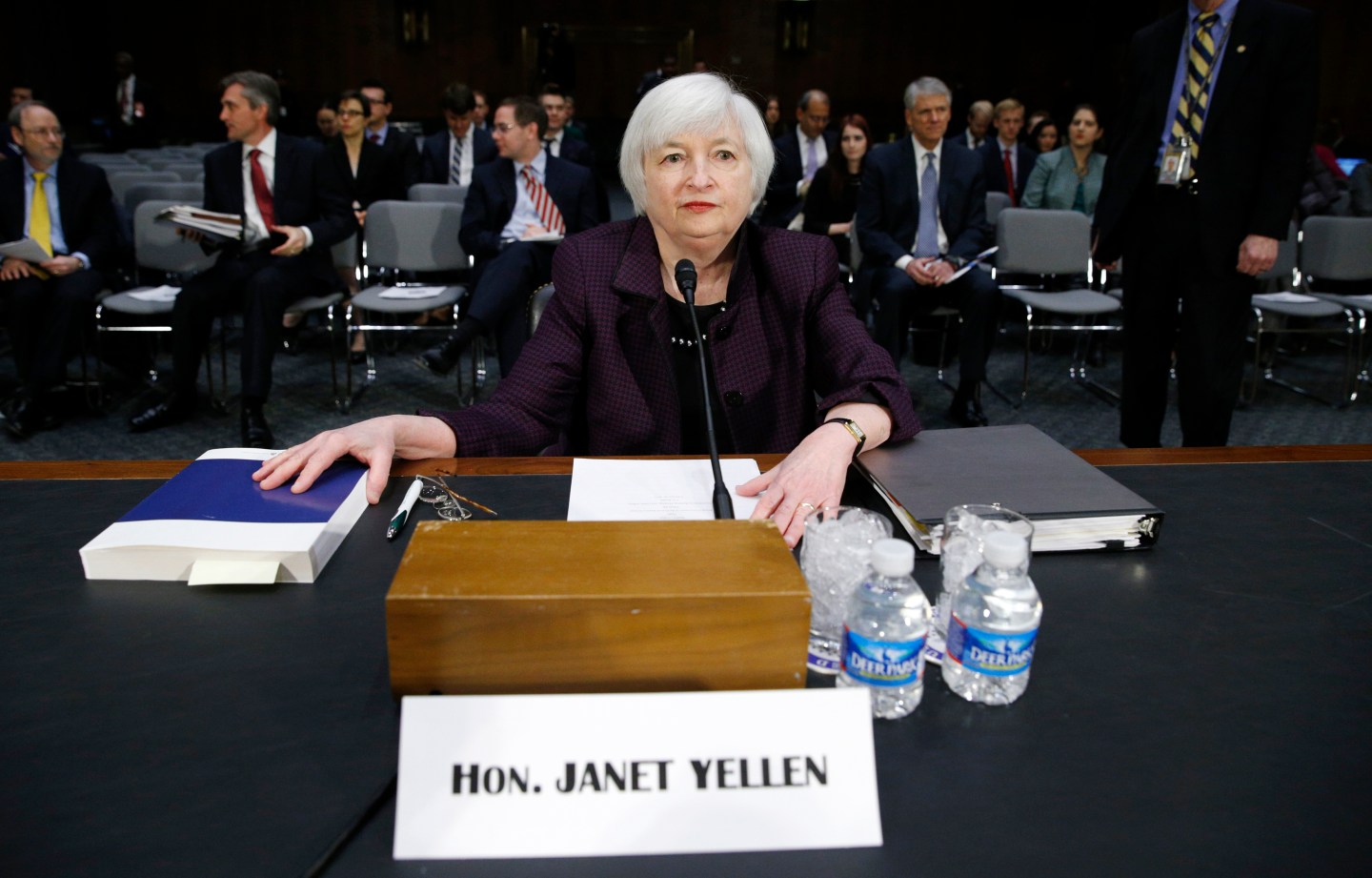
Janet Yellen testifies on Capitol Hill in Washington
Federal Reserve Chair Janet Yellen takes her seat to testify at a Senate Banking, Housing and Urban Affairs Committee hearing on "Semiannual Monetary Policy Report to Congress" on Capitol Hill in Washington, February 24, 2015. World shares held near record highs on Tuesday after Greece produced a list of proposed economic reforms, and the dollar rose on expectations Federal Reserve chair Janet Yellen would signal the Fed was still moving towards raising interest rates. REUTERS/Kevin Lamarque (UNITED STATES - Tags: POLITICS BUSINESS) - RTR4QYSCPhotograph by Kevin Lamarque — Reuters

In this era of unprecedented, global monetary stimulus, markets hang on every word central bankers utter.

Central bankers, however, are less interested in financial markets. If you ask Janet Yellen, for instance, she’d say that the stock market is one “transmission mechanism” through which monetary policy affects the real economy. Yes, low interest rates will indirectly lead to higher stock valuations, but the central bank’s real aim is to simulate the real economy by encouraging businesses to invest and consumers to spend.

James Montier of the investment management firm GMO, however, argues that central bank policy never makes it to the real economy. In a paper published this week, Montier argues that the economics and investment communities “idolatry” of interest rates is the “greatest con ever perpetrated.” Writes Montier:

There seems to be a perception that central bankers are gods (or at the very least minor deities in some twisted economic pantheon). Coupled with this deification of central bankers is a faith that interest rates are a panacea. Whatever the problem, interest rates can solve it. Inflation too high, simply raise interest rates. Economy too weak, then lower interest rates . . . This obsession with interest rates as a cure-all rests on some dubious views about the way the world works. First, is an interest rate cut expansionary or contractionary with respect to spending? Those who believe interest rates are an effective tool clearly believe a rate cut is expansionary because it reduces the cost of financing and then stimulates demand (via investment, consumption, and/or net exports). This emphasises the obvious but oft unspoken truth that monetary policy works via the debt channel (or reducing savings, which is the same thing as increasing leverage).

Montier argues that, actually, interest rates have very little bearing on corporate and individual investment and consumption decisions. Take a look at the following charts. The first shows that corporate investment is generally financed with internal funds, rather than debt:

Screen Shot 2015-05-21 at 1.16.12 PM

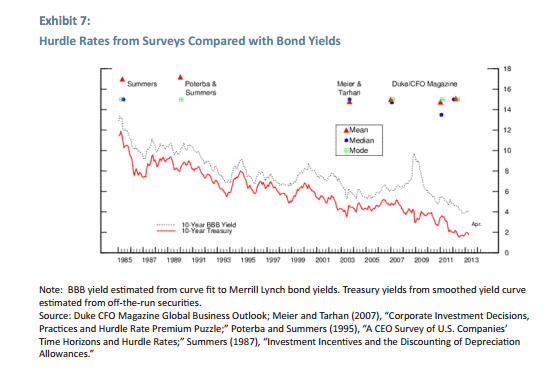
Here’s another showing interest rates over time, combined with surveys showing “internal hurdle rates” for investment projects. Regardless of where interest rates are, companies generally require a 15% rate of return when embarking on a new investment:
Screen Shot 2015-05-21 at 1.20.16 PM

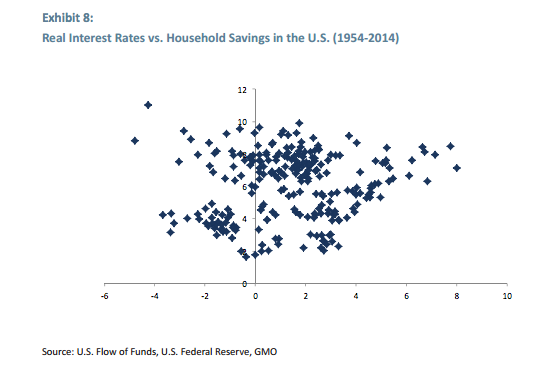
Finally, Montier argues that there isn’t a strong correlation between household savings rates and interest rates:
Screen Shot 2015-05-21 at 1.43.55 PM

“It would appear that monetary policy isn’t the most effective tool for managing the economy,” Montier writes. “I am well aware that almost everyone reading this is likely to disagree: that is the nature of the greatest con ever perpetuated.”

Montier argues that fiscal policy is the only way for the government to meaningfully manage the economy, but it is ignored for “political rather than economic” reasons. He postulates that business groups are wary of the idea that direct government spending could support employment or play too large a role in the economy, because that require the business community to relinquish power.

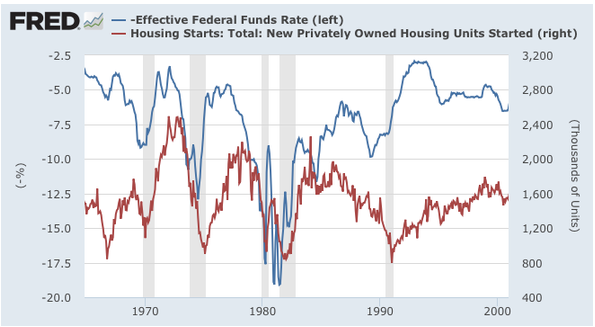
Economist and New York Times columnist Paul Krugman took umbrage with Montier’s analysis, despite the fact that these two seem to agree on Montier’s larger point that government spending should play a bigger role in propping up the economy. But Montier lumped Krugman in along with economists like Ben Bernanke and Janet Yellen who place too much faith in the power of monetary policy to manage the economy. Krugman struck back in a blog post, arguing that while interest rates may not affect business investment, they do have a major effect on housing:
Screen Shot 2015-05-21 at 4.41.22 PM


Krugman points to the strong correlation between housing construction and interest rates. Housing is a long-term investment in which the cost of money adds up to quite a lot over time. That’s a lot different than, say, a company’s decision to invest in smartphones for its employees.

So, perhaps Montier overstates his case. But it is striking to see the many ways in which monetary policy doesn’t touch the real economy. It’s been common among the economic commentariat to lament that the Fed is the only institution in Washington that has the freedom to experiment with stimulus, because of gridlock in Congress. But the Fed’s own impotence may allow it such freedom. Sure, Fed policy creates a lot of controversy. Members of Congress are known to wax apocalyptic about the effects of quantitative easing. But even the Fed itself admits that its trillions of dollars worth of bond buying has had, at best, a slightly positive effect on economic growth.

Fiscal policy on the other hand, is potent. And the American government–with its numerous checks and balances and veto points–is pretty good at preventing the wielding of power. Whether you believe more in the power of tax cuts or in infrastructure spending, changes in fiscal policy will have a powerful effect on the economy and create winners and losers. Monetary policy, on the other hand, is perhaps more like a placebo, that may help boost confidence but doesn’t come with too many unsavory side effects.


About the Author
By Chris Matthews
See full bioRight Arrow Button Icon

Latest in Finance

Finance
Lorem ipsum dolor sit amet, consectetur adipiscing elit, sed do eiusmod tempor incididunt ut labore et dolore magna aliqua. Ut enim ad minim veniam
By Fortune Editors
October 20, 2025
Finance
Lorem ipsum dolor sit amet, consectetur adipiscing elit, sed do eiusmod tempor incididunt ut labore et dolore magna aliqua. Ut enim ad minim veniam
By Fortune Editors
October 20, 2025
Finance
Lorem ipsum dolor sit amet, consectetur adipiscing elit, sed do eiusmod tempor incididunt ut labore et dolore magna aliqua. Ut enim ad minim veniam
By Fortune Editors
October 20, 2025
Finance
Lorem ipsum dolor sit amet, consectetur adipiscing elit, sed do eiusmod tempor incididunt ut labore et dolore magna aliqua. Ut enim ad minim veniam
By Fortune Editors
October 20, 2025
Finance
Lorem ipsum dolor sit amet, consectetur adipiscing elit, sed do eiusmod tempor incididunt ut labore et dolore magna aliqua. Ut enim ad minim veniam
By Fortune Editors
October 20, 2025
Finance
Lorem ipsum dolor sit amet, consectetur adipiscing elit, sed do eiusmod tempor incididunt ut labore et dolore magna aliqua. Ut enim ad minim veniam
By Fortune Editors
October 20, 2025

Most Popular

Finance
Lorem ipsum dolor sit amet, consectetur adipiscing elit, sed do eiusmod tempor incididunt ut labore et dolore magna aliqua. Ut enim ad minim veniam
By Fortune Editors
October 20, 2025
Finance
Lorem ipsum dolor sit amet, consectetur adipiscing elit, sed do eiusmod tempor incididunt ut labore et dolore magna aliqua. Ut enim ad minim veniam
By Fortune Editors
October 20, 2025
Finance
Lorem ipsum dolor sit amet, consectetur adipiscing elit, sed do eiusmod tempor incididunt ut labore et dolore magna aliqua. Ut enim ad minim veniam
By Fortune Editors
October 20, 2025
Finance
Lorem ipsum dolor sit amet, consectetur adipiscing elit, sed do eiusmod tempor incididunt ut labore et dolore magna aliqua. Ut enim ad minim veniam
By Fortune Editors
October 20, 2025
Finance
Lorem ipsum dolor sit amet, consectetur adipiscing elit, sed do eiusmod tempor incididunt ut labore et dolore magna aliqua. Ut enim ad minim veniam
By Fortune Editors
October 20, 2025
Finance
Lorem ipsum dolor sit amet, consectetur adipiscing elit, sed do eiusmod tempor incididunt ut labore et dolore magna aliqua. Ut enim ad minim veniam
By Fortune Editors
October 20, 2025
Rankings
  • 100 Best Companies
  • Fortune 500
  • Global 500
  • Fortune 500 Europe
  • Most Powerful Women
  • Future 50
  • World’s Most Admired Companies
  • See All Rankings
Sections
  • Finance
  • Leadership
  • Success
  • Tech
  • Asia
  • Europe
  • Environment
  • Fortune Crypto
  • Health
  • Retail
  • Lifestyle
  • Politics
  • Newsletters
  • Magazine
  • Features
  • Commentary
  • Mpw
  • CEO Initiative
  • Conferences
  • Personal Finance
  • Education
Customer Support
  • Frequently Asked Questions
  • Customer Service Portal
  • Privacy Policy
  • Terms Of Use
  • Single Issues For Purchase
  • International Print
Commercial Services
  • Advertising
  • Fortune Brand Studio
  • Fortune Analytics
  • Fortune Conferences
  • Business Development
About Us
  • About Us
  • Editorial Calendar
  • Press Center
  • Work At Fortune
  • Diversity And Inclusion
  • Terms And Conditions
  • Site Map

Latest in Finance

dalio
Economynational debt
Ray Dalio on the $38 trillion national debt: ‘My grandchildren and great grandchildren not yet born are going to be paying off this debt’
By Nick LichtenbergJanuary 9, 2026
4 hours ago
doctor
CommentaryMedicaid
Former White House advisor on the real reason your health care costs are going up: Medicare’s doctor pay gap
By Tomas J. PhilipsonJanuary 9, 2026
4 hours ago
Tom Shea, CEO of OneStream.
NewslettersCFO Daily
OneStream CEO: $6.4 billion deal to go private will accelerate AI strategy in finance
By Sheryl EstradaJanuary 9, 2026
5 hours ago
A refinery owned by Citgo, a subsidiary of PDVSA, the Venezuelan state owned oil company, sits along the I&M Canal on May 15, 2019 in Lemont, Illinois.
EnergyVenezuela
Paul Singer’s Elliott Management is one of the big winners in Venezuela’s forced sale of Citgo and the toppling of Maduro
By Jordan BlumJanuary 9, 2026
5 hours ago
Personal FinanceSavings accounts
Today’s best high-yield savings account rates on Jan. 9, 2026: Earn up to 5.00% APY
By Glen Luke FlanaganJanuary 9, 2026
5 hours ago
Personal FinanceCertificates of Deposit (CDs)
Best CD rates today, Jan. 9, 2026: Earn up to 4.18% APY if you lock in now
By Glen Luke FlanaganJanuary 9, 2026
5 hours ago

Most Popular

placeholder alt text
Law
Amazon is cutting checks to millions of customers as part of a $2.5 billion FTC settlement. Here's who qualifies and how to get paid
By Sydney LakeJanuary 6, 2026
3 days ago
placeholder alt text
Success
Diary of a CEO founder says he hired someone with 'zero' work experience because she 'thanked the security guard by name' before the interview
By Emma BurleighJanuary 8, 2026
1 day ago
placeholder alt text
Workplace Culture
Amazon demands proof of productivity from employees, asking for list of accomplishments
By Jake AngeloJanuary 8, 2026
23 hours ago
placeholder alt text
Future of Work
AI layoffs are looking more and more like corporate fiction that's masking a darker reality, Oxford Economics suggests
By Nick LichtenbergJanuary 7, 2026
2 days ago
placeholder alt text
Real Estate
Google billionaire Larry Page copies the Jeff Bezos playbook, buying a $173 million Miami compound that will save him millions in taxes
By Nick LichtenbergJanuary 8, 2026
21 hours ago
placeholder alt text
Crypto
Russia and Iran are increasingly turning to crypto—especially stablecoins—to avoid sanctions, report finds
By Carlos GarciaJanuary 8, 2026
1 day ago

© 2025 Fortune Media IP Limited. All Rights Reserved. Use of this site constitutes acceptance of our Terms of Use and Privacy Policy | CA Notice at Collection and Privacy Notice | Do Not Sell/Share My Personal Information
FORTUNE is a trademark of Fortune Media IP Limited, registered in the U.S. and other countries. FORTUNE may receive compensation for some links to products and services on this website. Offers may be subject to change without notice.