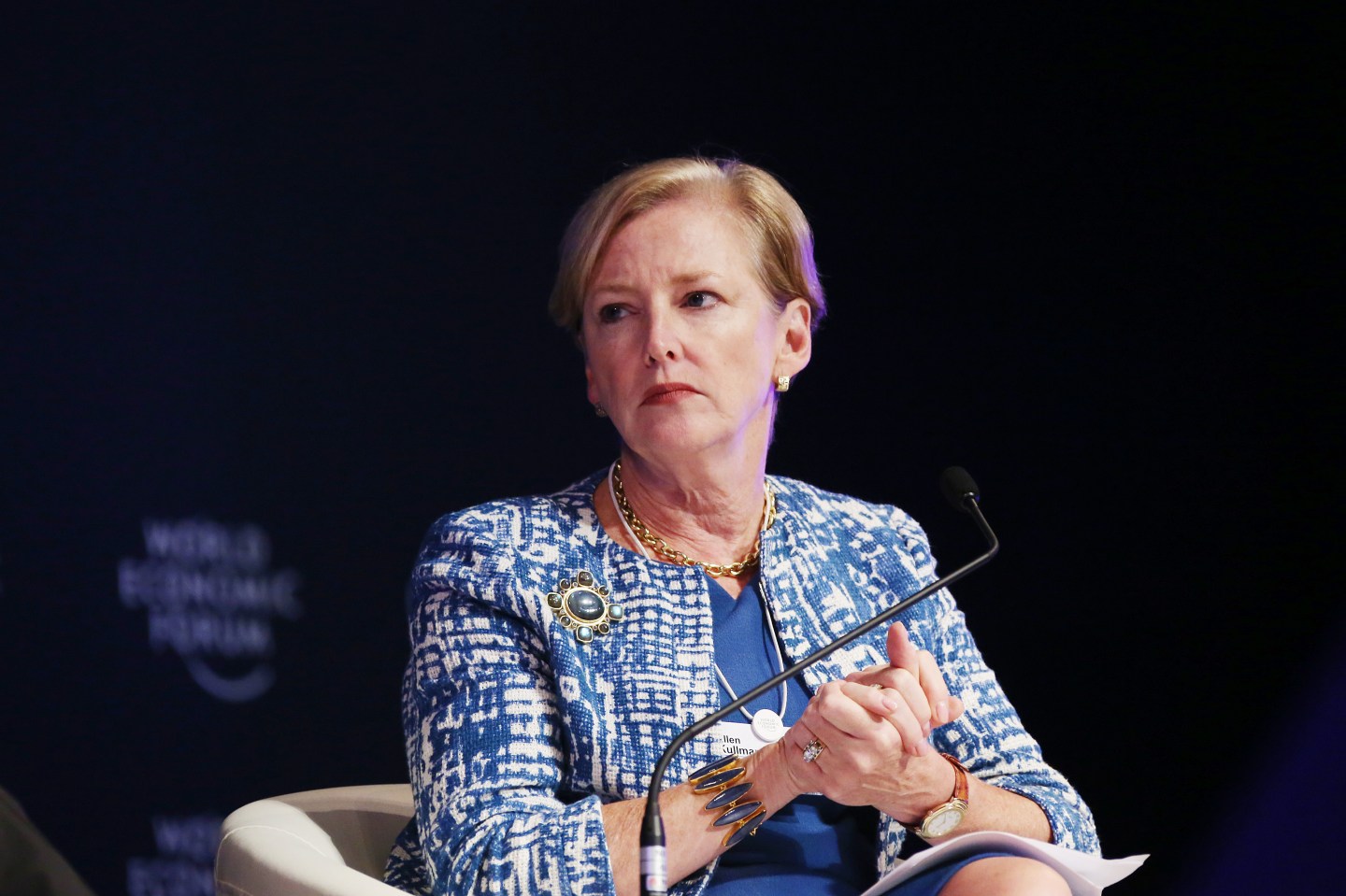
DuPont CEO Ellen Kullman will be put to the test this week. The chemical giant’s proxy vote is scheduled for May 13. How shareholders will vote—either with DuPont or its rival, activist hedge fund Trian Fund Management—will come down to how well they believe DuPont has performed under Kullman, who got the job at the start of 2009. Trian is seeking four seats on DuPont’s board and, potentially, a break-up of the nearly 213-year-old company. (Fortune’s full behind the scenes coverage of the DuPont proxy fight is here.)
Trian says DuPont under Kullman is stuck and that the company’s earnings and sales have been flat since 2011. But Trian has reached these conclusions by measuring apples to oranges.
In the past few years, DuPont has been selling off companies—including its coatings business, among others—that were profitable but cyclical. In the long term, those sales should help DuPont’s bottom line. But in the short term, it means DuPont can no longer collect earnings from those businesses, which has put a dent in the company’s profits. Profits at DuPont have also suffered from a cyclical downturn in some of its chemical businesses, which are set to be spun off from the company later this year.
But the fact that DuPont’s overall bottom line is relatively flat, despite those drags, means that its remaining businesses must be growing. And they have been. Kullman has focused on ridding DuPont of its slow-growth cyclical businesses, leaving it with high-profit operations that can still benefit from the company’s storied research and development teams. And her plan is working.
If you look at DuPont’s continuing businesses—not the ones it has gotten out of, or the ones it is spinning off—its operating earnings per share have grown by 19% a year on average since Kullman took over, according to the company.
Ed Garden, chief investment officer at Trian, though, says that number is inflated, and not an accurate way to judge DuPont’s progress. DuPont has benefitted from the sales of its coatings business and others. It has reinvested the money it has generated from those sales into its remaining businesses. So, if you exclude the performance of those businesses, you also have to exclude the cash DuPont received from selling them, Garden argues.
Trian says a better way to measure DuPont’s success or failure is by its cash flow, not its earnings. For instance, Trian argues, investors should really be looking at how much money DuPont has invested in its business and how much cash flow it has gotten back from those investments. The fund argues that DuPont should be getting at least an 8% return on its investment, which it says is DuPont’s so-called cost of capital, for any project to be worth it. Trian also says that the company’s return on invested capital has only been 5%. (Trian’s 8% cost of capital assumption may be too high, anyway. Earlier this year, the company was able to borrow $1 billion for six years in a bond deal at 3.6%.)
Trian calculates its 5% return figure for DuPont by looking at the difference between the cash flow the chemical company generated in 2007, which was $4.2 billion, and comparing it to the cash flow DuPont generated last year, which was $5.3 billion. That figure is considered the additional cash flow the company has earned from what it has invested in its business over time. If you take that $1.1 billion, divide it by the $17.3 billion Trian says the company has invested in its business since 2007, and then adjust it for a 22% tax rate, you get a 5% return.
But that’s a comparison between just two individual years of cash flow, 2007 and 2014, and not all the years in between. DuPont’s total earnings (for its existing businesses and the businesses it has sold off) have been up and down during that time. For example, if you compared 2007 to 2011, when DuPont had cash flow of $5.8 billion, you would get a much higher return on investment, something like 13% after taxes. What’s more, Trian’s return calculations assumes that if DuPont had never invested any of that $17.3 billion, its cash flow would have remained at a constant $4.2 billion per year. But it wouldn’t have. The cash flow probably would have shrunk.
What’s more, Trian’s investment return analysis seems to miss a central point about DuPont. Trian’s biggest activist investing successes have been with food companies, like Kraft and Snapple. In those businesses, Trian’s return analysis may make sense. A company spends money to develop and market a new food product over one or two years, and then that product sells or doesn’t in the next year or two. In other words, those industries allow you to quickly assess if you are investments are paying off.
DuPont doesn’t work like that. It’s a science-driven company focused on solving problems like world hunger and global warming with, for instance, drought-resistance seeds, which have been gaining market share from competitors but had to be developed over years. Research for such products can take years, sometimes decades, to pay off. Trian’s analysis, though, is strictly short-term focused, looking at one year’s investment to see if it produced cash flow in the next.
Even if you were to put the broader issues aside, the best way to calculate DuPont’s return over time would not be the way Trian has done it. Instead, it would be better to average the total excess cash flow DuPont has produced over the entire eight years between 2007 and 2014, and divide that figure by DuPont’s average annual investment. If you do the calculation that way, DuPont’s average return on its investments during that time is just over 9%. And that’s if you start in 2007. Start at the end of 2008, when Kullman took the reins as CEO, and the return on investment you get during her tenure comes out to a whopping 17%, after taxes.
What’s more, all of these numbers exclude DuPont’s seed business, which is its most profitable division. Trian conveniently left it out of its return equations. So, DuPont’s actual return on investment under Kullman is probably closer to 20% a year.
Trian wants to paint Kullman’s tenure as DuPont’s CEO as a disappointment, but it’s been far from that. Even by the hedge fund’s own flawed analysis, DuPont under Kullman has been a profit machine.