• Home
  • Latest
  • Fortune 500
  • Finance
  • Tech
  • Leadership
  • Lifestyle
  • Rankings
  • Multimedia
Finance

The average worker might not be getting ripped off after all

By
Chris Matthews
Down Arrow Button Icon
By
Chris Matthews
Down Arrow Button Icon
April 24, 2015, 10:23 AM ET
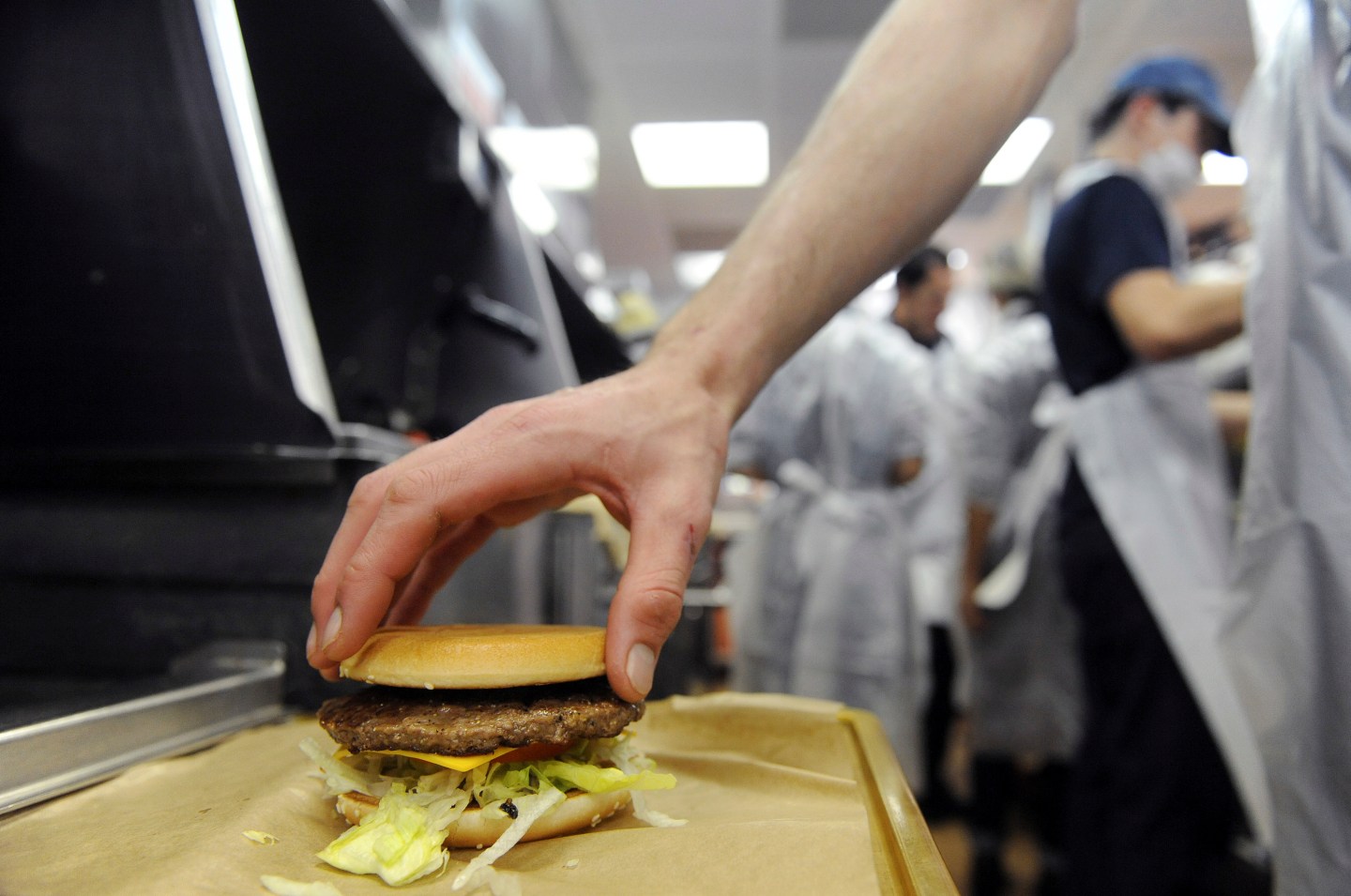
An employee prepares a hamburger at a US
Photograph by Remy Gabalda — AFP/Getty Images

If there is one idea that has made its way from ivory tower economists to the general public in recent years, it’s that the average worker has gotten short shrift in recent years.

The media has often repeated statistics that show that pay for the average worker has remained basically flat since 1979, even as worker productivity has soared. Left-leaning politicians like Massachusetts Senator Elizabeth Warren have argued that if the minimum wage had increased along with worker productivity, we’d have a $22 per-hour minimum wage. And if the household income of the middle class—those making between the 20th and 80th percentiles of income—had merely kept pace with worker productivity, the average middle class household would be bringing in $17,890 more than it was in 2010, according to the Economic Policy Institute.

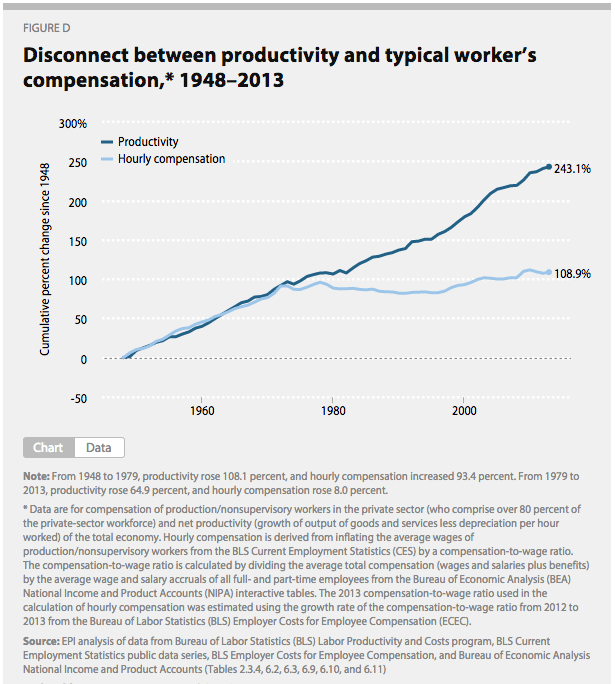
That’s a lot of money for the middle class to be leaving on the table, and it makes for good politics to appeal to people who feel the system is stacked against them. The problem is the statistics used to make the case often oversimplify what exactly is happening in the economy. Take, for example, this chart, also from the Economic Policy Institute, which purports to show the relationship between worker productivity and worker pay:
Screen Shot 2015-04-23 at 5.43.01 PM

Looking at this chart, it appears as if a fundamental change in the economy occurred during the 1970s. For the political left, this is convenient, because it fits into a larger narrative about the decline in the power of labor unions, the deregulation movement which began around the same time, and the decline in manufacturing employment. But putting together such a chart requires a lot of assumptions, including which employees you choose to include in the wage measure and the measure of price growth used to gauge inflation. Use a different set of assumptions and you get a very different picture. Take a look at this chart from Scott Winship at the Manhattan Institute:

Screen Shot 2015-04-23 at 3.59.55 PM

Unlike the EPI numbers, Winship uses a slightly different measure of inflation to adjust both productivity and compensation for inflation. He also includes the pay of all workers, not just non-supervisory employees. Finally, he adjusts the productivity to better measure what we’re trying see, which is, “whether workers are being fairly compensated.” Normally, we measure productivity by dividing GDP by the total number of hours worked. But if we’re trying to see what is happening in the workforce, it doesn’t make sense to include things like depreciation of plant and equipment in our measure of productivity growth, as both workers and owners benefit from those things. It also doesn’t make sense to include income from rent, which requires little labor to make productive.

Real wage growth figures can also be tricky. By many measures, like inflation adjusted hourly earnings, the median worker is worse off today than he was in the 1970s. But as Aaron McNay, an economist for the state of Montana, pointed out to the The Wall Street Journal, that changes significantly depending on what measure of inflation you use. When McNay measures real average weekly pay when looking at inflation as seen through personal consumption expenditure (how much households are spending), it turns out that average worker pay is at an all all-time high.

Finally, there is a debate in the economic community over whether the share of national income going to workers versus owners of capital is on the decline. For decades, economists thought that the share of GDP going to both groups was stable over time, but in recent years, increasing evidence suggests that owners are taking a bigger share of the pie. But again, this all depends on what sorts of metrics you use. Recently a 26-year old graduate student from MIT showed that the decline in the labor share is, contrary to what Thomas Piketty has argued, a product of appreciating real estate rather than the increased power of owners over labor.

Few economists would argue that income and wealth inequality across the rich world aren’t growing. And as the well off capture more of the gains of economic growth, that is necessarily going to hurt the median worker. But the magnitude of the average workers’ plight is very difficult to measure in any precise way. And the solutions that politicians have proposed to help the average worker—from raising the minimum wage, to across-the-board tax cuts, to changes in education policy—are, to say the least, not silver bullets.

In fact, real change to our system is more likely to come from the bottom up, with local governments and community colleges working with corporations to craft a supply chain for labor, and with individual workers learning to make better decisions about how they gain skills. Sure, something like smart tax reform can only do the economy good, but don’t expect big policy changes to solve a problem that we have difficulty even measuring.


About the Author
By Chris Matthews
See full bioRight Arrow Button Icon

Latest in Finance

Finance
Lorem ipsum dolor sit amet, consectetur adipiscing elit, sed do eiusmod tempor incididunt ut labore et dolore magna aliqua. Ut enim ad minim veniam
By Fortune Editors
October 20, 2025
Finance
Lorem ipsum dolor sit amet, consectetur adipiscing elit, sed do eiusmod tempor incididunt ut labore et dolore magna aliqua. Ut enim ad minim veniam
By Fortune Editors
October 20, 2025
Finance
Lorem ipsum dolor sit amet, consectetur adipiscing elit, sed do eiusmod tempor incididunt ut labore et dolore magna aliqua. Ut enim ad minim veniam
By Fortune Editors
October 20, 2025
Finance
Lorem ipsum dolor sit amet, consectetur adipiscing elit, sed do eiusmod tempor incididunt ut labore et dolore magna aliqua. Ut enim ad minim veniam
By Fortune Editors
October 20, 2025
Finance
Lorem ipsum dolor sit amet, consectetur adipiscing elit, sed do eiusmod tempor incididunt ut labore et dolore magna aliqua. Ut enim ad minim veniam
By Fortune Editors
October 20, 2025
Finance
Lorem ipsum dolor sit amet, consectetur adipiscing elit, sed do eiusmod tempor incididunt ut labore et dolore magna aliqua. Ut enim ad minim veniam
By Fortune Editors
October 20, 2025

Most Popular

Finance
Lorem ipsum dolor sit amet, consectetur adipiscing elit, sed do eiusmod tempor incididunt ut labore et dolore magna aliqua. Ut enim ad minim veniam
By Fortune Editors
October 20, 2025
Finance
Lorem ipsum dolor sit amet, consectetur adipiscing elit, sed do eiusmod tempor incididunt ut labore et dolore magna aliqua. Ut enim ad minim veniam
By Fortune Editors
October 20, 2025
Finance
Lorem ipsum dolor sit amet, consectetur adipiscing elit, sed do eiusmod tempor incididunt ut labore et dolore magna aliqua. Ut enim ad minim veniam
By Fortune Editors
October 20, 2025
Finance
Lorem ipsum dolor sit amet, consectetur adipiscing elit, sed do eiusmod tempor incididunt ut labore et dolore magna aliqua. Ut enim ad minim veniam
By Fortune Editors
October 20, 2025
Finance
Lorem ipsum dolor sit amet, consectetur adipiscing elit, sed do eiusmod tempor incididunt ut labore et dolore magna aliqua. Ut enim ad minim veniam
By Fortune Editors
October 20, 2025
Finance
Lorem ipsum dolor sit amet, consectetur adipiscing elit, sed do eiusmod tempor incididunt ut labore et dolore magna aliqua. Ut enim ad minim veniam
By Fortune Editors
October 20, 2025
Rankings
  • 100 Best Companies
  • Fortune 500
  • Global 500
  • Fortune 500 Europe
  • Most Powerful Women
  • Future 50
  • World’s Most Admired Companies
  • See All Rankings
Sections
  • Finance
  • Leadership
  • Success
  • Tech
  • Asia
  • Europe
  • Environment
  • Fortune Crypto
  • Health
  • Retail
  • Lifestyle
  • Politics
  • Newsletters
  • Magazine
  • Features
  • Commentary
  • Mpw
  • CEO Initiative
  • Conferences
  • Personal Finance
  • Education
Customer Support
  • Frequently Asked Questions
  • Customer Service Portal
  • Privacy Policy
  • Terms Of Use
  • Single Issues For Purchase
  • International Print
Commercial Services
  • Advertising
  • Fortune Brand Studio
  • Fortune Analytics
  • Fortune Conferences
  • Business Development
About Us
  • About Us
  • Editorial Calendar
  • Press Center
  • Work At Fortune
  • Diversity And Inclusion
  • Terms And Conditions
  • Site Map

© 2025 Fortune Media IP Limited. All Rights Reserved. Use of this site constitutes acceptance of our Terms of Use and Privacy Policy | CA Notice at Collection and Privacy Notice | Do Not Sell/Share My Personal Information
FORTUNE is a trademark of Fortune Media IP Limited, registered in the U.S. and other countries. FORTUNE may receive compensation for some links to products and services on this website. Offers may be subject to change without notice.


Most Popular

placeholder alt text
Uncategorized
Transforming customer support through intelligent AI operations
By Lauren ChomiukNovember 26, 2025
19 days ago
placeholder alt text
Success
Sorry, six-figure earners: Elon Musk says that money will 'disappear' in the future as AI makes work (and salaries) irrelevant
By Orianna Rosa RoyleDecember 15, 2025
7 hours ago
placeholder alt text
Success
Apple cofounder Ronald Wayne sold his 10% stake for $800 in 1976—today it’d be worth up to $400 billion
By Preston ForeDecember 12, 2025
3 days ago
placeholder alt text
Success
40% of Stanford undergrads receive disability accommodations—but it’s become a college-wide phenomenon as Gen Z try to succeed in the current climate
By Preston ForeDecember 12, 2025
3 days ago
placeholder alt text
AI
Deloitte's CTO on a stunning AI transformation stat: Companies are spending 93% on tech and only 7% on people
By Nick LichtenbergDecember 15, 2025
10 hours ago
placeholder alt text
Politics
Trump admits he can't tell if the GOP will control the House after next year's elections. 'I don't know when all of this money is going to kick in'
By Jason MaDecember 14, 2025
1 day ago

Latest in Finance

Co-owners Dean Smith, left, and Joanne Farrugia pose for a photograph in JaZams, one of their toy stores Friday, June 27, 2025, in Princeton, N.J.
RetailTariffs
Small businesses say Trump tariffs are hurting this group of consumers this holiday season—here’s what is getting more expensive
By Mae Anderson and The Associated PressDecember 15, 2025
30 minutes ago
A woman takes a bag of groceries during a free food distribution for recipients of the Supplemental Nutrition Assistance Program (SNAP) organized by the Volusia County Sheriff's Office and The Jewish Federation at the Daytona International Speedway in Daytona Beach, Florida, on November 9, 2025.
PoliticsSNAP
Trump vows to fight ‘fraud’ in SNAP benefits for 42 million Americans
By Geoff Mulvihill and The Associated PressDecember 15, 2025
31 minutes ago
Jerome Powell, with an American flag in the background, speaks and gestures with his left hand.
EconomyFederal Reserve
‘We are now firmly back in a good is bad/bad is good regime’: Weak job data may lead to more rate cuts and boost stocks, Morgan Stanley economist says
By Sasha RogelbergDecember 15, 2025
1 hour ago
BankingFederal Reserve
Kevin vs. Kevin: Warsh overtakes Hassett as favorite to be Fed chair nominee on prediction market
By Jason MaDecember 15, 2025
2 hours ago
Personal Financechecking accounts
Best checking accounts for December 2025
By Glen Luke FlanaganDecember 15, 2025
3 hours ago
Personal FinanceSavings
Best savings account bonuses for December 2025
By Glen Luke FlanaganDecember 15, 2025
3 hours ago