As California’s current drought is now in its fourth year, Governor Jerry Brown signed an executive order requiring that cities and towns reduce water use by 25%. People potentially face fines of up to $500 a day for refusing to comply.
But the result could mean a lot more than just brown lawns. Some industries will face significant challenges, as they too face restrictions that could curtail delivery of services and products.
Exactly how much of an economic toll the drought will take is tough to say. One analysis found that the agriculture sector alone lost $2.2 billion and 17,100 seasonal and part-time jobs last year, due to the drought. But the overall impact is hard to assess; for decades California hasn’t seriously monitored how different industries use water. “We have a fairly good breakdown of how much water agriculture and urban areas use, but there’s no centralized further breakdown by industry,” Heather Cooley, director of the water program at non-profit research group Pacific Institute, told Fortune.
To be sure, many employers will get by with letting the lawns outside their office building dry up. Still, there are industries where water is intrinsic to doing business, whether making and processing products or delivering services. Here are six that are most likely to be seriously impacted, with ramifications stretching far beyond the state borders.
Agriculture
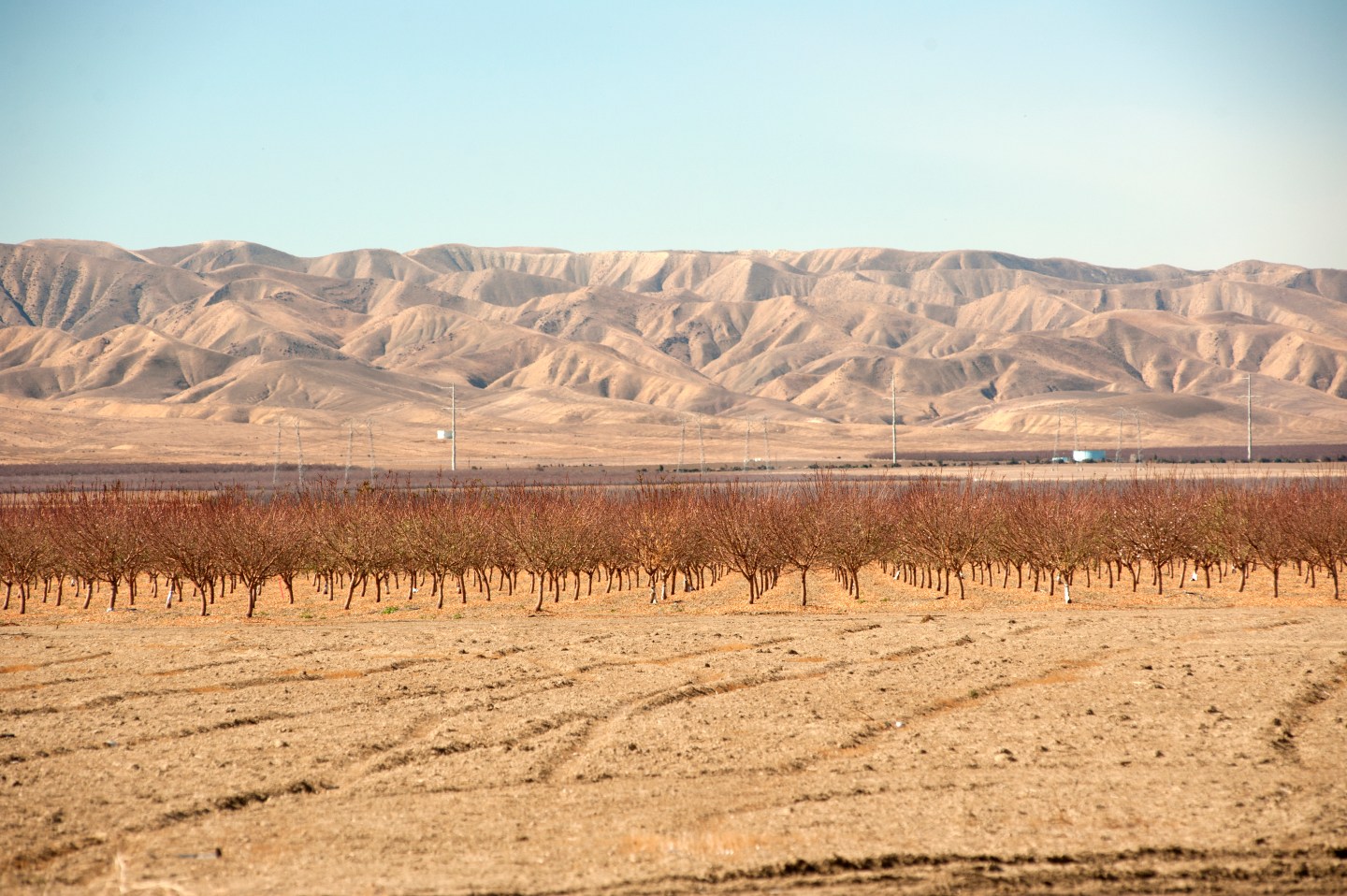
California is largest agriculture producer of any state, to the tune of $46.4 billion in 2013, with fruits and nuts pulling down $20 billion of that. Agriculture uses more than 80% of the state’s water.
Although the executive order exempted farmers from additional cuts in water use, they’ve already seen many previous ones. “[We] have seen significant water allocation restrictions to farmers in surface water,” said Troy Walters, a senior economist at analyst firm IHS, to Fortune. Some farmers are getting to no water from either the state or federal sources, so they’ve relied on wells, because groundwater is “almost entirely unregulated.” According to Cooley, 400,000 acres, or about 5% of the state’s irrigated acreage, were left fallow last year.
Things could get worse, because some of the most profitable crops are water-intensive. For example, California produces 80% of the world’s almonds and it takes about one gallon of water to produce one almond. A walnut takes almost 5 gallons, while a head of broccoli takes 5.4, one head of lettuce needs 3.5 gallons, and a tomato, 3.3. By the way, California produces 90% of the country’s tomatoes, 74% of the lettuce, and 95% of the broccoli.
Food processing
California not only grows food but processes it. In 2005, the state had 11% of the country’s food-processing jobs. “That segment is directly tied to agriculture,” Walters said. “It’s in the same boat. It’s less input for them and reduced payroll as well.” The news will be bad for lower-income communities that depend on the jobs. “You’ll see significant reductions in household incomes in areas already severely hurting.” Higher prices for processed goods could also hurt sales. Wine prices, particularly for brands focused on price-sensitive consumers, are already expected to head up.
Semiconductors
Although Intel pulled its last fabrication plant from California in 2009, semiconductor manufacturing is still a going concern in the state. Maxim Integrated, TowerJazz, and TSI Semiconductors all still have fabrication plants in the state.
In making semiconductors, companies must polish the surface of silicon blanks that will be turned into chips for computers, cell phones, consumer electronics, cars, and thousands of other uses. “Ultra-pure water is very important for that industry,” said Seth Cutler, a senior industry analyst for market analyst firm Frost & Sullivan. “They need water purified to a high standard.”
And they need a lot of it. A single semiconductor fabrication plant can use as much water as a small city. That means the current plants could represent three cities worth of consumption. Less water could mean a lower ability to produce a current volume of chips. But semiconductor plants depend on volume to operate efficiency. Slow them down, and the owners might consider doing business elsewhere.
Energy
Energy isn’t the most water-intensive industry in California, but the use is significant. The state does depend on hydroelectric power generation for part of its mix. As less water is available to turn turbines and generators, utilities must find replacement power, which will typically be more expensive. “The loss of hydro power between October 2011 and October 2014 cost Californians about $1.4 billion,” Cooley said.
Tourism and leisure
The direct impact on tourism and leisure is still not clear. Although ski resorts have been hit hard — some have had to close — according to Walters, overall, tourism in California has been on the rise. But as Cutler noted, a water shortage could still have a powerful “image cost” for the state. “Maybe California [would be] seen as not such a good place to travel, live, or do business,” he said. “That could have a lasting impression on someone.
California has had an image of plenty and that has to change.” When restaurants can’t serve patrons water without first being asked, hotels must ask customers if they want linens laundered, and officials consider a rule against running decorative fountains, looking desperate becomes easy, and that’s bad PR.
Water utilities
The problems for water utilities are multiple. The need to conserve raises the issue of inefficiencies and maintenance problems. For example, breaks or leaks anywhere in the system translate into water lost before it can be delivered. “The actual leakage rate for municipal water rate can be as high as 25 percent or 30 percent,” Cutler said. Because pipes are largely underground, finding and fixing leaks can be difficult or costly.
New technologies can help locate problems, as can data analysis of water flows at different points in a system to find mismatches that could indicate a loss. But repairs and maintenance still mean digging up pavement or sidewalks.
More importantly, California lacks robust monitoring and management of its total water system, according to Cooley. Although the state does have some idea of ground water levels at any particular time, “we don’t know how much is going in and we don’t know how much is going out,” she said. “It’s akin to knowing the balance of your checking account but not knowing the inflows and outflows.” Ground water is a resource that farmers are heavily using to supplement shortages in surface water. Some wells are already going dry. Cooley also said that the only data on how much water non-agricultural industries use is 20 years out of date. The state lacks the information for the degree of control it needs to exert, even as the public and politicians look to utilities to manage the problem.
Watch more business news from Fortune: