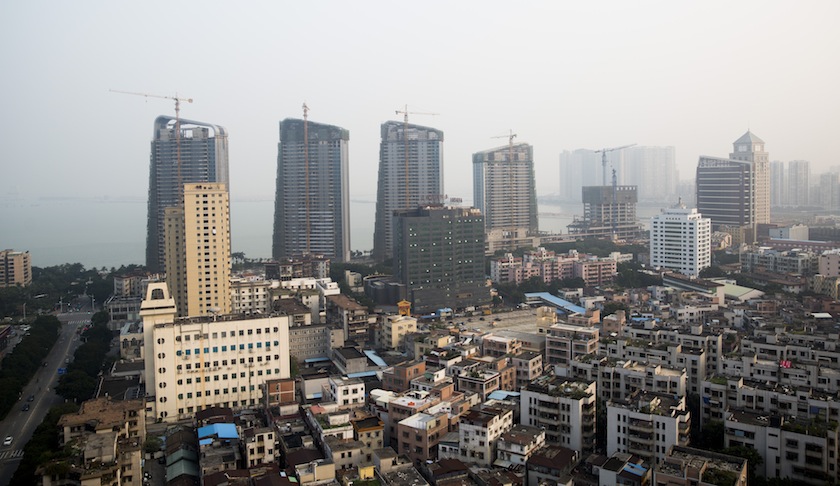
There are two indisputable facts about China’s mammoth investments in its infrastructure and factories. One, they are a growth engine, accounting for roughly half of the country’s GDP increase since 2000. The other fact is that China’s investment rate, averaging 43% of GDP since 2000, is greater than any other major economy in history.
Many question whether such investment in the Chinese economy can maintain its role as the nation’s primary driver of growth. Most economists believe that China must shift from an investment-based growth model to one focused on consumption. (According to the World Bank, Chinese household consumption was only 34% of GDP in 2013.) Amid this debate, one question has gone unanswered: How much bang has China got for the trillions of bucks it has poured into its physical capital over the last two decades?
A recent study performed by two economists affiliated with the Chinese National Development and Reform Commission (NDRC), Beijing’s powerful economic planning and regulatory agency, offered a revealing glimpse into this puzzle. The economists examined two indicators: the delivery rate of completed fixed-asset investment projects and the incremental capital output ratio (ICOR), which measures how much additional capital is required to generate an extra unit of GDP growth. The researchers concluded that both measures show an alarming increase in wasteful and ineffective investments in China.
The delivery rate of completed capital projects, which was 74-79% in the late 1990s, has now fallen below 60%. This implies that nearly 40% of Chinese investment projects are either not finished on time or not completed at all.
The even more alarming figure, which made headlines around the world, is that ineffective investment has cost China $10.8 trillion since 1997. Sixty-two percent of the wasteful investment—$6.8 trillion—was made after 2009, when China went on an investment binge to stimulate its economy.
The two scholars reached this startling conclusion by noting that China’s ICOR has risen 50%, from 2.6 (for the period of 1979-1996) to 4 (for the period of 1997-2013). In practical terms, this means that before 1997 China needed $2.60 in investment to generate one dollar of GDP growth; today, China needs $4 to produce a dollar of GDP growth. The rise of ICOR, according to the researchers, indicates that China’s investments have become less efficient.
To be sure, one can raise technical questions about using ICOR to estimate investment efficiency. A country’s ICOR can rise as its economy becomes more capital intensive. Obviously, agriculture requires less capital than manufacturing. In China’s case, ICOR was 0.3 for agriculture but 5.9 for manufacturing during 2001-2007. Therefore, in all likelihood, the estimate that China has flushed $10.8 trillion down the drain since 1997 should be taken with caution.
Nevertheless, the two audacious government-affiliated economists have asked the right question even though their conclusion may not be totally convincing. Their study highlights a serious problem that many in the international business community have overlooked: the role of the state in making investment decisions in China.
Based on official data, the Chinese government and state-owned enterprises invest $2.3 trillion a year in infrastructure and factories (43% of the country’s total investment). Since government-funded investments are driven by political decisions, these investments are more likely to fall victim to waste and corruption. Research conducted by a scholar at China’s Tsinghua University’s School of Management shows that government-funded infrastructure projects, contrary to conventional wisdom, undercut China’s productivity. Even when the Chinese government invests in factories, its decisions can result in poor outcomes. This is the case with the manufacturing sector. Every self-respecting local government in China, it seems, wants to own steel mills, cement factories, and auto plants. As a result, these sectors are plagued by overcapacity across the country, which destroys investment returns.
To be sure, there is plenty of bad news here. For example, failed investments saddle Chinese banks, which finance most of the investments made by the Chinese government and SOEs, with mountains of non-performing loans. But there may be a silver lining behind China’s abysmal investment record. The shocking inefficiency of Chinese investments also means that reforms could potentially generate significant benefits. With a more efficient investment system, Beijing could cut down on its overall investment and channel more of its resources into encouraging consumption, which would make China’s economic growth more sustainable in the long run.
Let us hope that, instead of punishing the two economists for revealing China’s dirty little secret, the Chinese government will get the message and start meddling less in the country’s investment activities.
Minxin Pei is the Tom and Margot Pritzker ’72 Professor of Government at Claremont McKenna College and a non-resident senior fellow of the German Marshall Fund of the United States