
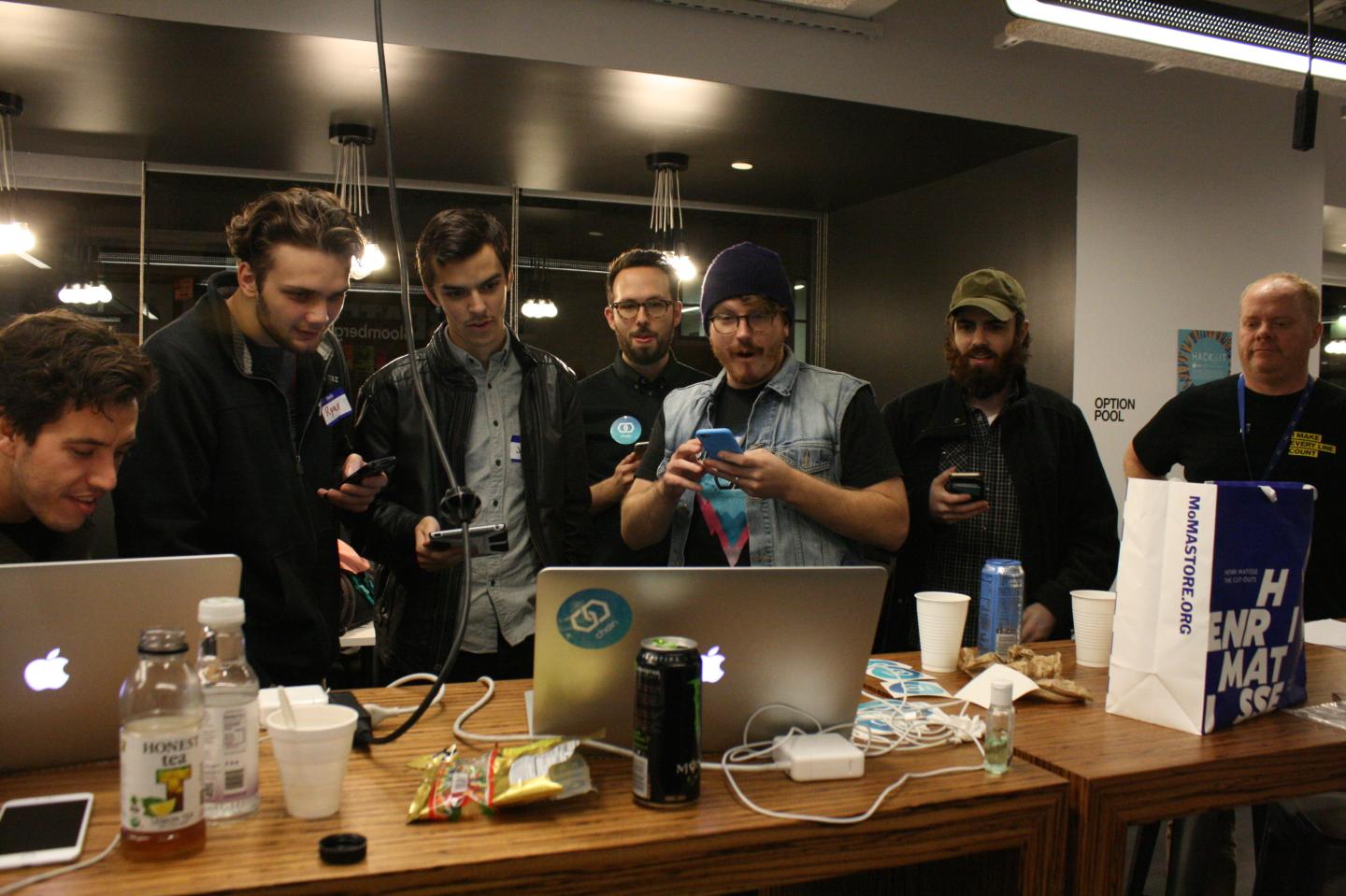
Amid the hushed, hurried clatter of keyboards at New York University’s newly opened entrepreneurship lab, students huddle in teams of one-to-four, scarfing down bok choy and fried dumplings. It’s past midnight. Empty cans of Monster energy drink, half-eaten Oreos, and Jolly Rancher wrappers are strewn about. “Fluxed” light—named for the application f.lux, which alters the warmth of computer screens based on time of day, easing eye strain— emanates from some laptops. No one appears tired yet.
Tonight (or, more appropriately, this morning) a few dozen students have eschewed coursework to compete in the university’s first-ever cryptocurrency-themed hackathon: a nearly 30-hour competition to conceive and build tools involving the virtual currency network bitcoin. Forming makeshift militias, matriculants clack on laptops, forking code and pulling data from the web. Teams convene in workspaces named after startup slang—“pre-money,” “hacker,” “hustler.” In each entryway there is a mounted, touch-screen scheduling system. Even the elevator and bathroom are in on the act—the former is the “pitch room;” the latter, the “exit strategy.” The lab occupies a space once home to the campus computer store.
At a far wall, Daniel Basner, a third-year computer science student at NYU, fiddles with a circuit breadboard and wires. He is plugging green LEDs into a small hardware prototyping platform called an Arduino. Though Basner had no intention to compete when he stumbled into the lab an hour or so earlier, he decided it looked fun and joined in. “I don’t particularly care about bitcoins,” he admits. Yet here he is, jerry-rigging a gadget that will light up whenever its owner receives a payment in the digital currency. “Things are better when they light up,” he assures an onlooker. “If you have the choice of something lighting up or not, the answer is light up every time.”
Another set of contestants is working to assemble a bitcoin “piggybank”—a lockable digital wallet that permits financial transactions only after a set period of time. The team originally intended to create a map that would track where all bitcoin transactions are taking place. It switched gears after an event sponsor suggested a simpler idea. Had they more time and expertise, says teammate Md Islam, a 21-year-old computer science student at the City College of New York, the group would have designed a porcine interface.
As the hackathon continues, Matylda Czarnecka, the founder of a hackathon consultancy called Hackonauts and a 2010 NYU alum who helped organize the present event, occasionally rises to quell the concerns of public safety officers who are curious about the lab’s late-night activity. Through the night, she announces the start of workshops, takes photographs, and packs excess meals into UberX cabs to be sent to a local shelter. She first organized a hackathon in 2011, when they “started becoming a thing,” she says. Since then, she has helped plan coding events for clients such as Yahoo, Microsoft, and the New York-based non-profit HackNY.
“At the beginning I found myself frequently defining what a hackathon is,” Czarnecka says, describing how she used to pitch her business. “Now the question I get is: Do you think it’s a bubble that will burst? Is it over? Have hackathons jumped the shark?” Tellingly, another hackathon is taking place down the street at NYU’s Interactive Telecommunications Program. (Its provocative title: “Stupid Shit No One Needs & Terrible Ideas Hackathon.”) Czarnecka grins, unruffled. “The format may change but the need isn’t going away,” she says. “If hackathons didn’t evolve or change, that would be against the premise of a hackathon.”
In the past couple of years hackathons have climbed from the basements of geeky diversion to the corporate luxury boxes of mainstream sport. Businesses and universities regularly host the events as standard fare innovation activities. (Companies as diverse as McDonald’s, Purina, and Aetna have held them.) The events spur programmers and developers to collaborate on quick turnaround projects, make new connections, show off their work, and receive prizes. At hackathons, Czarnecka likes to stay up until a little before sunrise—just before the contestants begrudgingly remember there’s a deadline. On this day, she’ll nap at 4:30 a.m.
One of the night’s celebrities is Yifu Guo, a 24-year-old two-time startup founder who specializes in the bitcoin payment network. He has agreed to help judge the competition and watches in the main room as students tinker and tabulate. By now, it’s past 2 a.m. Guo, clad in a leather jacket and with hair tied in a jet-black ponytail, roams underneath extension cords that dangle like tentacles from the ceiling. Guo is an NYU dropout who made his fortune as an early adopter of bitcoin. Through his first company Avalon, he was also the first person to bring dedicated bitcoin “mining” hardware—machines designed specifically to solve complex puzzles that reward their operators in cryptocurrency—to market. Guo is used to keeping nocturnal hours, thanks to business partners in Germany and China. In the wee hours of the morning, he looks livelier than the hacking cohort.
As more and more hours pass, heads nod. Eyes droop. Jaws yawn. The clock cycles. Lines of code propagate. Eventually, enough time has passed that Czarnecka, who has returned from her brief respite, announces impending product demonstrations. Suddenly, it’s 4 p.m. Lungs inflate. Ears perk. Fingers translate last-minute touches into code.
After a few introductory remarks, Baserman takes the stage for the first demo. He asks someone to send him a bitcoin payment. “This is a clever ploy!” someone in the audience shouts. Peter Smith, co-founder of the bitcoin startup Blockchain (one of the event’s sponsors) and a judge at the day’s event, offers to make a donation while Fred Wilson, managing director at the venture capital firm Union Square Ventures and another judge, jumps out of his seat to take photos with his phone’s camera. Wilson asks Baserman whether he has thought about turning “Lightcoin,” as Baserman has dubbed the unassuming box of wires, into wearable device. He has toyed with the idea of a jacket or scarf, he replies. In a moment, his device blinks and chimes: money received.
Following Baserman, a succession of teams demo their crypto-currency experiments. One team presents a slick website that tracks bitcoin transactions and catalogues receipts, an add-on for a merchant point-of-sale system. Another team displays an exchange rate ticker that aggregates prices from the most popular bitcoin exchanges. Another introduces a Galaga-style flash game that rewards its players in “Satoshis,” a unit of bitcoin named after the currency’s mysteriously elusive alleged inventor, Satoshi Nakamoto. Next, a hacker takes the stage. He displays on the projection screen what looks like two dancing cartoon worms—one green, one blue—atop some sort of chart. He speaks in the past tense, and tells the audience what he learned.
After breaking to deliberate, the judges return to the room to announce prizes. One team that devised an arbitrage engine called “Coin Shop” wins a drone. A team that built a receipt aggregator named “Bitrec” earns a bitcoin payment encoded with the date the crypto-currency was born—Jan. 3, 2009. At last, Wilson takes the stage to announce the grand prize: $1,500 worth of bitcoin. “Once again proving that we all like to play games,” he declares, scanning the slumping, tense faces of the tired hackers before him. “To the moon!”
Two juniors from King’s College—the first U.S. school to accept bitcoin—celebrate. Jordan Frankfurt, wearing a moustache and a fish-patterned baseball cap, and Ryan Skinner, sporting shaggy hair and a shirt with a cat’s face printed on its pocket, join Wilson at the front of the room. A photographer snaps a picture. The pair plan to create a bitcoin-fueled website in the style of addictinggames.com to lure a new generation of crypto-currency users. Advertisements will support the bitcoin eked out to the site’s gamers, and they’ll spend that virtual money, so the idea goes, on in-app purchases. The two return to their seats and high-five.
“Honestly, even if we didn’t win, I had so much fun creating the game either way. We want to keep doing it,” Skinner says as the crowd disperses: many to rest, no doubt. “I mean, we got this,” Frankfurt chimes, indicating the prize. “How could we not?”
Disclosure: The author owns a small amount of bitcoin.