• Home
  • Latest
  • Fortune 500
  • Finance
  • Tech
  • Leadership
  • Lifestyle
  • Rankings
  • Multimedia

Trendingnow

1

The millennial generation has split, new Fed research shows: Those over 35 are edging toward boomer-style wealth, while everyone else falls behind

2

Scott Bessent casually says the U.S. has more than $1 trillion in gold—and that it doesn’t matter for the dollar

3

Mark Cuban says he has the solution to growing income inequality, and it's to reward every employee—from CEO to janitor—with company stock

1

The millennial generation has split, new Fed research shows: Those over 35 are edging toward boomer-style wealth, while everyone else falls behind

2

Scott Bessent casually says the U.S. has more than $1 trillion in gold—and that it doesn’t matter for the dollar

3

Mark Cuban says he has the solution to growing income inequality, and it's to reward every employee—from CEO to janitor—with company stock
LeadershipCommentary

What the U.S. and China understand, that Putin fails to see

By
Minxin Pei
Minxin Pei
Down Arrow Button Icon
By
Minxin Pei
Minxin Pei
Down Arrow Button Icon
November 17, 2014, 4:24 PM ET
Barack Obama, Xi Jinping
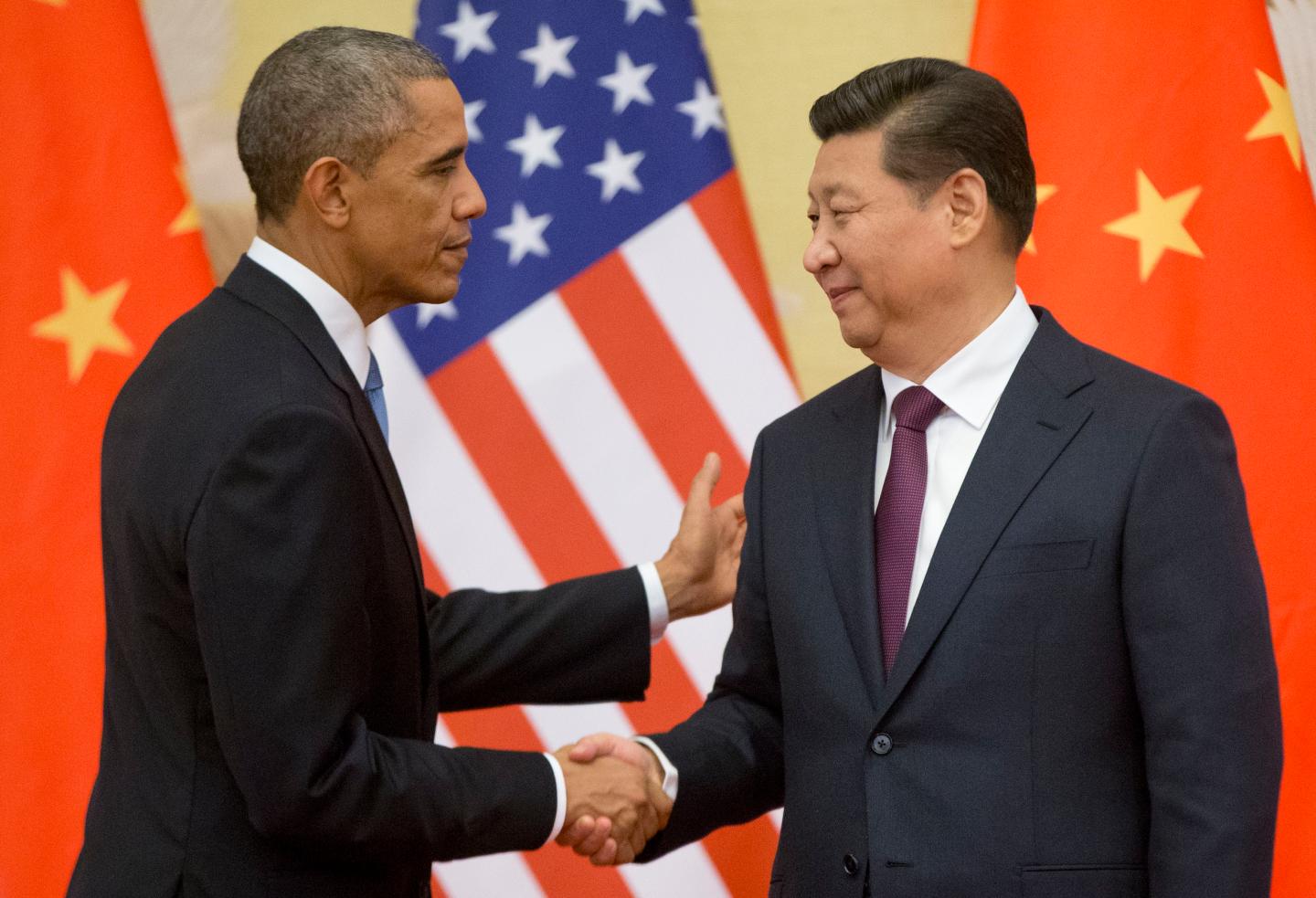
U.S. President Barack Obama, left, and Chinese President Xi Jinping shake hands following the conclusion of their joint news conference at the Great Hall of the People in Beijing, Wednesday, Nov. 12, 2014. (AP Photo/Pablo Martinez Monsivais)Photograph by Pablo Martinez Monsivais — AP
Add Fortune on Google for similar content.

A surprisingly productive summit in Beijing last week has changed, at least for now, the dynamics in U.S.-China relations.

There is little doubt that the four key agreements reached between Presidents Barack Obama and Xi Jinping—on climate change, elimination of tariffs on IT products, reciprocal visa liberalization, and notice on major military deployments—will help stabilize and advance a relationship that has been adrift for the last year-and-a-half.

The most remarkable fact about the Beijing summit is that it occurred at all. Since Xi came to power two years, he has pursued a hardline domestic agenda and an assertive foreign policy. The deterioration of human rights conditions in China and rising tensions with the nation’s neighbors has put China and the U.S. on a collision course. In fact, shortly before the summit, most China watchers were concerned that U.S.-China relations were drifting toward conflict.

But the outcome of the summit shows that such a conflict is avoidable. Given their irreconcilable differences over democracy, human rights, and visions of global order, the U.S. and China will always be rivals. However, unlike the former Soviet Union, China also shares important interests with the U.S., such as trade, investment, and international peace. The challenge in managing U.S.-China relations is in getting the balance right.

In Beijing last week, Presidents Obama and Xi showed they could walk and chew at the same time. By putting aside their differences over the most contentious bilateral issues, the two leaders focused on the tasks that, if accomplished, could further expand their shared interests.

If we parse the agreements on IT tariffs, visa liberalization, and climate change, China apparently has made more concessions than the U.S. Since the U.S. has no tariffs on IT products, the agreement will result in a loss of import duties for China, estimated at several billion dollars a year. The relaxation of visa controls will similarly benefit American business more because of the ease of travel and the resulting attractiveness of the U.S. as a destination for private Chinese investment.

On climate change, Beijing’s agreement to cap its greenhouse gas emissions by 2030 marks its first formal commitment to limiting emissions and is significant on two fronts. First, Beijing’s pledge will dramatically alter the political dynamics in global climate change talks. Up to this point, China has sided with developing nations and insisted that rich countries should bear the primary responsibility for emission reductions. With the U.S.-China climate agreement, China has essentially abandoned its long-held position. As a result, other developing countries, especially India and Brazil, will likely have to modify their positions, increasing the chances of success at the next United Nations Climate Change Conference, scheduled for December 2015 in Paris.


Second, Chinese commitment to an emissions cap will almost certainly accelerate the country’s energy transition. Although China pledges to increase the share of primary energy production from renewables to 20% by 2030—a realistic task—accomplishing this goal will not be easy since China’s energy demand will be much bigger by then and most of the renewables will have to come from nuclear, wind, and solar. Based on the remarks of a senior Chinese official in charge of climate change policy, a key benefit of committing to a cap on emissions is to force painful restructuring of the Chinese coal-dependent energy industry.

For the American business community, the good news from the Beijing summit is not solely limited to the potential opportunities in China’s energy sector. By opting for cooperation, not confrontation, Xi now must moderate some of Beijing’s unfriendly policies toward Western businesses (such as the aggressive enforcement of anti-monopoly laws). For Xi, repairing China’s commercial ties with the U.S. is also politically necessary. Like his predecessors, Xi would like to be welcomed to the White House for a formal state visit (preferably before the end of his first term in 2017). The successful Beijing summit makes it a near certainty that Obama will be hosting Xi in Washington next year.

If there is one loser in all of this, it is Russian President Vladimir Putin (who was also in town for the Asia-Pacific Economic Cooperation summit). Isolated and pressured by sanctions, Putin has been eager to seek Xi’s support to counter the West. During Putin’s visit to Beijing, China and Russia signed a preliminary agreement on a 30-year natural gas deal which will increase Russian exports of natural gas to China by 30 billion cubic meters a year starting in 2020.

If Putin was hoping that, by building closer energy ties to China, he could count on Xi to stand with him in confronting the West, he must have been sorely disappointed. He has little appreciation of the complexity and interdependence of U.S.-China relations. Putin tends to see things in black and white, but Xi and Obama know how to operate within shades of gray—and they have both come out ahead in Beijing.

Minxin Pei is the Tom and Margot Pritzker Professor ’72 Professor of Government and a non-resident senior fellow of the German Marshall Fund of the United States

About the Author
By Minxin Pei
See full bioRight Arrow Button Icon
Add Fortune on Google for similar content.

Latest in Leadership

Finance
Lorem ipsum dolor sit amet, consectetur adipiscing elit, sed do eiusmod tempor incididunt ut labore et dolore magna aliqua. Ut enim ad minim veniam
By Fortune Editors
October 20, 2025
Finance
Lorem ipsum dolor sit amet, consectetur adipiscing elit, sed do eiusmod tempor incididunt ut labore et dolore magna aliqua. Ut enim ad minim veniam
By Fortune Editors
October 20, 2025
Finance
Lorem ipsum dolor sit amet, consectetur adipiscing elit, sed do eiusmod tempor incididunt ut labore et dolore magna aliqua. Ut enim ad minim veniam
By Fortune Editors
October 20, 2025
Finance
Lorem ipsum dolor sit amet, consectetur adipiscing elit, sed do eiusmod tempor incididunt ut labore et dolore magna aliqua. Ut enim ad minim veniam
By Fortune Editors
October 20, 2025
Finance
Lorem ipsum dolor sit amet, consectetur adipiscing elit, sed do eiusmod tempor incididunt ut labore et dolore magna aliqua. Ut enim ad minim veniam
By Fortune Editors
October 20, 2025
Finance
Lorem ipsum dolor sit amet, consectetur adipiscing elit, sed do eiusmod tempor incididunt ut labore et dolore magna aliqua. Ut enim ad minim veniam
By Fortune Editors
October 20, 2025

Most Popular

Finance
Lorem ipsum dolor sit amet, consectetur adipiscing elit, sed do eiusmod tempor incididunt ut labore et dolore magna aliqua. Ut enim ad minim veniam
By Fortune Editors
October 20, 2025
Finance
Lorem ipsum dolor sit amet, consectetur adipiscing elit, sed do eiusmod tempor incididunt ut labore et dolore magna aliqua. Ut enim ad minim veniam
By Fortune Editors
October 20, 2025
Finance
Lorem ipsum dolor sit amet, consectetur adipiscing elit, sed do eiusmod tempor incididunt ut labore et dolore magna aliqua. Ut enim ad minim veniam
By Fortune Editors
October 20, 2025
Finance
Lorem ipsum dolor sit amet, consectetur adipiscing elit, sed do eiusmod tempor incididunt ut labore et dolore magna aliqua. Ut enim ad minim veniam
By Fortune Editors
October 20, 2025
Finance
Lorem ipsum dolor sit amet, consectetur adipiscing elit, sed do eiusmod tempor incididunt ut labore et dolore magna aliqua. Ut enim ad minim veniam
By Fortune Editors
October 20, 2025
Finance
Lorem ipsum dolor sit amet, consectetur adipiscing elit, sed do eiusmod tempor incididunt ut labore et dolore magna aliqua. Ut enim ad minim veniam
By Fortune Editors
October 20, 2025
Fortune Secondary Logo
Rankings
  • 100 Best Companies
  • Fortune 500
  • Global 500
  • Fortune 500 Europe
  • Most Powerful Women
  • World's Most Admired Companies
  • See All Rankings
  • Lists Calendar
Sections
  • Finance
  • Fortune Crypto
  • Features
  • Leadership
  • Health
  • Commentary
  • Success
  • Retail
  • Mpw
  • Tech
  • Lifestyle
  • CEO Initiative
  • Asia
  • Politics
  • Conferences
  • Europe
  • Newsletters
  • Personal Finance
  • Environment
  • Magazine
  • Education
Customer Support
  • Frequently Asked Questions
  • Customer Service Portal
  • Privacy Policy
  • Terms Of Use
  • Single Issues For Purchase
  • International Print
Commercial Services
  • Advertising
  • Fortune Brand Studio
  • Fortune Analytics
  • Fortune Conferences
  • Business Development
  • Group Subscriptions
About Us
  • About Us
  • Press Center
  • Work At Fortune
  • Terms And Conditions
  • Site Map
  • About Us
  • Press Center
  • Work At Fortune
  • Terms And Conditions
  • Site Map
  • Facebook icon
  • Twitter icon
  • LinkedIn icon
  • Instagram icon
  • TikTok icon
  • YouTube icon

Latest in Leadership

Alphabet’s SpaceX stake fuels a $98 billion gain, beating estimates
Big TechMarkets
Alphabet’s SpaceX stake fuels a $98 billion gain, beating estimates
By Barbara Ortutay and The Associated PressJuly 23, 2026
3 hours ago
Benjamin Franklin's experiment with the kite.
AIScience
The Trump administration is revamping the era of the ‘gentleman scientist.’ It’ll cost $200 billion
By Eva RoytburgJuly 23, 2026
4 hours ago
Amazon founder Jeff Bezos
SuccessBillionaires
Amazon’s Jeff Bezos could be the latest American billionaire to buy into European soccer clubs—he’s eyeing up a stake in Liverpool FC
By Emma BurleighJuly 23, 2026
4 hours ago
Sanae Takaichi
Successwork-life balance
Japan’s prime minister sleeps just ‘zero to three’ hours a night—even as Tokyo pushes a 4-day workweek to fight ‘death by overwork’
By Preston ForeJuly 23, 2026
4 hours ago
All hail London—whatever the U.K.’s new Prime Minister says 
EuropeLetter from London
All hail London—whatever the U.K.’s new Prime Minister says 
By Kamal AhmedJuly 23, 2026
6 hours ago
AI coding company Cursor, soon to be acquired by SpaceX, expands its CFO council
NewslettersCFO Daily
AI coding company Cursor, soon to be acquired by SpaceX, expands its CFO council
By Sheryl EstradaJuly 23, 2026
7 hours ago

Most Popular

The millennial generation has split, new Fed research shows: Those over 35 are edging toward boomer-style wealth, while everyone else falls behind
Real Estate
The millennial generation has split, new Fed research shows: Those over 35 are edging toward boomer-style wealth, while everyone else falls behind
By Nick LichtenbergJuly 22, 2026
1 day ago
Scott Bessent casually says the U.S. has more than $1 trillion in gold—and that it doesn’t matter for the dollar
Economy
Scott Bessent casually says the U.S. has more than $1 trillion in gold—and that it doesn’t matter for the dollar
By Sasha RogelbergJuly 22, 2026
1 day ago
Mark Cuban says he has the solution to growing income inequality, and it's to reward every employee—from CEO to janitor—with company stock
Success
Mark Cuban says he has the solution to growing income inequality, and it's to reward every employee—from CEO to janitor—with company stock
By Sasha RogelbergJuly 20, 2026
3 days ago
'The man who dies rich dies disgraced': The last time America had such wealth inequality, Andrew Carnegie knew he had to give it all away
Success
'The man who dies rich dies disgraced': The last time America had such wealth inequality, Andrew Carnegie knew he had to give it all away
By Nick LichtenbergJuly 22, 2026
1 day ago
Mathematicians grapple with a ‘very rapid and very unsettling change’ as AI cracks yet another century-old problem
AI
Mathematicians grapple with a ‘very rapid and very unsettling change’ as AI cracks yet another century-old problem
By Eva RoytburgJuly 21, 2026
2 days ago
Despite a $156 million contract, Knicks star Jalen Brunson still calls his parents for financial advice any time he makes a big purchase
Success
Despite a $156 million contract, Knicks star Jalen Brunson still calls his parents for financial advice any time he makes a big purchase
By Emma BurleighJuly 21, 2026
2 days ago

© 2026 Fortune Media IP Limited. All Rights Reserved. Use of this site constitutes acceptance of our Terms of Use and Privacy Policy | CA Notice at Collection and Privacy Notice | Do Not Sell/Share My Personal Information
FORTUNE is a trademark of Fortune Media IP Limited, registered in the U.S. and other countries. FORTUNE may receive compensation for some links to products and services on this website. Offers may be subject to change without notice.