
• Home
  • Latest
  • Fortune 500
  • Finance
  • Tech
  • Leadership
  • Lifestyle
  • Rankings
  • Multimedia
FinanceWall Street

Wall Street’s Little Secret: It wins both the coming and going

By
Allan Sloan
Allan Sloan
Down Arrow Button Icon
By
Allan Sloan
Allan Sloan
Down Arrow Button Icon
November 13, 2014, 7:15 AM ET
Rich Men On Wall Street
Vintage illustration of a group rich men wearing top hats on Wall Street, 1927. (Illustration by GraphicaArtis/Getty Images)Illustration by GraphicaArtis/Getty Images

You have to love the way Wall Street works. What other industry do you know of that can happily profit from two mutually contradictory trends, both of which it promotes with unbridled zeal?

The first trend is big companies breaking themselves into separate parts in the name of efficiency and shareholder value.

The second trend is big companies making large acquisitions in order to minimize their U.S. taxes, paying little regard, if any, to how the acquisitions will actually work out.

Breaking companies into pieces is all the rage these days, and Street dealmakers (and hedge funds looking for quick stock price increases) are pushing spinoffs as an efficient, shareholder-friendly practice. Twenty of these transactions were completed or announced this year through the end of October, according to S&P Capital IQ. That’s more than in the previous three years combined, which had a total of 14. And this year still isn’t over.

The other big rage on Wall Street is so-called inversions (which I call desertions) that involve U.S. companies buying foreign-based companies, then changing their tax residence to the foreign firms’ domiciles to take advantage of lower tax rates.

So, you see, it’s great for companies like HP to split themselves into separate businesses in the name of efficiency. But it’s also great for other U.S. companies to bulk up by making big acquisitions. How can we have these contradictions co-existing so comfortably? Because—be still, my heart!—Wall Street isn’t in business to help its customers or its clients or us retail shareholders (though that sometimes happens as a byproduct). Wall Street is in business to make money for Wall Street.

In both breakups and inversions, Wall Street is giving corporate customers what they want—or what they have come to believe they want. (As Street cynics say, “When the ducks quack, feed them.”) Meanwhile, the Street reaps a rich harvest of advice fees, financing fees, and trading profits from these deals.
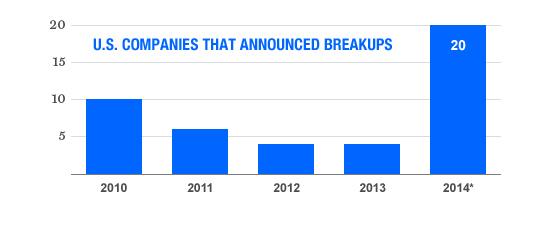
SPLIT-UP MANIA So far this year 20 U.S. corporations have announced or completed deals to break themselves up—more than in the previous three years combined.
SPLIT-UP MANIA So far this year 20 U.S. corporations have announced or completed deals to break themselves up—more than in the previous three years combined.Graphic Source: S&P Capital IQ * through Oct. 31

The current trend of corporate breakups and spinoffs is a reversal of the previous, bigger-is-better trend. Companies such as eBay and Symantec were cheered when they bought PayPal and Veritas in 2002 and 2005, respectively. Now those firms are being cheered for splitting themselves up. Wall Street profits by putting the firms together; now it profits by taking them apart.

That brings us to corporate inversions, transactions in which a U.S. company buys a foreign-based company. I’ll spare you my customary rant on how these deals undermine our society and Main Street’s remaining faith in corporate America. Instead, I’ll focus on the shareholder-unfriendly economics of the takeovers that companies do in order to invert.

In an inversion, a company typically pays a fat premium to do a takeover in which it issues stock equal to at least 25% of its shares outstanding, the legal threshold required for inversions. That’s a big takeover, folks.

Companies crow—sometimes publicly, sometimes only in private—about how much money they will save in taxes by inverting. But what almost no one but me seems to discuss is the cost to existing shareholders of paying a fat premium, combined with the risk of having to make a big acquisition work out. According to a Harvard Business Review paper published in 2011, “Study after study puts the failure rate of mergers and acquisitions somewhere between 70% and 90%.” There’s no reason to think that inversion-motivated takeovers will work out any better for shareholders than the conventional kind typically do.

But you can be sure that inversion-motivated takeovers, like garden-variety takeovers and the current wave of split-ups, will work out well for Wall Street. Be it breakups or bulk-ups, the Street collects its fees and profits upfront, leaving the messes behind for stockholders, employees, and other stakeholders to deal with. Yet another example of high finance at work.

Reporter associate: Marty Jones

This story is from the December 1, 2014 issue of Fortune.

About the Author
By Allan Sloan
See full bioRight Arrow Button Icon

Latest in Finance

Finance
Lorem ipsum dolor sit amet, consectetur adipiscing elit, sed do eiusmod tempor incididunt ut labore et dolore magna aliqua. Ut enim ad minim veniam
By Fortune Editors
October 20, 2025
Finance
Lorem ipsum dolor sit amet, consectetur adipiscing elit, sed do eiusmod tempor incididunt ut labore et dolore magna aliqua. Ut enim ad minim veniam
By Fortune Editors
October 20, 2025
Finance
Lorem ipsum dolor sit amet, consectetur adipiscing elit, sed do eiusmod tempor incididunt ut labore et dolore magna aliqua. Ut enim ad minim veniam
By Fortune Editors
October 20, 2025
Finance
Lorem ipsum dolor sit amet, consectetur adipiscing elit, sed do eiusmod tempor incididunt ut labore et dolore magna aliqua. Ut enim ad minim veniam
By Fortune Editors
October 20, 2025
Finance
Lorem ipsum dolor sit amet, consectetur adipiscing elit, sed do eiusmod tempor incididunt ut labore et dolore magna aliqua. Ut enim ad minim veniam
By Fortune Editors
October 20, 2025
Finance
Lorem ipsum dolor sit amet, consectetur adipiscing elit, sed do eiusmod tempor incididunt ut labore et dolore magna aliqua. Ut enim ad minim veniam
By Fortune Editors
October 20, 2025

Most Popular

Finance
Lorem ipsum dolor sit amet, consectetur adipiscing elit, sed do eiusmod tempor incididunt ut labore et dolore magna aliqua. Ut enim ad minim veniam
By Fortune Editors
October 20, 2025
Finance
Lorem ipsum dolor sit amet, consectetur adipiscing elit, sed do eiusmod tempor incididunt ut labore et dolore magna aliqua. Ut enim ad minim veniam
By Fortune Editors
October 20, 2025
Finance
Lorem ipsum dolor sit amet, consectetur adipiscing elit, sed do eiusmod tempor incididunt ut labore et dolore magna aliqua. Ut enim ad minim veniam
By Fortune Editors
October 20, 2025
Finance
Lorem ipsum dolor sit amet, consectetur adipiscing elit, sed do eiusmod tempor incididunt ut labore et dolore magna aliqua. Ut enim ad minim veniam
By Fortune Editors
October 20, 2025
Finance
Lorem ipsum dolor sit amet, consectetur adipiscing elit, sed do eiusmod tempor incididunt ut labore et dolore magna aliqua. Ut enim ad minim veniam
By Fortune Editors
October 20, 2025
Finance
Lorem ipsum dolor sit amet, consectetur adipiscing elit, sed do eiusmod tempor incididunt ut labore et dolore magna aliqua. Ut enim ad minim veniam
By Fortune Editors
October 20, 2025
Fortune Secondary Logo
Rankings
  • 100 Best Companies
  • Fortune 500
  • Global 500
  • Fortune 500 Europe
  • Most Powerful Women
  • Future 50
  • World’s Most Admired Companies
  • See All Rankings
Sections
  • Finance
  • Fortune Crypto
  • Features
  • Leadership
  • Health
  • Commentary
  • Success
  • Retail
  • Mpw
  • Tech
  • Lifestyle
  • CEO Initiative
  • Asia
  • Politics
  • Conferences
  • Europe
  • Newsletters
  • Personal Finance
  • Environment
  • Magazine
  • Education
Customer Support
  • Frequently Asked Questions
  • Customer Service Portal
  • Privacy Policy
  • Terms Of Use
  • Single Issues For Purchase
  • International Print
Commercial Services
  • Advertising
  • Fortune Brand Studio
  • Fortune Analytics
  • Fortune Conferences
  • Business Development
  • Group Subscriptions
About Us
  • About Us
  • Editorial Calendar
  • Press Center
  • Work At Fortune
  • Diversity And Inclusion
  • Terms And Conditions
  • Site Map
  • About Us
  • Editorial Calendar
  • Press Center
  • Work At Fortune
  • Diversity And Inclusion
  • Terms And Conditions
  • Site Map
  • Facebook icon
  • Twitter icon
  • LinkedIn icon
  • Instagram icon
  • Pinterest icon

Latest in Finance

 The world’s 500 richest people made more than a quarter trillion yesterday as volatile markets react to fragile Iran war ceasefire
EconomyBillionaires
 The world’s 500 richest people made more than a quarter trillion yesterday as volatile markets react to fragile Iran war ceasefire
By Jacqueline MunisApril 9, 2026
6 hours ago
Only five ships crossed the Strait of Hormuz Thursday, far below Iran’s pledge as negotiations begin
EnergyIran
Only five ships crossed the Strait of Hormuz Thursday, far below Iran’s pledge as negotiations begin
By Eva RoytburgApril 9, 2026
8 hours ago
7 best debt relief companies 2026
Personal FinanceLoans
7 best debt relief companies 2026
By Joseph HostetlerApril 9, 2026
8 hours ago
iran
EnergyFood and drink
A global food emergency: Why the closed Strait of Hormuz puts half the world’s calories at risk
By Aya S. Chacar and The ConversationApril 9, 2026
11 hours ago
Willie Walsh, wearing a blue suit, looks to his right with his mouth slightly open.
EnergyAviation
Jet fuel supply disruptions are comparable to 9/11 and could take months to replenish even if Hormuz Strait is reopening, airline trade group warns
By Sasha RogelbergApril 9, 2026
11 hours ago
erewhon
EconomyFood and drink
Americans hate the economy so much, they’re buying $22 smoothies
By Yuanyuan (Gina) Cui, Patrick Van Esch and The ConversationApril 9, 2026
11 hours ago

Most Popular

The U.S. government is spending $88 billion a month in interest on national debt—equal to spending on defense and education combined
Economy
The U.S. government is spending $88 billion a month in interest on national debt—equal to spending on defense and education combined
By Fortune EditorsApril 9, 2026
16 hours ago
Gen Z doesn't want your full-time job. They want several part-time roles, and it's reshaping the entire workforce
Success
Gen Z doesn't want your full-time job. They want several part-time roles, and it's reshaping the entire workforce
By Fortune EditorsApril 9, 2026
19 hours ago
2 years ago, Saudi Arabia quietly canceled the ‘petrodollar’ deal with America that wired the world economy for 50 years. Then war broke out in Iran
Energy
2 years ago, Saudi Arabia quietly canceled the ‘petrodollar’ deal with America that wired the world economy for 50 years. Then war broke out in Iran
By Fortune EditorsApril 7, 2026
2 days ago
A Meta employee created a dashboard so coworkers can compete to be the company's No. 1 AI token user—and Zuckerberg doesn't even rank in the top 250
AI
A Meta employee created a dashboard so coworkers can compete to be the company's No. 1 AI token user—and Zuckerberg doesn't even rank in the top 250
By Fortune EditorsApril 9, 2026
19 hours ago
Self-made billionaire MrBeast says his work-life balance is nonexistent and calls it a ‘miracle’ if he works less than 15-hour days: ‘I live to work’
Success
Self-made billionaire MrBeast says his work-life balance is nonexistent and calls it a ‘miracle’ if he works less than 15-hour days: ‘I live to work’
By Fortune EditorsApril 8, 2026
1 day ago
White-collar workers are quietly rebelling against AI as 80% outright refuse adoption mandates
AI
White-collar workers are quietly rebelling against AI as 80% outright refuse adoption mandates
By Fortune EditorsApril 9, 2026
17 hours ago

© 2026 Fortune Media IP Limited. All Rights Reserved. Use of this site constitutes acceptance of our Terms of Use and Privacy Policy | CA Notice at Collection and Privacy Notice | Do Not Sell/Share My Personal Information
FORTUNE is a trademark of Fortune Media IP Limited, registered in the U.S. and other countries. FORTUNE may receive compensation for some links to products and services on this website. Offers may be subject to change without notice.