
• Home
  • Latest
  • Fortune 500
  • Finance
  • Tech
  • Leadership
  • Lifestyle
  • Rankings
  • Multimedia
Finance

How to use that $900 billion of offshore cash to create U.S. jobs

By
Allan Sloan
Down Arrow Button Icon
By
Allan Sloan
Down Arrow Button Icon
October 24, 2014, 8:30 AM ET
Juan Barreto/AFP— Getty

One of the stories that firms deserting our country like to tell is that by moving their corporate domicile (but not their actual headquarters) outside the United States to duck taxes, they will be able to use cash they currently have parked offshore to expand their operations in the U.S.

So when the new rules the Treasury issued in September upended the biggest proposed corporate “inversion” in history—Illinois-based AbbVie’s (ABBV) $54 billion takeover of Ireland-based Shire—there was whining about how the Treasury is killing prospective American jobs.

To which I say: give me a break. Under current law, it’s already relatively simple, inexpensive, and profitable for an American company to use its offshore cash for productive and job-adding U.S. projects. And as I think you’ll see, the method we’re talking about, which Standard & Poor’s has dubbed “synthetic cash repatriation,” looks like a better long-term deal for shareholders than paying a multi-billion-dollar premium to buy an offshore company in an inversion deal.

In an inversion, a U.S. company buys a foreign company, technically sells out to it, and thus transforms itself into a non-U.S. company to avoid high U.S. taxes, but continues to benefit from being in our country. That’s why I (and subsequently President Obama) have taken to calling these inverters “deserters.”

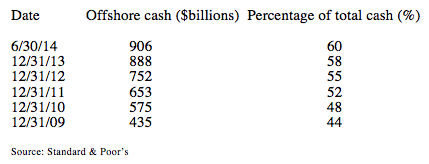
U.S. companies rarely bring home the profits they earn in other countries, because that would subject them to the 35% U.S. corporate income tax, less the tax (if any) paid where the money was earned. As of June 30, S&P estimates that the U.S. companies whose credit it rates held $906 billion of cash offshore, money that would be subject to U.S. tax if companies brought it home directly.

UN-AMERICAN BILLIONS Corporate America says it can’t use that money to expand in our country without inverting. Sorry, that’s not the case.

But there’s a simple and obvious way for companies to use the cash indirectly to fund U.S. investments. Think of it as “clever borrowing.”

Here’s how it would work. It’s a play in three acts.

Act One We start with something I learned from tax expert Edward Kleinbard, a University of Southern California law school professor and a prolific, witty, and effective polemicist whose new book, We Are Better than This: How Government Should Spend Our Money, is a must-read for anyone who wants to be educated about taxes and social policy.

Kleinbard told me something that I should have known but didn’t: American companies are required to pay U.S. income tax on interest and dividends earned on their offshore cash, regardless of whether that income is repatriated to the U.S. (For details, ask a tax techie about Subpart F.) That’s something that very few people know, but it’s really important for our analysis.

Act Two Last April, S&P issued a nifty report showing how some big U.S. companies are indirectly using their offshore cash to facilitate cheap borrowing in the U.S. That’s the practice that S&P dubs, quite cleverly, “synthetic cash repatriation.” In case you’re interested—and you should be—offshore cash is 60% of the total cash that S&P-rated companies had on their books as of June 30, up from 44% at year-end 2009.
Companies' Offshore Cash
Now, let’s combine Acts One and Two. Because the income earned on firms’ offshore cash is taxable in the U.S., there’s no penalty for repatriating that income into our country. So a company with offshore cash can borrow in the U.S. and use the income earned on its offshore money to pay some or all of the (tax-deductible) interest that it incurs on its U.S. borrowing.

If the interest rates at which a company invests its surplus cash offshore and borrows in the U.S. for projects here were identical, the offshore interest income would totally offset the U.S. interest expense. But in the real world, the money a company would borrow to fund a productive, job-creating project would typically have a longer maturity than the short-term securities in which firms generally stash their offshore cash. Therefore, money borrowed in the U.S. to fund a project here would carry a higher interest rate than what the offshore cash earns.

So let’s say a company is earning 1% on its offshore cash and pays 3% to borrow here. After taxes—remember, interest paid in the U.S. is deductible to the borrower—that 2% spread costs the company only 1.3%.

Act Three The grand finale: A big company that wants to make a capital investment in the U.S. typically has a “hurdle rate”—a minimum return that it expects to earn on that investment—of at least 10% after taxes.

If an investment isn’t likely to earn at least the hurdle rate return, the company probably won’t make it, regardless of where the cash to pay for it comes from. If the projected profit exceeds the hurdle rate, the company will make the investment. Shelling out 1.3% after tax to finance an investment expected to earn double digits after tax is a no-brainer.

Using offshore cash to borrow cheaply in the U.S. strikes me as a better long-term deal for shareholders than having a company shell out big money to buy an inversion partner, and then having to make that corporate marriage work. (The acquisition has to be sizable, relative to the inverter’s stock market value, for the deal to qualify for inversion treatment under the tax code.)

There’s no question that a 1.3% annual cost makes “financial engineering” maneuvers, such as using U.S. borrowings to pay dividends and buy back shares, less lucrative for shareholders than they would otherwise be. However, as we’ve seen, if a company wants to use synthetically repatriated cash to expand and grow, that 1.3% isn’t a big deal.

My conclusion: the idea that a U.S. company with offshore cash has to invert and desert our country in order to make an investment here is nonsense. Up with intelligent borrowing. Down with whining.

This is an expanded version of a column that will appear in the November 17, 2014 issue of Fortune.

About the Author
By Allan Sloan
See full bioRight Arrow Button Icon

Latest in Finance

Finance
Lorem ipsum dolor sit amet, consectetur adipiscing elit, sed do eiusmod tempor incididunt ut labore et dolore magna aliqua. Ut enim ad minim veniam
By Fortune Editors
October 20, 2025
Finance
Lorem ipsum dolor sit amet, consectetur adipiscing elit, sed do eiusmod tempor incididunt ut labore et dolore magna aliqua. Ut enim ad minim veniam
By Fortune Editors
October 20, 2025
Finance
Lorem ipsum dolor sit amet, consectetur adipiscing elit, sed do eiusmod tempor incididunt ut labore et dolore magna aliqua. Ut enim ad minim veniam
By Fortune Editors
October 20, 2025
Finance
Lorem ipsum dolor sit amet, consectetur adipiscing elit, sed do eiusmod tempor incididunt ut labore et dolore magna aliqua. Ut enim ad minim veniam
By Fortune Editors
October 20, 2025
Finance
Lorem ipsum dolor sit amet, consectetur adipiscing elit, sed do eiusmod tempor incididunt ut labore et dolore magna aliqua. Ut enim ad minim veniam
By Fortune Editors
October 20, 2025
Finance
Lorem ipsum dolor sit amet, consectetur adipiscing elit, sed do eiusmod tempor incididunt ut labore et dolore magna aliqua. Ut enim ad minim veniam
By Fortune Editors
October 20, 2025

Most Popular

Finance
Lorem ipsum dolor sit amet, consectetur adipiscing elit, sed do eiusmod tempor incididunt ut labore et dolore magna aliqua. Ut enim ad minim veniam
By Fortune Editors
October 20, 2025
Finance
Lorem ipsum dolor sit amet, consectetur adipiscing elit, sed do eiusmod tempor incididunt ut labore et dolore magna aliqua. Ut enim ad minim veniam
By Fortune Editors
October 20, 2025
Finance
Lorem ipsum dolor sit amet, consectetur adipiscing elit, sed do eiusmod tempor incididunt ut labore et dolore magna aliqua. Ut enim ad minim veniam
By Fortune Editors
October 20, 2025
Finance
Lorem ipsum dolor sit amet, consectetur adipiscing elit, sed do eiusmod tempor incididunt ut labore et dolore magna aliqua. Ut enim ad minim veniam
By Fortune Editors
October 20, 2025
Finance
Lorem ipsum dolor sit amet, consectetur adipiscing elit, sed do eiusmod tempor incididunt ut labore et dolore magna aliqua. Ut enim ad minim veniam
By Fortune Editors
October 20, 2025
Finance
Lorem ipsum dolor sit amet, consectetur adipiscing elit, sed do eiusmod tempor incididunt ut labore et dolore magna aliqua. Ut enim ad minim veniam
By Fortune Editors
October 20, 2025
Rankings
  • 100 Best Companies
  • Fortune 500
  • Global 500
  • Fortune 500 Europe
  • Most Powerful Women
  • Future 50
  • World’s Most Admired Companies
  • See All Rankings
Sections
  • Finance
  • Leadership
  • Success
  • Tech
  • Asia
  • Europe
  • Environment
  • Fortune Crypto
  • Health
  • Retail
  • Lifestyle
  • Politics
  • Newsletters
  • Magazine
  • Features
  • Commentary
  • Mpw
  • CEO Initiative
  • Conferences
  • Personal Finance
  • Education
Customer Support
  • Frequently Asked Questions
  • Customer Service Portal
  • Privacy Policy
  • Terms Of Use
  • Single Issues For Purchase
  • International Print
Commercial Services
  • Advertising
  • Fortune Brand Studio
  • Fortune Analytics
  • Fortune Conferences
  • Business Development
About Us
  • About Us
  • Editorial Calendar
  • Press Center
  • Work At Fortune
  • Diversity And Inclusion
  • Terms And Conditions
  • Site Map

© 2025 Fortune Media IP Limited. All Rights Reserved. Use of this site constitutes acceptance of our Terms of Use and Privacy Policy | CA Notice at Collection and Privacy Notice | Do Not Sell/Share My Personal Information
FORTUNE is a trademark of Fortune Media IP Limited, registered in the U.S. and other countries. FORTUNE may receive compensation for some links to products and services on this website. Offers may be subject to change without notice.


Most Popular

placeholder alt text
Economy
The $38 trillion national debt is to blame for over $1 trillion in annual interest payments from here on out, CRFB says
By Nick LichtenbergDecember 17, 2025
2 days ago
placeholder alt text
AI
Meta’s 28-year-old billionaire prodigy says the next Bill Gates will be a 13-year-old who is ‘vibe coding’ right now
By Eva RoytburgDecember 19, 2025
17 hours ago
placeholder alt text
Success
As graduates face a ‘jobpocalypse,’ Goldman Sachs exec tells Gen Z they need to know their commercial impact 
By Preston ForeDecember 18, 2025
1 day ago
placeholder alt text
Economy
‘This is a wacky number’: economists cry foul as new government data assumes zero housing inflation in surprising November drop
By Eva RoytburgDecember 18, 2025
1 day ago
placeholder alt text
Success
Billionaire who sold two companies to Coca-Cola says he tries to persuade people not to become entrepreneurs: ‘Every single day, you can go bankrupt’
By Dave SmithDecember 19, 2025
13 hours ago
placeholder alt text
Success
The scientist who helped create AI says it’s only ‘a matter of time’ before every single job is wiped out—even safer trade jobs like plumbing
By Orianna Rosa RoyleDecember 19, 2025
14 hours ago

Latest in Finance

Sam Altman looks down and to the side, frowning.
AIOpenAI
Sam Altman says he’s ‘0%’ excited to be CEO of a public company as OpenAI drops hints about an IPO: ‘In some ways I think it’d be really annoying’
By Sasha RogelbergDecember 19, 2025
10 hours ago
CryptoKlarna
Klarna partners with Coinbase to receive stablecoin funds from institutional investors
By Ben WeissDecember 19, 2025
11 hours ago
AIDebt
AI hyperscalers have room for ‘elevated debt issuance’ — even after their recent bond binge, BofA says
By Jason MaDecember 19, 2025
11 hours ago
Late Apple cofounder Steve Jobs
SuccessCareers
Steve Jobs sold his Volkswagen to raise $1,300 for Apple’s first computer. He became a millionaire just two years later at 23
By Emma BurleighDecember 19, 2025
11 hours ago
Thomas “Tom” McInerney is President, CEO and a Director of Genworth Financial
CommentaryCaregiving
I’m a CEO who’s spent nearly 40 years talking to presidents, lawmakers and leaders about our long-term care crisis. They knew this moment was coming
By Thomas McInerneyDecember 19, 2025
12 hours ago
jewelry
EconomySmall Business
‘This year is just not a jewelry Christmas’: Meet a 64-year-old small businesswoman who’s seen her Main Street decline for the last decade
By Makiya Seminera and The Associated PressDecember 19, 2025
13 hours ago