
• Home
  • Latest
  • Fortune 500
  • Finance
  • Tech
  • Leadership
  • Lifestyle
  • Rankings
  • Multimedia

Trendingnow

1

The millennial generation has split, new Fed research shows: Those over 35 are edging toward boomer-style wealth, while everyone else falls behind

2

Spain lifted the World Cup, but the IRS still gets a cut of its $50 million pay day as players, coaches and refs all face complex U.S. “jock taxes”

3

The $39 trillion U.S. national debt isn’t as high as Japan’s and Singapore’s relative to economy size—and yet it's still worse somehow

1

The millennial generation has split, new Fed research shows: Those over 35 are edging toward boomer-style wealth, while everyone else falls behind

2

Spain lifted the World Cup, but the IRS still gets a cut of its $50 million pay day as players, coaches and refs all face complex U.S. “jock taxes”

3

The $39 trillion U.S. national debt isn’t as high as Japan’s and Singapore’s relative to economy size—and yet it's still worse somehow
TechBrainstorm Tech

Sandberg on Facebook: ‘We are our own biggest risk’

Andrew Nusca
By
Andrew Nusca
Andrew Nusca
Editorial Director, Brainstorm; author, Fortune Tech
Down Arrow Button Icon
Andrew Nusca
By
Andrew Nusca
Andrew Nusca
Editorial Director, Brainstorm; author, Fortune Tech
Down Arrow Button Icon
October 1, 2014, 12:51 AM ET
Sheryl Sandberg, Fortune Brainstorm Tech marketing dinner New York 2014
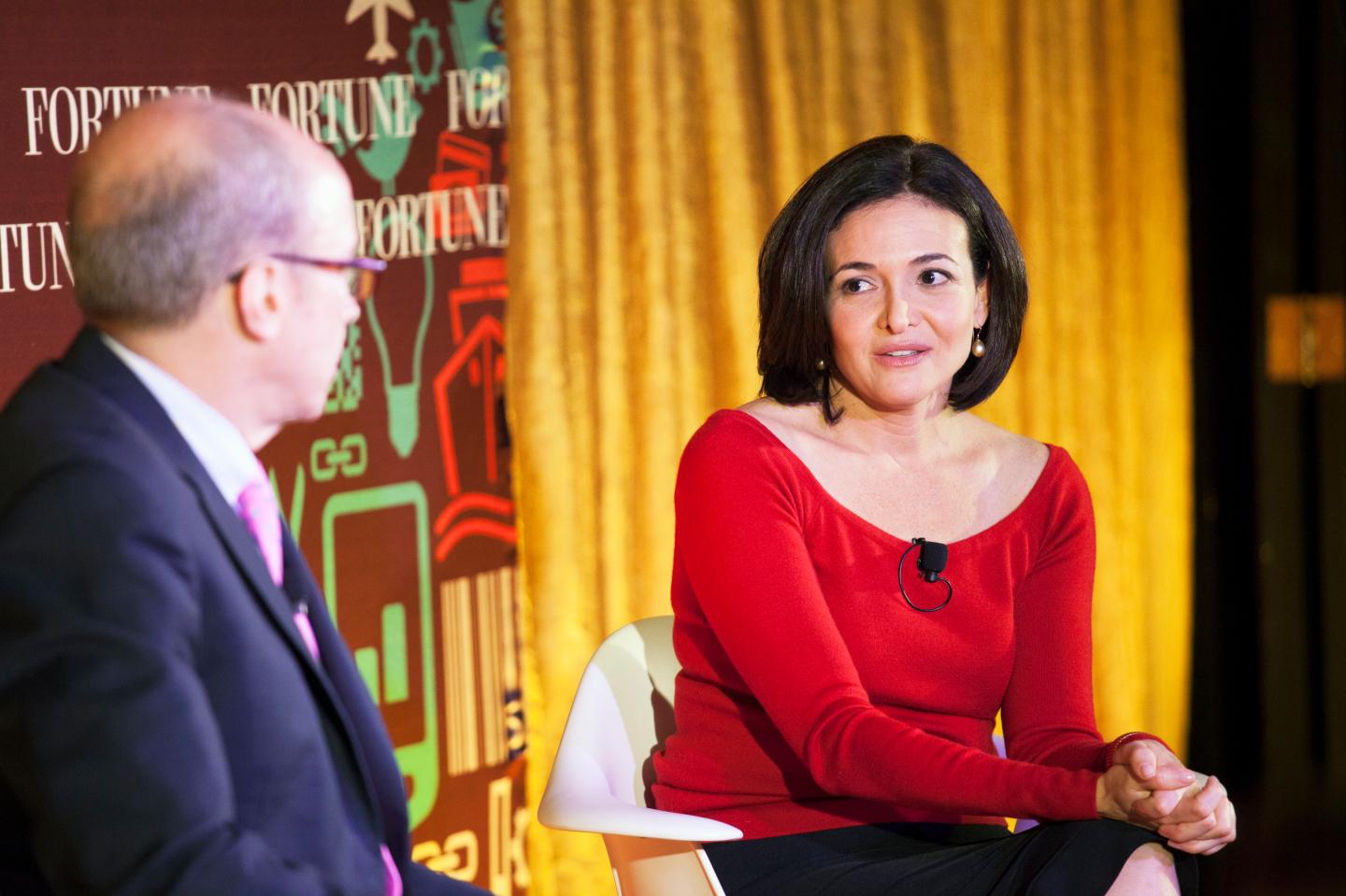
Facebook COO Sheryl Sandberg speaks to Fortune editor Alan Murray during a Fortune Brainstorm Tech marketing dinner in New York in September 2014.Photograph by Rebecca Greenfield/Fortune Brainstorm Tech
Add Fortune on Google for similar content.

Near the top of Facebook’s most recent annual report—which, I should warn you, runs nearly 100 pages long—the social networking company (FB) outlines its biggest business risks. The first is a tenet of any firm that dares to describe itself with the “s” word. “If we fail to retain existing users or add new users, or if our users decrease their level of engagement with Facebook,” it reads, “our revenue, financial results, and business may be significantly harmed.”

Read a bit further and you’ll come across the second biggest risk to Facebook’s business. It reads: “We generate a substantial majority of our revenue from advertising. The loss of marketers, or reduction in spending by marketers with Facebook, could seriously harm our business.” Substantial, if you’re wondering, is 89% of the almost $8 billion it took in last year.

It is this reason why Sheryl Sandberg, the company’s chief operating officer, was in New York this week. Sandberg, of Lean In fame, was in town for the city’s annual Advertising Week. On Sunday, her company announced that it had rebuilt Atlas, an advertising software suite it bought from Microsoft (MSFT) in early 2013. The new software promises to make cross-device marketing easier. (Or, in the words of Facebook’s own marketing, base it on “people.”)

On Tuesday, Sandberg found herself at a Fortune Brainstorm Tech marketing dinner at Mario Batali’s Del Posto restaurant, explaining to a roomful of marketing and ad executives why even the most basic ad targeting today isn’t effective.

“If you look at how ads are served and measured, the systems we’ve used to do them aren’t working anymore,” she said. “Because they’re cookie-based, they don’t work on mobile. They don’t work offline to online. And they don’t really understand that people have multiple devices. They worked really well when everyone had a desktop computer and nothing else. The old systems don’t work.”

Atlas, she continued, “enables ad-serving and measurement. So that it’s real people and real results. It enables marketers to be more effective and actually reach their target. We think close to 40% of the targeting that is just age and gender, which is the most basic targeting anyone does online, is not getting to the right people.”

What Sandberg didn’t expect was to be put on the defensive by Ello, a pipsqueak rival that has seemingly taken the Internet by storm by professing to never, ever run advertisements. Fortune editor Alan Murray, who interviewed Sandberg during the dinner, asked her about the upstart. She nodded, then threw up her hands.

“I haven’t seen the site,” Sandberg said. “Ever since I’ve been at Facebook, I see things all the time which are like, ‘My Mom’s getting on Facebook, I’m getting off.’ Saturday Night Live did that skit years ago. What really matters is that people get the best product. And they get that by a company being very focused.”

She went on. “People will continue to use Facebook if they understand that we don’t tell who they are to anyone, if they understand that they have control over what they share, and if we build a great product that continues to connect. I think what we’re really focused on is all of those things, particularly the product. What we worry about as we get bigger is, we want to innovate. And so we stay very focused on continuing to ship products.”

[fortune-brightcove videoid=3814526606001]
The 800-pound gorilla in the room, of course, was not so much Ello, whose story has just begun and may prove to be brief. It was the tacit acknowledgment that Facebook has challenged its users’ patience in recent months with changes to its products that cater to its real customers: advertisers. Today, a chief complaint about Facebook is that its algorithms too often show content or ads that are irrelevant to its users. Another is that it doesn’t respect its users’ privacy.

“Neither Atlas nor Facebook tells anyone who you are,” Sandberg said. She would repeat the sentiment, nearly verbatim, later in the talk.

However you feel about Facebook’s business model, it is clear that there is plenty of room for growth. On one hand, the company still trails Google (GOOG) in total ad revenue by a wide margin. On the other, it has fully transitioned into a mobile-first company, receiving more revenue from portable devices than not for the first time in 2014. (“The shift to mobile is the fastest adoption of a communication technology we’ve ever seen,” Sandberg said. “The word ‘online’ is about to be something only your parents say.”) Can Facebook catch up to its Silicon Valley neighbor, just a dozen miles down the road in Mountain View?

“As people transition from offline to online, I think the answer is that we can both win,” Sandberg said. “People are moving online and moving digital. If you look at it right now, mobile is 25% on average of U.S. consumer time and it’s 10% of the [advertising] budget. And as things move from offline to online, I think Google will do very well [and] I think we can do really well.”

She added: “I think there’s room for this pie to grow.” Even as Facebook claims 1 of every 5 minutes a person spends on their Internet-connected phone.

[fortune-brightcove videoid=3814478833001]
The biggest challenge for Facebook, which now counts 8,000 employees and recently celebrated its tenth anniversary, is how it can stay out of its own way on the road to continued growth. “Most companies mess it up all on their own because they don’t execute very well,” Sandberg said. “We are our own biggest risk.”

Editor’s note: Though Sandberg didn’t reprise her Lean In talk, she did remark that there were many women present in the room of marketing executives, and took a moment to conduct an experiment in which she first asked the men in the room to raise their hands if they had ever been told that they were “bossy” at work. (A small handful did.) Then she asked the women. (About four times as many hands went up.)

“If you go to most business dinners in New York or San Francisco, most of the women in this room are used to being the only women in the room,” she said. “That’s what I want to change. That’s what we all want to change.” Joking that a bossy little girl has executive leadership skills isn’t something to chuckle about, she said. There should be as little humor in the thought as there would be for a bossy little boy. “That bias exists in all of us,” she said, “in men, in women, in me.”

About the Author
Andrew Nusca
By Andrew NuscaEditorial Director, Brainstorm; author, Fortune Tech
Instagram iconLinkedIn iconTwitter icon

Andrew Nusca is the editorial director of Brainstorm, Fortune's innovation-obsessed community and event series. He also authors Fortune Tech, Fortune’s flagship tech newsletter.

See full bioRight Arrow Button Icon
Add Fortune on Google for similar content.

Latest in Tech

Finance
Lorem ipsum dolor sit amet, consectetur adipiscing elit, sed do eiusmod tempor incididunt ut labore et dolore magna aliqua. Ut enim ad minim veniam
By Fortune Editors
October 20, 2025
Finance
Lorem ipsum dolor sit amet, consectetur adipiscing elit, sed do eiusmod tempor incididunt ut labore et dolore magna aliqua. Ut enim ad minim veniam
By Fortune Editors
October 20, 2025
Finance
Lorem ipsum dolor sit amet, consectetur adipiscing elit, sed do eiusmod tempor incididunt ut labore et dolore magna aliqua. Ut enim ad minim veniam
By Fortune Editors
October 20, 2025
Finance
Lorem ipsum dolor sit amet, consectetur adipiscing elit, sed do eiusmod tempor incididunt ut labore et dolore magna aliqua. Ut enim ad minim veniam
By Fortune Editors
October 20, 2025
Finance
Lorem ipsum dolor sit amet, consectetur adipiscing elit, sed do eiusmod tempor incididunt ut labore et dolore magna aliqua. Ut enim ad minim veniam
By Fortune Editors
October 20, 2025
Finance
Lorem ipsum dolor sit amet, consectetur adipiscing elit, sed do eiusmod tempor incididunt ut labore et dolore magna aliqua. Ut enim ad minim veniam
By Fortune Editors
October 20, 2025

Most Popular

Finance
Lorem ipsum dolor sit amet, consectetur adipiscing elit, sed do eiusmod tempor incididunt ut labore et dolore magna aliqua. Ut enim ad minim veniam
By Fortune Editors
October 20, 2025
Finance
Lorem ipsum dolor sit amet, consectetur adipiscing elit, sed do eiusmod tempor incididunt ut labore et dolore magna aliqua. Ut enim ad minim veniam
By Fortune Editors
October 20, 2025
Finance
Lorem ipsum dolor sit amet, consectetur adipiscing elit, sed do eiusmod tempor incididunt ut labore et dolore magna aliqua. Ut enim ad minim veniam
By Fortune Editors
October 20, 2025
Finance
Lorem ipsum dolor sit amet, consectetur adipiscing elit, sed do eiusmod tempor incididunt ut labore et dolore magna aliqua. Ut enim ad minim veniam
By Fortune Editors
October 20, 2025
Finance
Lorem ipsum dolor sit amet, consectetur adipiscing elit, sed do eiusmod tempor incididunt ut labore et dolore magna aliqua. Ut enim ad minim veniam
By Fortune Editors
October 20, 2025
Finance
Lorem ipsum dolor sit amet, consectetur adipiscing elit, sed do eiusmod tempor incididunt ut labore et dolore magna aliqua. Ut enim ad minim veniam
By Fortune Editors
October 20, 2025
Fortune Secondary Logo
Rankings
  • 100 Best Companies
  • Fortune 500
  • Global 500
  • Fortune 500 Europe
  • Most Powerful Women
  • World's Most Admired Companies
  • See All Rankings
  • Lists Calendar
Sections
  • Finance
  • Fortune Crypto
  • Features
  • Leadership
  • Health
  • Commentary
  • Success
  • Retail
  • Mpw
  • Tech
  • Lifestyle
  • CEO Initiative
  • Asia
  • Politics
  • Conferences
  • Europe
  • Newsletters
  • Personal Finance
  • Environment
  • Magazine
  • Education
Customer Support
  • Frequently Asked Questions
  • Customer Service Portal
  • Privacy Policy
  • Terms Of Use
  • Single Issues For Purchase
  • International Print
Commercial Services
  • Advertising
  • Fortune Brand Studio
  • Fortune Analytics
  • Fortune Conferences
  • Business Development
  • Group Subscriptions
About Us
  • About Us
  • Press Center
  • Work At Fortune
  • Terms And Conditions
  • Site Map
  • About Us
  • Press Center
  • Work At Fortune
  • Terms And Conditions
  • Site Map
  • Facebook icon
  • Twitter icon
  • LinkedIn icon
  • Instagram icon
  • TikTok icon
  • YouTube icon

Latest in Tech

European travel platform Omio raises $10 million and buys Rail Europe as it chases Asia’s tourism market 
Asiatourism
European travel platform Omio raises $10 million and buys Rail Europe as it chases Asia’s tourism market 
By Nicholas GordonJuly 24, 2026
1 hour ago
Meet SLB: The $70 billion oil services giant poised to cash in on AI data centers and the post-Strait of Hormuz oil exploration boom
Magazineoil and gas
Meet SLB: The $70 billion oil services giant poised to cash in on AI data centers and the post-Strait of Hormuz oil exploration boom
By Jordan BlumJuly 24, 2026
1 hour ago
tokens
AIAI agents
‘You just hired a million bad employees’: How the brief tokenmaxxing era delivered the opposite of what it promised
By Nick LichtenbergJuly 24, 2026
1 hour ago
AMD’s Lisa Su defends open-source AI following Hugging Face security breach caused by OpenAI agents
AIAdvanced Micro Devices
AMD’s Lisa Su defends open-source AI following Hugging Face security breach caused by OpenAI agents
By Sebastian HerreraJuly 23, 2026
9 hours ago
Alphabet Inc. and Google CEO Sundar Pichai speaks during the inauguration of a Google Artificial Intelligence (AI) hub in Paris on February 15, 2024. (
Big TechWall Street
AI is forcing Big Tech to do something it’s never done: Spend more than it earns, and Wall Street hates it
By Eva RoytburgJuly 23, 2026
10 hours ago
Innovaccer's founders sit in chairs on a stage
AIData
Innovaccer’s CEO walked away from Disney and NASA to fix healthcare’s data mess. Now the startup has crossed $200 million in ARR
By Lily Mae LazarusJuly 23, 2026
10 hours ago

Most Popular

The millennial generation has split, new Fed research shows: Those over 35 are edging toward boomer-style wealth, while everyone else falls behind
Real Estate
The millennial generation has split, new Fed research shows: Those over 35 are edging toward boomer-style wealth, while everyone else falls behind
By Nick LichtenbergJuly 22, 2026
2 days ago
Spain lifted the World Cup, but the IRS still gets a cut of its $50 million pay day as players, coaches and refs all face complex U.S. “jock taxes”
Personal Finance
Spain lifted the World Cup, but the IRS still gets a cut of its $50 million pay day as players, coaches and refs all face complex U.S. “jock taxes”
By Joshua HongJuly 23, 2026
1 day ago
The $39 trillion U.S. national debt isn’t as high as Japan’s and Singapore’s relative to economy size—and yet it's still worse somehow
Economy
The $39 trillion U.S. national debt isn’t as high as Japan’s and Singapore’s relative to economy size—and yet it's still worse somehow
By Sasha RogelbergJuly 23, 2026
17 hours ago
Current price of oil as of July 23, 2026
Personal Finance
Current price of oil as of July 23, 2026
By Joseph HostetlerJuly 23, 2026
22 hours ago
Scott Bessent casually says the U.S. has more than $1 trillion in gold—and that it doesn’t matter for the dollar
Economy
Scott Bessent casually says the U.S. has more than $1 trillion in gold—and that it doesn’t matter for the dollar
By Sasha RogelbergJuly 22, 2026
2 days ago
Mark Cuban says he has the solution to growing income inequality, and it's to reward every employee—from CEO to janitor—with company stock
Success
Mark Cuban says he has the solution to growing income inequality, and it's to reward every employee—from CEO to janitor—with company stock
By Sasha RogelbergJuly 20, 2026
4 days ago

© 2026 Fortune Media IP Limited. All Rights Reserved. Use of this site constitutes acceptance of our Terms of Use and Privacy Policy | CA Notice at Collection and Privacy Notice | Do Not Sell/Share My Personal Information
FORTUNE is a trademark of Fortune Media IP Limited, registered in the U.S. and other countries. FORTUNE may receive compensation for some links to products and services on this website. Offers may be subject to change without notice.