• Home
  • News
  • Fortune 500
  • Tech
  • Finance
  • Leadership
  • Lifestyle
  • Rankings
  • Multimedia
FinanceBurger King

Buffett’s Burger King bet

By
Dan Primack
Dan Primack
Down Arrow Button Icon
By
Dan Primack
Dan Primack
Down Arrow Button Icon
August 25, 2014, 8:23 PM ET
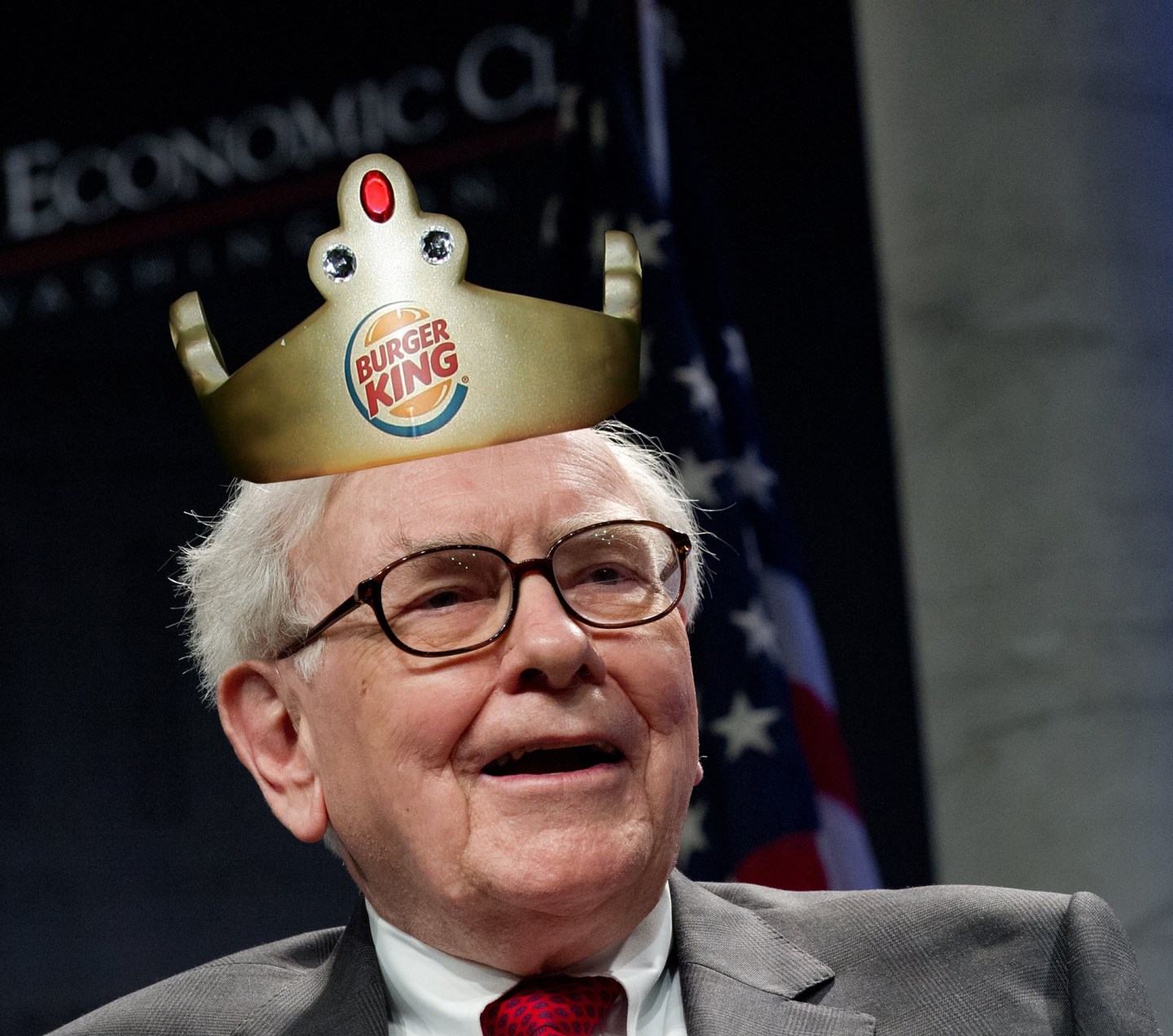
Billionaire Warren Buffett, CEO and chai
Billionaire Warren Buffett, CEO and chairman of investment company Berkshire Hathaway, speaks during a conversation with David Rubenstein, president of the Economic Club of Washingtron, during the club's 25th anniversary dinner in EWashington on June 5, 2012. AFP PHOTO/Nicholas KAMM (Photo credit should read NICHOLAS KAMM/AFP/GettyImages)

Warren Buffett is finally getting into the burger business.

Buffett’s Berkshire Hathaway (BRKA) has agreed to help finance Burger King’s (BKW) purchase of Canadian coffee-and-doughnut chain Tim Hortons (THI).

The deal, first reported by The Wall Street Journal, was officially announced Tuesday morning. The two companies said they have agreed to merge, bringing together Burger King, which is majority-owned by Brazilian private equity firm 3G Capital, and Tim Hortons, creating an $18 billion quick-serve restaurant behemoth.

The two companies said that Tim Hortons shareholders will receive C$65.50 in cash and 0.8025 shares of the new, combined company for each Tim Hortons share they currently own. When the deal is closed, 3G Capital will own about 51% of the combined company.

Berkshire is not expected to purchase common stock in the combined company, but instead is helping to finance the deal — alongside J.P. Morgan Chase & Co. and Wells Fargo — in exchange for preferred stock that would pay out an annual dividend.

Buffett worked with Brazil’s 3G Group last year to purchase ketchup-maker H.J. Heinz Co.

According to a source familiar with the situation, 3G reached out to Buffett back in 2010 about partnering on its original takeover of Burger King, but he demurred (although he already was in the quick-serve food biz via Berkshire’s ownership of Dairy Queen). Among Buffett’s concerns about Burger King were a succession of failed CEOs and the seeming invincibility of McDonald’s. Since then, Burger King’s revenue has consistently declined during 3G’s ownership (in large part due to its divestiture of company-owned stores), although both its profits and EBITDA have increased (3G is known for its focus on cutting costs). The company’s stock also is up more than 100% since returning to the public markets in June 2012.

By coming aboard now, however, Buffett may be hopping atop a political powder keg.

Burger King plans to relocate its headquarters from Florida to Ontario following the deal, making it just the latest in a series of so-called “tax inversions” that allow acquiring U.S. companies to lower their tax bills. Canada’s corporate tax rate is just 26.5%, compared to the U.S. rate of 35%. Burger King still would be required to pay U.S. taxes on U.S. operations, but ultimately would enjoy a lower IRS bill than were it to officially remain in Miami (in a strange twist, Tim Hortons had been incorporated in Delaware before later ‘self-inverting’). Approximately 44% of Burger King’s 2013 revenue came from outside the U.S.

Most of the political pressure to change tax law to prevent inversions has come from Democrats, with President Obama publicly denouncing such transactions. So it should be interesting to see if Buffett’s participation in Burger King either causes Democrats to back off, or possibly gets Republicans on board with existing reform efforts.

For his part, Buffett has said that he does not believe U.S. companies are unduly burdened by taxes, but he does see irrationality in the tax code and would prefer more consistency in corporate rates from country to country. Perhaps what he would argue is that Burger King and Tim Hortons will grow larger in the U.S. as a combined company than as separate entities, thus ultimately generating more U.S. tax revenue.

Under terms of the agreement, Burger King cannot walk away just because U.S. tax law changes. Also, Berkshire would be expected to pay U.S. taxes on its dividend income at a full rate, without the dividend received deduction that benefits holders of preferred shares of U.S.-based companies.

About the Author
By Dan Primack
See full bioRight Arrow Button Icon

Latest in Finance

CryptoBinance
Binance has been proudly nomadic for years. A new announcement suggests it’s finally chosen a headquarters
By Ben WeissDecember 7, 2025
3 hours ago
Big TechOpenAI
OpenAI goes from stock market savior to burden as AI risks mount
By Ryan Vlastelica and BloombergDecember 7, 2025
7 hours ago
InvestingStock
What bubble? Asset managers in risk-on mode stick with stocks
By Julien Ponthus, Natalia Kniazhevich, Abhishek Vishnoi and BloombergDecember 7, 2025
7 hours ago
EconomyTariffs and trade
Macron warns EU may hit China with tariffs over trade surplus
By James Regan and BloombergDecember 7, 2025
7 hours ago
EconomyTariffs and trade
U.S. trade chief says China has complied with terms of trade deals
By Hadriana Lowenkron and BloombergDecember 7, 2025
8 hours ago
PoliticsCongress
Leaders in Congress outperform rank-and-file lawmakers on stock trades by up to 47% a year, researchers say
By Jason MaDecember 7, 2025
8 hours ago

Most Popular

placeholder alt text
Real Estate
The 'Great Housing Reset' is coming: Income growth will outpace home-price growth in 2026, Redfin forecasts
By Nino PaoliDecember 6, 2025
2 days ago
placeholder alt text
AI
Nvidia CEO says data centers take about 3 years to construct in the U.S., while in China 'they can build a hospital in a weekend'
By Nino PaoliDecember 6, 2025
2 days ago
placeholder alt text
Economy
The most likely solution to the U.S. debt crisis is severe austerity triggered by a fiscal calamity, former White House economic adviser says
By Jason MaDecember 6, 2025
1 day ago
placeholder alt text
Economy
JPMorgan CEO Jamie Dimon says Europe has a 'real problem’
By Katherine Chiglinsky and BloombergDecember 6, 2025
1 day ago
placeholder alt text
Big Tech
Mark Zuckerberg rebranded Facebook for the metaverse. Four years and $70 billion in losses later, he’s moving on
By Eva RoytburgDecember 5, 2025
3 days ago
placeholder alt text
Politics
Supreme Court to reconsider a 90-year-old unanimous ruling that limits presidential power on removing heads of independent agencies
By Mark Sherman and The Associated PressDecember 7, 2025
15 hours ago
Rankings
  • 100 Best Companies
  • Fortune 500
  • Global 500
  • Fortune 500 Europe
  • Most Powerful Women
  • Future 50
  • World’s Most Admired Companies
  • See All Rankings
Sections
  • Finance
  • Leadership
  • Success
  • Tech
  • Asia
  • Europe
  • Environment
  • Fortune Crypto
  • Health
  • Retail
  • Lifestyle
  • Politics
  • Newsletters
  • Magazine
  • Features
  • Commentary
  • Mpw
  • CEO Initiative
  • Conferences
  • Personal Finance
  • Education
Customer Support
  • Frequently Asked Questions
  • Customer Service Portal
  • Privacy Policy
  • Terms Of Use
  • Single Issues For Purchase
  • International Print
Commercial Services
  • Advertising
  • Fortune Brand Studio
  • Fortune Analytics
  • Fortune Conferences
  • Business Development
About Us
  • About Us
  • Editorial Calendar
  • Press Center
  • Work At Fortune
  • Diversity And Inclusion
  • Terms And Conditions
  • Site Map

© 2025 Fortune Media IP Limited. All Rights Reserved. Use of this site constitutes acceptance of our Terms of Use and Privacy Policy | CA Notice at Collection and Privacy Notice | Do Not Sell/Share My Personal Information
FORTUNE is a trademark of Fortune Media IP Limited, registered in the U.S. and other countries. FORTUNE may receive compensation for some links to products and services on this website. Offers may be subject to change without notice.