
• Home
  • Latest
  • Fortune 500
  • Finance
  • Tech
  • Leadership
  • Lifestyle
  • Rankings
  • Multimedia
Brainstorm Tech

Three types of cybersecurity threats (and two employees) to worry about most

Andrew Nusca
By
Andrew Nusca
Andrew Nusca
Editorial Director, Brainstorm and author of Fortune Tech
Down Arrow Button Icon
Andrew Nusca
By
Andrew Nusca
Andrew Nusca
Editorial Director, Brainstorm and author of Fortune Tech
Down Arrow Button Icon
July 16, 2014, 3:28 PM ET
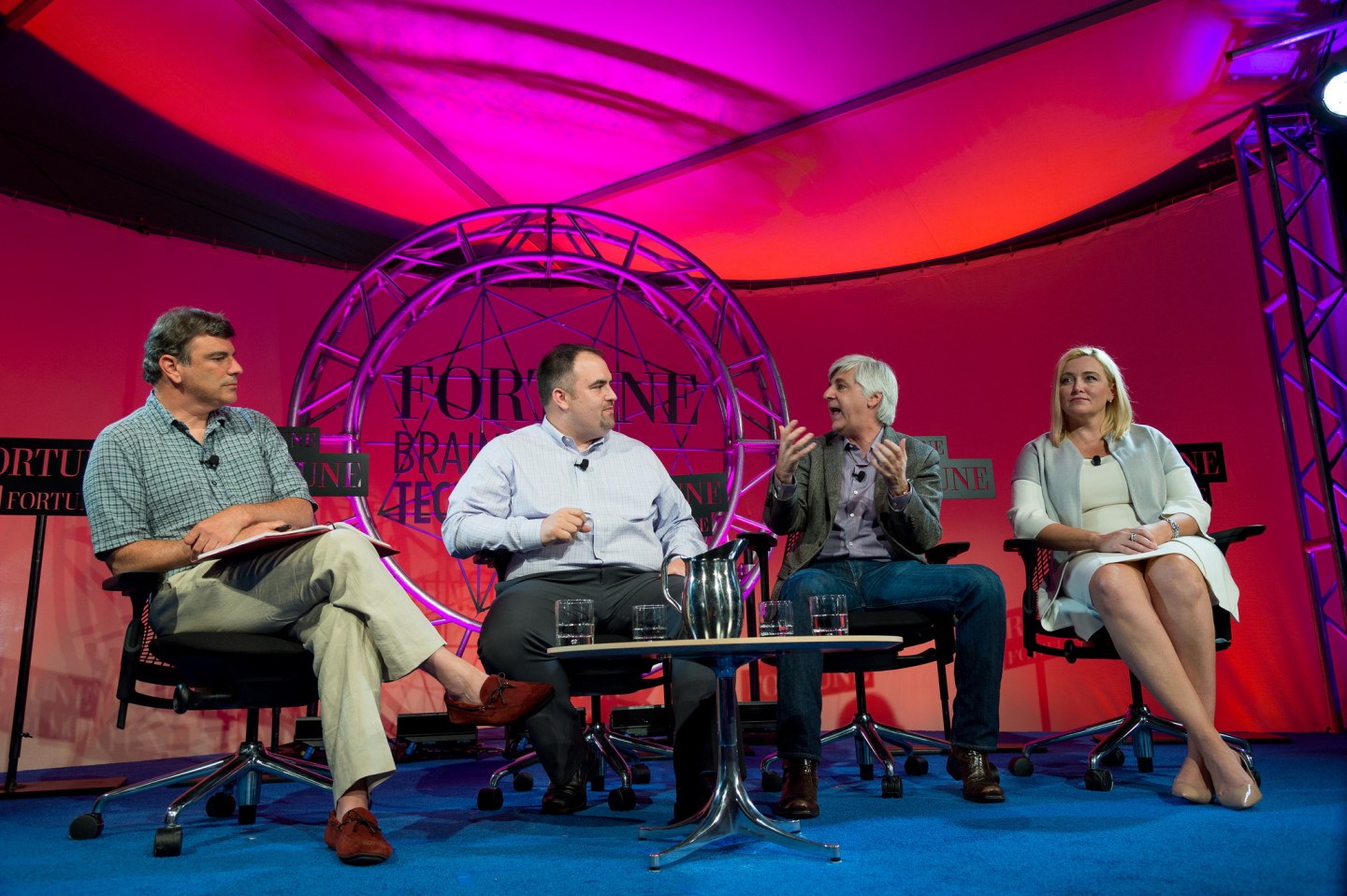
Left to right: Michael Schrage, Sloan School, MIT; Stephen Gillett, COO, Symantec; Dan Kaufman, Director of the Information Innovation Office, DARPA; Christy Wyatt, CEO, Good Technology.
Left to right: Michael Schrage, Sloan School, MIT; Stephen Gillett, COO, Symantec; Dan Kaufman, Director of the Information Innovation Office, DARPA; Christy Wyatt, CEO, Good Technology.Stuart Isett/Fortune Brainstorm TECH

ASPEN, Colo.—For corporations, the cybersecurity landscape has changed. The threats are coming from new places. They’re aiming at different targets. The executives tasked with stopping them? The strategies—internally and externally—are evolving.

At the Fortune Brainstorm Tech conference on Wednesday, executives from Symantec (SYMC), Good Technology, and DARPA—the U.S. Department of Defense’s research arm—explored (in sobering detail) how to identify and defend against today’s threats.

“The landscape has changed,” said Stephen Gillett, Symantec’s chief operating officer. “It used to be we had a perimeter we need to defend against the perimeter. Now the active opponents, as we call them—they’re usually much more organized, much more funded. They’re tiered by incentives.”

There are three types of threats, Gillett said.

“You have the young student—we call them ‘script kiddies.’ They want to hack their alumni website, and they want notoriety,” he said. “Then you have digital arms of organized crime. They have org designs, journeymen charts, pay scales. People make a career out of that. Their incentive is primarily economic: they want money, they want access to cash. Then you have what is ultimately the most dangerous and sophisticated [group], which is not in it for notoriety, not in it for economics, and that’s state-sponsored. It’s very sophisticated. It’s probably the second-most talked about topic in [Washington] D.C. in terms of its threat.”

What’s truly scary is that many employees don’t understand how much they are at risk, said Christy Wyatt, chief executive at Good Technology.

“The question is not who is the enemy, the question is where are the vulnerabilities?” she said. It’s more likely that an employee doesn’t realize the value of the data access they have, even if they’re a low-profile employee. “It’s figuring out the weak links,” she said.

Ditto executives, who underestimate how much their companies are at risk.

“A number of companies that I speak to say, ‘I don’t know that what we have all that much that’s valuable’ or the end users that say, ‘I’m an admin or I’m a controller or I’m in marketing, what do I possibly have? It’s not like I’m filing patents.’ ” Wyatt said. “The path in is probably not as obvious as you’re carrying around top secret information on your device. It’s that’s a stepping stone to the next point where they can kind of get into the network and start to do the really naughty things when they get in.”

And they’ve been doing that at an increasing rate. A number of Fortune 500 companies, such as Target (TGT), have experienced major breaches this year. Others, such as Starbucks (SBUX), discovered vulnerabilities that left personal data at risk.

Senior executives may not be aware of the weakest link in their organization, Gillett said.

“One of the big retailers was compromised through the heating and ventilation contractor,” he said. “So the subcontractor would come in—no matter how much that big retailer had purchased in terms of security, point solutions, network gateways, devices, encryption—the lowest common-denominator was a heating and ventilation cooling technician who had access.”

He added: “That’s where the bad guys are going. They’re not going after the COO or the CEO. In 2013, we saw that they’re going after the PR—the person traveling with [the senior executive]—and the administrative assistant. We’re relatively hardened as executives, but our PR and our assistant are not.”

So how to defend against all this? Dan Kaufman, the director of DARPA’s Information Innovation Office, said that companies need to rethink the way they approach security.

“People are always searching for the silver bullet. I don’t think it exists,” he said. “There’s a speed and a need to adapt that’s often much faster than corporate policy can do.”

Worse, corporations often try to put the burden on the user, requiring multiple pass phrases or elaborate access flows. That’s not sustainable, Kaufman said. “I actually think it falls on us as technologists. I think that has to be invisible to the user. I think we need to build devices in an intelligent manner so that you use them the way you want to use them and we’ll do the protection.”

He added: “Machine learning will play a much, much larger role. The scope of this is so large, the idea of a person at a keyboard defending your network is extremely antiquated.”

It all rolls up to the chief security officer (CSO) or chief information security officer (CISO), who needs to work differently with his peers to counter these threats, the panelists said.

“They’re increasingly having to step up their game and truly be the security thought leader, and the partner for their CEOs and their boards,” Gillett said. “You see chief security officers and chief information security officers moving out of the office of the CIO and reporting to CEOs. But that comes with responsibility.”

Wyatt concurred. “There are so many conflicting voices in the enterprise today: the users want one thing, the CISO wants something else, line of businesses in the middle, board of directors is being held accountable,” she said. “It’s not so much that they don’t know, it’s being able to sort of travel the path to get what they need.”

The days of the CISO telling employees that they can’t use a certain device or have access to certain data are over, she added. Today, employees know how to access the data anyway, or they’ll move it to the cloud. There’s a balance that a security officer must strike, and it needs to align with—not slow—a company’s normal operations, Wyatt said.

“It’s a business requirement that’s going to drive value for the business,” she said. “The CISO has to find some way to get comfortable with the risk that that opens up.”

[youtube https://www.youtube.com/watch?v=TEl1qXYK0z0]

Correction, July 17, 2014: An earlier version of this article incorrectly stated that Starbucks experienced a “major breach.” The company instead found (and fixed) a vulnerability in its mobile application. “No customer data was stolen whatsoever,” said Linda Mills, a company spokeswoman.

About the Author
Andrew Nusca
By Andrew NuscaEditorial Director, Brainstorm and author of Fortune Tech
Instagram iconLinkedIn iconTwitter icon

Andrew Nusca is the editorial director of Brainstorm, Fortune's innovation-obsessed community and event series. He also authors Fortune Tech, Fortune’s flagship tech newsletter.

See full bioRight Arrow Button Icon

Latest in

Finance
Lorem ipsum dolor sit amet, consectetur adipiscing elit, sed do eiusmod tempor incididunt ut labore et dolore magna aliqua. Ut enim ad minim veniam
By Fortune Editors
October 20, 2025
Finance
Lorem ipsum dolor sit amet, consectetur adipiscing elit, sed do eiusmod tempor incididunt ut labore et dolore magna aliqua. Ut enim ad minim veniam
By Fortune Editors
October 20, 2025
Finance
Lorem ipsum dolor sit amet, consectetur adipiscing elit, sed do eiusmod tempor incididunt ut labore et dolore magna aliqua. Ut enim ad minim veniam
By Fortune Editors
October 20, 2025
Finance
Lorem ipsum dolor sit amet, consectetur adipiscing elit, sed do eiusmod tempor incididunt ut labore et dolore magna aliqua. Ut enim ad minim veniam
By Fortune Editors
October 20, 2025
Finance
Lorem ipsum dolor sit amet, consectetur adipiscing elit, sed do eiusmod tempor incididunt ut labore et dolore magna aliqua. Ut enim ad minim veniam
By Fortune Editors
October 20, 2025
Finance
Lorem ipsum dolor sit amet, consectetur adipiscing elit, sed do eiusmod tempor incididunt ut labore et dolore magna aliqua. Ut enim ad minim veniam
By Fortune Editors
October 20, 2025

Most Popular

Finance
Lorem ipsum dolor sit amet, consectetur adipiscing elit, sed do eiusmod tempor incididunt ut labore et dolore magna aliqua. Ut enim ad minim veniam
By Fortune Editors
October 20, 2025
Finance
Lorem ipsum dolor sit amet, consectetur adipiscing elit, sed do eiusmod tempor incididunt ut labore et dolore magna aliqua. Ut enim ad minim veniam
By Fortune Editors
October 20, 2025
Finance
Lorem ipsum dolor sit amet, consectetur adipiscing elit, sed do eiusmod tempor incididunt ut labore et dolore magna aliqua. Ut enim ad minim veniam
By Fortune Editors
October 20, 2025
Finance
Lorem ipsum dolor sit amet, consectetur adipiscing elit, sed do eiusmod tempor incididunt ut labore et dolore magna aliqua. Ut enim ad minim veniam
By Fortune Editors
October 20, 2025
Finance
Lorem ipsum dolor sit amet, consectetur adipiscing elit, sed do eiusmod tempor incididunt ut labore et dolore magna aliqua. Ut enim ad minim veniam
By Fortune Editors
October 20, 2025
Finance
Lorem ipsum dolor sit amet, consectetur adipiscing elit, sed do eiusmod tempor incididunt ut labore et dolore magna aliqua. Ut enim ad minim veniam
By Fortune Editors
October 20, 2025
Rankings
  • 100 Best Companies
  • Fortune 500
  • Global 500
  • Fortune 500 Europe
  • Most Powerful Women
  • Future 50
  • World’s Most Admired Companies
  • See All Rankings
Sections
  • Finance
  • Leadership
  • Success
  • Tech
  • Asia
  • Europe
  • Environment
  • Fortune Crypto
  • Health
  • Retail
  • Lifestyle
  • Politics
  • Newsletters
  • Magazine
  • Features
  • Commentary
  • Mpw
  • CEO Initiative
  • Conferences
  • Personal Finance
  • Education
Customer Support
  • Frequently Asked Questions
  • Customer Service Portal
  • Privacy Policy
  • Terms Of Use
  • Single Issues For Purchase
  • International Print
Commercial Services
  • Advertising
  • Fortune Brand Studio
  • Fortune Analytics
  • Fortune Conferences
  • Business Development
About Us
  • About Us
  • Editorial Calendar
  • Press Center
  • Work At Fortune
  • Diversity And Inclusion
  • Terms And Conditions
  • Site Map
  • Facebook icon
  • Twitter icon
  • LinkedIn icon
  • Instagram icon
  • Pinterest icon

Latest in

LaurenAntonoff
Successwork-life balance
This CEO has a ‘1950s family structure in reverse’—her husband does the child care, cooking and cleaning: ‘I do the making money and paying taxes’
By Preston ForeJanuary 18, 2026
2 hours ago
vian
Commentaryquantum computing
I oversee a lab where engineers try to destroy my life’s work. It’s the only way to prepare for quantum threats
By Bernard VianJanuary 18, 2026
2 hours ago
U.S. President Donald Trump walks on the South Lawn after landing at the White House on January 4, 2026, in Washington, D.C.
Economynational debt
National debt is already killing the American Dream, says top economist—and it might push the U.S. into an outright depression
By Eleanor PringleJanuary 18, 2026
4 hours ago
PoliticsFBI
FBI asks agents to voluntarily travel to Minneapolis
By Margi Murphy, Jeff Stone and BloombergJanuary 17, 2026
9 hours ago
BankingCredit cards
It may come down to Trump using political pressure to force banks to cap interest rates on credit cards
By Ken Sweet and The Associated PressJanuary 17, 2026
11 hours ago
PoliticsAffordable Care Act (ACA)
There’s broad bipartisan support in Congress to renew Obamacare subsidies, but the abortion issue could block a deal and keep premiums high
By Mary Clare Jalonick and The Associated PressJanuary 17, 2026
11 hours ago

Most Popular

placeholder alt text
Newsletters
The oil CEO who stood up to Trump is a follower of the disciplined 'Exxon way' and has a history of blunt statements
By Jordan BlumJanuary 13, 2026
5 days ago
placeholder alt text
Politics
The Nobel Prize committee doesn't want Trump getting one, even as a gift—but they treated Obama very differently
By Nick LichtenbergJanuary 16, 2026
2 days ago
placeholder alt text
Banking
'Absolutely, positively no chance, no way, no how, for any reason': Dimon says he'd never run the Fed but 'would take the call' to lead Treasury
By Jacqueline MunisJanuary 16, 2026
2 days ago
placeholder alt text
Success
Jensen Huang tells Stanford students their high expectations may make it hard for them to succeed: 'I wish upon you ample doses of pain and suffering'
By Orianna Rosa RoyleJanuary 16, 2026
2 days ago
placeholder alt text
Economy
America’s $38 trillion national debt is so big the nearly $1 trillion interest payment will be larger than Medicare soon
By Shawn TullyJanuary 15, 2026
3 days ago
placeholder alt text
Innovation
Exclusive: Elon Musk’s Boring Co. is studying a tunnel project to Tesla Gigafactory near Reno
By Jessica MathewsJanuary 16, 2026
1 day ago

© 2025 Fortune Media IP Limited. All Rights Reserved. Use of this site constitutes acceptance of our Terms of Use and Privacy Policy | CA Notice at Collection and Privacy Notice | Do Not Sell/Share My Personal Information
FORTUNE is a trademark of Fortune Media IP Limited, registered in the U.S. and other countries. FORTUNE may receive compensation for some links to products and services on this website. Offers may be subject to change without notice.