• Home
  • News
  • Fortune 500
  • Tech
  • Finance
  • Leadership
  • Lifestyle
  • Rankings
  • Multimedia

Retailing 2.0: The humble strip mall is bouncing back

By
Becky Quick
Becky Quick
Down Arrow Button Icon
By
Becky Quick
Becky Quick
Down Arrow Button Icon
April 10, 2014, 10:57 AM ET
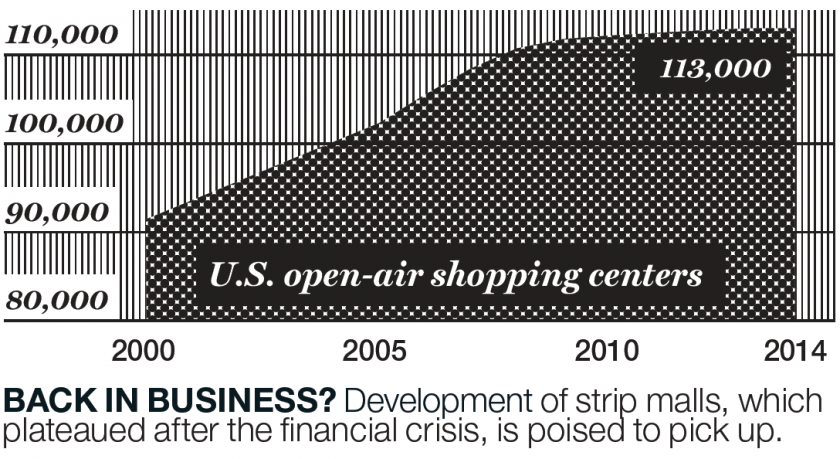
Source: International Council of Shopping Centers

Becky Quick is an anchor on CNBC’s Squawk Box.

On the surface the argument seems perfectly sound: Online shopping is turning the traditional shopping mall into a relic destined for the wrecking ball.

But don’t try telling that to Dave Henry, the CEO of Kimco Realty, the largest public owner and operator of strip centers in North America. “I’ve got a little file built up for when I get these questions, because everybody thinks we’re going out of business,” he says with a laugh, rattling off figures from a plethora of sources. “There are 50 Subway stores opening every week, and four ‘dollar stores’ every day. Five Guys Burgers is growing by one store a day, and so are 7-Eleven and Dunkin’ Donuts. T.J. Maxx and Ross Stores — between them they’ll grow 200 stores a year.” His list continues: Nordstrom Rack is adding 25 to 30 stores, PetSmart expects to have 1,300 locations, up from 700 today. And Whole Foods is opening 40 new stores a year. (More on the food retailer’s expansion plans here.)

In fact, over the next two years, Henry says, more new-store openings are planned than at any time in the past five years. And all those new stores could add up to a new boom for shopping centers, particularly the type of properties that Henry develops. Of course plenty of strip-mall stalwarts have shut their doors, including, most recently, discounter Loehmann’s.

That’s because today Henry’s strip malls — he prefers the term “neighborhood and community shopping centers” — rely much more heavily on restaurants, gyms, salons, pet groomers, and day-care centers — services the Internet can’t provide. So while online shopping for everything from shoes to diapers to washing machines is here to stay (Internet shopping last year accounted for about 11% of consumers’ $3 trillion in retail spending, according to the National Retail Federation), some shopping simply cannot be disintermediated.

Henry also understands brick-and-mortar shopping needs to be an experience, not a chore. “We’re trying to appeal to a younger generation and make it more of a 24-hour entertainment center,” says Henry. Kimco also tries to offset the fact that so many of its tenants are national chains by playing up ties to the community: “We try to have social events, featuring the Girl Scouts or marching bands performing,” Henry says. “You draw traffic to these properties, and then retailers do better.”

His optimism is a welcome sign for anyone in the traditional retail game, which in recent years has been struggling for multiple reasons, not just the Internet. The recession hit retail development particularly hard as the lack of consumer spending dried up all demand for expansion. In the years leading up to the financial crisis, developers were adding about 2,000 to 3,000 new shopping centers a year. That ground to a halt in 2009; just a few hundred were built in each of the past few years. But now comes a ray of hope: While the number of outlets plateaued, the American population grew by more than 2 million people a year. Even by conservative estimates, that means more than 10 million new shoppers have been created since the Great Recession began. That, combined with the limited supply, is finally starting to spur demand again.

And Henry even sees online shopping as a potential boon to his strip centers. It may be an overly optimistic view of the competition, but Henry points out that 13 of the top 20 online retailers include the likes of Wal-Mart and Macy’s. He hopes that some might want to add additional space connected to their stores to serve as fulfillment centers for nearby customers.

All in all, it’s a compelling argument, and one that suggests that reports of the death of strip malls have been greatly exaggerated. In reality, what we’re watching is Darwinian evolution. The retail outlets that aren’t adapting to Americans’ changing spending habits are the ones that won’t survive. But those who are evolving might just thrive.

This story is from the April 28, 2014 issue of Fortune.

About the Author
By Becky Quick
See full bioRight Arrow Button Icon

Latest in Retail

Bambas
LawSocial Media
22-year-old Australian TikToker raises $1.7 million for 88-year-old Michigan grocer after chance encounter weeks earlier
By Ed White and The Associated PressDecember 6, 2025
2 days ago
RetailConsumer Spending
U.S. consumers are so financially strained they put more than $1 billion on buy-now, pay later services during Black Friday and Cyber Monday
By Jeena Sharma and Retail BrewDecember 5, 2025
2 days ago
Best vegan meal delivery
Healthmeal delivery
Best Vegan Meal Delivery Services of 2025: Tasted and Reviewed
By Christina SnyderDecember 5, 2025
2 days ago
Retailmeal delivery
Best Prepared Meal Delivery Services of 2025: RD Approved
By Christina SnyderDecember 5, 2025
2 days ago
Steve Milton is the CEO of Chain, a culinary-led pop-culture experience company founded by B.J. Novak and backed by Studio Ramsay Global.
CommentaryFood and drink
Affordability isn’t enough. Fast-casual restaurants need a fandom-first approach
By Steve MiltonDecember 5, 2025
3 days ago
Big TechSpotify
Spotify users lamented Wrapped in 2024. This year, the company brought back an old favorite and made it less about AI
By Dave Lozo and Morning BrewDecember 4, 2025
3 days ago

Most Popular

placeholder alt text
Real Estate
The 'Great Housing Reset' is coming: Income growth will outpace home-price growth in 2026, Redfin forecasts
By Nino PaoliDecember 6, 2025
2 days ago
placeholder alt text
AI
Nvidia CEO says data centers take about 3 years to construct in the U.S., while in China 'they can build a hospital in a weekend'
By Nino PaoliDecember 6, 2025
2 days ago
placeholder alt text
Economy
The most likely solution to the U.S. debt crisis is severe austerity triggered by a fiscal calamity, former White House economic adviser says
By Jason MaDecember 6, 2025
1 day ago
placeholder alt text
Economy
JPMorgan CEO Jamie Dimon says Europe has a 'real problem’
By Katherine Chiglinsky and BloombergDecember 6, 2025
1 day ago
placeholder alt text
Big Tech
Mark Zuckerberg rebranded Facebook for the metaverse. Four years and $70 billion in losses later, he’s moving on
By Eva RoytburgDecember 5, 2025
3 days ago
placeholder alt text
Uncategorized
Transforming customer support through intelligent AI operations
By Lauren ChomiukNovember 26, 2025
11 days ago
Rankings
  • 100 Best Companies
  • Fortune 500
  • Global 500
  • Fortune 500 Europe
  • Most Powerful Women
  • Future 50
  • World’s Most Admired Companies
  • See All Rankings
Sections
  • Finance
  • Leadership
  • Success
  • Tech
  • Asia
  • Europe
  • Environment
  • Fortune Crypto
  • Health
  • Retail
  • Lifestyle
  • Politics
  • Newsletters
  • Magazine
  • Features
  • Commentary
  • Mpw
  • CEO Initiative
  • Conferences
  • Personal Finance
  • Education
Customer Support
  • Frequently Asked Questions
  • Customer Service Portal
  • Privacy Policy
  • Terms Of Use
  • Single Issues For Purchase
  • International Print
Commercial Services
  • Advertising
  • Fortune Brand Studio
  • Fortune Analytics
  • Fortune Conferences
  • Business Development
About Us
  • About Us
  • Editorial Calendar
  • Press Center
  • Work At Fortune
  • Diversity And Inclusion
  • Terms And Conditions
  • Site Map

© 2025 Fortune Media IP Limited. All Rights Reserved. Use of this site constitutes acceptance of our Terms of Use and Privacy Policy | CA Notice at Collection and Privacy Notice | Do Not Sell/Share My Personal Information
FORTUNE is a trademark of Fortune Media IP Limited, registered in the U.S. and other countries. FORTUNE may receive compensation for some links to products and services on this website. Offers may be subject to change without notice.