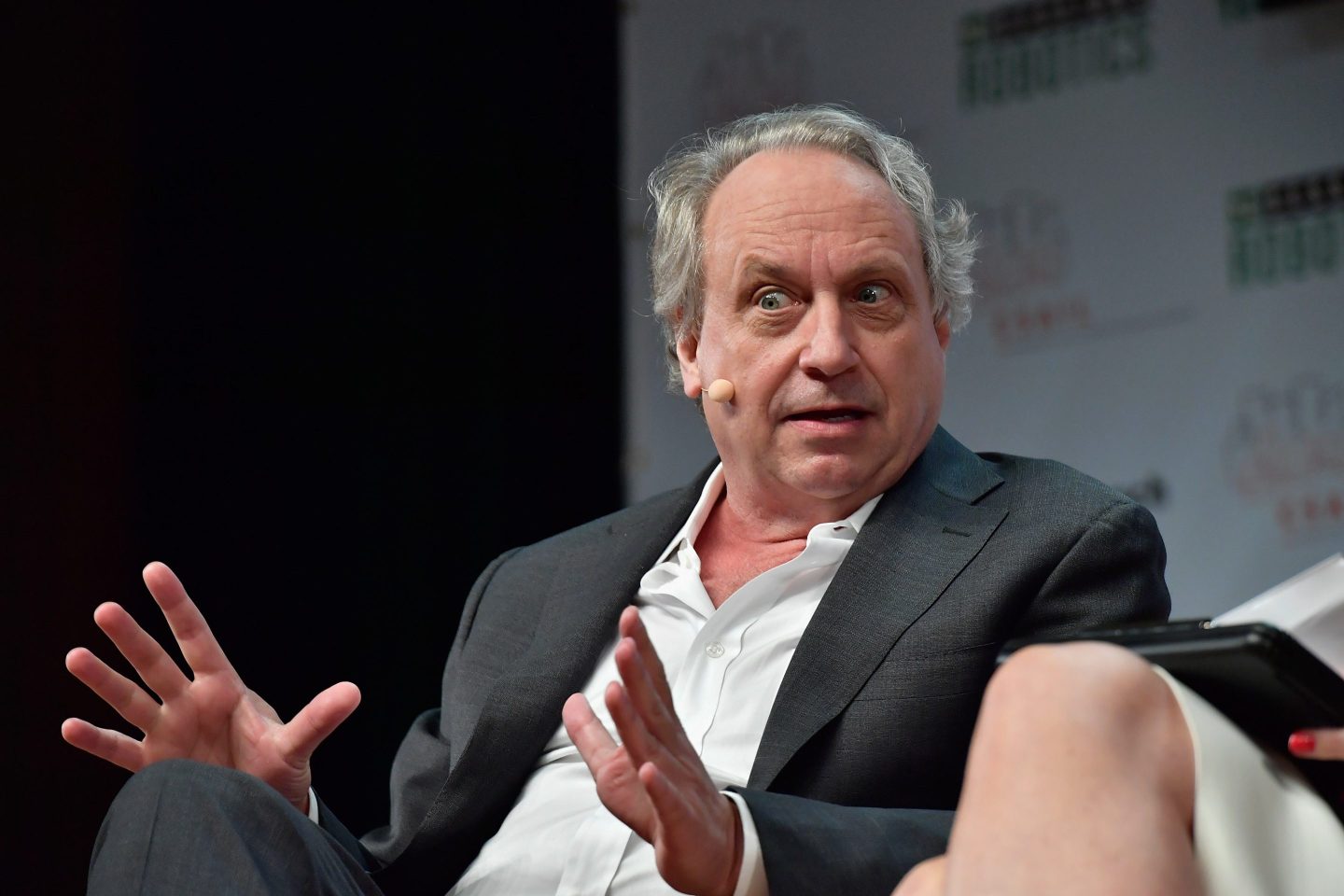
Eric Schmidt, chairman of Google, and Peter Thiel, technology investor and entrepreneur, participated in a lively debate at Fortune Brainstorm Tech in Aspen, CO, about the future of technology, and so much more. Fortune’s Adam Lashinsky moderated.
[cnnmoney-iframe src=”http://fora.tv/program_landing_frameview?id=16152&type=clip&autoplay=0″ w=614 h=384]
Below is an unedited transcript of the event.

Eric Schmidt (left) and Peter Thiel in a lighter moment.
ADAM LASHINSKY: Gentlemen, Eric, why don’t you go sit on the far side. Peter, maybe sit next to me. I won’t make any jokes about who is on the right or who is on the left. We’ve got plenty of time for that.
Good evening, everybody. Thank you for your patience. The lights are sufficiently bright that we can’t see any of you, so I hope that you can see us. Terrific, thank you. That’s the god thing about having people have a few glasses of wine before the conversation. We have an energetic audience.
Okay, we have two of the most distinguished people in the technology industry in Silicon Valley to hear very different perspectives tonight. Peter Thiel, sitting directly next to me, is one of the most successful investors that Silicon Valley has ever known. He was an early ‑‑ he was the first investor in Facebook. He was a founder and CEO of PayPal. He helped found Palantir, which has been a tremendous success. He has a hedge fund, Clarium Capital; an early stage venture, no not early stage, yes, early stage venture capital fund, Founder’s Fund; and many, many other things that I think we will have an opportunity to discuss this evening. He has an interesting perspective on the technology world that he and many of you are a part of, and we’ll get to that in a moment.
Sitting next to him, a man who really needs as little introduction as Peter does is Eric Schmidt, the Executive Chairman of Google. Eric nurtured Google (GOOG) from the days when it needed was then called adult supervision. It’s interesting that Larry and Sergey are clearly adults now, and have been for a long time. And Eric is now, as he has time to do other things, doing many other things in addition to Google, some of which he’ll talk about this evening.
The premise that we want to discuss ‑‑ I know we said this would be a debate, we will debate, we will discuss, we will have an opportunity for audience Q&A ‑‑ is what is the benefit of the technology industry, and what is the benefit of technology as we know it, the role that Silicon Valley and other parts of the technology industry play in that?
I’m going to ask each gentleman to speak for about four or five minutes on what their perspective is on this.
And, Eric, I’m going to ask you to start by explaining your view of what technology brings to the world.
ERIC SCHMIDT: I think the message of technology innovation is an overwhelmingly positive one. And it’s easy to criticize some of the effects of this. But the fact of the matter is that in the last 20 or 30 years the globalization that we’re all part of has brought a couple of billion people from pretty significant policy to what we would think of as lower middle class or middle class lives. The investment, especially in countries of Asia and so forth, that you’re seeing will continue that for a very long time.
If you look at the rate of innovation in our sort of lifetimes, we’ll go from a very small number of people having access to the world’s information to virtually everyone in the world having access to all the world’s information, and in their own language.
If you look at these devices ‑‑ this, of course, is my ad for Google, the Android phone, and then the new Nexus 7 tablet ‑‑ with these devices you have access to super computers that can do the kind of knowledge and analysis that is incredible to think about in terms of artificial intelligence, machine learning, and those sorts of things. And these have transformed our world.
MORE: Thiel vs. Schmidt: The fireworks fly
If you think about going forward what happens, well, Moore’s Law has not been repealed, and Moore’s Law will continue for a while longer. The physicists are still working.
ADAM LASHINSKY: Just explain, there are a few people in the world, in the audience, who don’t know about Moore’s Law.
ERIC SCHMIDT: Moore’s Law stated originally by Gordon Moore in 1965, and as restated, is roughly that transistor densities double every two years. And it looks like there’s another decade or so of that before physical limits are encountered. Again, people are working very hard. So, that tells you basically that these devices improve in price performance by a factor of 10 or 20 very, very rapidly.
And there are other things involving fiber optics, and so forth, which are even more accelerating, storage, et cetera, and that’s going to continue.
So, the important thing here is that we have an opportunity now to ultimately end up with devices and knowledge sources which are the perfect buddy, they can answer questions that you have, that can suggest things for you and understand what you might want to do, to help you through life, to help you with medicine.
If you add that, and then you take a look at what’s going on with data analytics, take a look at the sort of data analytics that’s going on around medicine, genetics, and unlocking the human genome, and the other kinds of genetic sequencing people can do, explosion of data that we can now reduce in order to try to understand the combinatorics of disease, I think we can look forward to a world, at least for people who have a certain amount of income, extraordinarily long lives that are very, very productive with an enormous amount of information. And that pace, in my view, is accelerating.
If you take a look at the folks who are not so fortunate, the people in the developing world, for tem the world gets better, too. It doesn’t get better as much as our world does, but they get access to the things that they’ve wanted for decades that they cannot have today.
Peter?
ADAM LASHINSKY: Eric, I feel better listening to you.
And turning to you, Peter, I want to prompt you by reading a few Thielisms, do you say Thiel or Thiel?
PETER THIEL: Thiel.
MORE: Follow here for all #FortuneTech coverage.
ADAM LASHINSKY: Thielisms. Thank you. You have said that the problem with elites is that they are skewed in an optimistic direction. You say that America has lost its belief in the future. And lastly, and I believe this is the slogan of our Founder’s Fund, Founder’s Fund states: We wanted flying cars, instead we got 140 characters. (Laughter.)
PETER THIEL: Yes.
ADAM LASHINSKY: Peter Thiel.
PETER THIEL: Well, I don’t ‑‑ I think, Eric, you do a fantastic job as Google’s minister of propaganda. (Laughter.)
ADAM LASHINSKY: You said you were going to be nice.
PETER THIEL: Well, he does a fantastic job.
ERIC SCHMIDT: I think I’ll just take the compliment.
PETER THIEL: And I think that ‑‑ and I agree with you that technology is critical. It is the only way that things get better in the developed world. And I think we should distinguish the developed and emerging markets very sharply. In places like China, India, Africa, Latin America, there’s zero need for innovation. All they need to do is copy things that work.
But the part of the world where technology is really necessary for things to get better is the developed world, U.S., Western Europe, Japan. And the part that I would challenge you a little bit on is just how healthy the state of technology generally is. There are obviously individual companies that do quite sell, especially if they have world-class monopolies like Google has in search.
ADAM LASHINSKY: Legal monopolies.
PETER THIEL: They’re legal as long as they don’t try to tie in and oppress other companies by extending their monopoly power unfairly. But it’s quite legal to have a monopoly as long as you don’t abuse it.
ERIC SCHMIDT: I’ll take that one, too.
PETER THIEL: But I think that when you look at this question of how much technological progress has been happening, we get into all these complicated measurement issues. The one that I cite as the big data point is that if you look at the U.S. say in the last 40 years, 1973 to today, median wages have been stagnant. Maybe the mean wages have gone up maybe a small amount, not very much. The 40 years before that, 1932 to 1972, they went up by a factor of 6.
So, if you looked at how people did from ’32 to ’72, you had a six-fold improvement, and it was matched by incredible technological progress. Cars got better. You had the aeronautics industry got started. You went from no planes to supersonic jets. You had the computers were invented. You had all sorts of incredibly important dimensions in which progress took place.
And so I agree we’ve had certain narrow areas where there’s been significant progress, but it’s very odd that it hasn’t translated into economic well being. And this is not just a problem with capitalist countries, like the U.S. You may say the U.S. is too capitalist for your liking, Eric, but it’s also true of socialist countries, like France ‑‑
ADAM LASHINSKY: Do I need to be making a list, or are you keeping track? (Laughter.)
PETER THIEL: It’s true of all sorts of other countries, like Japan, where things have been surprisingly stagnant. And there’s this weird question of what’s going on. You have Moore’s Law on the one hand. On the other hand, if I had to sort of simplify it, we’ve had incremental but relentless progress on the computer side. And on the other hand, we’ve had basically no progress on energy. And if you think about where oil prices were in 1973, it was $2 or so a barrel, it is now at north of $100 a barrel, and so you’ve had sort of a catastrophic failure of energy innovation. And it’s basically been offset by computer innovation. I think that’s sort of the simplified account of what’s happened in the last 40 years.
ADAM LASHINSKY: So, before I give Eric and opportunity to jump in I want to prompt you in one way, Peter, which is why do you think this is?
PETER THIEL: The why questions always get immediately ideological. I’m Libertarian, I think it’s because the government has outlawed technology. We’re not allowed to develop new drugs with the FDA charging $1.3 billion per new drug. You’re not allowed to fly supersonic jets, because they’re too noisy. You’re not allowed to build nuclear power plants, say nothing of fusion, or thorium, or any of these other new technologies that might really work.
So, I think we’ve basically outlawed everything having to do with the world of stuff, and the only thing you’re allowed to do is in the world of bits. And that’s why we’ve had a lot of progress in computers and finance. Those were the two areas where there was enormous innovation in the last 40 years. It looks like finance is in the process of getting outlawed. So, the only thing left at this point will be computers and if you’re a computer that’s good. And that’s the perspective Google takes, because it thinks of the world of the future ‑‑
ADAM LASHINSKY: You’re not accusing him of being a computer are you?
PETER THIEL: You know, they like computers more than people in many cases. That’s why they missed the social networking revolution. But, if you look at it from the perspective 40 years in the future, Moore’s Law is good if you’re a computer, but the question is how good is it for human beings and how does this translate into economic progress for humans?
ADAM LASHINSKY: Before getting into politics, do you ‑‑
ERIC SCHMIDT: There’s such a long list.
ADAM LASHINSKY: I know it’s a long list, but can you ‑‑ just take the narrow point that these facts, these economic facts that he cited, taking just conditions in the United States over the past several decades, income being one, and sort of talk to that for a moment.
ERIC SCHMIDT: The U.S. issues have to do with entitlement spending, bad government, and demographic issues.
ADAM LASHINSKY: Well, you two are in agreement on that then?
ERIC SCHMIDT: We actually are. And the problem is he states the argument completely wrongly.
ADAM LASHINSKY: Okay, go.
ERIC SCHMIDT: The first 40 years were a golden period in the United States for the same reason that the same thing is occurring in places in the Arab world and in China, which are going through the same demographic dividend. The fact of the matter is that all of these countries face this issue. The problem going forward in America is, in fact, a demographic problem. You have the lengthening of lives, which by the way is considered progress and innovation. People are living much longer
PETER THIEL: That’s why demographics are not a problem. If people are living longer and healthier lives they will be productive for much longer. There is no demographic problem whatsoever.
ERIC SCHMIDT: That is, unfortunately, not true.
PETER THIEL: Then there’s a problem that we haven’t cured Alzheimer’s, that we have too many people that are obese, and old, and fat and can’t work anymore.
ADAM LASHINSKY: All right. Go ahead, Eric, please.
ERIC SCHMIDT: It is an absolute fact that people still choose to retire at roughly the same years when they do, and maybe they shouldn’t. Maybe they should work until 80 rather than 65. But, if you look at a technological basis I think that to argue that the technological impact is not strong, or that the bits and so forth and so on is crazy. Look at what information technology ‑‑
ADAM LASHINSKY: Crazy is a term of art, you understand, right?
ERIC SCHMIDT: Thank you. You only need to look at the economic numbers.
ADAM LASHINSKY: Go ahead and make your point on that.
ERIC SCHMIDT: Technology does not determine economic policy and there are plenty of examples of bad government ‑‑
PETER THIEL: In that case you’re saying technology is completely decoupled from the economy.
ERIC SCHMIDT: No, I’m actually saying that the economy is largely determined by the way governments make decisions and governments make bad decisions, and you and I would agree to that. And there are plenty of ways where you could stimulate more innovation. Let’s use your energy example. America in the next decade can actually become energy independent both in oil and gas, due to innovations in oil extraction and so forth, and so on. That’s an example of innovation that’s actually quite material.
PETER THIEL: Assuming fracking doesn’t get outlawed, which is the more likely possibility.
ERIC SCHMIDT: But, you made your argument as an absolute and then you put in this sort of ‑‑
PETER THIEL: You’re shifting to the future. I’m talking about ‑‑
ERIC SCHMIDT: Yes, that’s my job. We’re talking about the future.
PETER THIEL: And you can easily, and I’m saying we should look to the last 40 years as clues for the future. So, if we’ve had 40 years of stagnation, where wages have been stagnant, the most likely ‑‑
ERIC SCHMIDT: We have not. People are living longer. People are wealthier. There’s fewer deaths. Drug addiction is lower. There’s all sorts of reasons why ‑‑
ADAM LASHINSKY: Excuse me. Peter is making the point as a generalization.
ERIC SCHMIDT: But, we don’t agree on a basic fact.
ADAM LASHINSKY: I know, but do you agree with his contention that we have invested in the wrong things?
ERIC SCHMIDT: Of course we have.
ADAM LASHINSKY: But, how can you agree to that?
PETER THIEL: America is investing all of its assets in non-productive areas, when it should invest ‑‑
ERIC SCHMIDT: Not all of them, you don’t think Google is investing in the wrong areas, do you?
PETER THIEL: America, I’m talking about the government.
ADAM LASHINSKY: He’s criticizing the government.
PETER THIEL: If you take a look at private companies, private companies in America are doing fantastically well, public companies; excuse me, public not private. They’re well run, in general. The problem that all of these countries are having is that they have a political problem, which is related to how our politics works. It’s true in Europe. It’s true in the United States. It’s true in Japan, et cetera, et cetera.
ERIC SCHMIDT: I don’t think the politics have changed that much in the last 40 years versus the 40 years before that.
PETER THIEL: Then maybe we got a free ride during those 40 years, but the fact of the ‑‑
ERIC SCHMIDT: I think there was a huge technological tailwind in those 40 years that’s no longer there.
PETER THIEL: If past is prologue then you would predict only good things for the future.
ERIC SCHMIDT: What’s very odd about this conversation is you’re saying technology doesn’t matter, that it’s all politics.
PETER THIEL: I didn’t say that. I said, in fact, it’s the only innovation available, which is your point.
ERIC SCHMIDT: But, you’re saying we’ve been stagnant for 40 years because of bad government policy. If technology ‑‑
PETER THIEL: I didn’t say we’re stagnant. I said our policies could be improved.
ERIC SCHMIDT: Well, if the wages have been stagnant for 40 years, because of government policy, you should adjust that technology is just this tiny little side thing going on in a corner.
PETER THIEL: I do this thing with politicians where I ask them, I need you to repeat after me. You take a dollar bill out and on the back it says, in god we trust. I say, please say in god we trust, all others have to bring data. As long as you believe that politicians can operate without facts you get the government that you want, right. That’s what we’re dealing with.
ADAM LASHINSKY: Let me ask you this. Hold on, Peter, one second.
There’s one thing, Eric, that you haven’t answered. At the high level Peter has made the assertion that making, for example, cars go faster, or being able to, I don’t know, for rockets to go higher or faster, to be able to colonize Mars, as an example, are the sorts of things we’re not doing and they’re less important than having good algorithmic search. Is that a fair characterization, Peter?
ERIC SCHMIDT: If you look at the improvements in power to weight ratio with new materials in cars I think you’d be pretty impressed with that. There’s a whole renaissance of materials science going on, with new smart services, new much lighter, much stronger materials, all of this being driven by American universities. There is a mini-boom I America in advanced manufacturing using all these new technologies.
PETER THIEL: I often think it’s worth looking at quantity not quality, and we’re not going faster. The Concorde was decommissioned in 2003, and if you include low-tech airport security mechanisms, we’re back to about 1960 type travel speeds today in the U.S. But, let’s take another area that’s probably much more basic, something like agriculture. We had a green revolution in the ’50s and ’60s that basically doubled world food production in line with population growth. It’s decelerated dramatically over the last 40 years and that’s reflected in this incredible rise in food prices that we’ve seen over the last decade.
ERIC SCHMIDT: I don’t agree with that. I disagree with your facts there.
PETER THIEL: When you talk about the Arab spring, you can say that it’s evidence of Google and Twitter ‑‑
ERIC SCHMIDT: I didn’t say that.
PETER THIEL: ‑‑ liberating the world through information. But, the actual facts on the ground are that food prices rose by 30 to 50 percent in the previous year and you basically had people who had become ‑‑ you had desperate people who had become more hungry than scared, who revolted. Then Eric goes around and says, let them eat iPhones, or maybe not ‑‑ that’s not precisely what he would say.
ERIC SCHMIDT: Let’s just say that everything he just said is not actually true. Let’s start with the food revolution. The issues of food in the globe are all related to mismanagement by governments. Many, many people have looked at this. And even without synthetic foods and the other things that are being developed, we can feed everybody. It’s just bad policies. And that can be fixed with better governments, more representative governments, so forth and so on.
With respect to the Arab Spring, and having been there and spent quite a bit time talking to the people, these people were very courageous and they used the tools available to them to topple these sort of bad regimes that weren’t giving them what they wanted. Sure, food prices went up, but there was a long history of repression. If you go back, each of these groups had a couple of years earlier tried and had been squelched.
The fact of the matter is that the dictators who were overthrown had a failure to regulate the Internet. They regulated everything else, the telephone, the television and so forth.
ADAM LASHINSKY: So, on the margin, Twitter and Facebook and other social media devices contributed to greater freedom, greater freedom of expression for some of these people and on the margin helped them achieve their political goals, yes or no?
PETER THIEL: Look, I am in favor of all the computer companies that are being built. And I think that we should be doing even more in most of these businesses. It is ‑‑
ERIC SCHMIDT: He was asking about the Arab Spring.
PETER THIEL: I think the Arab Spring, I think the fundamental driver for that was the food prices went up 50 percent and people were going to starve and I think it’s smug and complacent to pretend that it was anything other than that.
ADAM LASHINSKY: I think that’s a fair point. But, the question is did the social margin?
PETER THIEL: At the margin, but the main thing was people were facing starvation. It’s really, really outrageous for you to ignore that fact.
ERIC SCHMIDT: But, in Indonesia, since I was actually there, right, and talked to them, I can assure that that’s not what they told me. I do agree with you and I want to be clear that the social media was on the margin, was not the primary driver. The primary driver was the feeling that we need to change these static regimes. And that’s what’s happening with these other countries, as well, now.
PETER THIEL: I think one of the things that’s very odd about this discussion is that I thought we were going to talk about technology. Eric seems to think it’s all about politics, which in a way I think concedes my basic point, which is that technology is no longer that big a driver. If our political system were somewhat screwed up, I don’t think it’s the best, I don’t think it’s the worst in the world, it shouldn’t matter. Its somewhat screwed up, but technology should be a large enough force that it could power a change.
ADAM LASHINSKY: You touched on the employment issue earlier, the New York Times did a major piece suggesting that Apple doesn’t account for the same kind of employment in the United States that General Motors did in the 1950s. And you make a similar case, Twitter, Facebook, as great as they are, 140 characters is neat, but they don’t’ employ a lot of people.
PETER THIEL: They’re all great companies.
ADAM LASHINSKY: In that they’re profitable.
PETER THIEL: But, they’re not ones that are able to basically ‑‑ you know, they’re sort of the exception to the rule that we don’t have enough innovation. So, you have to avoid confusing the specific and the general. Google is a great company. It has 30,000 people, or 20,000, whatever the number is. They have pretty safe jobs. On the other hand, Google also has 30, 40, 50 billion in cash. It has no idea how to invest that money in technology effectively. So, it prefers getting zero percent interest from Mr. Bernanke, effectively the cash sort of gets burned away over time through inflation, because there are no ideas that Google has how to spend money.
ERIC SCHMIDT: Let me see if I can help Peter answer your question. The core problem we have going forward, since I think we’re supposed to talk bout the future, is that you have two forces that are going to govern much of what’s going to happen in the future. The first is globalization, which we’re not going to repeal. And the second one is automation, which we’re not going to repeal. And if you look, these problems are ultimately cast in political systems in the west, and I think eventually globally, as jobs problems. And the solution to jobs problems, in my view, is education, right, education at many levels, and many different ways, which we can discuss.
I don’t see another solution to this. It’s absolutely true, as Peter says, that these gems, if you will, and you were nice enough to call those companies ‑‑ describe them so well; they’re not employing enough people.
ADAM LASHINSKY: You have $50 billion at Google, why don’t you spend it on doing more in tech, or are you out of ideas? And I think Google does more than most companies. You’re trying to do things with self-driving cars and supposedly with asteroid mining, although maybe that’s just part of the propaganda ministry. And you’re doing more than Microsoft, or Apple, or a lot of these other companies. Amazon is the only one, in my mind, of the big tech companies that’s actually reinvesting all its money, that has enough of a vision of the future that they’re actually able to reinvest all their profits.
ERIC SCHMIDT: They make less profit than Google does.
PETER THIEL: But, if we’re living in an accelerating technological world, and you have zero percent interest rates in the background, you should be able to invest all of your money in things that will return it many times over, and the fact that you’re out of ideas, maybe it’s a political problem, the government has outlawed things. But, it still is a problem.
ADAM LASHINSKY: I’m going to go to the audience very soon, but I want you to have the opportunity to address your quality of investments, Eric.
ERIC SCHMIDT: I think I’ll just let his statement stand.
ADAM LASHINSKY: You don’t want to address the cash horde that your company does not have the creativity to spend, to invest?
ERIC SCHMIDT: What you discover in running these companies is that there are limits that are not cash. There are limits of recruiting, limits of real estate, regulatory limits as Peter points out. There are many, many such limits. And anything that we can do to reduce those limits is a good idea.
PETER THIEL: But, then the intellectually honest thing to do would be to say that Google is no longer a technology company, that it’s basically ‑‑ it’s a search engine. The search technology was developed a decade ago. It’s a bet that there will be no one else who will come up with a better search technology. So, you invest in Google, because you’re betting against technological innovation in search. And it’s like a bank that generates enormous cash flows every year, but you can’t issue a dividend, because the day you take that $30 billion and send it back to people you’re admitting that you’re no longer a technology company. That’s why Microsoft can’t return its money. That’s why all these companies are building up hordes of cash, because they don’t know what to do with it, but they don’t want to admit they’re no longer tech companies.
ADAM LASHINSKY: Briefly, and then we’re going to go to the audience.
ERIC SCHMIDT: So, the brief rebuttal is, Chrome is now the number one browser in the world. The platform for enterprise innovation on top of Google is I think phenomenal. The rate at which people are using Google to redo the way their businesses work, there are many, many examples of business innovation that Peter is not choosing to see.
ADAM LASHINSKY: And of Google’s investments in them.
I’m going to open this to the audience. You do not need to restrict your questions to the topics that we’ve been discussing on stage. And I see a hand up right over there.
Please identify yourself, and keep your question brief.
QUESTION: Okay, it’s Mark Mahaney at Citi. Eric, one of the places that Google has been investing a lot in, it seems, is in hardware, the Motorola acquisition, et cetera. We had a speaker at the beginning of the day, Marc Andreessen, who said in addition to software taking over, it’s leading to this hardware resurgence. Almost the implication that you need to combine software and hardware to succeed as a consumer technology company in the future. Do you agree with that, and what do you think the risks are to that?
ERIC SCHMIDT: I think you’re going to see more and more interesting innovation in the hardware/software blend. One way to understand the PC industry is that the structure that Microsoft built sort of held a certain architecture for scale, and now that Apple and other device companies have really sort of beaten that model, you have open-ended innovation in many, many different devices.
We would further argue that Android, another example of an innovation that Peter chose not to cite, which is on its way to having a billion ‑‑
PETER THIEL: Jobs might disagree with this.
ADAM LASHINSKY: Steve Jobs?
PETER THIEL: Yes.
ADAM LASHINSKY: Were he here with us.
ERIC SCHMIDT: Android is now both larger in unit volume, and faster growth rate than the iPhone. But, in any case, Android is free, and is being used in many, many new consumer devices. I didn’t bring it here, but we have now our own product called the Nexus Q, which is an example of that. There will be many, many such things.
ADAM LASHINSKY: But you are a believer in the integration of hardware and software I think was Mark’s question.
ERIC SCHMIDT: Absolutely.
ADAM LASHINSKY: Absolutely was the answer, Mark.
Right here, right in front. Please identify yourself, sir.
QUESTION: I’m Andy Serwer, the Editor of Fortune. (Laughter.) I have a question for Peter.
ERIC SCHMIDT: You don’t know who he is, Adam?
QUESTION: That’s all right. I have a question for Peter. Peter, I’m not a libertarian, but you made some good points. But you also are a technologist, right, and what I would like to ask you is, how would you improve the technology environment? If you were running technology companies today, what would you do differently to change all this?
PETER THIEL: Well, I think there are ‑‑ I think it’s a multi-faceted problem. I do think there are regulatory political issues. I think that there’s a failure of imagination ion the part of people starting things. I think often the incentives are too short-term. People are not able to invest in multi-year projects. It’s one of the things that Google has done relatively better than most of these technology companies.
ADAM LASHINSKY: That’s called damning with feint praise.
PETER THIEL: And so I do think there sort of are all sorts of things like this at the margins that you try to do. On the non-profit side, I’ve tried to direct my non-profit donations towards technological projects that are not profitable. I think there’s a lot of great technology that’s not immediately profitable, but that could be quite valuable in different ways. And so, I think taking technology as something critical, not being complacent about it, and continually pushing that we need to do more is an incredible imperative. There are many other trends in our world. There are good trends, globalization is a good trend. It has nothing to do whatsoever with technology. Globalization was going on in the 19th Century, it is about the spread of ideas. You could spread ideas with the telegraph, or with letters, or books. And that’s happening, and China and India will be better places because of globalization.
What I’m interested in is vertical growth, intensive growth, doing fundamentally new things. And I thin that involves a change in financial priorities, corporate priorities, and cultural and political priorities.
ADAM LASHINSKY: Over here, please. Right here in front, just wait for the microphone, please, before you identify yourself. I’ll go over there next. Can we get the microphone. I’ll go here with the microphone, and then we’ll come over to you, Michael. Go ahead, please.
QUESTION: Mehdi Maghsoodnia, CEO of Rafter. I wonder, neither of you sort of pointed out why historically finance was not, our financial institutions, our finance in general was not such an influence and factor in terms of innovation investment and growth. Now you’re living in an age where money shows up in financial institutions, and within a year you can make as much money as potentially you make in any venture investment that you have to sit on for ten years by arbitraging a pretty mature market.
ADAM LASHINSKY: Sir, your question is?
QUESTION: So, I wonder if neither of you guys pointed to that as an influence for lack of investment in long-term innovation.
ADAM LASHINSKY: Eric, go ahead.
ERIC SCHMIDT: There’s a general problem right now of it’s very hard to get money through the normal mechanisms, because the banks are scared. But the issue of too much money, too little money is a cycled that’s been going on for 100 years if you study JP Morgan, and the crash, and so forth and so on. I think you conclude one of two things. You either decide that banks are private businesses, in which they should be allowed to fail, or you decide that they are public, in which case they need to be regulated. You don’t want to privatize just the games.
So, if you’re a capitalist, which I actually am, Peter, you actually believe that it’s important that businesses be able to fail. Where is my $20 billion bailout is the way you phrased the question. And until the regulatory system sort of addresses that dichotomy, you’re not going to resolve this.
ADAM LASHINSKY: Do you see common ground here?
PETER THIEL: Well, I’m glad that Eric is ‑‑ I will not question him if he’s a self-described capitalist. So, I’ll take it as an adequate confession of faith. (Laughter.) But I think that ‑‑ I disagree with the premise behind the question that there’s some sort of tradeoff between finance and other areas of innovation. I think it’s easy to be anti-finance at this point in our society, and I thin the reality is we have an economy that got very lopsided towards finance, but it’s fundamentally because people weren’t able to do other things.
So, if you ask why did all the rocket scientists go to work on Wall Street in the ’90s to create new financial products, and you say well they were paid too much in finance and we have to beat up on the finance industry, that seems like that’s the wrong side to focus on. I think the answer was, no, they couldn’t get jobs as rocket scientists anymore because you weren’t able to build rockets, or supersonic airplanes, or anything like that. And so you have to ‑‑ it’s like why did brilliant people in the Soviet Union become grand master chess players? It’s not that there’s something deeply wrong with chess, it’s they weren’t allowed to do anything else.
ADAM LASHINSKY: Michael Schrage right up front.
QUESTION: I’m asking this question as sort of a born again Austrian, so my sympathies are to Mr. Thiel, but I want to ask this question of you, Eric. You’ve described government as broken and dysfunctional. Why, and this may be misunderstanding on my part and the part of many people in this audience, why do you publicly articulate a stance that Washington should be more involved in business and regulatory issues?
ERIC SCHMIDT: I’m not sure I’ve made that argument.
QUESTION: Okay.
ERIC SCHMIDT: Again, many arguments are being ascribed to me.
QUESTION: Excellent.
ERIC SCHMIDT: Why don’t you ask me a direct question, like I’m here and you’re there.
QUESTION: The direct question is, when one looks at what the Obama Administration has done in terms of bailouts, et cetera, in terms of energy policy for renewables, et cetera, it seems as if the bias is for greater top down involvement and injection in economic planning and decision making rather than the facilitation of bottom up entrepreneurship where the government plays the role more of a referee than as an investor. That seems to be the bias I ascribe to you.
ERIC SCHMIDT: Are you making a comparison by the Republications or Democrats?
QUESTION: No.
ADAM LASHINSKY: You agree with the assertion, I guess.
ERIC SCHMIDT: No, because the Republicans do the same stuff.
ADAM LASHINSKY: That’s why I’m not making the assertion.
ERIC SCHMIDT: Right. So, there’s a fairly straightforward way of answering your question, which is I think most people in this audience would agree that it’s better to let the private sector make investment decisions and largely be unregulated unless there’s externalities. It’s also the case that the government, because of a lot of things, but especially all the lobbying that goes on, has enormous influence in shaping all of that. So, I have argued, and will argue very strongly, that the government has a role in gibing more money to education. But I would also argue that everyone in education should have a choice, because choice is how you get competition among government services. And that’s how I would come out there.
ADAM LASHINSKY: Now, on that point, we don’t have time for any more questions, but one thing that we didn’t get to on the subject of education, and I would just like to ask Peter to speak for a minute or two about your fellowship program, what it is, what you’re trying to accomplish, and what your commentary about the state of education is.
PETER THIEL: Well, let me just make my commentary on the state of education. I think that this is one of the last ‑‑ we’ve had a whole series of bubbles in this country. They’ve been quite destructive. There was the tech bubble in the ’90s, the housing/finance bubble in the last decade, and we have something of a government bubble going on right now. It’s the strangest of all, because the government is so clearly dysfunctional, and yet we have this idea that it’s going to fix things. That things affiliated with government will do things better.
We have a bubble in education. If there’s anything in our society that’s a bubble, it is education. Costs have tripled since 1980, or quadrupled, 300 percent increase after inflation in 1980 for secondary education, college education. It’s not clear that the quality has gone up at all. And if you measure how many years it takes for people to recoup the debt that they take on in college, it’s actually steadily increasing. Since 2000, it’s actually been better to finish after high school than after college on a relative basis. So, college was a good investment, was increasingly good investment through 2000. Since 2000, there’s been basically a roughly consistent gap between college and high school education because the debt has kept going up that people amass, it has actually become relatively ‑‑ it’s still better, but by a lesser degree since 2000.
So, we have an enormous amount of money that’s being spent on education. And basically I think the crazy cultural shift that’s happening is that people who are in the younger generation, millennials, are getting completely screwed. They’re basically being turned into something like indentured servants where they have to pay off their college loans. Bush rewrote the bankruptcy laws in 2005 to make it impossible to get out of college debt even if you go personally bankrupt. And so I think there is this very serious issue that education and the debts that are being imposed on people linked to education are turning an entire generation into something close to indentured servants. And that’s seems to me to be a very bad development. And because they’re not getting paid enough, the education has been hyped beyond belief.
ADAM LASHINSKY: Eric, I feel a sense of fairness to give you the final word tonight. (Laughter.)
ERIC SCHMIDT: The problem I have with your argument, Peter, is it would appear that through that logic fewer people would get educated and the problem that I see going forward is the only way to maintain competitiveness is to have more education in the right ways, around innovation, new companies, and so forth. I can tell you that the generation of people we’ve hired at Google, the young people, men and women, are fantastic.
PETER THIEL: If you limit education to people who are getting engineering degrees, we can cut it back by about 90 percent.
ERIC SCHMIDT: I think most people would argue that there’s some role for liberal arts, however small.
ADAM LASHINSKY: That sounds less than a 10 to 1 ratio.
ERIC SCHMIDT: That was a joke.
ADAM LASHINSKY: Whenever people say they’re joking they never are.
ERIC SCHMIDT: No, actually that’s not true. In the life of Twitter you actually have to label your jokes. Thank you very much.
ADAM LASHINSKY: Ladies and gentlemen.
ERIC SCHMIDT: Thank you, Peter.
ADAM LASHINSKY: I’ll just say thank you very much to Peter Theil and Eric Schmidt, thank you.