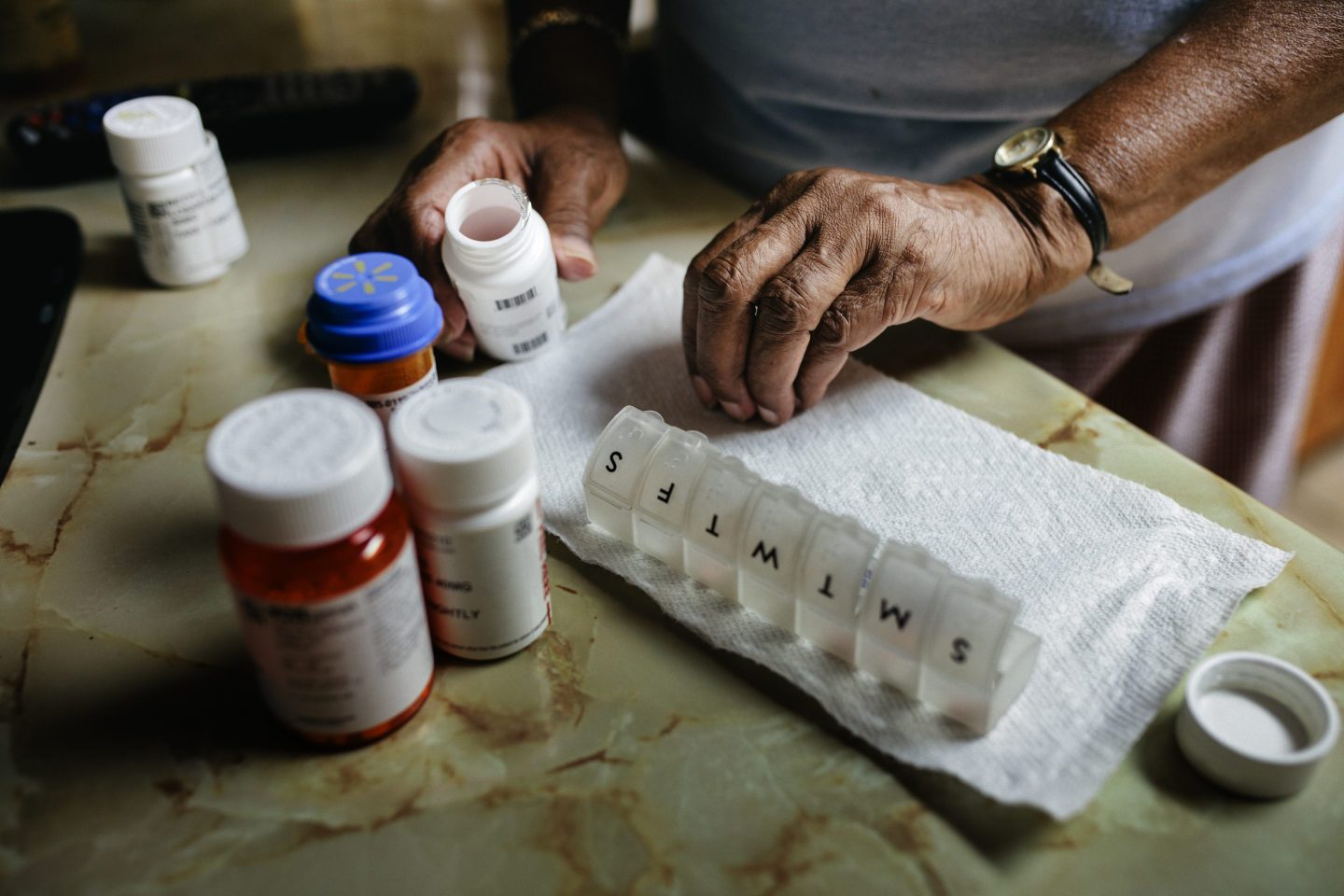
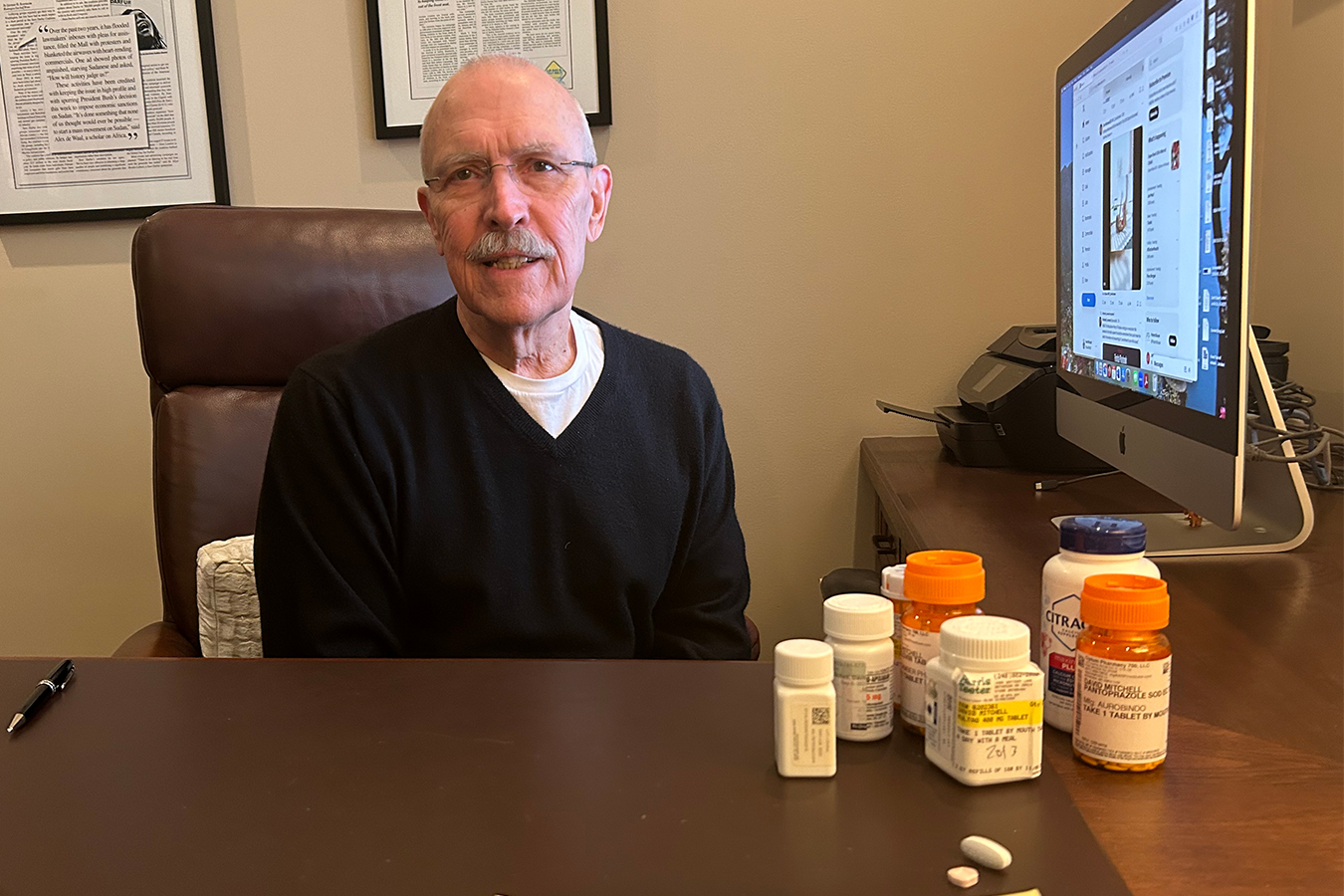
Last year alone, David Mitchell paid $16,525 for 12 little bottles of Pomalyst, one of the pricey medications that treat his multiple myeloma, a blood cancer he was diagnosed with in 2010.
The drugs have kept his cancer at bay. But their rapidly increasing costs so infuriated Mitchell that he was inspired to create an advocacy movement.
Patients for Affordable Drugs, which he founded in 2016, was instrumental in getting drug price reforms into the 2022 Inflation Reduction Act. Those changes are kicking in now, and Mitchell, 73, is an early beneficiary.
In January, he plunked down $3,308 for a Pomalyst refill “and that’s it,” he said. Under the law, he has no further responsibility for his drug costs this year — a savings of more than $13,000.
The law caps out-of-pocket spending on brand-name drugs for Medicare beneficiaries at about $3,500 in 2024. The patient cap for all drugs drops to $2,000 next year.
“From a selfish perspective, I feel great about it,” he said. But the payment cap will be “truly life-changing” for hundreds of thousands of other Medicare patients, Mitchell said.
President Joe Biden’s battle against high drug prices is mostly embodied in the IRA, as the law is known — a grab bag of measures intended to give Medicare patients immediate relief and, in the long term, to impose government controls on what pharmaceutical companies charge for their products. The law represents the most significant overhaul for the U.S. drug marketplace in decades.
With Election Day on the horizon, the president is trying to make sure voters know who was responsible. This month, the White House began a campaign to get the word out to seniors.
“The days where Americans pay two to three times what they pay for prescription drugs in other countries are ending,” Biden said in a Feb. 1 statement.
KFF polling indicates Biden has work to do. Just a quarter of adults were aware that the IRA includes provisions on drug prices in July, nearly a year after the president signed it. He isn’t helped by the name of the law, the “Inflation Reduction Act,” which says nothing about health care or drug costs.
Biden’s own estimate of drug price inflation is quite conservative: U.S. patients sometimes pay more than 10 times as much for their drugs compared with people in other countries. The popular weight loss drug Wegovy lists for $936 a month in the U.S., for example — and $83 in France.
Additional sections of the law provide free vaccines and $35-a-month insulin and federal subsidies to patients earning up to 150% of the federal poverty level, and require drugmakers to pay the government rebates for medicines whose prices rise faster than inflation. But the most controversial provision enables Medicare to negotiate prices for certain expensive drugs that have been on the market for at least nine years. It’s key to Biden’s attempt to weaken the drug industry’s grip.
Responding to Pressure
The impact of Medicare’s bargaining over drug prices for privately insured Americans remains unclear. States have taken additional steps, such as cutting copays for insulin for the privately insured.
However, insurers are increasing premiums in response to their higher costs under the IRA. Monthly premiums on traditional Medicare drug plans jumped to $48 from $40 this year, on average.
On Feb. 1, the Centers for Medicare & Medicaid Services sent pharmaceutical makers opening bids for the first 10 expensive drugs it selected for negotiation. The companies are responding to the bids — while filing nine lawsuits that aim to kill the negotiations altogether, arguing that limiting their profits will strangle the pipeline of lifesaving drugs. A federal court in Texas dismissed one of the suits on Feb. 12, without taking up the substantive legal issue over constitutionality.
The nonpartisan Congressional Budget Office predicted the IRA’s drug pricing elements would save the federal government $237 billion over 10 years while reducing the number of drugs coming to market in that period by about two.
If the government prevails in the courts, new prices for those 10 drugs will be announced by September and take effect in 2026. The government will negotiate an additional 15 drugs for 2027, another 15 for 2028, and 20 more each year thereafter. CMS has been mum about the size of its offers, but AstraZeneca CEO Pascal Soriot on Feb. 8 called the opening bid for his company’s drug Farxiga (which earned $2.8 billion in U.S. sales in fiscal year 2023) “relatively encouraging.”
Related Biden administration efforts, as well as legislation with bipartisan support, could complement the Inflation Reduction Act’s swing at drug prices.
The House and Senate have passed bills that require greater transparency and less self-serving behavior by pharmacy benefit managers, the secretive intermediaries that decide which drugs go on patients’ formularies, the lists detailing which prescriptions are available to health plan enrollees. The Federal Trade Commission is investigating anti-competitive action by leading PBMs, as well as drug company patenting tricks that slow the entry of cheaper drugs to the market.
‘Sending a Message’
Months after drug companies began suing to stop price negotiations, the Biden administration released a framework describing when it could “march in” and essentially seize drugs created through research funded by the National Institutes of Health if they are unreasonably priced.
The timing of the march-in announcement “suggests that it’s about sending a message” to the drug industry, said Robin Feldman, who leads the Center for Innovation at the University of California Law-San Francisco. And so, in a way, does the Inflation Reduction Act itself, she said.
“I have always thought that the IRA would reverberate well beyond the unlucky 10 and others that get pulled into the net later,” Feldman said. “Companies are likely to try to moderate their behavior to stay out of negotiations. I think of all the things going on as attempts to corral the market into more reasonable pathways.”
The IRA issues did not appear to be top of mind to most executives and investors as they gathered to make deals at the annual J.P. Morgan Healthcare Conference in San Francisco last month.
“I think the industry is navigating its way beyond this,” said Matthew Price, chief operating officer of Promontory Therapeutics, a cancer drug startup, in an interview there. The drugs up for negotiation “look to be assets that were already nearing the end of their patent life. So maybe the impact on revenues is less than feared. There’s alarm around this, but it was probably inevitable that a negotiation mechanism of some kind would have to come in.”
Investors generally appear sanguine about the impact of the law. A recent S&P Global report suggests “healthy revenue growth through 2027” for the pharmaceutical industry.
Back in Washington, many of the changes await action by the courts and Congress and could be shelved depending on the results of the fall election.
The restructuring of Medicare Part D, which covers most retail prescription drugs, is already lowering costs for many Medicare patients who spent more than $3,500 a year on their Part D drugs. In 2020 that was about 1.3 million patients, 200,000 of whom spent $5,000 or more out-of-pocket, according to KFF research.
“That’s real savings,” said Tricia Neuman, executive director of KFF’s Medicare policy program, “and it’s targeted to people who are really sick.”
Although the drug industry is spending millions to fight the IRA, the Part D portion of the bill could end up boosting their sales. While it forces the industry to further discount the highest-grossing drugs, the bill makes it easier for Medicare patients to pick up their medicines because they’ll be able to afford them, said Stacie Dusetzina, a Vanderbilt University School of Medicine researcher. She was the lead author of a 2022 study showing that cancer patients who didn’t get income subsidies were about half as likely to fill prescriptions.
States and foundations that help patients pay for their drugs will save money, enabling them to procure more drugs for more patients, said Gina Upchurch, the executive director of Senior PharmAssist, a Durham, North Carolina-based drug assistance program, and a member of the Medicare Payment Advisory Commission. “This is good news for the drug companies,” she said.
Relief for Patients
Lynn Scarfuto, 73, a retired nurse who lives on a fixed income in upstate New York, spent $1,157 for drugs last year, while most of her share of the $205,000 annual cost for the leukemia drug Imbruvica was paid by a charity, the Patient Access Network Foundation. This year, through the IRA, she’ll pay nothing because the foundation’s first monthly Imbruvica payment covered her entire responsibility. Imbruvica, marketed jointly by AbbVie and Janssen, a subsidiary of Johnson & Johnson, is one of the 10 drugs subject to Medicare negotiations.
“For Medicare patients, the Inflation Reduction Act is a great, wonderful thing,” Scarfuto said. “I hope the negotiation continues as they have promised, adding more drugs every year.”
Mitchell, a PR specialist who had worked with such clients as the Campaign for Tobacco-Free Kids and pharmaceutical giant J&J, went to an emergency room with severe back pain in November 2010 and discovered he had a cancer that had broken a vertebra and five ribs and left holes in his pelvis, skull, and forearm bones. He responded well to surgery and treatment but was shocked at the price of his drugs.
His Patients for Affordable Drugs group has become a powerful voice in Washington, engaging tens of thousands of patients, including Scarfuto, to tell their stories and lobby legislatures. The work is supported in part by millions in grants from Arnold Ventures, a philanthropy that has supported health care policies like lower drug prices, access to contraception, and solutions to the opioid epidemic.
“What got the IRA over the finish line in part was angry people who said we want something done with this,” Mitchell said. “Our patients gave voice to that.”