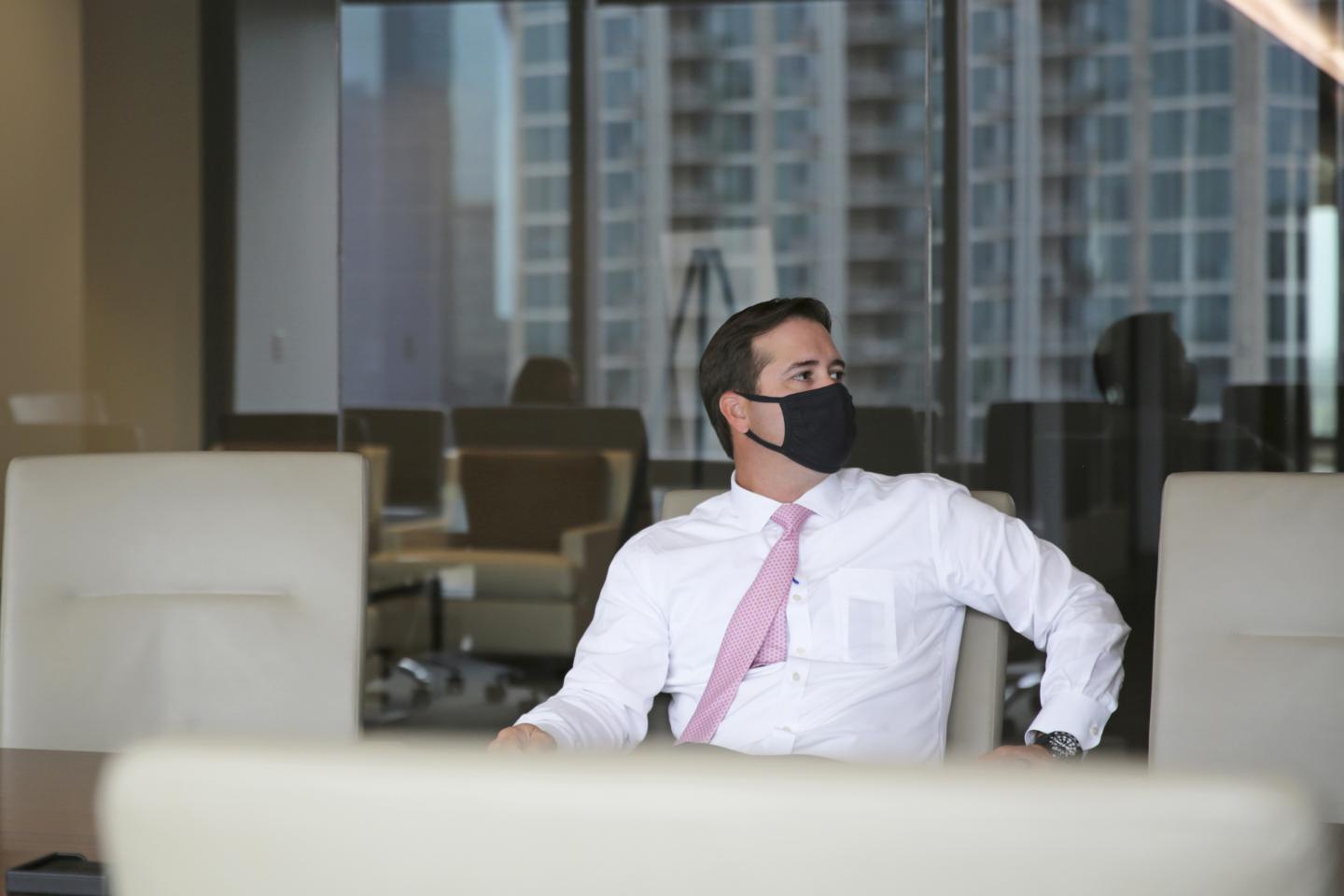
Labor Day marked the end of the total work-from-home era for many U.S. workers, with companies including Apple, Comcast, and Peloton demanding a return to the office after the long holiday weekend.
The unspoken premise behind the edict was that the COVID pandemic as we know it is over—or at least a shadow of what it used to be.
But public health experts say that many Americans—and their bosses—are making rosy assumptions about what the rest of the year will look like that aren’t based in science. The reality is that the virus probably isn’t going away any time soon, and how severe the next COVID wave will be is still a mystery.
“Any modeling done more than three to four weeks ahead is meaningless,” Dr. Michael Osterholm, director of the University of Minnesota’s Center for Infectious Disease Research and Policy (CIDRAP), told Fortune. He added that anyone who says otherwise “probably wants to sell you a bridge.”
“We have so little experience with coronaviruses and how they play out,” he said. “We’re kind of in limbo land right now.”
COVID be damned—bosses want workers back in the office
Last year was filled with failed return-to-office deadlines.
Several U.S. companies planned for a Labor Day return in 2021, but the Delta variant upended those plans. Early 2022 was the next target, until Omicron upended those plans too.
More recent announcements about the end of remote work have left out COVID altogether. Apple recently set a Sept. 5 deadline for employees to return to the workplace at least three days a week but provided no COVID-related explanation as to why, such as the virus potentially letting up.
And a memo from Comcast CEO Dave Watson reportedly mentioned the importance of in-person collaboration in innovation, but nothing about COVID beyond a statement that vaccines aren’t required, and a request that employees work from home or take time off when they’re sick, according to the Philadelphia Inquirer and other sources.
Although there have been some notable rebellions, it seems that workers with employers hell-bent on getting them back into the office are being forced to leave remote work behind—whether or not the virus cooperates.
But bosses could be forgiven for assuming the pandemic is nearly over. The White House and World Health Organization have recently made statements that some experts say are far too optimistic.
Global COVID deaths are at the lowest level they’ve been at since March 2020, prompting World Health Organization head Dr. Tedros Adhanom Ghebreyesus this week to proclaim that the world has “never been in a better position to end the pandemic.”
“We are not there yet,” Ghebreyesus said. “But the end is in sight.”
And earlier this month, the White House seemed to pivot away from a dire forecast it issued in May that projected a fall/winter wave of up to 100 million COVID infections—more than the country’s recorded total so far—and potentially a sizable wave of deaths.
At a Sept. 6 news conference, Dr. Ashish Jha, the White House’s COVID response coordinator, said that science has “caught up with the virus,” and that annual COVID boosters—similar to annual flu shots—are likely in the near future.
But other public health experts aren’t so optimistic.
“That could be one scenario,” CIDRAP’s Osterholm said. “Another scenario could be that we in fact see a new variant emerge that’s capable of evading immune protection, that’s more infectious.”
Beyond COVID-19, and the SARS and MERS epidemics of the early 2000s, scientists have very little experience with coronaviruses, he said—and there’s no reason to say one scenario is more likely than the other.
“What we don’t want to do is provide comfort and comforting answers to the public because we think that’s what they want,” he said.
The trouble with projections
In 2020, the idea of forecasting a virus like one forecasts the weather was a novel one. Bad virus “weather” ahead? Wear a mask, just as you might wear a raincoat if a storm was expected.
But there’s a reason forecasts are only issued for the next few days—or in the case of COVID, weeks, experts say.
“We’ve gotten very good at projecting what the pandemic is going to look like three, four, five weeks from now,” Dr. John Swartzberg, a professor at the Division of Infectious Diseases and Vaccinology at the University of California, told Fortune.
“Beyond now—and certainly beyond six weeks from now—the accuracy of predictions drops dramatically,” he added. “You get two to three months out, and it’s almost like flipping a coin.”
The terms “forecasting” and “modeling” are often used interchangeably, but they shouldn’t be, according to Dr. Elizabeth Carlton, assistant professor at the Colorado School of Public Health and member of the state’s COVID-19 modeling team. COVID forecasts predict conditions in the near term—the next two to four weeks. Projections, however, are more long-term, and require scientists to make assumptions.
Thus, any COVID projection more than a few weeks out—like the White House’s dire fall and winter prediction issued this spring—are based on conjecture and entirely uncertain.
A best attempt at a look ahead
Near-term U.S. COVID forecasts in the U.S. are mostly positive.
“Most scenarios indicate that hospitalization rates from COVID-19 infection will be similar to current rates or decline slowly over the next few weeks,” the CDC told Fortune earlier this month.
Beyond that, though, other public health agencies are careful to highlight the uncertainty in their projections about what will happen over the next few months.
Maria Van Kerkhove, technical lead for COVID-19 response at the World Health Organization, told Fortune this week that “continued” waves of COVID are expected, though she added that providing a more specific picture is currently impossible.
Carlton believes there is reason for hope this holiday season—hope with a “giant asterisk.”
At the individual level, one’s risk of coming down with COVID “is lower than it has been for a while,” she said, especially given new Omicron boosters.
While now is not the time to throw caution to the wind and personal precautions should continue, “I think there is some justification for letting your hair down,” she added.
“This is not the flu—we’ve lost over 200,000 people this year to COVID,” she said. “In bad flu years we lose tens of thousands. But we’re not where we were a few years ago.”
But it’s not the time for public health and disaster preparedness officials to take a breather, Carlton noted.
When it comes to the world’s next COVID wave—and there will be another, experts say—the virus is holding its cards close. Most of the experts Fortune spoke to named subvariants BA.4.6 and BA.2.75 as potential variants of concern worth keeping an eye on this fall and winter. No one variant, however, is currently raising major red flags.
Little is known about the duo of Omicron spawns—including how severe symptoms might be and whether they may be able to evade immunity from even new Omicron boosters. Both show the ability, at least in some locations, to compete with the globally dominant BA.5—though neither so far is making rapid progress.
Because some variants like BA.2.75, also known as Centaurus, are making slow progress in the face of BA.5, they must have some advantages over it when it comes to transmissibility, Osterholm said.
But he adds that a “sense of humility” is what’s most needed as the U.S. faces another COVID winter.
“For all we know, a Pi or Sigma could show up, replacing Omicron,” he said.
An unpredictable virus
The virus wasn’t always so difficult to predict. In the pandemic’s earlier days, a variant that hit the U.K. hard would often have the same effect on the U.S. several weeks later.
But now, the virus is spawning so many subvariants in so many different locations that it’s difficult to pinpoint any one of them in any one region, and predict if and when it’s headed to the U.S., Carlton said.
With BA.5 seemingly dropping to a relatively low plateau of 60,000 newly reported cases per day, it’s easy to interpret the lull in waves as an end to the pandemic, Swarztberg says.
But we’ve come to that conclusion before—incorrectly so—and we keep doing it. It’s what Carlton and other experts call the “fear-fatigue” cycle or the “panic-neglect” cycle, both of which entail a lack of proactive precaution and reactivity that often involves too little action, too late.
Last year, the U.S. was in a good place in late September, October, and November, Swarztberg said.
“But then we saw a new variant called Omicron in South Africa,” he said. “Within three weeks, it was here.”
Past epidemic coronaviruses SARS and MERS, while far less transmissible, were far more lethal, with fatality rates ranging from 20% to 30%, versus that of COVID-19, which is less than 1%, Osterholm said.
But it’s possible, he contends, that COVID-19 eventually evolves to develop the lethality of SARS and MERS while maintaining its signature transmissibility.
Even if such a scenario never plays out, COVID is currently the fourth leading cause of death in the country—a fact we’ve collectively numbed to, according to Osterholm.
“The same number three years ago would have been a ‘house on fire’ moment,” he said.
“The question is, is that number going to keep dropping gradually, like a soft landing? Stay the same? Potentially go back up again with a climb? We just don’t know.”
Sign up for the Fortune Features email list so you don’t miss our biggest features, exclusive interviews, and investigations.