A distinctive feature of Russia’s military tactics has been that it doesn’t rule out using nuclear weapons in a conventional war.
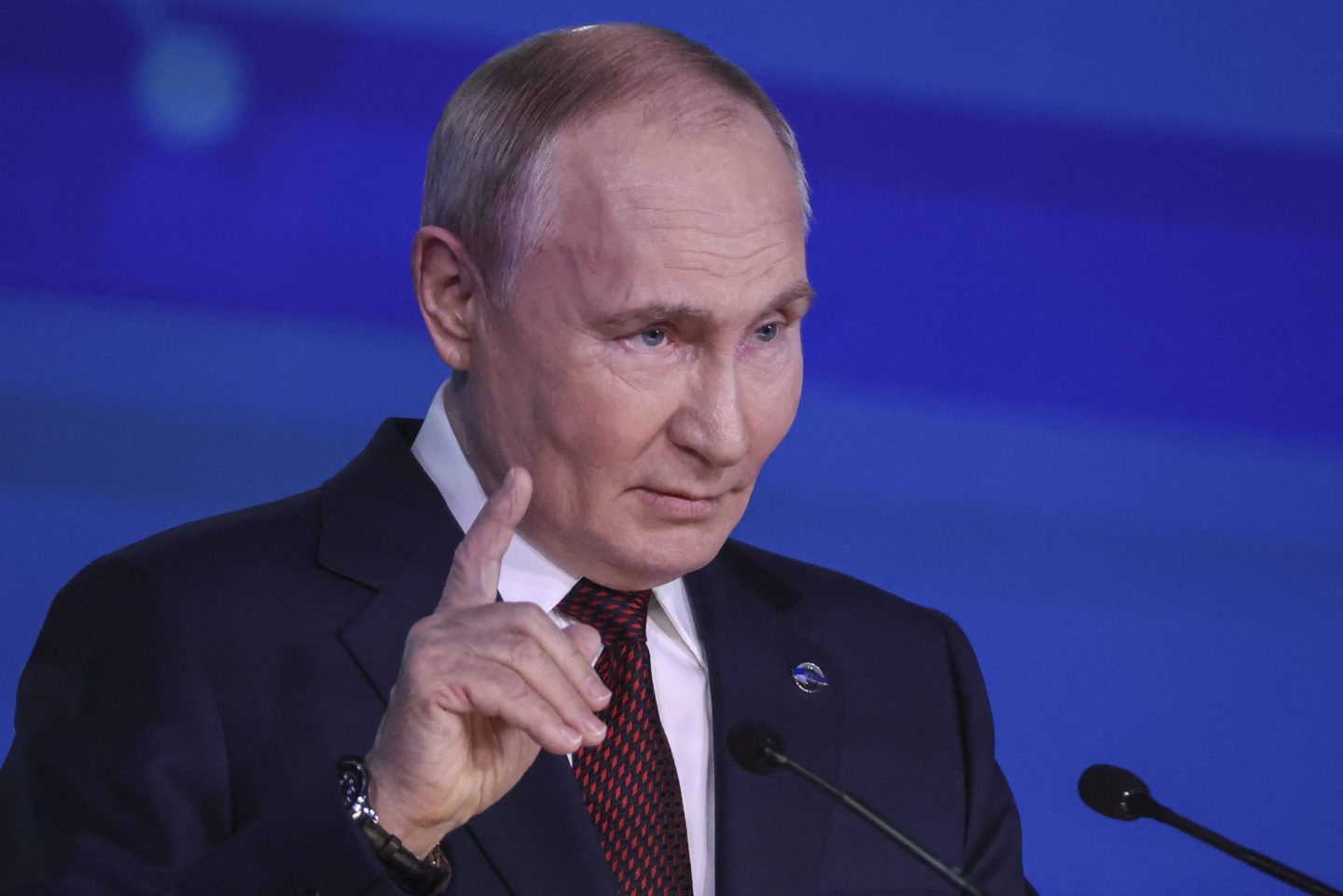
Now, President Vladimir Putin has lowered the bar further for deploying tactical and more powerful strategic atomic weapons, in a broad overhaul of his country’s nuclear doctrine. The shift comes just as the US eased restrictions on Ukrainian forces firing American weapons into Russian territory.
Irrespective of whether Putin is really prepared to go nuclear, the threat is intended to show the world that Russia remains a major power and that Washington and its allies should limit their support for Ukraine. It’s the main reason why they have only slowly allowed Kyiv to use more powerful weapons, and avoided sending troops to help it repel Russia’s invasion.
What’s changed?
Under the revised nuclear guidelines, the Kremlin could use nuclear weapons in response to an attack on Russian soil by Kyiv using conventional Western weapons. The shift follows Putin’s order in May for Russia’s military to carry out combat drills to prepare for the potential use of tactical nuclear weapons.
Previously, the Russian government had given itself the option of a nuclear response if an aggressor jeopardized Russia’s “very existence.” The November update now refers to attacks that “create a critical threat to the sovereignty and (or) territorial integrity” of Russia and its neighbor and ally Belarus.
Potential targets for a nuclear attack under the revised doctrine include not only nations that attack Russia directly, but any state that provides its territory and resources for the preparation and execution of acts of aggression against Russia.
The doctrine states that any attack on Russia will be considered an attack by all members of a coalition, bloc or alliance of which the attacking nation is a member. Russia will also consider perceived aggression by a non-nuclear state that has the participation or support of a nuclear state as a joint attack conducted by both.
What has Putin said about using nuclear weapons?
At the start of Russia’s full-scale invasion of Ukraine, Putin threatened any nation that interfered in the conflict with “consequences that you have never experienced in your history.” That was widely seen as threatening a nuclear strike. In June 2023, Putin said Russia had deployed some of its tactical nuclear weapons in Belarus, an ally that’s been a staging ground for Russian attacks on Ukraine. Russia regularly holds drills to test its strategic weapon delivery systems, including practice launches of ICBMs and shorter-range cruise missiles.
In February, responding to French President Emmanuel Macron refusing to rule out sending troops to Ukraine, Putin cited new Russian strategic weapons that are entering service and said the US and Europe “must understand that we also have weapons that can hit targets on their territory and that all this really threatens a conflict with the use of nuclear weapons, and therefore the destruction of civilization.”
Putin seemed to soften that stance a short time later, telling an interviewer in March that using tactical nuclear weapons in the war in Ukraine had never crossed his mind and that he didn’t think Russia and the US were heading toward a nuclear conflict.
So far, Putin hasn’t given authorization for Russia’s military to carry out a test of a tactical nuclear warhead, saying he would only do that in response to an atomic weapon test by the US.
What explains Russia’s interest in tactical nuclear weapons?
Nuclear weapons are seen primarily as a deterrent: Their enormous destructive power make a potential aggressor think twice about launching an attack. Tactical nuclear weapons, of which Russia has many, could serve a further purpose — victory in a conventional war.
A Russian strategy known as “escalate to de-escalate” contemplates using a tactical nuclear weapon on the battlefield to change the course of a conflict that Russian forces are at risk of losing.
John Hyten, who served as the top US nuclear weapons military official, says a more accurate translation of the Russian strategy is “escalate to win.”
What’s a tactical nuclear weapon?
“Tactical” is an inexact term for a nuclear weapon that could be used within a theater of war. It generally refers to a less powerful warhead (the explosive head of a missile, rocket or torpedo) delivered at a shorter range — by mines, artillery, cruise missiles or bombs dropped by aircraft — than the “strategic” nuclear weapons that the US and Russia could launch at each other’s homeland using intercontinental ballistic missiles. Arms control accords between the US and the Soviet Union starting in the 1970s (and later between the US and Russia) focused mostly on the number of strategic nuclear weapons, not tactical ones.
How powerful can a tactical nuclear weapon be?
Where today’s most powerful strategic warheads are measured in the many hundreds of kilotons, tactical nuclear weapons can have explosive yields of less than 1 kiloton; many are in the tens of kilotons. For some perspective, the atomic bombs dropped by the US on the Japanese cities of Hiroshima and Nagasaki in 1945 had explosive yields of about 15 kilotons and 20 kilotons, respectively.
What’s in Russia’s arsenal?
The US Defense Department reported in 2018 that Russia had “significant advantages” over the US and its allies in tactical nuclear forces and was improving delivery capabilities. Researchers at the Federation of American Scientists estimated that entering 2022, Russia had 4,477 nuclear warheads, of which 1,525 — roughly one-third — could be considered tactical.
What would a tactical nuclear strike look like?
Nina Tannenwald, author of The Nuclear Taboo: The United States and the Non-Use of Nuclear Weapons Since 1945, paints a scenario of even a small nuclear weapon, one with an explosive yield of 0.3 kiloton, producing “damage far beyond that of a conventional explosive.” It could, she wrote in Scientific American in March 2022, “cause all the horrors of Hiroshima, albeit on a smaller scale.” It’s possible, however, that if detonated at the right altitude, a small-yield warhead might wipe out opposing forces beneath without leaving behind long-term radiation damage that leaves the battlefield off-limits to all.
How would the world respond?
Because Ukraine isn’t a member of the North Atlantic Treaty Organization — Putin has demanded that it never be allowed to join — the US and its allies aren’t obliged to come to its defense. But the West would be under great pressure to respond to a nuclear attack, perhaps even with a tactical weapon of its own. From there, it would be anyone’s guess.
“I don’t think there’s any such thing as the ability to easily use tactical nuclear weapons and not end up with Armageddon,” Biden warned in 2022.
The US is thought to have about 150 B-61 nuclear gravity bombs — ones dropped from aircraft, with variable yields that can be as low as 0.3 kiloton — stationed in five NATO countries: Belgium, Germany, the Netherlands, Italy and Turkey. Two other NATO members, the UK and France, are known to have nuclear weapons of their own. And Poland expressed interest in “sharing” US nuclear weapons, which could mean anything from offering escort or reconnaissance jets for a nuclear mission to actually hosting the weapons.