
• Home
  • Latest
  • Fortune 500
  • Finance
  • Tech
  • Leadership
  • Lifestyle
  • Rankings
  • Multimedia
TechElectric vehicles
Europe

A German Rust Belt? As Chinese EVs like BYD swarm Europe’s key markets, historic examples of deindustrialization pose a warning to the continent’s carmakers

Ryan Hogg
By
Ryan Hogg
Ryan Hogg
Europe News Reporter
Down Arrow Button Icon
Ryan Hogg
By
Ryan Hogg
Ryan Hogg
Europe News Reporter
Down Arrow Button Icon
April 10, 2024, 1:00 AM ET
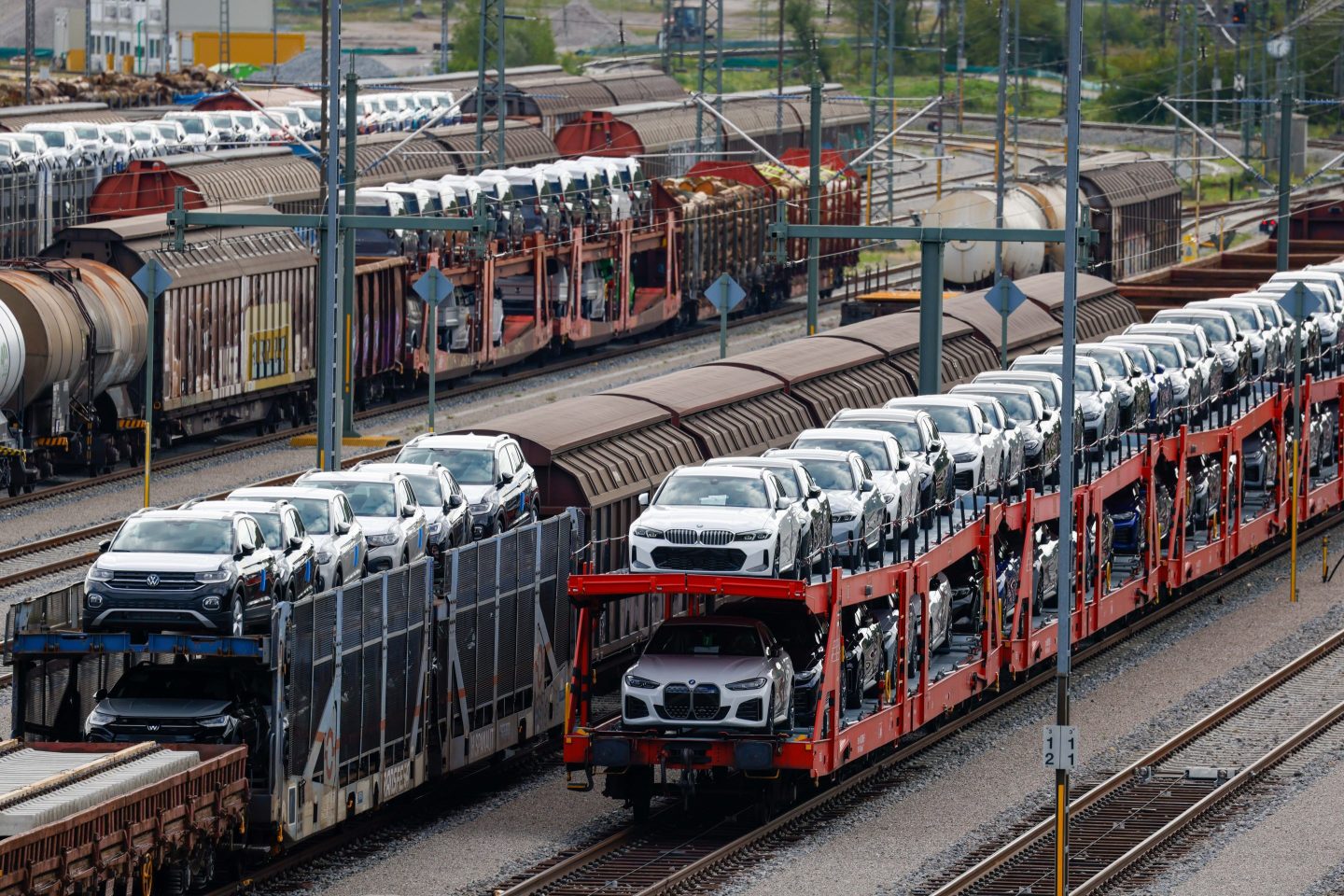
Freight wagons, loaded with newly manufactured Volkswagen AG and BMW AG automobiles, at a railway yard in Munich, Germany, on Friday, July 28, 2023. Germany exited its winter recession in the second quarter but output only stagnated, with questions about the fundamental health of Europe's largest economy remaining.
Europe’s automakers are reeling from a Chinese threat.Michaela Rehle—Bloomberg/Getty Images

European automakers are still digesting the shock from the sudden onslaught of cheap Chinese carmakers like BYD onto their shores months after the first purpose-built ships started ominously carrying them to the continent.  

But as more data about China’s encroachment on the European market comes to light, any denial of the country’s threat must quickly turn to acceptance to head off the worst outcome.

Whether they’re concerned about Chinese EVs wreaking havoc on their export market, or more disastrously wiping production from their home countries, European automakers could do with taking a history lesson to understand the worst-case scenarios of China’s latest onslaught.

Chinese EVs incoming

European brands have been slowly giving up ground to Chinese imports over the past few years. 

Data from the European Automobile Manufacturers’ Association (ACEA) shows European automakers’ market share in the EU fell from 74.2% to 70.6% between 2019 and 2022. China’s share, meanwhile, rose from 0% to 1.3%. 

But that hides a much more dramatic shift that is now occurring in Europe. 

Chinese manufacturers, in particular BYD, have shocked legacy carmakers in the past 12 months with their ultracheap offerings and aggressive plans to expand in Europe.

The results so far speak for themselves.

Research from campaign group Transport & Environment found that a quarter of EVs sold in Europe this year could be made in the EU, up from 19.5% last year.

It’s a dramatic shift in import-export dynamics across the continent, particularly for Germany’s industrial powerhouse. 

It’s also a shift that might remind history buffs of the U.S. Rust Belt.

German Rust Belt? 

The Rust Belt signifies the deindustrialization of major U.S. steel hubs in the Northwest and Mideast as manufacturing moved abroad.

Manufacturing employment fell by 35% in the space of 10 years at the start of this century, having already experienced a significant decline between the 1970s and 2000.

The fallout from the sudden loss of industry has had decades-long ramifications, namely through economic decline, emigration, and urban decay.

Commentators have often referenced the Rust Belt to help explain a rising wave of populism that elevated Donald Trump to the White House.

Some 11% of German employees worked in the country’s automotive sector in 2021, according to the ACEA, the sixth highest share in the EU. 

In addition to losing customers in its own continent, Germany is likely to lose out in its other export markets to BYD cars, accelerating its movement toward a more import-intensive trading dynamic. 

Nigel Griffiths, director of auto vehicle forecasting at S&P Global Mobility, doesn’t think the European EV market will deteriorate to the extent that it would create a new Rust Belt on the scale of the U.S. But things will change for the worse.

“We believe things are in motion for there to be this trend change: Europe will come from decades and decades of being a net exporter of vehicles, to being a net importer,” Griffiths told Fortune.

The outlook for European automotive employment had been turning gloomy for several years prior to COVID-19, accelerated by a shift to EVs, which has lessened the number of parts required to build a car, Griffiths points out.

The semiconductor-shortage crisis also forced automakers to prioritize the types of models they were producing, which gave Chinese automakers an opening in that market.

“All of those [issues] suggest far fewer jobs in the sector. So you’ve got that happening at the same time now as this trade effect, which is also going to be negative to long-term employment in the sector,” Griffiths said.

Nishita Aggarwal, an automotive industry analyst at the Economist Intelligence Unit (EIU), is more optimistic about Europe’s ability to fend off the threat from China and protect jobs in the region.

The EU’s investigation into allegedly anticompetitive subsidies provided to Chinese automakers from their government may result in extra tariffs being placed on Chinese imports. 

Other measures to protect native automakers will likely be introduced, Aggarwal says.  

“However, given China’s dominance over EV and battery production and sales, there will be some short-term disruptions, as European companies scramble to develop or source alternative supplies,” Aggarwal says.

That battery dominance is no small obstacle, as JATO Dynamics global analyst Felipe Munoz explains.

“China is the only country in the world with an electrification policy that not only spans public incentives and infrastructure but includes total control over the raw materials required for battery production,” Munoz says.

“The U.S. and Europe do not currently have this advantage. If this does not change, and its industries remain dependent on components from China, then the influence of Europe’s automakers will decline not only in Europe but globally.”

Japanese lessons

A more pertinent comparison than the Rust Belt might come from looking east and 40 years into the past.

Europe’s battle with Chinese automakers, particularly for their respective export markets, has comparisons with a tussle that occurred between Japanese incumbent carmakers and disrupters from South Korea, according to S&P’s Griffiths.

South Korean carmakers copied the Japanese playbook for exporting to Western markets, with Hyundai, Daewoo, and Kia striking deals with U.S. parts makers and shipping hundreds of thousands of models to the States. 

It didn’t take too long for American buyers to get over brand loyalty built up by Japanese carmakers like Toyota over decades, as college students and other bargain hunters swarmed to cheap South Korean products, the Los Angeles Times reported back in 1987.

South Korea’s encroachment on Japan’s export market occurred over a 10-year period, Griffiths says. But European automakers can’t expect to have the same amount of preparation time.

“In China, they’re probably looking at how the Koreans came in and will probably try to do the same thing, but at a speed two to three times faster than that, Griffiths said.

“They won’t wait more than a decade.”

Join us at the Fortune Workplace Innovation Summit May 19–20, 2026, in Atlanta. The next era of workplace innovation is here—and the old playbook is being rewritten. At this exclusive, high-energy event, the world’s most innovative leaders will convene to explore how AI, humanity, and strategy converge to redefine, again, the future of work. Register now.
About the Author
Ryan Hogg
By Ryan HoggEurope News Reporter

Ryan Hogg was a Europe business reporter at Fortune.

See full bioRight Arrow Button Icon

Latest in Tech

Finance
Lorem ipsum dolor sit amet, consectetur adipiscing elit, sed do eiusmod tempor incididunt ut labore et dolore magna aliqua. Ut enim ad minim veniam
By Fortune Editors
October 20, 2025
Finance
Lorem ipsum dolor sit amet, consectetur adipiscing elit, sed do eiusmod tempor incididunt ut labore et dolore magna aliqua. Ut enim ad minim veniam
By Fortune Editors
October 20, 2025
Finance
Lorem ipsum dolor sit amet, consectetur adipiscing elit, sed do eiusmod tempor incididunt ut labore et dolore magna aliqua. Ut enim ad minim veniam
By Fortune Editors
October 20, 2025
Finance
Lorem ipsum dolor sit amet, consectetur adipiscing elit, sed do eiusmod tempor incididunt ut labore et dolore magna aliqua. Ut enim ad minim veniam
By Fortune Editors
October 20, 2025
Finance
Lorem ipsum dolor sit amet, consectetur adipiscing elit, sed do eiusmod tempor incididunt ut labore et dolore magna aliqua. Ut enim ad minim veniam
By Fortune Editors
October 20, 2025
Finance
Lorem ipsum dolor sit amet, consectetur adipiscing elit, sed do eiusmod tempor incididunt ut labore et dolore magna aliqua. Ut enim ad minim veniam
By Fortune Editors
October 20, 2025

Most Popular

Finance
Lorem ipsum dolor sit amet, consectetur adipiscing elit, sed do eiusmod tempor incididunt ut labore et dolore magna aliqua. Ut enim ad minim veniam
By Fortune Editors
October 20, 2025
Finance
Lorem ipsum dolor sit amet, consectetur adipiscing elit, sed do eiusmod tempor incididunt ut labore et dolore magna aliqua. Ut enim ad minim veniam
By Fortune Editors
October 20, 2025
Finance
Lorem ipsum dolor sit amet, consectetur adipiscing elit, sed do eiusmod tempor incididunt ut labore et dolore magna aliqua. Ut enim ad minim veniam
By Fortune Editors
October 20, 2025
Finance
Lorem ipsum dolor sit amet, consectetur adipiscing elit, sed do eiusmod tempor incididunt ut labore et dolore magna aliqua. Ut enim ad minim veniam
By Fortune Editors
October 20, 2025
Finance
Lorem ipsum dolor sit amet, consectetur adipiscing elit, sed do eiusmod tempor incididunt ut labore et dolore magna aliqua. Ut enim ad minim veniam
By Fortune Editors
October 20, 2025
Finance
Lorem ipsum dolor sit amet, consectetur adipiscing elit, sed do eiusmod tempor incididunt ut labore et dolore magna aliqua. Ut enim ad minim veniam
By Fortune Editors
October 20, 2025
Rankings
  • 100 Best Companies
  • Fortune 500
  • Global 500
  • Fortune 500 Europe
  • Most Powerful Women
  • Future 50
  • World’s Most Admired Companies
  • See All Rankings
Sections
  • Finance
  • Leadership
  • Success
  • Tech
  • Asia
  • Europe
  • Environment
  • Fortune Crypto
  • Health
  • Retail
  • Lifestyle
  • Politics
  • Newsletters
  • Magazine
  • Features
  • Commentary
  • Mpw
  • CEO Initiative
  • Conferences
  • Personal Finance
  • Education
Customer Support
  • Frequently Asked Questions
  • Customer Service Portal
  • Privacy Policy
  • Terms Of Use
  • Single Issues For Purchase
  • International Print
Commercial Services
  • Advertising
  • Fortune Brand Studio
  • Fortune Analytics
  • Fortune Conferences
  • Business Development
About Us
  • About Us
  • Editorial Calendar
  • Press Center
  • Work At Fortune
  • Diversity And Inclusion
  • Terms And Conditions
  • Site Map
  • Facebook icon
  • Twitter icon
  • LinkedIn icon
  • Instagram icon
  • Pinterest icon

Latest in Tech

Alphabet and Google CEO Sundar Pichai seated next to Apple CEO Tim Cook at a formal dinner.
AIApple
What Apple’s AI deal with Google means for the two tech giants, and for $500 billion ‘upstart’ OpenAI
By Jeremy Kahn and Beatrice NolanJanuary 13, 2026
13 hours ago
A smartphone displaying the Google Gemini logo.
AIEye on AI
As ‘agentic commerce’ gains ground, companies shouldn’t put too much faith in ‘GEO,’ one industry insider warns
By Jeremy KahnJanuary 13, 2026
19 hours ago
AIChatbots
Being mean to ChatGPT can boost its accuracy, but scientists warn you may regret it
By Marco Quiroz-GutierrezJanuary 13, 2026
21 hours ago
AIGoldman Sachs Group
‘Humans could go the way of horses’: Goldman calculated how bad the AI ‘job apocalypse’ will be—and its analysts were pleasantly surprised
By Jim EdwardsJanuary 13, 2026
21 hours ago
Mark Zuckerberg
Future of WorkMeta
Meta is changing its performance review to reward output over effort, taking a page from Amazon and X
By Jake AngeloJanuary 13, 2026
22 hours ago
Warren Buffett on the phone
SuccessProductivity
Gen X CEO uses AI versions of Steve Jobs and Warren Buffett as a ‘fantasy board of directors’ to help him prepare for meetings and performance reviews
By Preston ForeJanuary 13, 2026
22 hours ago

Most Popular

placeholder alt text
Tech
Elon Musk asked people to upload their medical data to X so his AI company could learn to interpret MRIs and CT scans
By Sasha RogelbergJanuary 11, 2026
3 days ago
placeholder alt text
Success
Despite his $2.6 billion net worth, MrBeast says he’s having to borrow cash and doesn’t even have enough money in his bank account to buy McDonald’s
By Emma BurleighJanuary 13, 2026
23 hours ago
placeholder alt text
Newsletters
The oil CEO who stood up to Trump is a follower of the disciplined 'Exxon way' and has a history of blunt statements
By Jordan BlumJanuary 13, 2026
1 day ago
placeholder alt text
Economy
The longer the Supreme Court delays its tariff decision, the better it is for President Trump
By Jim EdwardsJanuary 13, 2026
1 day ago
placeholder alt text
AI
'Godfather of AI' says the technology will create massive unemployment and send profits soaring — 'that is the capitalist system'
By Jason MaJanuary 12, 2026
2 days ago
placeholder alt text
Economy
Treasury spent $276 billion in interest on the national debt in the final three months of 2025, says the CBO—up $30 billion from a year prior
By Eleanor PringleJanuary 12, 2026
2 days ago

© 2025 Fortune Media IP Limited. All Rights Reserved. Use of this site constitutes acceptance of our Terms of Use and Privacy Policy | CA Notice at Collection and Privacy Notice | Do Not Sell/Share My Personal Information
FORTUNE is a trademark of Fortune Media IP Limited, registered in the U.S. and other countries. FORTUNE may receive compensation for some links to products and services on this website. Offers may be subject to change without notice.