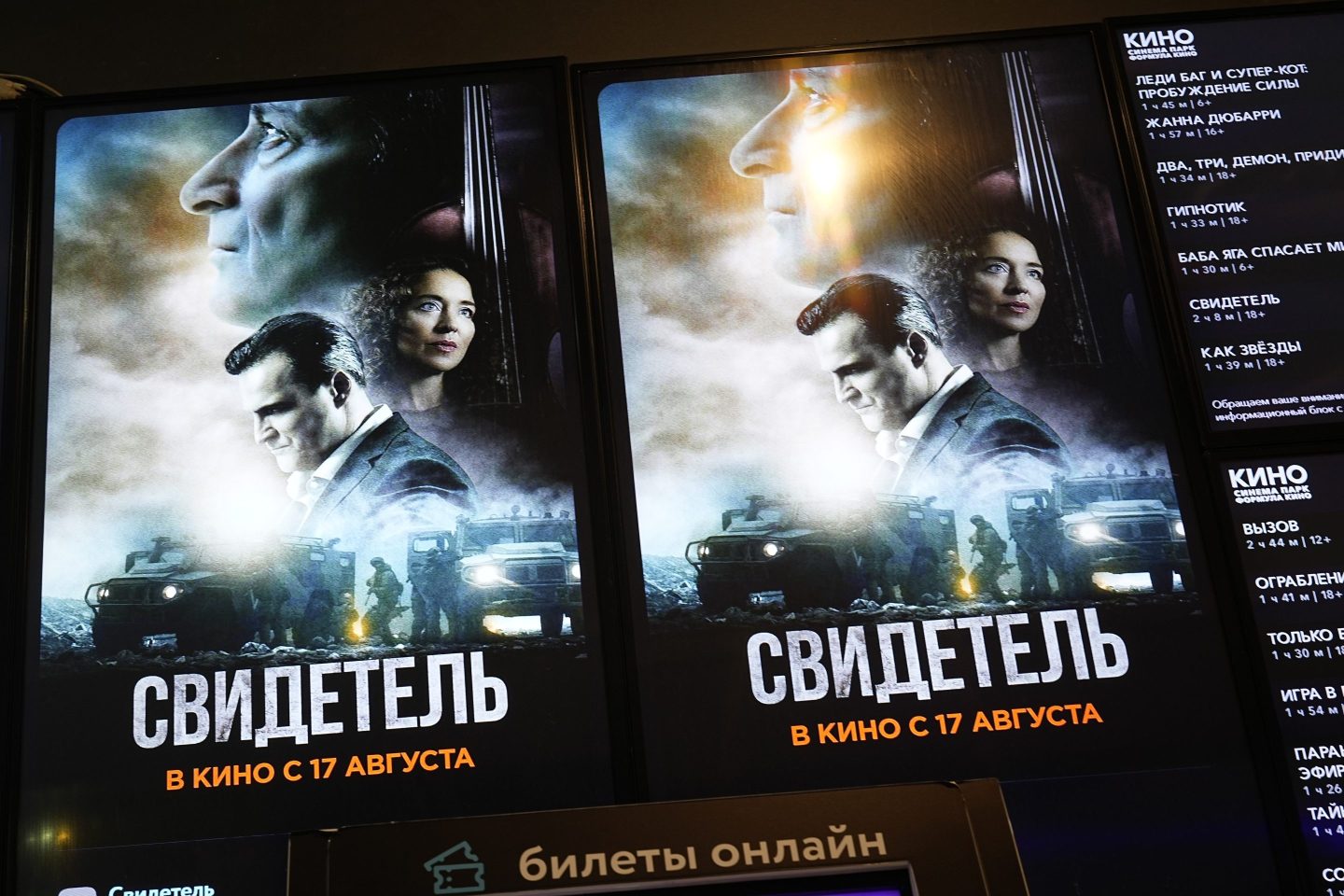
The movie centers around a renowned violinist from Belgium arriving in Kyiv to perform. The date is February 2022, and his trip is upended as Russia starts bombing Ukraine. The musician survives a series of “inhuman crimes and bloody provocations by Ukrainian nationalists,” and he wants to tell the world “what it was really like.”
“The Witness” — a state-sponsored drama that premiered in Russia on Aug. 17 — is the first feature film about the 18-month-old invasion. It depicts Ukrainian troops as violent neo-Nazis who torture and kill their own people. One even wears a T-shirt with Hitler on it; another is shown doing drugs. It also has the main character’s young son wondering: “Isn’t Ukraine Russia?”
It’s the narrative the Kremlin has been promoting since the first days of the war — all packaged up in a motion picture.
The release of “The Witness” comes after Russian authorities announced a plan to boost production of movies glorifying Moscow’s actions in Ukraine and is part of a growing number of propaganda films.
But in an era of instantaneous information and disinformation in wartime and other times, two questions present themselves: Are propaganda films actually effective? And are they any good?
Whether such films will attract viewers is a big question. Similar movies have been box-office disasters. Plus, sociologists say the public interest in following the war has waned, and people these days mainly want to escape from the gloom and doom of news from Ukraine.
“We regularly hear (from respondents) that it’s a huge stress, a huge pain,” says Denis Volkov, director of the Levada Center, Russia’s top independent pollster. Some Russians, he says, insist they “don’t discuss, don’t watch, don’t listen” to the news about Ukraine in an effort to cope with that stress.
Theaters ordered by Putin to screen heroism of Russian warriors
Film is an important medium that governments have used to shape patriotic messages — from the early days of the Soviet Union to wartime use by Nazi Germany and Italy, and even by the United States during and immediately after World War II. In more modern times, North Korea founder Kim Il Sung and his son and successor, Kim Jong Il, presided over a regular output of propaganda movies.
State-sponsored propaganda films have also been employed in the Middle East to varying degrees of success. Syria’s civil war, for instance, became a focal point of Ramadan TV soap operas in the past decade, including some that were supportive of Syrian President Bashar Assad. Iran regularly funds films glorifying hard-liners and paramilitary forces it backs across the region.
In today’s Russia, propaganda as fiction isn’t a haphazard effort. Russian authorities speak openly about their intention to bring the Ukraine war — or, rather, the Russian narrative around it — to the big screen.
Russian President Vladimir Putin has ordered the Culture Ministry to ensure theaters screen documentaries about the “special military operation,” as the Kremlin calls its war in Ukraine. The ministry also has prioritized themes when allocating state funding for films. These include “heroism and selflessness of Russian warriors” in Ukraine and “battling modern manifestations of the Nazi and fascist ideology” — a false accusation Putin makes about Kyiv’s leaders.
The state funding that makers of Russian films can tap into this year is more than ever: 30 billion rubles (about $320 million) offered by two government bodies and a state-run nonprofit. That’s a pivotal part of today’s industry, which has been heavily dependent on state funding for years.
Russian film critic Anton Dolin describes it as a “vicious system when the state is the main and richest producer in the country.” In an interview with The Associated Press, Dolin notes that all films have to get a screening license from the Culture Ministry. So “censorship mechanisms” work even for those who don’t take money from the government.
Propaganda already deployed following 2008 invasion of Georgia
That doesn’t mean that Russian filmmakers who get state funding always produce propaganda. There is also “very decent cinema” out there, says critic and culture expert Yuri Saprykin.
Indeed, some Oscar nominees from Russia received state funding — for example, “Leviathan” by renowned film director Andrey Zvyagintsev, which was released in 2015 in Russia and later slammed by the Culture Ministry as “anti-Russian” for its critical depiction of Russian reality. And there were other numerous domestic hits: widely watched historical dramas, sci-fi blockbusters, portrayals of legendary Soviet athletes.
Generally, Russia’s film industry until recently was “considered a good, culturally global citizen, producing good films, sometimes challenging the regime,” says Gregory Dolgopolov, film and video production scholar at the University of New South Wales.
After Russia’s brief war with Georgia in 2008, Russian state TV broadcast a film reflecting Moscow’s version of how its neighbor started the conflict. Its storyline was somewhat similar to that of “The Witness”: an American and his Russian friend witness the beginning of the war and embark on a mission to bring the truth to the world, while Georgian security forces try to stop them.
That happened again after the 2014 illegal annexation of Crimea – and this time, the Kremlin’s narratives spilled into movie theaters.
The 2017 film “Crimea” justified Moscow’s seizure of the peninsula and portrayed a popular uprising in Kyiv in 2014 that ousted Ukraine’s pro-Kremlin president as pointlessly violent, with Ukrainians brutally beating and killing their compatriots. It was not only state-funded; its creators said the idea came from Defense Minister Sergei Shoigu.
A year later, a state-sponsored romantic comedy about Crimea —- written by Margarita Simonyan, chief editor of the government-funded TV network RT — focused on a Putin pet project: a bridge linking the peninsula to the mainland. It depicted Crimea thriving under Russia’s reign.
Both films were promoted by state media but bashed by independent critics for weak plots and flat characters. Both eventually failed at the box office. Several other films about the conflict in eastern Ukraine, which Moscow fueled while blaming Kyiv, were even less popular.
“Why would people go to see an ad for the state, the state they suffer from … especially when they have an alternative?” Dolin wonders.
The alternative — Hollywood blockbusters — was always much more successful, no matter how hard the Kremlin tried to fuel anti-Western sentiment. So much so that at some point Russia’s authorities started postponing releases of Hollywood hits that coincided with domestic movies they wanted to succeed.
Still, “any Spider-Man movie, any Marvel movie, any `Star Wars’, any American film earned a fortune in Russia,” said Ivan Philippov, creative executive at AR Content, production company of renowned film producer Alexander Rodnyansky.
Slate of new films expected to grow
Overall, the Russian industry over the years expressed little interest in making propaganda films about Moscow’s conflict in Ukraine. Philippov notes that of hundreds of movies released in Russia every year, only about a dozen since 2014 have been dedicated to this topic.
He expects this number to grow and points to two in the works in addition to “The Witness.” One, “The Militiaman,” follows a Moscow artist who decides to join the Kremlin-backed separatist insurgency in eastern Ukraine, abandoning his bohemian life in the Russian capital.
Another, “Mission ‘Ganges’,” is about Russian troops trying to save a group of Indian students trapped in a Ukrainian city as Moscow’s “special military operation” unfolds. The city, the storyline says, is held by “Ukrainian nationalists,” who “wreak havoc” and are trying to “hunt down” the students.
After major Hollywood studios halted their business in Russia last year, there are no Marvel movies to compete with these, though some movies still trickle through in the form of pirated copies and there are still certain European and lower-profile American movies available.
But other Russian films out there are proving popular among moviegoers seeking positive emotions. “Cheburashka,” a fairy tale featuring the iconic Soviet cartoon character that was released during the New Year holidays this year, was a smashing success. It earned nearly 7 billion rubles ($74 million) against the 850 million (roughly $9 million) spent making it.
Philippov says no one in the industry could even imagine such earnings. But filmmakers are following suit, remaking Soviet classics and turning to fairy tales. “The industry drew one conclusion: Russians very much want to distract themselves from what constitutes their daily routine,” Philippov says. “They very much don’t want to watch (films) about the war.”
As if to echo that sentiment, “The Witness” premiered in Russia without much fanfare and few mentions even in state media. At a movie theater in Moscow on a rainy Sunday afternoon last week, almost a dozen movie-goers said they came to see films other than “The Witness,” though several said they planned on watching it at some point. By the time the showing began, there were only about 20 people in an auditorium large enough for 180.
During its first weekend, it had earned just over 6.7 million rubles — or about $70,000.
That’s not entirely surprising, if you ask Ruth Ben-Ghiat, a history professor at New York University who studies authoritarianism and propaganda.
“When an authoritarian is in a defensive position and is waging a war and it’s not going well,” she says, the films made for indoctrination purposes are “not often very good.”